Analysis of BaZi Rhythms and Boundaries in Cross-Cultural Partner Selection among Chinese in the UK and Europe
把这篇文章落到自己身上验证:先看结构,再进入个人分析,不做泛泛阅读。
Why This Scenario Is Especially Difficult for Overseas Chinese
Chinese living in the UK and Europe face multiple challenges in cross-cultural partner selection, not only language and customs differences but also complex impacts from tax status, family distance, and cross-border legal regulations. Communication barriers arising from cultural differences often amplify emotional conflicts, particularly evident in clashes of lifestyle pace and values.
At the same time, overseas Chinese generally carry traditional BaZi beliefs, hoping to find the best match through Four Pillars (BaZi). However, the overseas environment complicates the traditional BaZi application. The strength of the Day Master and the role of the Yong Shen (favorable element) may be amplified or diminished by local life rhythms, social resources, and family support networks, creating tension between BaZi judgment and real-life decisions.
Furthermore, financial management, tax filing, and future children’s education planning in cross-cultural partnerships require balancing BaZi rhythms with practical boundaries. Overseas families often face dual pressures of lacking belonging and cultural identity, making the external environment a critical variable influencing BaZi energy expression.
Overall, BaZi judgment cannot be understood in isolation; it must integrate the social structure, legal policies, and cultural integration level of the UK and Europe to provide effective guidance and rhythm control for cross-cultural partner selection.
Three Core Dimensions of BaZi Judgment
First, the strength of the Day Master determines the dominant energy of the individual within the BaZi chart. A relatively weak Day Master means limited personal resources and energy, requiring reliance on the Yong Shen (favorable element) for supplementation and balance. This is closely related to adaptability and resource integration ability in an overseas environment.
Second, the pattern type, such as Zheng Yin (Proper Seal) pattern, Zheng Guan (Proper Officer) pattern, or Zheng Cai (Proper Wealth) pattern, reflects the individual’s social role positioning and inner potential. The Zheng Yin pattern tends toward support and preservation, Zheng Guan relates to rules and authority, while Zheng Cai focuses on wealth and material resource accumulation. Considering the overseas lifestyle rhythm, these patterns reveal strengths and challenges in cross-cultural partner relationships.
Third, the current Da Yun (decade luck cycle) and Liu Nian (annual fortune) reflect the operational rhythm of BaZi energies, determining timing and risks for decisions. A stable Da Yun suits maintaining and steadily advancing relationships, while in unfavorable luck periods caution is advised due to possible major changes. The interaction between Liu Nian and Da Yun especially catalyzes or suppresses adaptation and family integration in cross-cultural contexts.
Finally, identifying the Ji Shen (unfavorable element) and Yong Shen helps clarify which conflicts to avoid and which energies to strengthen. In cross-cultural partnerships, Ji Shen represents potential cultural frictions and psychological barriers, while Yong Shen is key to promoting harmony and growth. Combined with palace positions, BaZi judgment becomes more targeted and practical.
Three Real BaZi Chart Cases
Case 1: The female Day Master is Ren (壬, Water), relatively weak, with a Zheng Yin (Proper Seal) pattern and Yong Shen being Metal. The current Da Yun is Ding You (丁酉), representing a stable preservation phase. Living in the UK and Europe, she faces dual challenges of cultural differences and insufficient family support. The Zheng Yin pattern emphasizes internal support and knowledge accumulation, and Metal as Yong Shen aligns well with the UK’s economic environment, offering development opportunities. In cross-cultural partner selection, the chart suggests focusing on rational communication and maintaining a stable rhythm, avoiding emotional fluctuations triggered by Ji Shen Wood and Fire. The recommendation is to first assess cultural value compatibility, then leverage the Metal Yong Shen energy to find a mutually beneficial way of relating.
Case 2: The female Day Master is Ji (己, Earth), relatively weak, with a Zheng Guan (Proper Officer) pattern and Yong Shen being Fire. The current Da Yun is Wu Chen (戊辰), overall stable and suitable for preservation. The Zheng Guan pattern symbolizes rules and responsibility; Fire as Yong Shen in Europe’s multicultural environment represents enthusiasm and initiative, but Ji Shen Metal and Water may indicate obstacles in identity and legal matters during cross-cultural adaptation. Practically, she needs to balance cultural traditions and modern legal policies in partner choice, planning taxes and family relations reasonably. The suggestion is to confirm responsibility distribution and cultural identity in future plans before advancing emotional depth according to the Da Yun rhythm.
Case 3: The male Day Master is Xin (辛, Metal), relatively weak, with a Zheng Cai (Proper Wealth) pattern and Yong Shen being Fire. The current Da Yun is Ren Zi (壬子), a period of unfavorable luck requiring caution against major incidents. The Zheng Cai pattern shows emphasis on wealth and resource accumulation; Fire as Yong Shen in Europe represents motivation and breakthroughs. The current weak Da Yun combined with cultural and social factors makes cross-cultural relationships prone to conflicts and instability. Practically, attention should be paid to cross-border financial management and family support systems. The judgment sequence recommends stabilizing personal resources and emotions first, then assessing the partner’s cultural tolerance, avoiding rushing the relationship, and waiting for timing that improves Da Yun influence.
Common Misconceptions among Overseas Chinese in This Scenario
Many overseas Chinese overemphasize cultural differences themselves in cross-cultural partner selection, neglecting the impact of BaZi cycles and Yong Shen rhythms on personal emotions and relationship development. This often leads to attributing emotional conflicts simply to cultural incompatibility, overlooking key energy fluctuations at critical Da Yun and Liu Nian nodes.
Another common misconception is blindly pursuing ideal BaZi matches without integrating real factors such as tax status, residential stability, and family support, resulting in BaZi judgments disconnected from actual life. Especially in the UK and Europe, legal and economic conditions directly affect partner relationships; ignoring these makes it difficult to realize BaZi advantages.
Some also overly rely on avoiding Ji Shen (unfavorable elements), neglecting the positive guiding role of Yong Shen. BaZi is not a simple taboo list but a dynamic energy adjustment tool. Proper use of Yong Shen, combined with adapting life rhythms to the real environment, truly promotes steady development of cross-cultural partnerships.
Practical Judgment Sequence
Step one: Clarify the Day Master’s strength and Yong Shen, evaluating personal energy and adaptability. In overseas contexts, a weak Day Master requires focus on the Yong Shen’s role and controlling Ji Shen to judge whether the relationship can provide necessary support and supplementation.
Step two: Combine current Da Yun and Liu Nian to judge timing for action. Stable Da Yun periods suit advancing relationships, while unfavorable or transitional luck periods call for caution and waiting to avoid major decisions during emotional volatility or environmental instability.
Step three: Adjust BaZi rhythms according to real constraints such as tax status, cross-border issues, and family distance. By assessing both partners’ cultural identity, economic planning, and legal compatibility, ensure partner selection meets BaZi needs while addressing practical overseas life challenges.
FAQ
Question 1: How does Yong Shen affect relationship stability in cross-cultural partner selection? Answer: Yong Shen is the key element that supplements the Day Master’s energy. In cross-cultural relationships, it represents the energy flow of interaction between partners. Proper utilization of Yong Shen promotes understanding and support, helping both overcome conflicts caused by cultural differences and enhancing relationship stability.
Question 2: How to use Da Yun and Liu Nian to judge the timing of mate selection while living in the UK and Europe? Answer: Da Yun and Liu Nian reflect personal energy highs and environmental changes. Stable Da Yun periods are suitable for advancing emotional bonds and establishing deep connections; when Liu Nian involves unfavorable stars or clashes, caution is advised to avoid impulsive decisions and wait for favorable timing to develop.
Question 3: What are the practical manifestations of Ji Shen in cross-cultural partner relationships? Answer: Ji Shen represents conflicting factors in BaZi that may manifest as communication barriers, value conflicts, or lifestyle differences in cross-cultural relationships. Identifying Ji Shen helps anticipate potential disputes early, enabling mitigation and adjustment strategies to prevent escalation.
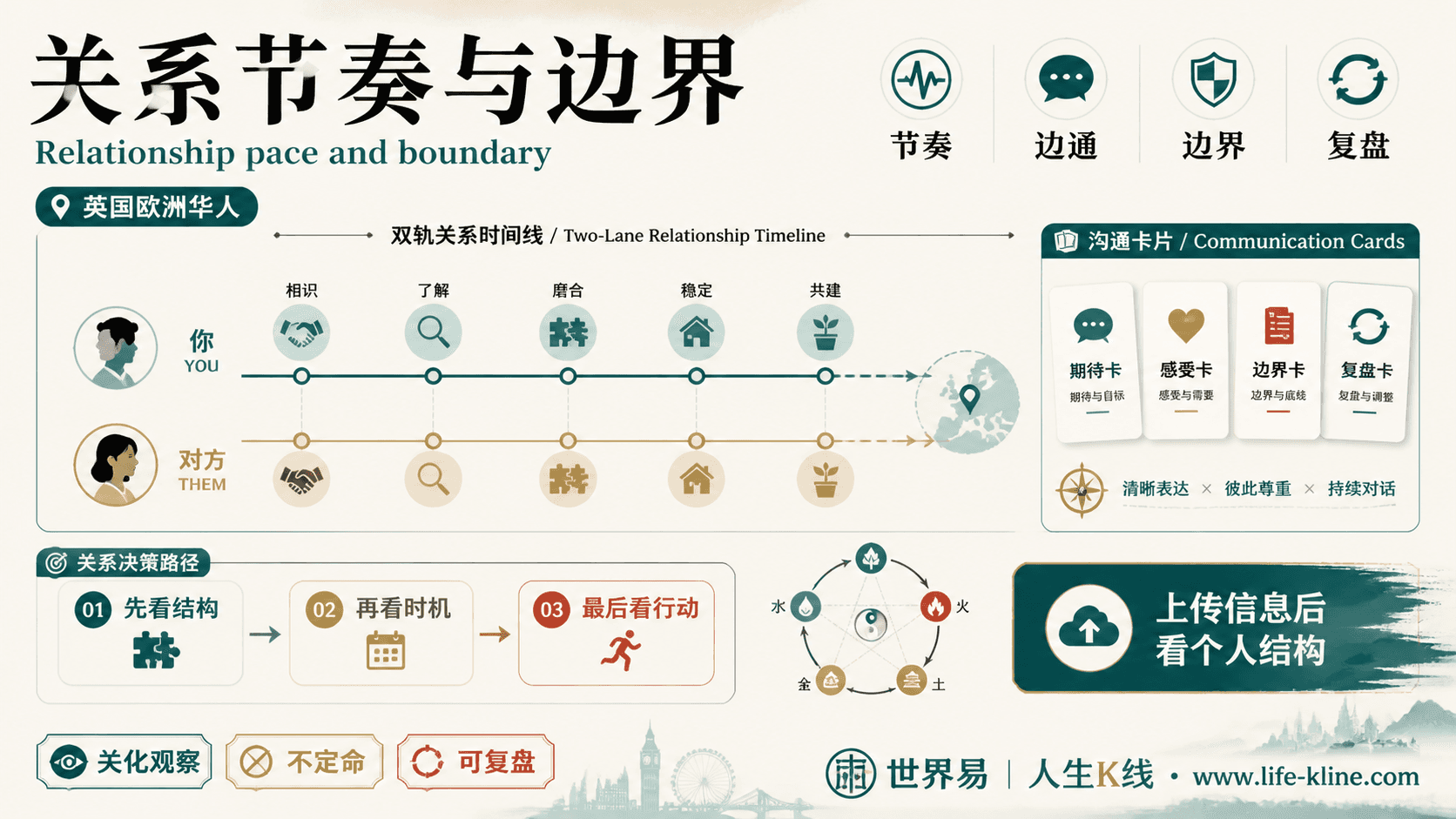
关系节奏与边界|英国欧洲华人
这张图把《Analysis of BaZi Rhythms and Boundaries in Cross-Cultural Partner Selection among Chinese in the UK and Europe》里的命理概念转成关系、边界和应用场景,适合先看图建立结构,再回到知识文章正文理解细节。
关系节奏与边界不应被写成固定结论。更适合英国欧洲华人的读法,是把传统术语翻译成结构、时机、环境、行动和复盘。
查看图片解读