BaZi Analysis and Practical Guidance for Health Recovery of Chinese Migrants in the UK and Europe
把这篇文章落到自己身上验证:先看结构,再进入个人分析,不做泛泛阅读。
Why This Scenario Is Especially Difficult for Overseas Chinese
Chinese migrants to the UK and Europe face physiological adaptation pressures due to cold climate, high humidity, and latitude differences. Their original lifestyle habits and dietary structures undergo drastic changes, which easily lead to decreased immunity and recurrence of chronic diseases, especially pronounced during middle age and menopause stages.
Cultural differences create barriers for Chinese in accessing medical resources, psychological adjustment, and lifestyle changes. Language communication difficulties and unfamiliarity with the healthcare system further complicate health recovery. Traditional BaZi concepts become an important auxiliary reference to better understand bodily signals in this context.
In BaZi structures, the strength of the Day Master, along with the Yong Shen and Ji Shen, interact with local climate and dietary structures in foreign environments, potentially amplifying or suppressing certain bodily reactions. For example, a fire-strong individual may face internal heat stagnation issues in cold and damp environments, while a water-strong person needs to be cautious of cold-damp invasion.
Additionally, cross-border living brings family distance, tax burdens, and economic pressures that indirectly affect the quality of health recovery. Therefore, BaZi judgments must integrate these multidimensional real-world factors to provide practical and feasible guidance.
Three Core Dimensions of BaZi Judgment
First, the strength of the Day Master determines the body's fundamental energy and self-regulation ability. An overly strong Day Master often has robust vitality but may suffer from internal consumption, while a weak Day Master relies on the support of the Yong Shen to maintain balance. Changes in climate and diet after migration directly affect the Day Master’s performance.
Second, the relationship between the Yong Shen and Ji Shen reflects the elements needed by the body and its balance state. For example, if the Yong Shen is Water or Metal, more attention should be paid to the spleen, stomach, and lung functions in a cold and damp environment. Conversely, if the Ji Shen is Wood or Fire, one should avoid excessive external stimuli corresponding to those elements. The Da Yun (decade luck cycle) and Liu Nian (annual fortune) jointly adjust the overall health trend.
Third, the palaces and patterns symbolize influences in different life areas. Patterns such as Zheng Guan (Proper Officer), Zheng Cai (Proper Wealth), and Shang Guan (Hurting Officer) each relate to physical, psychological, and external environmental factors. The auspiciousness of Da Yun and the specific combinations of Liu Nian determine fluctuations in physical health. Proper use of this information helps grasp optimal recovery timing.
Integrating these three dimensions, BaZi judgment not only reveals the individual's constitution and environmental adaptation status but also guides specific health management strategies. This is particularly crucial under the multiple environmental variables brought by cross-border migration.
Three Real BaZi Chart Cases
Case 1: This lady’s Day Master is 丁火 (Ding Fire), which is relatively strong. Her pattern is Zheng Guan (Proper Officer), with Yong Shen being Water and Metal, and Ji Shen being Wood. She is currently in the 丁亥 (Ding Hai) Da Yun, with a stable fortune, and the Liu Nian of 丙午 (Bing Wu) shows adaptability. In the cold and damp environment of the UK and Europe, her fire-strong constitution faces risks of cold-damp invasion. The Water and Metal Yong Shen indicate the need to focus on respiratory and kidney care. Westernized diet and low sunlight exposure after migration may weaken her fire vitality. Physical signals such as easy fatigue and shortness of breath require special attention. It is recommended to prioritize supplementing Water and Metal elements according to the Yong Shen, strengthen lung and kidney functions through moderate exercise and traditional Chinese medicine conditioning, and avoid the liver and gallbladder burden caused by the Wood Ji Shen. Judgments should first assess cold-damp symptoms, then combine with physical strength fluctuations to adjust lifestyle rhythm.
Case 2: This lady’s Day Master is 己土 (Ji Earth), relatively strong. Her pattern is Zheng Cai (Proper Wealth), with Yong Shen being Metal and Ji Shen being Fire. She is currently in the 戊午 (Wu Wu) Da Yun, maintaining stability, and the Liu Nian 丙午 (Bing Wu) also shows adaptability. Earth-strong constitutions are prone to cold-damp troubles in the UK’s humid and cold climate. The Metal Yong Shen suggests attention to respiratory and circulatory system health. The Ji Shen Fire indicates the need to avoid excessive spicy and stimulating foods after migration to prevent internal heat disturbance. The Westernized diet with increased protein and fat intake may burden digestion and kidneys. During health recovery, digestive and respiratory functions should be closely monitored, with particular attention to dietary adjustments and adequate rest. The judgment sequence should start from digestion and absorption status, then combine with physical recovery trends to gradually optimize nutrition plans.
Case 3: This lady’s Day Master is 壬水 (Ren Water), relatively strong. Her pattern is Shang Guan (Hurting Officer), with Yong Shen being Earth and Fire, and Ji Shen being Metal. She is currently in the 己卯 (Ji Mao) Da Yun, which is auspicious, and the Liu Nian 丙午 (Bing Wu) aligns favorably. Water-strong constitutions tend to accumulate excessive internal dampness in the UK’s humid environment. The Earth and Fire Yong Shen indicate the need to warm yang and dispel dampness, enhancing spleen and stomach functions. The Metal Ji Shen warns against excessive cold exposure and overexertion. Although the cold and damp climate may increase bodily burdens after migration, the auspicious Da Yun creates good conditions for recovery. Dietary adjustments should increase warming and tonifying elements, avoiding cold and raw foods. Health judgments should first analyze internal dampness and yang qi status, then combine Da Yun and Liu Nian trends to scientifically arrange exercise and diet for comprehensive rehabilitation.
Common Misconceptions Among Overseas Chinese in This Scenario
Many overseas Chinese migrants ignore the impact of climate and latitude on their BaZi structure, blindly relying on their original lifestyle habits, resulting in imbalanced bodily regulation and slow health recovery. Especially, insufficient identification of Yong Shen and Ji Shen leads to a lack of targeted dietary and routine adjustments.
Some overly depend on singular BaZi conclusions, neglecting the interaction between Da Yun and Liu Nian with the real environment, lacking awareness of dynamic adjustments. This causes health management to lack flexibility and foresight.
Additionally, inadequate psychological adaptation and cultural barriers cause some Chinese to underutilize medical systems and health resources, affecting disease prevention and physical recovery. BaZi analysis should be combined with practical medical care to form a scientific health management system.
Another misconception is neglecting the impact of family support and cross-border pressures on physical condition. If BaZi judgments do not consider social environments, it is difficult to comprehensively grasp the complexity of health recovery, leading to one-sided strategy formulation.
Practical Judgment Sequence
First, combine the strength of the Day Master and the Yong Shen and Ji Shen to assess which bodily systems are most vulnerable after migration, such as respiratory, digestive, spleen-stomach, and kidney functions. Observe bodily signals such as fatigue, shortness of breath, indigestion, and weight fluctuations to preliminarily determine adjustment priorities.
Second, refer to the current Da Yun and Liu Nian status to judge the trend of physical recovery—whether it is suitable for active adjustments (such as supplementing Yong Shen elements, adjusting diet and exercise) or better to maintain and wait for environmental stability to avoid adverse effects from overstimulation.
Finally, combine local climate changes and lifestyle habits to dynamically monitor bodily reactions and adjust BaZi-assisted health strategies. It is recommended that when obvious discomfort signals appear, first investigate lifestyle factors related to the Ji Shen, and promptly consult medical professionals to ensure a positive interaction between BaZi judgment and practical healthcare.
FAQ
Question 1: Why do I easily experience fatigue and respiratory problems after moving to the UK? Answer: The UK’s cold and humid climate suppresses fire-strong or earth-strong constitutions, affecting lung and kidney functions. This increases energy consumption and makes the respiratory system vulnerable to cold-damp invasion, causing fatigue and shortness of breath.
Question 2: How to adjust diet after migration based on BaZi judgment? Answer: First identify the Yong Shen and Ji Shen, prioritizing supplementation of the Five Elements represented by the Yong Shen. For example, if Water and Metal are Yong Shen, increase foods that moisten the lungs and nourish the kidneys. If Fire is the Ji Shen, avoid spicy and stimulating foods. Combine with Da Yun and Liu Nian to assess bodily tolerance and gradually adjust the diet structure.
Question 3: What is the impact of Da Yun and Liu Nian on health recovery? Answer: Da Yun represents long-term trends; auspicious Da Yun favor bodily function recovery and immune enhancement. Stable Da Yun suggests maintaining the status quo and avoiding drastic changes. Liu Nian reflects environmental changes and bodily conditions in the current year; adaptability is key, and timely lifestyle and medical strategy adjustments are necessary.
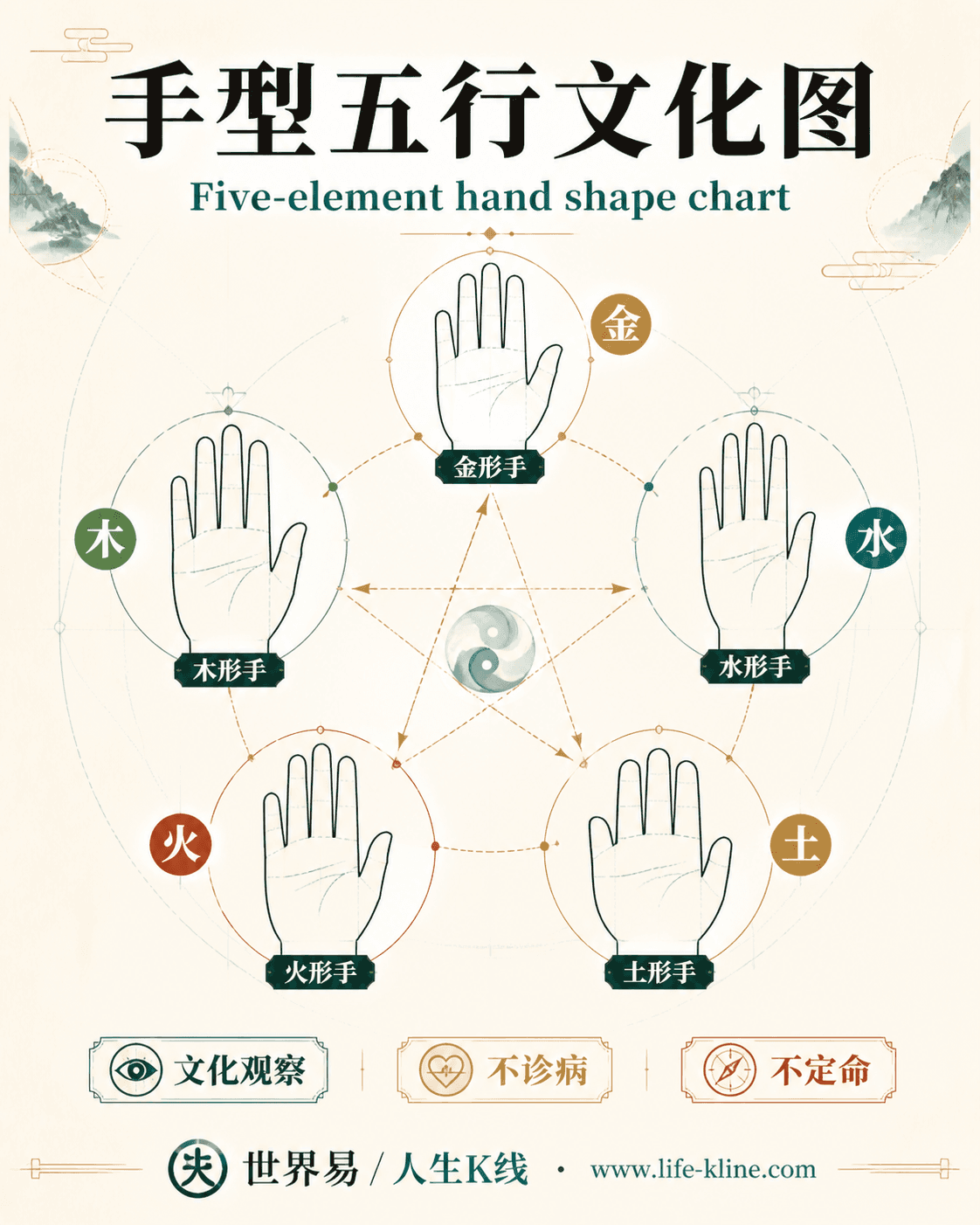
手型五行文化图|英国欧洲华人
这张图把《BaZi Analysis and Practical Guidance for Health Recovery of Chinese Migrants in the UK and Europe》里的命理概念转成关系、边界和应用场景,适合先看图建立结构,再回到知识文章正文理解细节。
手型五行文化图用于解释Chinese palmistry hand shape相关的手相文化观察方法,适合英国欧洲华人用户理解掌纹术语、上传边界和现实复盘方式。
查看图片解读