Analysis of BaZi Rhythms and Boundaries in Cross-Cultural Partner Selection Among North American Chinese
把这篇文章落到自己身上验证:先看结构,再进入个人分析,不做泛泛阅读。
Why This Scenario Is Especially Difficult for Overseas Chinese
North American Chinese face not only differences in culture, language, and lifestyle habits when selecting cross-cultural partners, but also complex practical constraints such as family expectations, identity recognition, and tax planning. The geographical distance in transnational marriages often increases communication costs and emotional maintenance difficulties. Coupled with legal and tax risks associated with overseas status, the decision-making complexity is significantly amplified.
From the perspective of cultural differences, fundamental disparities exist between Eastern and Western views on marriage, child education, and family roles, which easily trigger value conflicts. Especially in North America, differences in life rhythms and social circles between Chinese and non-Chinese partners require more understanding and tolerance to maintain emotional bonds.
Differences in BaZi structure are also magnified in this context. The overseas environment changes the space for fortune manifestation; for example, the alignment between Da Yun (decade luck cycles) and Liu Nian (annual fortune) with the real environment affects the timing and stability of partner selection. When the Yong Shen (favorable elements) harmonize with the real environment, partner selection decisions tend to be more rational and stable; conversely, disharmony may bring emotional setbacks or life pressures.
Therefore, North American Chinese must comprehensively consider BaZi rhythms and boundaries when choosing cross-cultural partners, avoiding blind following or emotional decisions. By leveraging BaZi tools combined with real-world conditions, they can form a scientific judgment system to minimize risks and improve marriage quality.
Three Core Dimensions of BaZi Judgment
First, the Day Master and structure form the foundation of BaZi judgment. The Day Master represents the core personal energy, and its strength determines the ability to cope with external environments. Structures such as Shang Guan (Hurting Officer) pattern, Pian Cai (Indirect Wealth) pattern, and Pian Yin (Indirect Resource) pattern reflect personality traits and the focus of major life areas. In cross-cultural partner selection, the strength of the Day Master and the structure determine the individual’s adaptability to cultural differences and strategies for handling conflicts.
Second, Yong Shen (favorable elements) and Ji Shen (unfavorable elements) indicate harmonizing and restraining factors in BaZi. The harmonizing effect of Yong Shen can alleviate real-world conflicts, helping individuals better integrate into foreign cultural environments and maintain emotional stability; Ji Shen may represent potential risks or obstacles, especially in cross-cultural marriages where activation of Ji Shen can trigger family conflicts or life difficulties.
Third, Da Yun (decade luck cycles) and Liu Nian (annual fortune) reflect the temporal dimension of BaZi rhythms. The strength of Da Yun and its interaction with Liu Nian influence the optimal timing for partner selection and the risk level of decisions. For North American Chinese in cross-cultural marriages, if Da Yun is weak or Liu Nian unfavorable, it is advisable to proceed cautiously with major decisions; conversely, stable Da Yun favors maintaining and deepening relationships.
Additionally, although the palace (house) environment is not directly involved in these cases, when combined with real identity and environmental factors, BaZi rhythms can be amplified or suppressed by reality, creating a complex decision-making background. Understanding these three core dimensions helps Chinese overseas rationally evaluate opportunities and challenges in cross-cultural partner selection.
Three Real BaZi Chart Case Studies
Case 1: The female’s Day Master is Ji (己, Earth), relatively strong, with a Shang Guan (Hurting Officer) structure. The Yong Shen are Wood and Water, and the Ji Shen is Fire. She is currently in the 7th year of the Bing Chen (丙辰) Da Yun, with relatively weak luck, and the Bing Wu (丙午) Liu Nian requires caution. In the context of North American Chinese cross-cultural partner selection, she has a strong desire for self-expression (a characteristic of the Shang Guan structure) when facing cultural and family conflicts. However, the weak Da Yun suggests slowing down the partner selection pace to avoid emotional conflicts or family disputes triggered by the Ji Shen Fire. It is recommended that she focus more on communication and understanding in the early stages of partner selection, guard against external pressures caused by Da Yun and Liu Nian, stabilize herself first, and advance the relationship more securely when the luck improves.
Case 2: The Day Master is Xin (辛, Metal), relatively strong, with a Pian Cai (Indirect Wealth) structure. The Yong Shen are Fire and Wood, and the Ji Shen is Earth. She is currently in the 7th year of the Wu Chen (戊辰) Da Yun, which is ominous, and the Bing Wu (丙午) Liu Nian also calls for caution. In the North American environment, the Pian Cai structure indicates a strong ability to attract wealth and resources, but the dangerous Da Yun warns of potential major changes in emotions and life. In cross-cultural partner selection, the Ji Shen Earth represents significant environmental or family pressure, which easily causes obstacles. It is advised that she prioritize investigating both families’ backgrounds and value conflicts, carefully assess stability, and avoid rushing into marriage during unfavorable Da Yun and Liu Nian periods. Waiting for a more favorable Da Yun cycle before making decisions is recommended.
Case 3: The Day Master is Ji (己, Earth), relatively strong, with a Pian Yin (Indirect Resource) structure. The Yong Shen are Wood and Water, and the Ji Shen is Fire. She is currently in the 4th year of the Xin Si (辛巳) Da Yun, with stable luck, and the Bing Wu (丙午) Liu Nian supports adaptability. In North American cross-cultural partner selection, the Pian Yin structure reflects strong learning ability and adaptability, enabling flexible adjustment when facing cultural differences. The stable Da Yun and supportive Liu Nian indicate that the current partner selection pace is suitable for maintaining and deepening the relationship, avoiding impatience. It is recommended that she emphasize self-growth and emotional accumulation, utilize the stable Da Yun period to gradually advance the relationship, and focus on cultural integration and communication.
These three cases collectively emphasize the importance of judging partner selection rhythm based on Da Yun and Liu Nian, while reminding overseas Chinese to pay attention to potential emotional risks and family pressures reflected by Yong Shen and Ji Shen, and to formulate scientific decision plans.
Common Misconceptions Among Overseas Chinese in This Scenario
Many North American Chinese overly emphasize cultural differences during cross-cultural partner selection while neglecting the influence of BaZi rhythms, resulting in improper timing and pacing of partner selection. In reality, changes in Da Yun and Liu Nian significantly affect emotional stability; ignoring this often leads to emotional setbacks or marital crises.
Another common misconception is blindly pursuing the Yong Shen in the BaZi chart while overlooking the potential risks of the Ji Shen. For example, although Yong Shen is beneficial, if Da Yun is weak or Ji Shen is activated, the actual outcome may not be ideal, easily escalating conflicts or increasing pressure.
Additionally, some Chinese overseas, due to their identity and complicated tax issues, rely excessively on idealized BaZi conclusions, ignoring real constraints such as family distance, legal status, and tax planning, ultimately affecting marital stability and happiness.
In summary, while BaZi is an important reference, overseas Chinese need to combine real-world conditions and BaZi rhythms for rational analysis, avoiding emotional decisions and superstition, to achieve better results in cross-cultural partner selection.
Practical Judgment Sequence
First, start with the Day Master and structure to clarify one’s BaZi characteristics and ability to handle cultural differences, assessing personal strengths and challenges in cross-cultural relationships. Next, combine Yong Shen and Ji Shen to judge emotional harmony and potential risks, identifying pressure points and conflict sources in the partner selection process.
Then, focus on the current Da Yun and Liu Nian to determine whether the timing is suitable for advancing key decisions. When Da Yun is weak or Liu Nian is unfavorable, a conservative approach is recommended to avoid rushing into marriage; stable Da Yun periods are suitable for deepening relationships and consolidating emotional foundations.
Finally, integrate real constraints such as identity, taxes, family distance, and cross-border lifestyle habits, merging BaZi judgment with real-world conditions to formulate feasible partner selection strategies. This step-by-step approach balances BaZi rhythms with practical considerations, effectively mitigating risks and improving success rates.
FAQ
Question 1: Is BaZi judgment important for overseas Chinese in cross-cultural partner selection? Answer: BaZi judgment is an important tool for understanding personal energy and partner selection rhythm, but it must be combined with real-world conditions for comprehensive analysis. Particularly, attention should be paid to the interaction between Da Yun, Liu Nian, and real-life pressures.
Question 2: How do Yong Shen and Ji Shen manifest in cross-cultural marriages? Answer: Yong Shen represents harmonizing and supportive forces that help alleviate conflicts arising from cultural differences; Ji Shen indicates potential conflicts or obstacles, which when triggered may cause emotional instability or family disputes and thus require careful handling.
Question 3: How to determine the best timing for partner selection? Answer: By combining Da Yun and Liu Nian to evaluate the current strength of luck and risks in the year. When luck is weak or the year is unfavorable, caution is advised; when luck is stable and the year is favorable, it is suitable to maintain and deepen the relationship. Avoid rushing impulsively.
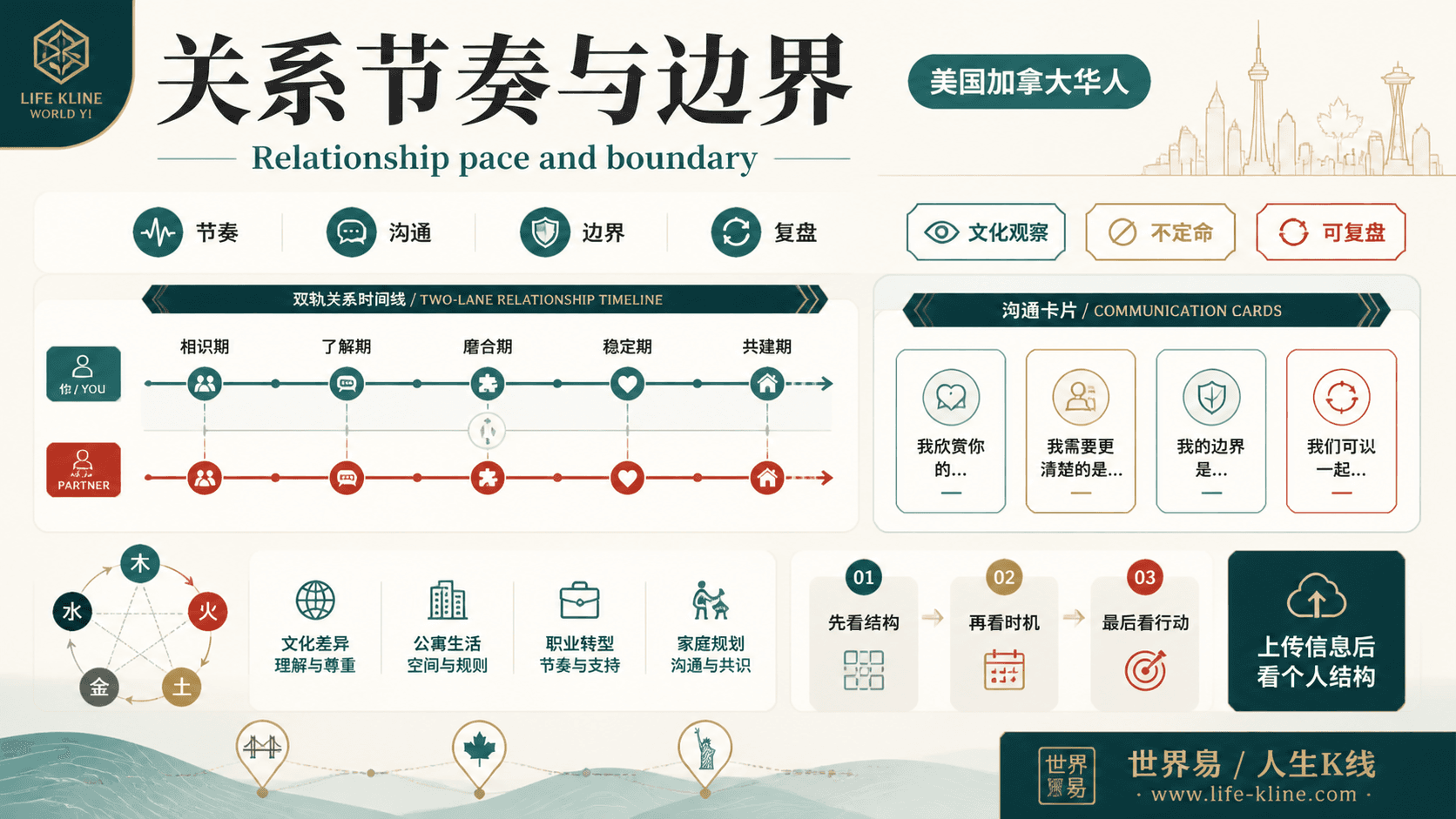
关系节奏与边界|美国加拿大华人
这张图把《Analysis of BaZi Rhythms and Boundaries in Cross-Cultural Partner Selection Among North American Chinese》里的命理概念转成关系、边界和应用场景,适合先看图建立结构,再回到知识文章正文理解细节。
关系节奏与边界不应被写成固定结论。更适合美国加拿大华人的读法,是把传统术语翻译成结构、时机、环境、行动和复盘。
查看图片解读