Xiao Shu: The Fifth Solar Term of Summer and the Boundary of BaZi Month Pillars
把这篇文章落到自己身上验证:先看结构,再进入个人分析,不做泛泛阅读。
Concept Definition
Xiao Shu is the fifth solar term of summer, marking the formal beginning of hot weather. At this time, the Sun's position on the ecliptic reaches 105 degrees. Geographically, we are in the peak of summer; all things grow to maturity but have not yet reached the zenith of Dashu.
In terms of time division, the Gregorian date for Xiao Shu is fixed on the 6th, 7th, or 8th of July, with a fluctuation of one or two days depending on the year. Within the metaphysical system, solar terms are not only turning points of natural climate but also critical nodes of time coordinates, defining the start and end of every metaphysical cycle.
In the calendar system, Xiao Shu belongs to the division of the solar ecliptic into twenty-four equal parts. It stands independently of lunar dates, possessing absolute objectivity. Unlike the first day of the lunar month which is based on the lunar phase, Xiao Shu is determined entirely by the apparent motion of the Sun. It is a product of ancient astronomy and calendar science, serving as the hub between modern Gregorian calendars and ancient lunar calendars.
Traditional Metaphysical Significance
In the core architecture of BaZi metaphysics, Xiao Shu plays a crucial role; it is the true boundary point for charting the month pillar and calculating Da Yun. BaZi charting emphasizes the 'Yue Ling' (Month Command), and the change of the Yue Ling must strictly follow the exact time of the solar term, not the first day of the lunar month. Once Xiao Shu passes, the original Wei month enters a new month, causing fundamental changes in the Heavenly Stems and Earthly Branches of the month pillar.
The Yue Jian corresponding to Xiao Shu is Wei. In the Five Elements, Wei Earth belongs to dry earth. At this time, solar energy is vigorous, fire qi is extremely strong, and Fire generates Earth, forming a pattern of Fire Earth interaction. As the last month of summer, although Yang qi is still strong, dry qi begins to rise. The earth nature shifts from moist to dry, producing a profound impact on the selection of Yong Shen (favorable element) and Ji Shen (unfavorable element) in the BaZi chart.
As dry earth, the characteristics of the Wei month in metaphysics manifest as stability but lack of mobility, often leading to personality traits of stubbornness or conservatism. Fire generating Earth means energy flows continuously, but too much is bad. If the original chart has too much Earth, it may lead to stagnant fortune. Therefore, analysis of the natal chart after the Xiao Shu solar term must focus on how dry earth constrains or generates Wood, Water, Metal, and Fire in the original chart.
Practical Configuration and Interpretation
In practical BaZi charting operations, one must strictly distinguish between Gregorian dates and lunar dates. Many beginners mistakenly believe the first day of the lunar month is the point where the month pillar switches; this is incorrect. The correct approach is to switch the month pillar based on the exact moment of solar terms like Xiao Shu and Dashu. Only after crossing the moment of Xiao Shu will the original month pillar change to the new one based on the Wei month.
For the calculation of Da Yun, the principle of switching solar terms is also followed. Da Yun is the flow of fortune over ten years, and its starting time must correspond precisely to a solar term. As the beginning of the fifth solar term of summer, Xiao Shu is often also a key node for a person's life fortune turning point. If the original chart favors Fire and Earth, fortune may be smoother after Xiao Shu; if the original chart dislikes dry earth, one must be cautious of health or career fluctuations caused by dry heat.
In terms of life analogy, Xiao Shu is like a mid-term acceptance point of a project; the accumulation before this moment converts into a new stage. In BaZi matching, if the Day Master is Wood, and Wei Earth is dry earth, Fire generating Earth damages Wood qi, requiring special attention. For those with Metal destiny, Earth generates Metal, but the generating power of dry Earth is weakened, requiring judgment based on the specific chart. In practice, one cannot look only at the name of the solar term but must conduct comprehensive judgment combining the Fire Earth interaction characteristics of the Wei month Jian.
Common Misconceptions
The most common misconception is treating the first day of the lunar month as the boundary point for BaZi charting. In reality, BaZi metaphysics relies on solar terms, not the first day of the lunar month. The first day of the lunar month is merely a marker of the lunar phase change, while BaZi requires the precise position of the Sun's ecliptic longitude. Xiao Shu may fall in the sixth lunar month, the seventh, or even span across two lunar months; therefore, solar term time must be the standard.
Another misconception is believing that after Xiao Shu, the chart must be purely dry earth or a pure Fire formation. The fact list clearly states that the Yue Jian of Xiao Shu is Wei, and the Wei month is dry earth, but BaZi is a dynamic balance system. Although Fire generating Earth is the general trend, whether a chart forms a pattern depends on the strength of the Day Master, factors like punishment, clash, combination, and harm. One cannot simply conclude that someone's fortune will improve or worsen just because Xiao Shu has passed; a full chart analysis is required.
FAQ
Q: Is the Gregorian date of Xiao Shu fixed? A: The Gregorian date for Xiao Shu usually falls between the 6th and 8th of July, with a fluctuation of one or two days depending on the year. This is determined by the moment the Sun's ecliptic longitude reaches 105 degrees.
Q: Should BaZi charting use the lunar calendar or solar terms? A: BaZi charting relies on solar terms, especially for changing the month pillar and starting Da Yun. One must base this on the time points of solar terms like Xiao Shu, not the first day of the lunar month as the dividing line.
Q: The Yue Jian of Xiao Shu is Wei; what is its Five Elements attribute? A: The Yue Jian corresponding to Xiao Shu is Wei, belonging to dry earth. At this time, Fire generates Earth, and the qi of dry earth in the Wei month gradually becomes strong, having an important impact on the Five Elements balance of the BaZi natal chart.
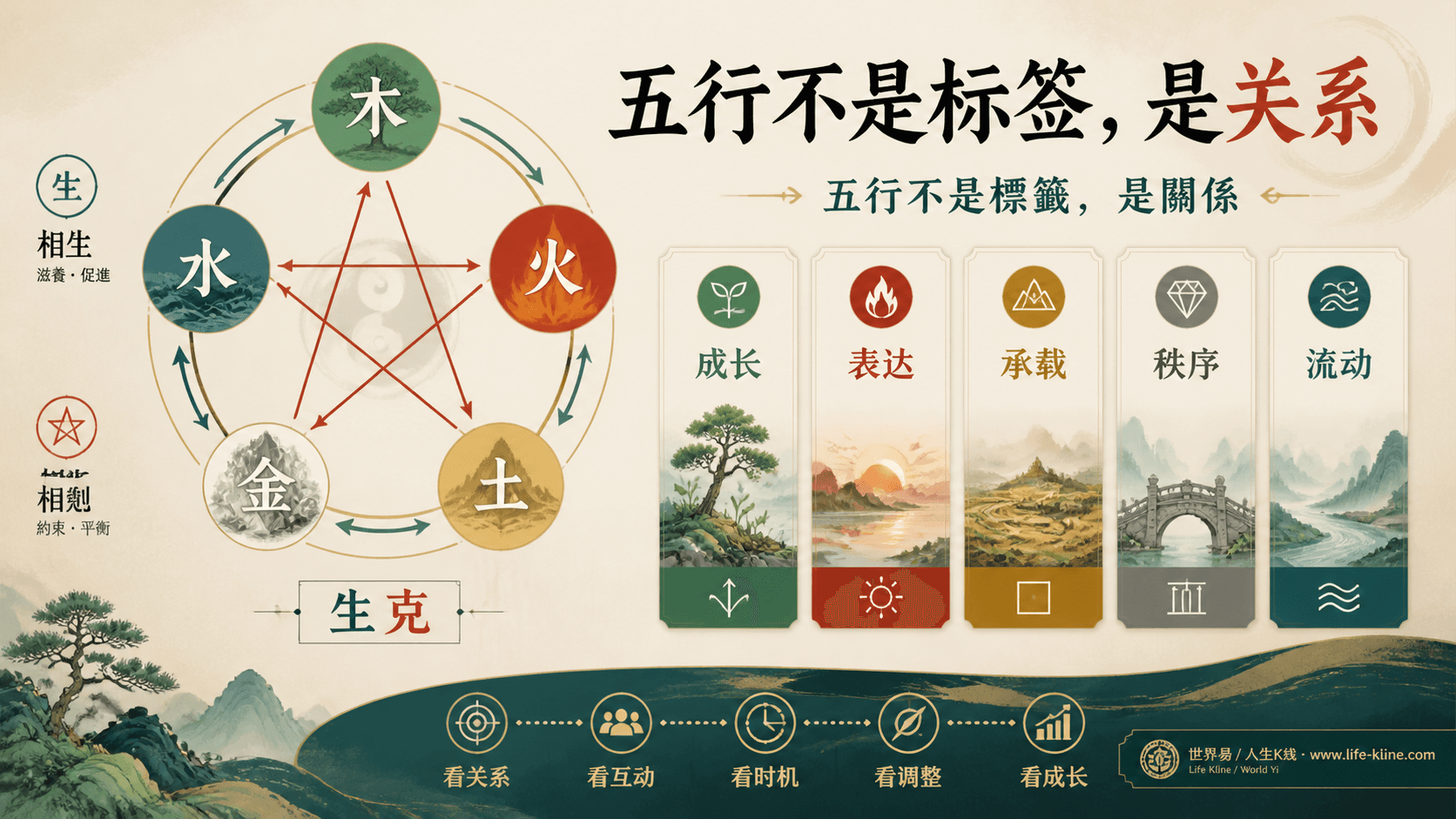
五行现代翻译图
这张图把《Xiao Shu: The Fifth Solar Term of Summer and the Boundary of BaZi Month Pillars》里的命理概念转成关系、边界和应用场景,适合先看图建立结构,再回到知识文章正文理解细节。
五行图把金木水火土从人格标签翻译成系统关系,帮助用户理解生克、承载和转化。