Comprehensive Guide to Zi Wei Hua Ji and Real Chart Case Analyses
把这篇文章落到自己身上验证:先看结构,再进入个人分析,不做泛泛阅读。
What is Zi Wei Hua Ji
Zi Wei Hua Ji is one of the Four Transformations (Si Hua) stars in Zi Wei Dou Shu, symbolizing misfortune, obstacles, and sudden changes. The term 'Hua Ji' literally means transforming into a star of taboo or unfavorable influence, indicating that certain stars in the natal chart exhibit adverse effects during specific periods due to Hua Ji, potentially bringing hindrances, conflicts, or crises.
Zi Wei Dou Shu is based on twelve palaces and fourteen principal stars. The Four Transformations—Hua Lu (Transformation of Prosperity), Hua Quan (Transformation of Authority), Hua Ke (Transformation of Merit), and Hua Ji (Transformation of Taboo)—represent dynamic adjustments of the principal stars' energies, reflecting their changing influences during different Da Yun (decade luck cycles) and Liu Nian (annual fortunes). Hua Ji, as the most cautionary among the Four Transformations, often signals that the individual needs to be particularly vigilant against unfavorable factors in certain stages.
The influence of Hua Ji is not limited to misfortune but also encompasses changes and challenges. It may cause emotional fluctuations, health concerns, interpersonal conflicts, or career obstacles, yet it is also regarded as an awakening opportunity that stimulates self-reflection and adjustment, enabling transformation and growth of destiny.
In practical Zi Wei Dou Shu applications, when Hua Ji conflicts with the Life Palace or other important palaces, extra caution is required. At such times, the individual's energy may be internally consumed, manifesting as low mood or self-doubt. However, this state also prompts the individual to reassess themselves, identify problems, and take action.
Overall, Zi Wei Hua Ji is an important indicator in Zi Wei Dou Shu that should not be overlooked. Understanding its connotations and manifestations helps the individual better grasp the challenges and opportunities within their destiny.
How to Interpret Zi Wei Hua Ji: Core Elements
When observing Zi Wei Hua Ji, it is essential first to clarify the Day Master’s attribute and its strength, as the Day Master’s strength determines the choice of Yong Shen (favorable element) and Ji Shen (unfavorable element), which in turn affects the specific manifestations of Hua Ji. When the Day Master is relatively weak, the negative effects of Hua Ji are more likely to surface, whereas a stronger Day Master may have greater resilience.
Secondly, the pattern (Ge Ju) is a key basis for understanding Hua Ji’s influence. Different patterns such as Pian Cai (Indirect Wealth), Zheng Cai (Direct Wealth), or Zheng Yin (Direct Resource) require different Yong Shen, and their Ji Shen vary accordingly. If Hua Ji involves the five element or palace associated with the Ji Shen, the negative impact is often intensified, thus a detailed analysis considering the pattern is necessary.
Da Yun (decade luck cycles) and Liu Nian (annual fortunes) serve as the temporal carriers of Hua Ji’s effects. Da Yun represents a ten-year trend in fortune, while Liu Nian reflects the fluctuations within a single year. When Hua Ji stars appear in Da Yun or Liu Nian, especially impacting the Yong Shen or key palaces, misfortune or obstacles are more likely to occur.
The interaction between Da Yun and Liu Nian is also crucial in assessing Hua Ji’s impact. For example, if the Da Yun is relatively stable, the disturbances caused by Hua Ji in Liu Nian may be limited; however, if the Da Yun is weak and Liu Nian also presents Hua Ji, one must be especially cautious of major changes and emotional disturbances.
Finally, although Hua Ji brings challenges, its negative effects often accompany awakening opportunities. The individual should use the warnings brought by Hua Ji to examine their shortcomings, adjust strategies, transform crises into opportunities, and realize turning points in their destiny.
Three Real Chart Cases
Case One involves a female aged 35-40, whose Day Master is Ding Fire (丁, Ding) and relatively weak. Her pattern is Pian Cai (Indirect Wealth), with Yong Shen being Fire and Ji Shen being Earth and Metal. She is in the 6th year of the Ding You (丁酉, Ding-You) Da Yun, and the current Liu Nian is Bing Wu (丙午, Bing-Wu). Under this Da Yun and Liu Nian combination, the Da Yun is stable, suitable for consolidation, while the Liu Nian requires flexible response. Zi Wei Hua Ji in this context advises her to pay attention to subtle changes in emotions and health. Although the Da Yun is steady, the Hua Ji in the Liu Nian may cause temporary internal consumption, reminding her to remain flexible while consolidating achievements.
Case Two concerns a female aged 30-35, whose Day Master is Bing Fire (丙, Bing) and relatively weak. Her pattern is Zheng Cai (Direct Wealth), with Yong Shen being Wood and Ji Shen being Earth and Metal. She is currently in the 9th year of the Wu Shen (戊申, Wu-Shen) Da Yun, and the Liu Nian is also Bing Wu (丙午, Bing-Wu). This Da Yun is unfavorable and requires guarding against major changes. Zi Wei Hua Ji here manifests as strong challenges, especially when the Hua Ji in Liu Nian overlaps with the pressure from Da Yun. The individual should be highly vigilant about risks of emotional downturns and sudden events. Although the impact of Hua Ji is severe, it can also be seen as an opportunity prompting self-reflection and adjustment, with the key being proactive response.
Case Three features a female aged 50-55, whose Day Master is Xin Metal (辛, Xin) and relatively strong. Her pattern is Zheng Yin (Direct Resource), with Yong Shen being Fire and Wood, and Ji Shen being Earth. She is in the 1st year of the Ren Xu (壬戌, Ren-Xu) Da Yun, and the Liu Nian is Bing Wu (丙午, Bing-Wu). This Da Yun is stable, suitable for consolidation, while the Liu Nian requires flexible adaptation. Although Zi Wei Hua Ji exists in this chart, due to the relatively strong Day Master and appropriate Yong Shen, the negative effects of Hua Ji are comparatively limited. The individual can harness the awakening energy brought by Hua Ji to timely adjust mindset and actions, avoiding internal consumption caused by emotional fluctuations, thereby progressing steadily.
Common Misconceptions
Many people mistakenly believe that Zi Wei Hua Ji inevitably brings disasters and absolute misfortune. In reality, although Hua Ji represents obstacles and changes, it is simultaneously an opportunity for self-awakening and transformation. Understanding the dual nature of Hua Ji helps one face challenges more rationally.
Another common misunderstanding is equating Hua Ji with fixed and unchangeable fate, assuming that once Hua Ji appears, it cannot be reversed. In fact, Zi Wei Dou Shu emphasizes temporal and spatial changes; the influence of Hua Ji in Da Yun and Liu Nian is dynamic. The individual can alleviate and resolve its negative effects by adjusting mindset and behavior.
Some also overlook the moderating role of Day Master strength and pattern on Hua Ji’s influence. Different Day Master strengths and configurations of Yong Shen and Ji Shen cause Hua Ji’s manifestations to vary greatly and cannot be generalized.
Lastly, some readers confuse the differences between BaZi (Four Pillars) and Zi Wei Dou Shu, attempting to explain Zi Wei Hua Ji simply by BaZi’s five element generating and overcoming logic, neglecting Zi Wei Dou Shu’s unique roles of palaces and principal stars, leading to misunderstandings.
Practical Advice
When facing challenges brought by Zi Wei Hua Ji, one should first consider their own Day Master strength and pattern, focusing on balancing Yong Shen and Ji Shen to avoid disruption of five element harmony caused by Hua Ji. Maintaining physical and mental health is especially important.
Secondly, when Hua Ji appears in Da Yun and Liu Nian, enhance self-awareness and timely adjust life and work rhythms. Avoid impulsiveness and recklessness, maintain calmness and rationality, and use the awakening energy of Hua Ji to promote growth.
Finally, it is recommended to combine the strengths of BaZi and Zi Wei Dou Shu, comprehensively analyze patterns and fortunes, understand oneself and external factors, and scientifically respond to changes brought by Hua Ji, thereby progressing steadily amid destiny’s fluctuations.
FAQ
Question 1: What is the difference between Zi Wei Dou Shu and BaZi? Answer: BaZi centers on five element generating and overcoming relationships, making it more suitable for judging long-term patterns and fortune trends. Zi Wei Dou Shu is based on twelve palaces and fourteen principal stars, better suited for analyzing specific events and interpersonal relationships, such as the Spouse Palace for partner matters, Children Palace for offspring, and Travel Palace for journeys. The two complement each other without conflict, and combined use provides a more comprehensive destiny analysis.
Question 2: What does the principal star Tian Fu represent in the Life Palace? Answer: Tian Fu governs consolidation, compassion, and steadiness, known as the 'Command Star.' Individuals with Tian Fu in their Life Palace are usually practical and cautious, though sometimes overly conservative. To judge the pattern’s purity, one must also consider auxiliary stars such as Zuo Fu and You Bi, Wen Chang and Wen Qu, as well as the Four Transformations (Hua Lu, Hua Quan, Hua Ke, Hua Ji).
Question 3: What happens if Hua Ji conflicts with the Life Palace? Answer: Hua Ji signifies misfortune, obstruction, and change. When Hua Ji conflicts with the Life Palace during a major luck cycle or annual fortune, it often causes internal energy consumption, manifesting as emotional low points, health warnings, or self-doubt. However, Hua Ji is also an awakening opportunity; intense emotional fluctuations often mark the beginning of destiny transformation, reminding the individual to adjust mindset and behavior.
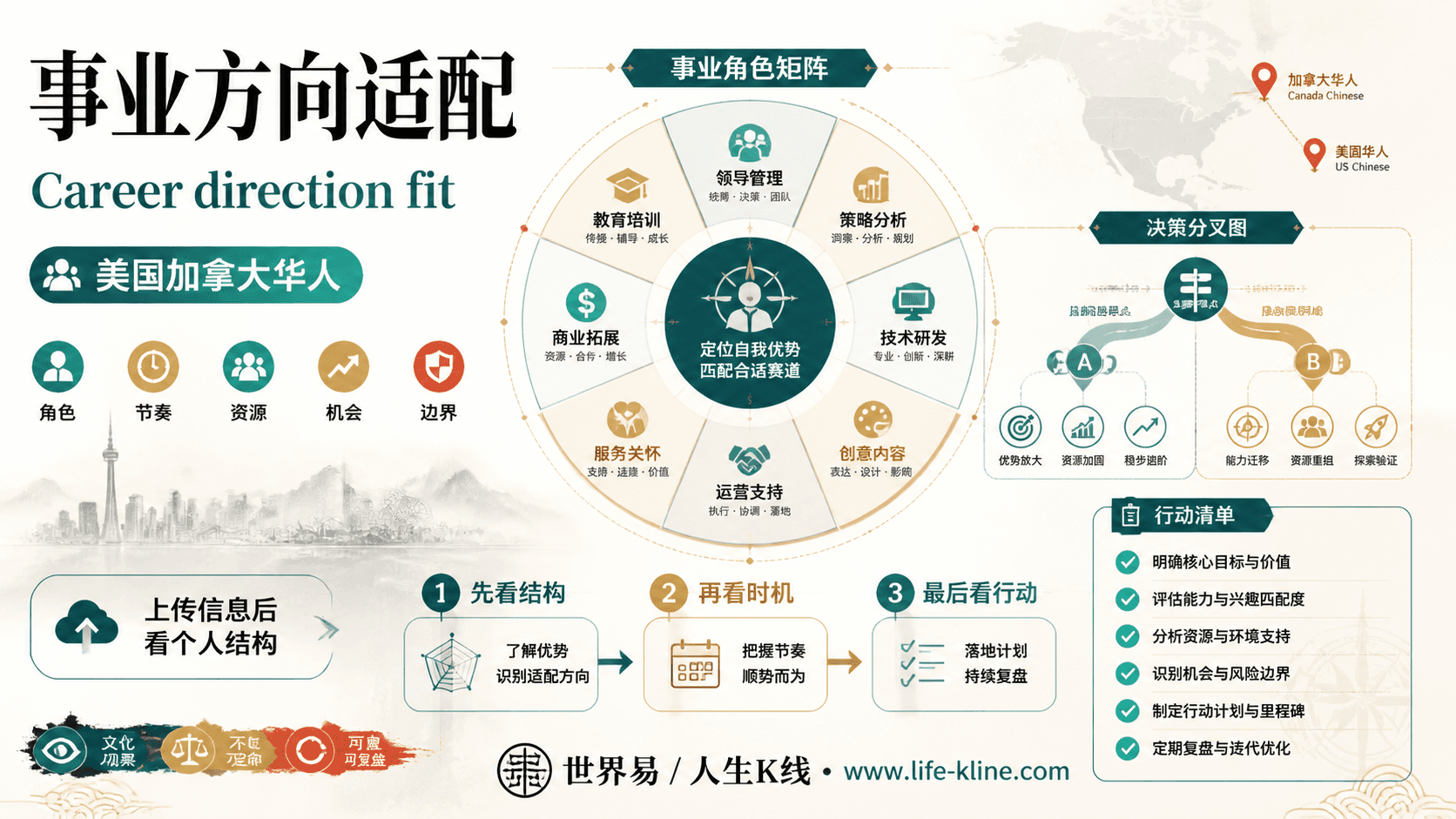
事业方向适配|美国加拿大华人
这张图把《Comprehensive Guide to Zi Wei Hua Ji and Real Chart Case Analyses》里的命理概念转成关系、边界和应用场景,适合先看图建立结构,再回到知识文章正文理解细节。
事业方向适配不应被写成固定结论。更适合美国加拿大华人的读法,是把传统术语翻译成结构、时机、环境、行动和复盘。
查看图片解读