Detailed Explanation of Zi Wei Dou Shu: Core Theories and Real Chart Case Studies
把这篇文章落到自己身上验证:先看结构,再进入个人分析,不做泛泛阅读。
What is Zi Wei Dou Shu
Zi Wei Dou Shu is an important component of traditional Chinese metaphysics, originating in the Song Dynasty. It has been continuously refined and developed by generations of metaphysics masters and has become a popular method for fate prediction. It centers on twelve palaces and fourteen main stars, revealing various aspects of a person's life such as fortune, personality, career, and marriage by analyzing the star configurations within the chart.
Unlike BaZi, which relies primarily on the Five Elements (Wood, Fire, Earth, Metal, Water) interactions of Sheng (generating) and Ke (overcoming), Zi Wei Dou Shu emphasizes the combination of palaces and main stars, highlighting the influence of spatial-temporal positions on destiny. This structure enables Zi Wei Dou Shu not only to assess the overall pattern but also to reflect detailed events and interpersonal changes, offering strong practical value.
The Zi Wei Dou Shu chart is derived from the four pillars of year, month, day, and hour, combined with the distribution of fourteen main stars (such as Zi Wei, Tian Fu, Qi Sha, etc.) across the twelve palaces, forming a complex metaphysical picture. By comprehensively analyzing star strength, palace auspiciousness, and the Four Transformations (Hua Lu, Hua Quan, Hua Ke, Hua Ji), practitioners can make relatively precise predictions and guidance about an individual's destiny.
How to Read Zi Wei Dou Shu: Core Elements
The core elements of Zi Wei Dou Shu include the chart’s Life Palace main stars, the strength of the Day Master, the pattern (geju), and the determination of Yong Shen (favorable elements) and Ji Shen (unfavorable elements). The Life Palace main stars determine the basic personality and fundamental tone of the person’s destiny. For example, Tian Fu star represents conservatism and steadiness, reflecting the individual's inner traits and outward behavior.
The Day Master in Zi Wei Dou Shu corresponds to the person’s intrinsic energy; its strength directly influences the overall momentum of the chart. A relatively strong Day Master typically manifests as abundant energy and strong initiative, while a weak Day Master requires reliance on Yong Shen to harmonize the Five Elements, bringing the chart into balance.
The pattern reflects the overall structure and destiny trajectory of the chart, such as Yang Ren pattern, Pian Cai pattern, Qi Sha pattern, each with its characteristics and coping strategies. Yong Shen and Ji Shen are key to adjusting the Five Elements balance within the chart; selecting and applying them appropriately can effectively neutralize unfavorable factors.
Additionally, Da Yun (decade luck cycles) and Liu Nian (annual fortune) represent the dynamic changes over time, exerting phase-specific influences on destiny. Da Yun often determines the general auspiciousness or adversity of a period, while Liu Nian reflects the specific fortune fluctuations of a given year. The interaction between Da Yun and Liu Nian is an indispensable factor in Zi Wei Dou Shu forecasting.
Three Real Chart Case Studies
Case 1: The gentleman’s four pillars are 戊午 (Wu Wu), 己未 (Ji Wei), 庚子 (Geng Zi), 辛巳 (Xin Si). The Day Master is 庚 (Geng Metal), relatively strong, with a Yang Ren pattern. Yong Shen are Fire and Wood, Ji Shen is Earth. Currently in the 甲子 (Jia Zi) Da Yun (ages 41-50), which is an auspicious luck cycle, with progress in career and wealth. The Liu Nian is 丙午 (Bing Wu), the eighth year of Jia Zi Da Yun, overall auspicious with Liu Nian supporting the Da Yun. This chart exemplifies that when the Day Master is relatively strong, Fire and Wood as Yong Shen are used to harmonize; leveraging the favorable Da Yun and Liu Nian can promote career and financial growth.
Case 2: The gentleman’s four pillars are 癸亥 (Gui Hai), 癸亥 (Gui Hai), 己未 (Ji Wei), 庚午 (Geng Wu). The Day Master is 己 (Ji Earth), relatively weak, with a Pian Cai pattern. Yong Shen is Fire, Ji Shen are Metal and Water. Currently in the 己未 (Ji Wei) Da Yun (ages 36-45), which is stable and suited for maintaining achievements. The Liu Nian is 丙午 (Bing Wu), the eighth year of Ji Wei Da Yun, with the Da Yun stable and Liu Nian requiring flexible adaptation. This chart illustrates that when the Day Master is weak, reliance on Yong Shen Fire to supplement is critical, avoiding interference from Ji Shen, maintaining stability during the Da Yun, and responding flexibly to Liu Nian changes to consolidate overall fortune.
Case 3: The gentleman’s four pillars are 癸酉 (Gui You), 丙辰 (Bing Chen), 庚申 (Geng Shen), 戊寅 (Wu Yin). The Day Master is 庚 (Geng Metal), relatively strong, with a Qi Sha pattern. Yong Shen are Fire and Wood, Ji Shen is Earth. Currently experiencing 壬子 (Ren Zi) Da Yun (ages 31-40), which is a stable luck cycle suited for maintaining achievements. The Liu Nian is 丙午 (Bing Wu), the third year of Ren Zi Da Yun, with overall stability and Liu Nian requiring flexible response. This chart shows that with a Qi Sha pattern and a strong Day Master, relying on Fire and Wood as Yong Shen to harmonize the Five Elements, combined with a maintenance strategy during the Da Yun, can effectively mitigate the intense characteristics of the Qi Sha pattern, avoiding harm and maintaining stable fortune.
Common Misconceptions
Many beginners mistakenly believe that Zi Wei Dou Shu can judge destiny solely based on the auspiciousness or inauspiciousness of the main stars, neglecting the comprehensive influence of palaces, patterns, and Yong Shen with Ji Shen. In fact, while main stars are important, their auspiciousness must be interpreted in conjunction with palaces and other stars to reach accurate conclusions.
Additionally, some people confuse BaZi with Zi Wei Dou Shu, thinking they are the same. In reality, BaZi focuses on the Five Elements’ Sheng and Ke interactions, suitable for judging long-term trends; Zi Wei Dou Shu emphasizes palaces and stars, adept at analyzing specific events and interpersonal relationships, such as the Spouse Palace for partners, Children Palace for offspring, and Travel Palace for journeys. Both have their strengths and complement each other rather than conflict.
Another misconception is ignoring the interaction between Da Yun and Liu Nian, looking at the auspiciousness or adversity of Da Yun or Liu Nian alone without considering their coordination, which can lead to biased predictions. Accurate metaphysical analysis should focus on the dynamic interplay of Da Yun and Liu Nian to grasp fortune changes comprehensively.
Practical Suggestions
In practical application of Zi Wei Dou Shu, one should first clarify the strength of the Day Master and the pattern type, then select appropriate Yong Shen and Ji Shen to adjust the Five Elements balance within the chart. This step is the foundation of metaphysical judgment and directly affects subsequent fortune analysis and auspicious or inauspicious predictions.
Combine the current Da Yun and Liu Nian situations to dynamically adjust understanding and coping strategies for fortune. For example, during auspicious luck cycles, actively expand career and social relationships; during stable or unfavorable Da Yun, it is better to maintain achievements or act cautiously. Changes brought by Liu Nian require flexible responses to avoid blind optimism or excessive pessimism.
Moreover, in-depth Zi Wei Dou Shu analysis requires attention to the Life Palace main stars and their Four Transformations, combined with auxiliary stars for supportive judgment, to fully grasp the mixed auspicious and inauspicious factors in the chart. Continuous practice and comparison with real cases help improve the accuracy and practicality of metaphysical judgments.
FAQ
Question 1: What is the difference between Zi Wei Dou Shu and BaZi? Answer: BaZi centers on the Five Elements’ Sheng and Ke interactions, suitable for judging long-term patterns and fortune trends; Zi Wei Dou Shu is framed by twelve palaces and fourteen main stars, better suited for analyzing specific events and interpersonal relationships, such as the Spouse Palace for partners, Children Palace for offspring, and Travel Palace for journeys. Both have their strengths and complement each other, not conflicting.
Question 2: What does the Tian Fu star represent in the Life Palace? Answer: The Tian Fu star signifies conservatism, compassion, and steadiness, commonly called the “Command Star.” People with Tian Fu in the Life Palace usually have a practical and cautious personality but may also be overly conservative. To judge the auspiciousness of the Tian Fu pattern, one must also consider auxiliary stars (such as Zuo Fu and You Bi, Wen Chang and Wen Qu) and the Four Transformations (Hua Lu, Hua Quan, Hua Ke, Hua Ji) to determine the overall purity or impurity of the chart.
Question 3: What happens if Hua Ji conflicts with the Life Palace? Answer: Hua Ji represents misfortune, obstruction, and change. If Hua Ji strikes the Life Palace, it often causes internal energy depletion, manifesting as low mood, health issues, or self-doubt. However, Hua Ji can also be a catalyst for awakening; intense negative emotions often become the starting point for changing destiny, prompting the individual to reflect and adjust their state.
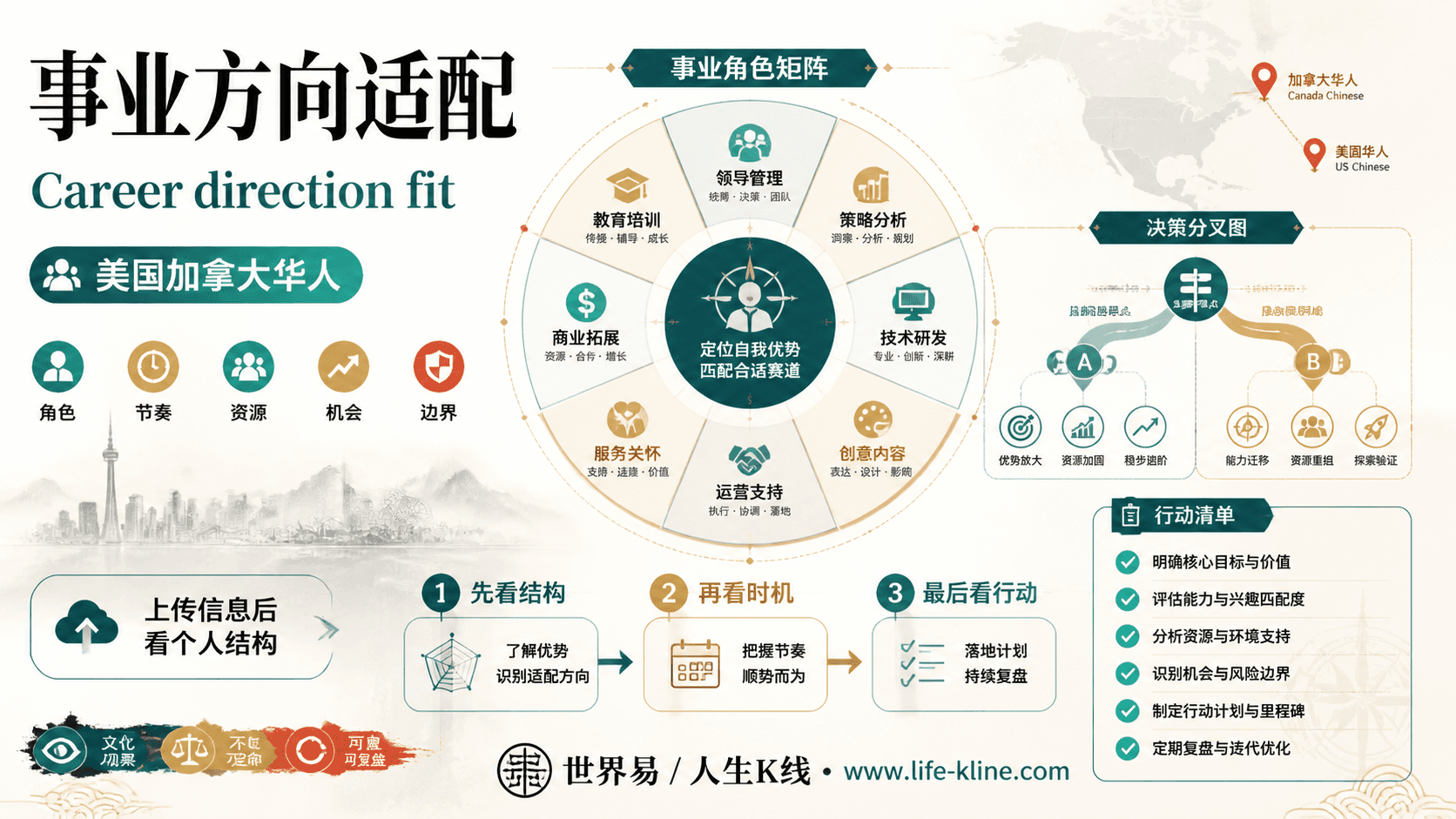
事业方向适配|美国加拿大华人
这张图把《Detailed Explanation of Zi Wei Dou Shu: Core Theories and Real Chart Case Studies》里的命理概念转成关系、边界和应用场景,适合先看图建立结构,再回到知识文章正文理解细节。
事业方向适配不应被写成固定结论。更适合美国加拿大华人的读法,是把传统术语翻译成结构、时机、环境、行动和复盘。
查看图片解读