Comprehensive Analysis of Zi Wei Dou Shu Spouse Palace: Patterns, Yong Shen, and Da Yun & Liu Nian Interpretation Guide
把这篇文章落到自己身上验证:先看结构,再进入个人分析,不做泛泛阅读。
What is the Zi Wei Dou Shu Spouse Palace
The Zi Wei Dou Shu Spouse Palace is one of the important palaces in Zi Wei Dou Shu, specifically used to reflect a person's marital status and partner relationships. The Spouse Palace reveals the harmony of married life, the partner’s personality traits, and the interaction between both parties through the configuration of the palace’s main stars and the Four Transformations (Si Hua).
Zi Wei Dou Shu originated from the combination of ancient Chinese astronomy and metaphysics, utilizing a twelve-palace system together with fourteen main stars to form a unique chart analysis method. The Spouse Palace, as one of the key palaces, is widely applied in predicting and analyzing marriage and emotional relationships.
The analysis of the Spouse Palace not only focuses on the nature of the main stars within the palace but also includes the influence of the Four Transformations (Hua Lu - Transformation of Prosperity, Hua Quan - Transformation of Authority, Hua Ke - Transformation of Merit, Hua Ji - Transformation of Adversity) and its relationships with other palaces. Through this information, one can assess the stability of the marriage, potential challenges, and auspicious or inauspicious changes.
How to Read the Zi Wei Dou Shu Spouse Palace: Core Elements
To analyze the Zi Wei Dou Shu Spouse Palace, it is first necessary to clarify the Five Elements attribute and strength of the Day Master, as the Day Master’s condition directly affects the energy foundation of the Spouse Palace. Combining this with the pattern to which the Day Master belongs allows a deeper understanding of the overall characteristics of the Spouse Palace and thus the nature of the marital relationship.
Yong Shen (favorable elements) and Ji Shen (unfavorable elements) play a regulating and balancing role in Spouse Palace analysis. Yong Shen represents the Five Elements beneficial to the Day Master and can promote harmony in the marital relationship; Ji Shen refers to elements harmful to the Day Master, which may cause emotional conflicts or setbacks. Therefore, the auspiciousness or inauspiciousness of the Spouse Palace largely depends on the strength and manifestation of Yong Shen and Ji Shen within the palace.
Da Yun (decade luck cycles) and Liu Nian (annual fortune) are important factors in the dynamic changes of the Spouse Palace. Da Yun represents the trend of overall fortune over a longer period, while Liu Nian reflects the fluctuations of fortune in specific years. By analyzing the interaction between Da Yun, Liu Nian, and the Spouse Palace, one can predict key changes and opportunities in married life.
Additionally, the configuration of the palace’s main stars and their Four Transformations should not be overlooked. Main stars such as Tian Fu (Heavenly Treasury) carry specific symbolic meanings and can reveal the partner’s personality traits and the marital atmosphere. The auspicious or inauspicious effects of the Four Transformations indicate the supporting or obstructing forces within the marital relationship.
Three Real Chart Cases
Case One involves a male aged 50-55, with a Day Master of Wu (戊, Earth), somewhat strong, belonging to the Qi Sha (Seven Killings) pattern. The Yong Shen are Wood and Water; the Ji Shen is Fire. Currently in the Ji Mao (己卯) Da Yun (ages 45-54), the Da Yun is stable and suitable for maintaining the status quo. The Liu Nian is Bing Wu (丙午), indicating adaptability in that year. The Spouse Palace reflects a certain firmness and intensity in the marriage due to the strong Day Master and Qi Sha pattern, but the harmonizing effect of the Yong Shen Wood and Water helps to soften conflicts. The stability of the Ji Mao Da Yun suggests a relatively steady marriage phase, while the changes in the Bing Wu Liu Nian advise flexible responses to spousal dynamics.
Case Two concerns a male aged 30-35, with a Day Master Yi (乙, Wood), somewhat weak, also belonging to the Qi Sha pattern. The Yong Shen is Water; the Ji Shen are Fire and Earth. He is currently in the Jia Xu (甲戌) Da Yun (ages 23-32), which is stable and suitable for maintaining the status quo. The Liu Nian is Bing Wu (丙午), indicating adaptability in that year. Due to the weak Day Master, the Spouse Palace may show traits of dependency or strong emotional needs. The guiding effect of Yong Shen Water helps nourish the relationship, but the Ji Shen Fire and Earth may bring friction or pressure. The stability of the Jia Xu Da Yun and the adaptability required by the Liu Nian suggest that during this period, attention to spousal communication and emotional management is essential to maintain harmony.
Case Three features a male aged 20-25, with a Day Master Yi (乙, Wood), somewhat strong, belonging to the Yang Ren (羊刃) pattern. The Yong Shen is Fire; the Ji Shen is Water. He is currently in the Bing Xu (丙戌) Da Yun (ages 17-26), which is auspicious, with progress in both career and wealth. The Liu Nian is Bing Wu (丙午), indicating a trend-following year. The strong Day Master and Yang Ren pattern symbolize a relatively strong and proactive personality. The Spouse Palace reflects a positive and active marital attitude. The effect of Yong Shen Fire enhances passion and motivation, while Ji Shen Water requires attention to emotional fluctuations. Both the Da Yun and Liu Nian are favorable, indicating a vibrant marital life during this phase, and following the trend can lead to good development.
Common Misconceptions
Many people mistakenly believe that the Zi Wei Dou Shu Spouse Palace solely reflects marital status and overlook its complex interactions with the Day Master’s strength, pattern, Yong Shen, and Ji Shen. In fact, the auspiciousness or inauspiciousness of the Spouse Palace is the result of multiple factors combined and should not be viewed in isolation by the palace’s main stars alone.
Another common misconception is confusing the analysis of spousal relationships between Zi Wei Dou Shu and BaZi (Four Pillars). Zi Wei Dou Shu reveals event details and relationship states through specific palaces and main stars, making it more suitable for examining concrete interactions in marriage; BaZi focuses on long-term trends and Five Elements interactions. The two systems complement rather than contradict each other.
Some analyses overly rely on Liu Nian or Da Yun as single factors, neglecting the overall pattern of the Spouse Palace and the fundamental state of the Day Master. While Da Yun and Liu Nian are important, accurate marital fortune judgments require integrating Yong Shen, Ji Shen, and the overall pattern evaluation.
Practical Suggestions
When analyzing the Zi Wei Dou Shu Spouse Palace, it is essential first to clarify the Five Elements attribute and strength of the Day Master, then conduct a comprehensive analysis combining the pattern with Yong Shen and Ji Shen. This approach enables an accurate grasp of the Spouse Palace’s energy structure and provides scientific metaphysical guidance for marital relationships.
Pay close attention to the influence of Da Yun and Liu Nian on the Spouse Palace, especially the interaction between the current Da Yun and Liu Nian. By predicting changes at key points, one can proactively adjust mindset and behavior to help resolve conflicts and challenges in marriage, promoting stable relationship development.
In practical application, it is recommended to combine the strengths of both Zi Wei Dou Shu and BaZi systems: observe the specific main stars and Four Transformations in the Spouse Palace, while also considering the long-term trends of Five Elements interactions, forming a comprehensive evaluation of marital fortune.
FAQ
What are the differences between Zi Wei Dou Shu and BaZi? Zi Wei Dou Shu uses the twelve-palace system and fourteen main stars as its framework, focusing more on depicting specific events and interpersonal relationships, such as the Spouse Palace reflecting partner conditions, the Children Palace showing the next generation, and the Travel Palace representing journeys. BaZi centers on the Five Elements’ generating and overcoming cycles, making it more suitable for analyzing long-term patterns and fortune trends. Both have their focus areas and are best used complementarily without conflict.
What does the main star Tian Fu represent in the Life Palace? The main star Tian Fu symbolizes preservation, compassion, and steadiness, often called the “Command Star.” It usually represents a solid and cautious personality. However, Tian Fu may also show tendencies toward excessive conservatism. To judge the purity or impurity of the Tian Fu pattern, one must also consider auxiliary stars (such as Zuo Fu, You Bi, Wen Chang, Wen Qu) and the influence of the Four Transformations (Hua Lu, Hua Quan, Hua Ke, Hua Ji).
What happens when Hua Ji conflicts with the Life Palace? Hua Ji represents danger, obstruction, and change. When Hua Ji clashes with the Life Palace, it often causes internal energy depletion, manifesting as emotional lows, health warnings, or self-doubt. However, this also presents an awakening opportunity, as intense emotions often become important catalysts for changing one’s destiny.
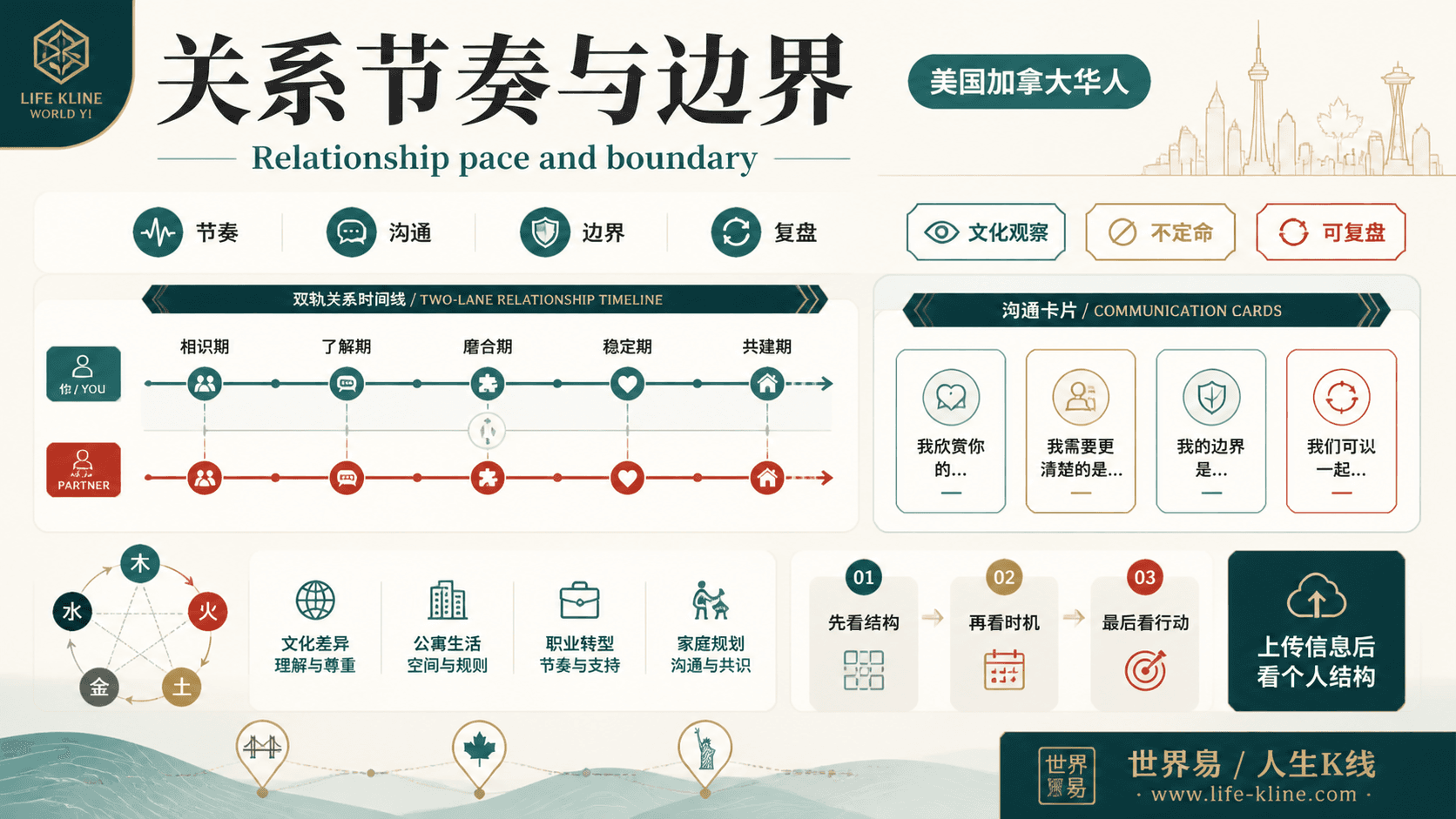
关系节奏与边界|美国加拿大华人
这张图把《Comprehensive Analysis of Zi Wei Dou Shu Spouse Palace: Patterns, Yong Shen, and Da Yun & Liu Nian Interpretation Guide》里的命理概念转成关系、边界和应用场景,适合先看图建立结构,再回到知识文章正文理解细节。
关系节奏与边界不应被写成固定结论。更适合美国加拿大华人的读法,是把传统术语翻译成结构、时机、环境、行动和复盘。
查看图片解读