Complete Guide to Office Desk Orientation Feng Shui: Metaphysical Perspectives and Practical Advice
把这篇文章落到自己身上验证:先看结构,再进入个人分析,不做泛泛阅读。
What Is Office Desk Orientation
Office desk orientation refers to the specific direction that a desk or work position faces. It is an important factor in Feng Shui that affects an individual’s career and mental state. A favorable desk orientation can guide positive qi (energy) into the workspace, enhancing concentration, creativity, and overall fortune.
Feng Shui originated in ancient China by observing the interaction between natural environments and human beings, emphasizing harmony between people and their surroundings. As a core element, office desk orientation stresses choosing suitable directions based on personal metaphysical characteristics to achieve qi balance and smooth flow.
In modern workplaces, optimizing desk orientation is not merely a traditional Feng Shui adjustment but also integrates the individual’s BaZi, including the Day Master, Yong Shen (favorable elements), and Ji Shen (unfavorable elements), scientifically guiding desk layout to promote career luck.
Therefore, selecting office desk orientation is not just about simple directional placement but a comprehensive discipline combining natural laws and personal metaphysical traits. A reasonable desk orientation helps individuals better realize their potential and attain career success and smooth progress.
How to Determine Office Desk Orientation: Core Elements
The core element in determining office desk orientation is first to consider the Day Master attribute from the BaZi (Eight Characters). The Day Master represents the person’s natal element; individuals with different Five Elements attributes suit different directions. One should select directions that generate or support the Yong Shen to strengthen one’s qi field.
Secondly, understanding the individual’s BaZi pattern and Yong Shen is necessary. The pattern reflects the overall BaZi structure, while the Yong Shen is the Five Element that balances the chart. The desk orientation should avoid Ji Shen directions to prevent qi clashes that cause work obstacles and fortune fluctuations.
The Da Yun (decade luck cycle) and Liu Nian (annual fortune) also influence desk orientation. During auspicious Da Yun and Liu Nian periods, adjusting the desk to align with the annual qi can amplify good luck; conversely, in years with heavy clashes, one should cautiously adjust to avoid negative effects.
Additionally, external environmental factors such as door and window positions, lighting, and spatial layout must be considered. Avoid placing the desk directly facing the door or mirrors, which are Feng Shui taboos, to maintain qi flow and stability.
In summary, determining office desk orientation is a comprehensive task that combines the individual’s Day Master, Yong Shen, and BaZi pattern with changes in Da Yun and Liu Nian, while also considering the actual office environment to achieve a scientific and Feng Shui integrated approach.
Three Real BaZi Case Studies
Case One is a female aged 35 to 40, with a Day Master of 丙 (Bing) Fire, which is relatively strong. Her pattern is Yang Ren (Goat Blade) pattern; her Yong Shen are Water and Metal, and Ji Shen is Wood. She is currently in the 庚午 (Geng Wu) Da Yun, which is auspicious, showing significant progress in career and wealth. According to metaphysics, her desk orientation should emphasize directions associated with Water and Metal to balance her strong Fire Day Master and avoid Wood directions, benefiting career development. The current Liu Nian is 丙午 (Bing Wu), aligning with the Da Yun. Choosing a direction with Metal and Water qi better supports the Da Yun energy, promoting smooth work.
Case Two is a female aged 40 to 45, with a Day Master of 丙 (Bing) Fire that is moderate. Her pattern is Cong Sha (Following Killing); Yong Shen are Water and Metal, and Ji Shen are Wood and Fire. She is in the 戊辰 (Wu Chen) Da Yun, which is stable and conservative. Since Fire is among her Ji Shen, her desk orientation should avoid directions with excessive Fire qi and favor Water and Metal directions to enhance the Yong Shen and improve stability. The current Liu Nian is 丙午 (Bing Wu); she should adapt flexibly by adjusting desk orientation to avoid Ji Shen directions and ensure steady career advancement.
Case Three is a female aged 20 to 25, with a Day Master of 乙 (Yi) Wood that is relatively weak. Her pattern is Bi Jian (Peer) pattern; Yong Shen is Water, and Ji Shen are Fire and Earth. She is in the 壬寅 (Ren Yin) Da Yun, which is auspicious, with improvements in career and wealth. Due to the weak Wood Day Master, her desk orientation should absorb more Water qi and avoid Fire and Earth directions to supplement Wood deficiency. The Liu Nian is 丙午 (Bing Wu) with strong Fire; special care is needed to avoid Fire directions and maintain sufficient Water qi at the desk to support smooth career development.
Common Misconceptions
Many people mistakenly believe that office desk orientation only needs to face an auspicious direction, ignoring individual metaphysical differences. In reality, different Day Masters and Yong Shen/Ji Shen require very different suitable orientations; blindly choosing may backfire.
Another misconception is neglecting changes in Da Yun and Liu Nian, assuming desk orientation is fixed. In fact, as the qi of Da Yun and Liu Nian fluctuate, desk orientation should be adjusted accordingly to align with fortune cycles for optimal results.
Some people overly rely on fixed auspicious or inauspicious directions, ignoring the importance of overall environmental layout. Although desk orientation is crucial, neglecting Feng Shui factors such as doors, lighting, and mirrors can still cause qi blockage and affect work performance.
Additionally, some think that rental environments cannot be adjusted for desk orientation and give up Feng Shui optimization. In fact, adjusting desk direction and layout does not require major changes; small reasonable adjustments can be effective. One should not abandon Feng Shui improvement possibilities due to environmental constraints.
Practical Advice
First, clarify your personal Day Master, Yong Shen, and Ji Shen from your BaZi, and consider changes in Da Yun and Liu Nian to select a suitable desk orientation. It is advisable to consult a professional BaZi practitioner for precise analysis before making adjustments to ensure scientific and targeted direction choices.
Second, in the actual office environment, avoid placing the desk directly facing the door or mirrors, avoid having beams overhead, ensure sufficient but not glaring lighting, and create a comfortable workspace with smooth qi flow. The desk should have a solid backing, symbolizing support in career.
Finally, even in short-term rented offices, pay attention to orientation adjustments and spatial arrangement. Use auxiliary items such as screens and plants to regulate qi, avoid clashes from Ji Shen directions, and help improve work efficiency and workplace fortune.
FAQ
Question 1: Should I consider Feng Shui in a rented house? Answer: Yes. Feng Shui’s influence depends mainly on the length of residence, not property ownership. Especially important are sleeping areas like bedrooms and beds, followed by work areas such as desks and office seats. Even in short-term rentals, adjusting bed orientation, avoiding beams overhead, and keeping beds away from bathroom doors can have immediate effects, improving the qi of living and working spaces.
Question 2: What are general principles for choosing office desk orientation? Answer: Desk orientation should be chosen according to personal preferred Yong Shen; there is no absolutely best direction. Generally, avoid desks facing doors or mirrors directly, avoid beams overhead, keep a supportive backing, and ensure moderate lighting and air circulation. If unsure of your Yong Shen, choosing a north-south orientation is advisable, as it aligns with Earth’s magnetic field and helps improve sleep quality and mental state, indirectly enhancing work efficiency.
Question 3: What is the Feng Shui significance of a mirror directly facing the door? Answer: In traditional Feng Shui, a mirror directly facing the door is considered to 'reflect wealth qi' away, because the qi entering the door is immediately bounced back by the mirror, preventing qi accumulation. It is recommended to move the mirror to a side wall or install a foyer curtain as a partition, which can block direct qi flow while maintaining spatial openness and aesthetics.
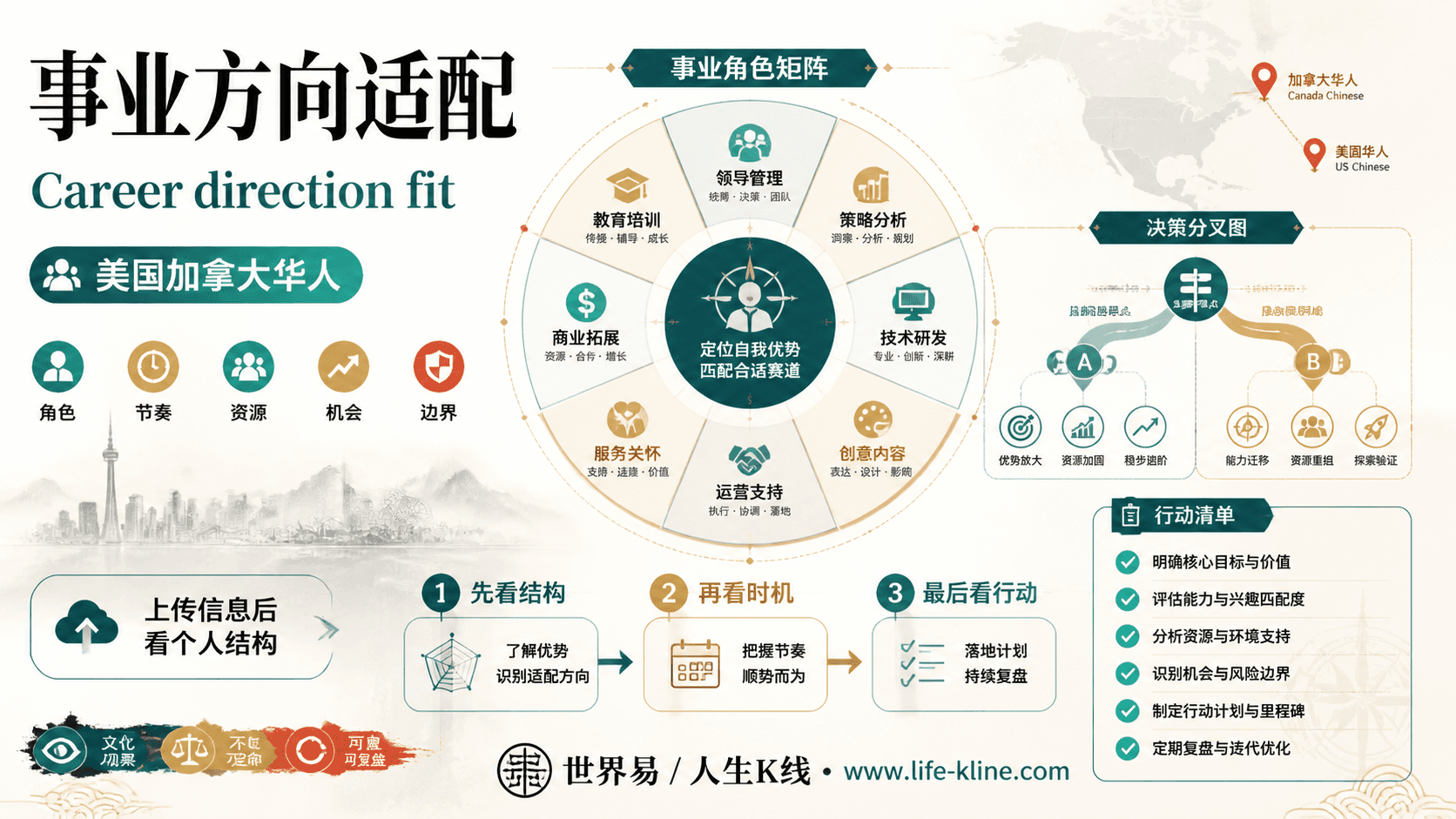
事业方向适配|美国加拿大华人
这张图把《Complete Guide to Office Desk Orientation Feng Shui: Metaphysical Perspectives and Practical Advice》里的命理概念转成关系、边界和应用场景,适合先看图建立结构,再回到知识文章正文理解细节。
事业方向适配不应被写成固定结论。更适合美国加拿大华人的读法,是把传统术语翻译成结构、时机、环境、行动和复盘。
查看图片解读