Comprehensive Interpretation of Entrance Feng Shui and Practical Guide with Real BaZi Charts
把这篇文章落到自己身上验证:先看结构,再进入个人分析,不做泛泛阅读。
What is Entrance Feng Shui
Entrance Feng Shui is one of the most important categories in Feng Shui studies, mainly referring to the main door of a residence or office and the energy layout of its surrounding environment. The entrance is the main channel for the flow of Qi (energy), regarded as the "mouth for receiving Qi," directly affecting the circulation of indoor energy and the fortune of the occupants.
The study of entrance Feng Shui originated from ancient Chinese Feng Shui, emphasizing the harmonious relationship between the environment and people. By reasonably arranging the door’s orientation, shape, and opening method, it can promote smooth Qi flow, avoid the intrusion of Sha Qi (negative energy), thereby bringing wealth, health, and family harmony.
Traditional Feng Shui believes that the door’s orientation and external factors such as roads, water flow, and buildings all influence the gathering and dispersal of Qi. Good entrance Feng Shui not only enhances the overall energy field of the residence but also improves the occupants’ mental state and quality of life, embodying the Feng Shui principle of "form and spirit combined."
How to Assess Entrance Feng Shui: Core Elements
When observing entrance Feng Shui, the first focus should be on the door’s orientation and surrounding environment. The door’s orientation should match the occupant’s BaZi (Four Pillars) favorable element (Yong Shen) to maximize the absorption of beneficial Qi. For example, those who favor Water should open toward directions with abundant water energy, while those who favor Fire should face directions with strong fire energy.
Secondly, the entrance should not directly face sharp corners, roads pointing straight at it, or mirrors reflecting directly. These situations cause Sha Qi to rush in directly, disrupting the stability of the energy field. Traditional Feng Shui recommends setting up a foyer, screen, or green plants as buffers to avoid overly rapid Qi flow, which can affect the occupant’s health and fortune.
The size of the door and the way it opens are also important factors. Doors that are too large or too small are unfavorable for Qi accumulation. The opening method should be smooth and natural to avoid obstructing the flow of Qi. Additionally, the entrance should be kept clean and bright, avoiding clutter to ensure smooth Qi circulation, enhancing family harmony and wealth luck.
Finally, decorations and colors at the entrance should be adjusted according to the occupant’s Five Elements favorable and unfavorable elements. Avoid using colors and items related to the Ji Shen (unfavorable element). For example, if the occupant’s Ji Shen is Wood, the entrance should not have excessive wooden decorations to prevent negatively impacting their fortune.
Three Real BaZi Chart Cases
Case 1: Female, aged 30-35, Day Master Bing Fire (丙, Bing) is relatively strong, with a Pian Cai (偏财, Indirect Wealth) pattern. Her Yong Shen is Water, and Ji Shen is Wood. She is currently in the Da Yun (decade luck cycle) of Bing Yin (丙寅) and the Liu Nian (annual fortune) of Bing Wu (丙午). Entrance Feng Shui should focus on supplementing the Water element and avoiding interference from Wood. If the entrance is near wooden structures or plants, it may strengthen the Ji Shen Wood’s influence, weakening the Yong Shen Water’s effect and impacting wealth luck. It is recommended to design the entrance with water-shaped decorations or blue tones, avoid wooden door frames or clustered green plants, promote water Qi flow, and enhance the Pian Cai pattern’s fortune.
Case 2: Female, aged 45-50, Day Master Xin Metal (辛, Xin) is relatively strong, with a Shi Shen (食神, Eating God) pattern. Her Yong Shen are Fire and Wood, and Ji Shen is Earth. She is currently in the Da Yun of Ji Mao (己卯) and the Liu Nian of Bing Wu (丙午). Entrance Feng Shui should emphasize strengthening the Fire and Wood energy fields and avoid excessive Earth elements. If the entrance vicinity is low-lying or has thick earth soil, it may increase the Ji Shen Earth’s influence, suppressing the Yong Shen Fire and Wood, affecting health and career. It is recommended to use red and green colors representing Fire and Wood, avoid earth tones and heavy stone materials, and keep the entrance layout smooth and bright to facilitate Qi flow.
Case 3: Male, aged 50-55, Day Master Yi Wood (乙, Yi) is relatively strong, with a Zheng Yin (正印, Proper Seal) pattern. His Yong Shen is Water, and Ji Shen is also Water. He is currently in the Da Yun of Ding Chou (丁丑) and the Liu Nian of Bing Wu (丙午). Although both Yong Shen and Ji Shen are Water, the Ji Shen Water emphasizes not having it in excess. Entrance Feng Shui should avoid overly strong Water elements to prevent energy imbalance. If there is a pond, fountain, or other water bodies near the entrance, it may cause negative effects of Ji Shen Water. It is recommended to moderately reduce Water elements at the entrance and increase Wood or Fire elements as support to balance the energy field and promote the stable development of the Zheng Yin pattern.
Common Misconceptions
Many people mistakenly believe that entrance Feng Shui only concerns the door’s orientation, neglecting the impact of the entrance environment and interior layout. In fact, entrance Feng Shui should comprehensively consider the door’s direction, size, opening method, and surrounding environment. A single factor cannot determine the overall Feng Shui quality.
Another common misconception is blindly pursuing "prosperous Qi" by overly complicating the entrance or piling up Feng Shui items. Excessive decorations can actually obstruct Qi flow and be counterproductive. The entrance should remain simple and bright, allowing natural Qi circulation to truly exert Feng Shui effects.
Some also ignore the connection between BaZi and entrance Feng Shui, blindly adjusting the entrance according to so-called Feng Shui theories without considering the occupant’s Yong Shen and Ji Shen. Feng Shui and BaZi complement each other; only by combining personal BaZi favorable and unfavorable elements can entrance Feng Shui adjustments be targeted and effective.
Practical Suggestions
When adjusting entrance Feng Shui, first clarify the occupant’s BaZi Yong Shen and Ji Shen, and arrange the entrance orientation and environment accordingly. Appropriately increase elements of the Yong Shen Five Elements, such as colors, materials, and decorations, to promote harmonious Qi flow.
Maintaining cleanliness and unobstructed flow at the entrance is crucial. Avoid clutter or obstacles to ensure smooth Qi entering indoors. If the entrance directly faces a mirror, consider adjusting the mirror’s position or setting up a foyer partition to prevent wealth Qi from reflecting outward.
Additionally, the surrounding environment of the entrance should be regularly maintained to avoid direct Sha Qi from sharp corners or roads. Appropriately planting green plants or installing screens can be both aesthetically pleasing and mitigate Sha Qi, achieving Feng Shui harmony.
FAQ
Question 1: Should Feng Shui be considered for rented houses? Answer: Feng Shui’s influence mainly depends on the length of residence rather than property ownership. Even for short-term rentals, adjusting bedroom bed orientation, avoiding beams overhead, and keeping distance from bathroom doors can immediately improve sleep quality and living energy. Therefore, Feng Shui layout is also important for rented homes.
Question 2: What is the best direction for the bed’s headboard? Answer: There is no absolute best direction; it should be adjusted based on the individual’s BaZi Yong Shen. The general principle is to avoid the headboard facing the door, bathroom wall, or directly under a beam, and to have a solid backing rather than an empty space. Without specific Yong Shen guidance, sleeping with the headboard facing north or south is generally ideal to improve sleep quality.
Question 3: Are there any Feng Shui considerations for a mirror facing the entrance? Answer: Traditional Feng Shui believes that a mirror directly facing the entrance causes "reflecting wealth Qi," where the incoming Qi is bounced back, making it difficult to retain wealth energy. It is recommended to move the mirror to a side wall or set up a foyer curtain or partition to prevent Qi from reflecting out, maintaining stable and gathered energy at the entrance.
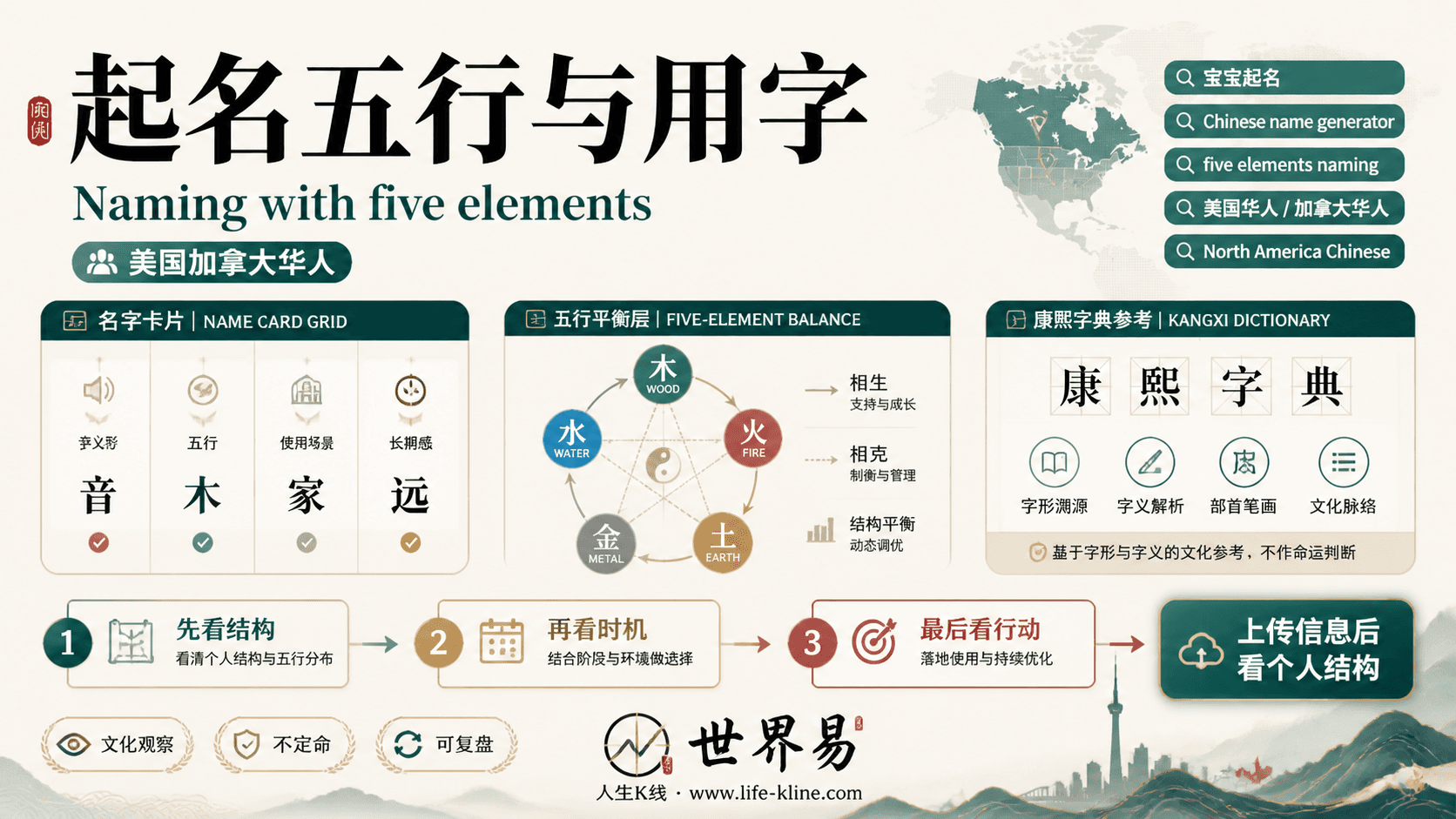
起名五行与用字|美国加拿大华人
这张图把《Comprehensive Interpretation of Entrance Feng Shui and Practical Guide with Real BaZi Charts》里的命理概念转成关系、边界和应用场景,适合先看图建立结构,再回到知识文章正文理解细节。
起名五行与用字不应被写成固定结论。更适合美国加拿大华人的读法,是把传统术语翻译成结构、时机、环境、行动和复盘。
查看图片解读