Complete Guide to Living Room Feng Shui Layout: Integration of Destiny Analysis and Practical Application
把这篇文章落到自己身上验证:先看结构,再进入个人分析,不做泛泛阅读。
What is Living Room Feng Shui Layout
Living room Feng Shui layout refers to the rational arrangement of the living room’s spatial layout, furniture placement, color coordination, and directional selection to adjust and optimize the resident’s Qi (energy) and fortune. As the main area where family members gather and receive guests, the Feng Shui quality of the living room directly reflects the overall family’s luck and harmony.
Feng Shui originated in ancient China as the study of the interaction between humans and their environment’s Qi field. The living room, as a prominent part of the residence, is regarded as a place to receive Qi, emphasizing smooth Qi flow and environmental balance. A well-designed living room layout can promote wealth, interpersonal relationships, and health.
In modern Feng Shui practice, living room layout not only considers traditional directions and shapes but also integrates contemporary interior design and personal destiny analysis. Adjustments are made based on the resident’s BaZi (Four Pillars) and their Yong Shen (favorable elements) to maximize Feng Shui effects. This approach reflects Feng Shui’s dynamic adaptability and scientific nature.
How to Analyze Living Room Layout: Core Elements
To analyze living room Feng Shui, one must first clarify the resident’s destiny pattern and Yong Shen. According to the Day Master’s strength and pattern in the Four Pillars BaZi, identify the favorable (Yong Shen) and unfavorable elements (Ji Shen), then adjust the living room’s colors, furnishings, and orientation accordingly. For example, those favoring Wood and Water should use green and blue tones and water-related decorations, while those avoiding Fire should avoid red colors and fiery elements.
Secondly, the living room entrance and Qi flow path must be unobstructed, avoiding Feng Shui taboos such as the door facing a mirror directly or beams pressing overhead. A mirror opposite the door easily reflects Qi away, causing wealth loss; it is better to place the mirror on a side wall or install a foyer curtain partition to stabilize the Qi field.
Additionally, furniture placement should have a sense of support; the sofa’s back should not be empty but backed by a solid wall, symbolizing stability and backing. The living room lighting should be bright and soft, avoiding dark corners to enhance the residents’ positive energy.
Finally, living room layout should remain flexible in response to current Da Yun (decade luck cycle) and Liu Nian (annual fortune) changes. During stable Da Yun periods, it is advisable to maintain the status quo and avoid frequent major changes; during Liu Nian fluctuations, moderate adjustments can be made to respond to external fortune shifts, achieving dynamic adaptability.
Three Real BaZi Case Studies
Case 1: The Day Master is Ji (己, Earth), relatively strong, with a Yang Ren (Yang Blade) pattern. The Yong Shen are Wood and Water, and the Ji Shen is Fire. The current Da Yun is Bing Shen (丙申), and the Liu Nian is Bing Wu (丙午). The Da Yun is stable, so maintaining the layout is recommended. For the living room, excessive use of Fire elements should be avoided. Furniture and decorations should incorporate Wood or Water elements, with green and blue as primary colors to help dissipate the Day Master’s strong Earth and harmonize the Qi field. Avoid placing fiery red items directly opposite the entrance to ensure smooth Qi flow. Adding an aquarium or green plants is suitable to enhance vitality and fortune.
Case 2: The Day Master is Xin (辛, Metal), balanced, with a Jie Cai (Rob Wealth) pattern. The Yong Shen is Earth, and the Ji Shen is Fire. The current Da Yun is Jia Wu (甲午), and the Liu Nian is Bing Wu (丙午), indicating stable fortune. The living room layout should emphasize strengthening Earth elements, such as using beige and earthy brown tones and ceramic or stone decorations. Fire colors and excessive bright firelight sources should be avoided. Furniture placement should be steady, with seating backed by a solid wall to form a strong support, which benefits wealth and interpersonal relationships. Mirrors should not face the door directly to prevent wealth leakage; installing a foyer partition or plant screen is advisable.
Case 3: The Day Master is Ding (丁, Fire), relatively weak, with a Jie Cai pattern. The Yong Shen is Wood, and the Ji Shen are Earth and Metal. The current Da Yun is Ren Wu (壬午), and the Liu Nian is Bing Wu (丙午), overall stable. The living room layout should focus on enhancing Wood elements by using green plants, wooden furniture, and teal-colored walls to boost the favorable Qi and reduce the influence of unfavorable Earth and Metal. Avoid excessive use of earth tones and metal decorations. The entrance and living room should maintain unobstructed Qi flow, with no overhead beams pressing down; bright lighting helps enhance the Fire Day Master’s vitality. The overall layout should be gentle and dynamic, matching the needs of a relatively weak Day Master.
Common Misconceptions
Many people mistakenly believe that living room Feng Shui layout only needs to follow fixed traditional directions and taboos, neglecting individual destiny differences. Feng Shui is not immutable; the Day Master’s strength and Yong Shen/Ji Shen directly influence the optimal layout plan. Ignoring destiny analysis greatly reduces the effectiveness of Feng Shui adjustments.
Another common misconception is blindly pursuing so-called “wealth-enhancing” decorations, such as placing numerous Cai Shen (God of Wealth) statues or treasure bowls, without considering overall Qi balance. Overly singular Feng Shui elements can cause Qi imbalance and obstruct smooth Qi flow.
Furthermore, the issue of mirrors facing the door is often overlooked. Many households place mirrors directly opposite the entrance, causing Qi reflection and wealth loss. Although convenient, this violates Feng Shui principles and requires reasonable adjustment.
Lastly, neglecting the impact of Da Yun and Liu Nian on Feng Shui layout, assuming once arranged it remains unchanged. In fact, changes in Da Yun and Liu Nian require timely living room layout adjustments to maintain dynamic balance and adaptability of the Qi field.
Practical Recommendations
When adjusting living room Feng Shui layout, it is recommended to first combine with one’s own BaZi to clarify the Day Master’s strength and Yong Shen/Ji Shen, selecting suitable colors and elements accordingly. For example, those with Wood and Water as Yong Shen can use more green, blue, and aquariums; those with Fire as Ji Shen should avoid red and open flames.
Secondly, keep the living room entrance Qi flow smooth, avoid mirrors directly facing the door, and if necessary, install foyer curtains or screens to prevent Qi reflection. Furniture placement should be stable and supported, with the sofa’s back not left empty to enhance security and Qi backing.
Finally, adjust the layout flexibly according to current Da Yun and Liu Nian fortunes. During stable Da Yun periods, maintain the layout and reduce major changes; if encountering unfavorable Liu Nian, appropriately adjust colors and decorations to assist the Yong Shen, enhancing the overall Qi field and family fortune.
FAQ
Question 1: Should Feng Shui be considered for rented houses? Answer: Yes. Feng Shui’s influence mainly depends on the length of residence rather than property ownership. For rented homes, especially bedroom and bed placement adjustments, such as bedhead orientation, avoiding beams pressing overhead, and keeping away from toilet doors facing the bedhead, can immediately improve the resident’s Qi and health.
Question 2: What is the best direction for the bedhead? Answer: There is no absolute best direction; the key is to determine it based on the individual’s BaZi Yong Shen. Generally, the bedhead should avoid facing the door directly, not lean against a toilet wall, not be under a beam, and have a solid backing. If the Yong Shen is uncertain, sleeping facing north or south is recommended to improve sleep quality and stabilize Qi.
Question 3: What are the Feng Shui considerations for a mirror facing the door? Answer: In traditional Feng Shui, a mirror directly facing the door is considered to reflect wealth away because the Qi entering the door is reflected back, blocking Qi from entering. It is advised to move the mirror to a side wall or install a foyer curtain or screen at the entrance to retain the mirror’s utility while preventing Qi loss.
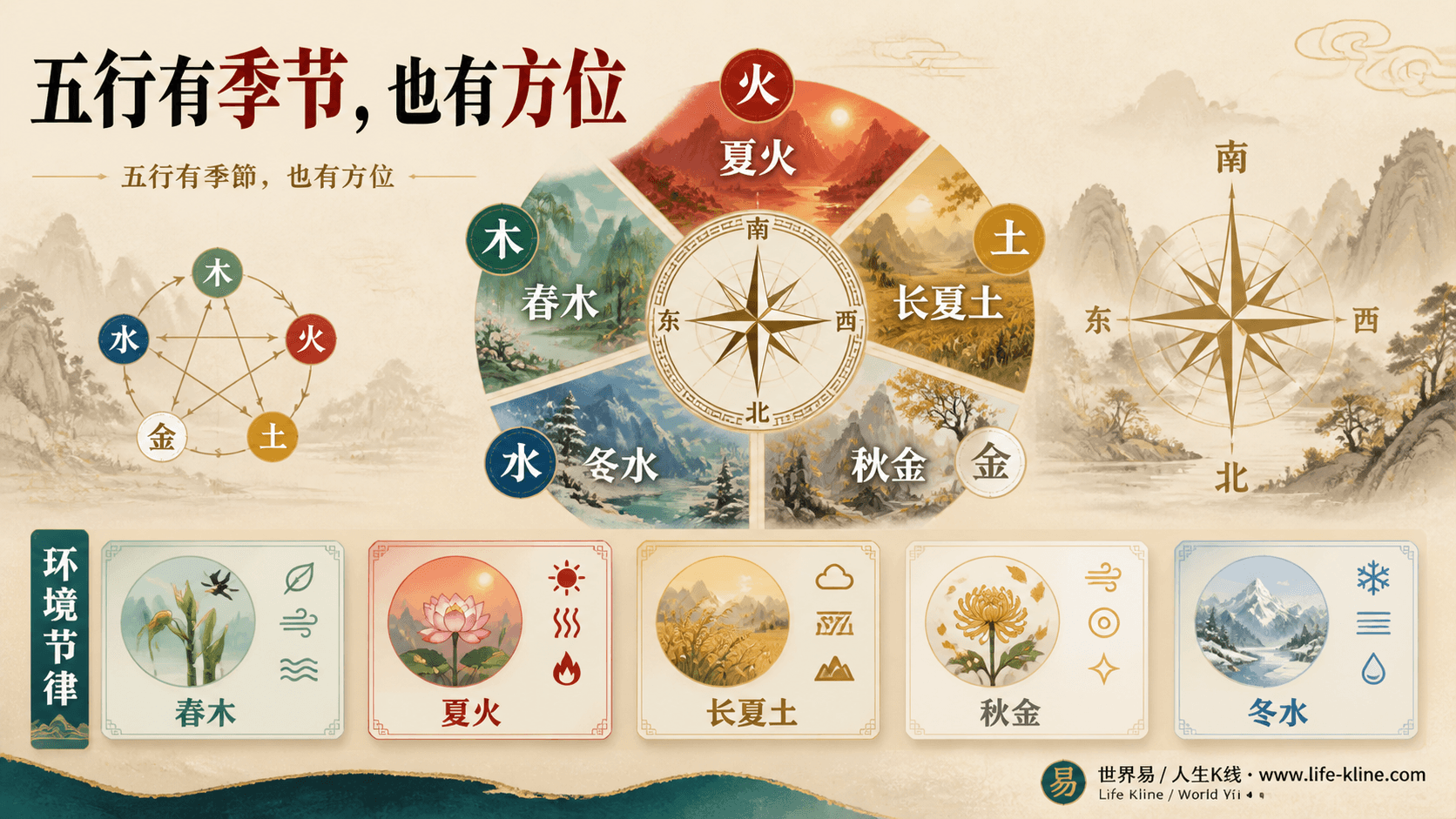
五行季节方位图
这张图把《Complete Guide to Living Room Feng Shui Layout: Integration of Destiny Analysis and Practical Application》里的命理概念转成关系、边界和应用场景,适合先看图建立结构,再回到知识文章正文理解细节。
五行理论将季节与方位作为重要参考坐标,帮助我们理解环境节律的变化。掌握这些对应关系,可为决策提供时位维度支持,而非预设结果。
查看图片解读