Complete Guide to Office Feng Shui: Optimizing Workplace Environment from a BaZi Perspective
把这篇文章落到自己身上验证:先看结构,再进入个人分析,不做泛泛阅读。
What is Office Feng Shui
Office Feng Shui is an important branch of Feng Shui studies, focusing on optimizing the office environment to promote workplace fortune and personal career development. It achieves this by adjusting the layout, orientation, and energy (Qi) of the office space, helping people improve work efficiency, interpersonal relationships, and financial luck. The theoretical foundation of office Feng Shui originates from traditional Chinese Feng Shui (Kan Yu) studies, emphasizing harmonious coexistence between humans and their environment.
Feng Shui is not merely about simple placement of items or directional choices; more importantly, it must be combined with an individual’s BaZi (Eight Characters) to find Feng Shui configurations suitable for oneself. Different BaZi patterns and Yong Shen have varying requirements for the office environment, so personalized Feng Shui adjustments can maximize positive effects.
The origin of office Feng Shui is closely related to the living and working environments of ancient Chinese scholars. With societal development, modern office Feng Shui research has become more detailed, covering aspects such as desk placement, chair orientation, lighting, and ventilation, becoming an important method to enhance workplace competitiveness.
How to Assess Office Feng Shui: Core Elements
When evaluating office Feng Shui, one must first consider the strength of the Day Master, the overall pattern, and the Yong Shen in the individual’s BaZi. The Day Master represents the person’s own Five Elements attribute; its strength determines whether certain elements need to be strengthened or suppressed. The pattern reflects the overall structure of the chart and personality tendencies. The Yong Shen is the key element to balance the chart, and the office environment should be optimized around the Yong Shen.
Secondly, the orientation and position of the office desk should be chosen according to the Yong Shen. For example, if the Yong Shen is Wood, the office area should be arranged with green plants or near wooden furniture to enhance the Wood energy; if the Yong Shen is Water, water features or blue decorations can be used as assistance. The Ji Shen (unfavorable elements) should be avoided to prevent obstruction of fortune.
The Da Yun (decade luck cycle) and Liu Nian (annual fortune) also influence office Feng Shui. Da Yun represents the ten-year trend of luck, while Liu Nian reflects yearly changes. When selecting and adjusting the office environment, one should align with the Da Yun and Liu Nian to ensure stability and adaptability, avoiding conflicts with unfavorable elements of the year.
Additionally, office Feng Shui involves factors such as door and window orientation, lighting, spatial layout, and air circulation. The entrance should not face a mirror directly to avoid reflecting away wealth energy; the desk should not have its back to the door to prevent lack of support; sufficient and soft lighting benefits concentration and health.
Three Real BaZi Case Studies
Case One is a female aged 25 to 30, with a Day Master of 戊土 (Wu Earth), slightly strong, belonging to the Qi Sha (Seven Killings) pattern. Her Yong Shen are Wood and Water, and Ji Shen is Fire. She is currently in the 10th year of the 丙子 (Bing Zi) Da Yun, with the 流年 (Liu Nian) of 丙午 (Bing Wu). Because the Day Master is slightly strong and Fire is the Ji Shen, the office Feng Shui should avoid strong Fire elements such as red decorations or intense lighting. Instead, Wood and Water elements should be increased, such as placing green plants and water cups or water features to support the Yong Shen and balance the Five Elements. The overall Da Yun is stable, so office adjustments focus on maintaining stability and comfort, avoiding excessive changes.
Case Two is a female aged 35 to 40, with a Day Master 丁火 (Ding Fire) that is slightly weak, belonging to the Shang Guan (Hurting Officer) pattern. Her Yong Shen is Wood, and Ji Shen are Earth and Metal. She is currently in the 3rd year of the 甲申 (Jia Shen) Da Yun, with the Liu Nian of 丙午 (Bing Wu). Due to the weak Day Master, the office environment should strengthen Wood energy, such as placing green plants on the desk and using wooden furniture, which helps enhance the Fire Day Master’s strength. Earth and Metal should be avoided, meaning minimal use of earth-tone colors and metal materials to prevent suppressing the Fire energy. The Da Yun is stable, so Feng Shui adjustments emphasize maintaining and adapting flexibly to improve career competitiveness.
Case Three is a male aged 55 to 60, with a Day Master 己土 (Ji Earth) slightly strong, belonging to the Qi Sha (Seven Killings) pattern. His Yong Shen are Wood and Water, and Ji Shen is Fire. He is in the 7th year of the 庚寅 (Geng Yin) Da Yun, with the Liu Nian of 丙午 (Bing Wu). With a strong Day Master and Fire as Ji Shen (direct clash), the office should avoid red colors or fire-related items such as stoves or lamps with strong fire energy. More Wood and Water elements should be used, such as potted plants and aquariums, to promote career and financial luck. The Geng Yin Da Yun is auspicious, and combined with appropriate office Feng Shui layout, it can further support career advancement.
Common Misconceptions
Many people think office Feng Shui only requires placing auspicious Feng Shui ornaments, but this is a misunderstanding of Feng Shui. Adjustments must be combined with personal BaZi; blindly placing ornaments may backfire, disrupting the Five Elements balance and affecting fortune.
Another misconception is ignoring the influence of Ji Shen in the office environment. Even if some Feng Shui layouts appear aesthetically pleasing or conform to traditional customs, if they conflict with the Ji Shen in the individual’s chart, negative effects can occur. Therefore, understanding and avoiding Ji Shen is an indispensable part of office Feng Shui.
Some believe office Feng Shui only works in spaces with long-term ownership. In fact, Feng Shui effects depend mainly on the duration of residence or work. Short-term or rented offices can also benefit from layout adjustments. Ignoring this may miss opportunities to improve workplace fortune.
Practical Recommendations
When determining office Feng Shui, it is recommended to first analyze the individual’s BaZi to clarify the Day Master’s strength, pattern, and Yong Shen, which serve as the basis for Feng Shui adjustments. According to the Yong Shen, increase the corresponding Five Elements in the layout, such as Wood, Water, Metal, Fire, or Earth, to enhance auspicious energy.
Desk placement should avoid having the back to the door or directly facing the door, ensuring a sense of support and stability. Lighting should be sufficient and soft, avoiding direct glare, while maintaining good air circulation to create a pleasant working atmosphere.
If unsure about the Yong Shen or Ji Shen, choosing a north-south orientation for the desk or bed aligns with the Earth’s magnetic field, which helps improve sleep quality and mental state. Daily office colors and decorations can be adjusted flexibly to respond to changes in Da Yun and Liu Nian, maintaining steady career development.
FAQ
Question 1: Should Feng Shui be considered for rented houses? Answer: Yes. Feng Shui’s influence depends mainly on the length of residence or work, not property ownership. Especially for sleeping areas like bedrooms and beds, which greatly affect health and fortune, followed by work areas such as desks and office seats. Even in short-term rentals, adjusting bed orientation, avoiding beams overhead, and keeping beds away from bathroom doors can quickly bring positive Feng Shui effects.
Question 2: What is the best direction for the bed head? Answer: There is no absolute best direction; the key is to align with the individual’s favorable (Yong Shen) elements in their BaZi. However, some general principles include not placing the bed head directly facing the door, not near bathroom walls, not under beams, and having a solid backing behind the bed head. If the Yong Shen is unknown, a north-south orientation is recommended as it aligns with the Earth’s magnetic field and improves sleep quality and health.
Question 3: Is there any Feng Shui consideration for a mirror facing the door? Answer: Traditional Feng Shui holds that a mirror directly facing the door causes “reflection of wealth energy,” meaning the incoming Qi is reflected back, making it difficult to accumulate wealth energy. Solutions include moving the mirror to a side wall or placing a screen curtain at the entrance to block direct reflection. This maintains spatial aesthetics while effectively retaining wealth energy and enhancing overall Feng Shui.
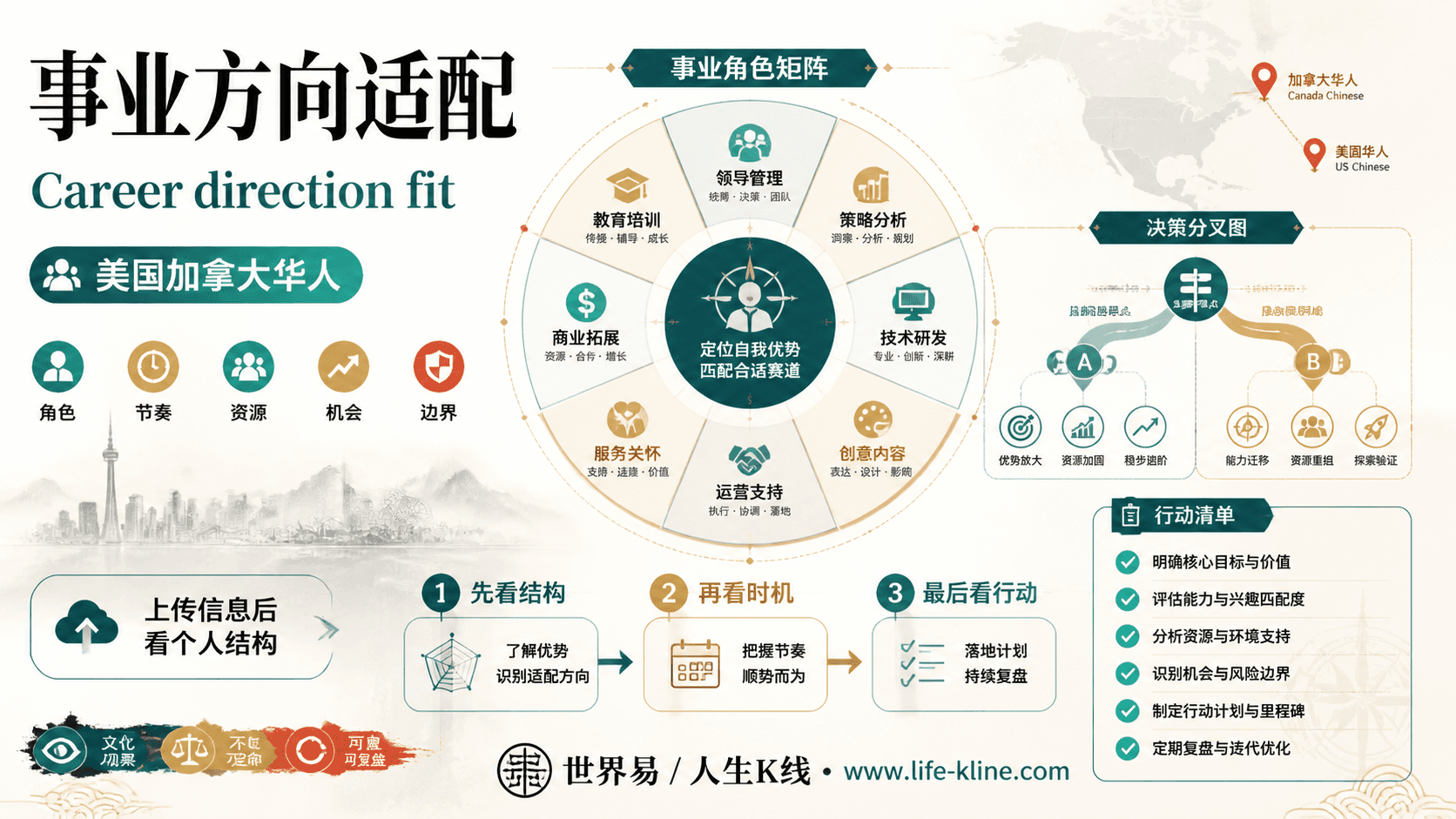
事业方向适配|美国加拿大华人
这张图把《Complete Guide to Office Feng Shui: Optimizing Workplace Environment from a BaZi Perspective》里的命理概念转成关系、边界和应用场景,适合先看图建立结构,再回到知识文章正文理解细节。
事业方向适配不应被写成固定结论。更适合美国加拿大华人的读法,是把传统术语翻译成结构、时机、环境、行动和复盘。
查看图片解读