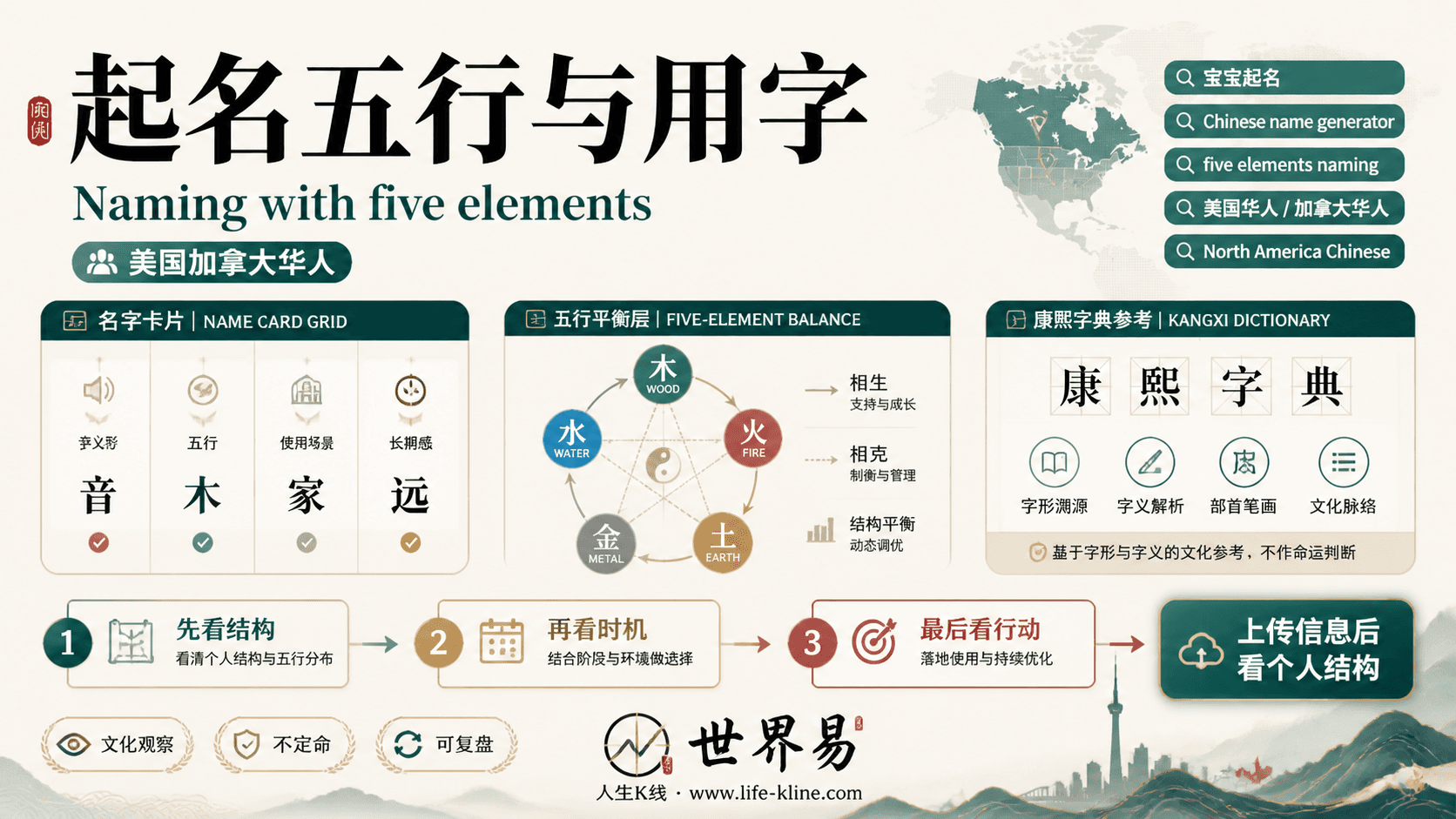
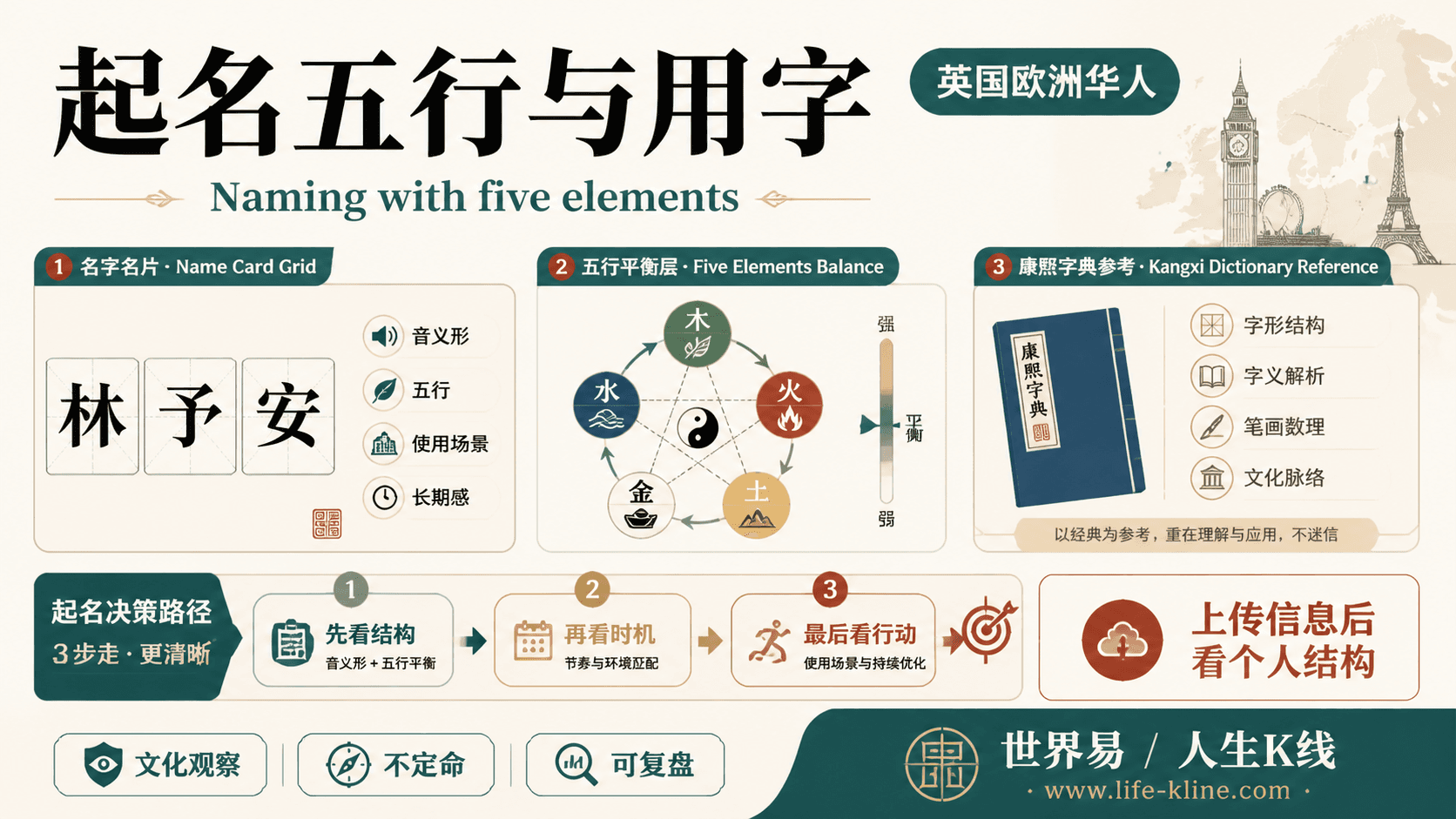
Complete Guide to Baby Naming: Using Metaphysics to Support Your Child’s Future Development
把这篇文章落到自己身上验证:先看结构,再进入个人分析,不做泛泛阅读。
What Is Baby Naming
Baby naming is the process by which parents select an appropriate name for their newborn. A name not only carries beautiful wishes but is traditionally believed in metaphysics to be closely related to a person’s fortune. Naming reflects cultural heritage and embodies hopes for the child’s future life, health, and career.
In traditional Chinese name studies, name selection is often combined with BaZi (Four Pillars) metaphysics, analyzing the baby’s year, month, day, and hour pillars (Heavenly Stems and Earthly Branches) to determine the Day Master’s strength and the Five Elements’ favorable and unfavorable aspects. This helps supplement the needed Five Elements to balance Yin and Yang.
Baby naming considers not only the auspiciousness of character strokes but also the pronunciation, recognizability, and cultural meaning. It avoids overly common names or those prone to ambiguity. A suitable name can boost the child’s confidence and reduce unnecessary obstacles in life.
With the integration of modern science and traditional metaphysics, baby naming has become more rational and systematic. Proper metaphysical analysis provides a basis for naming, making names more personalized and targeted, which benefits the child’s growth and development.
Therefore, baby naming is not a simple combination of characters but a comprehensive art that integrates culture, metaphysics, and psychology, laying a solid foundation for the child’s life.
Core Elements in Baby Naming
The core of baby naming lies in combining BaZi analysis. First, confirm the baby’s Day Master’s Five Element and strength, which determines the direction of elemental supplementation in the name. For example, a strong Day Master requires restraint or balance, while a weak one needs strengthening of the lacking elements.
Second, the pattern type determines the choice of Yong Shen (favorable element) and Ji Shen (unfavorable element) in naming. Yong Shen is the element needed to supplement the chart, while Ji Shen is the element to avoid. The name should emphasize adding Yong Shen elements and reducing Ji Shen elements to achieve Five Element balance.
The stroke count and numerology of the name are also important, considering the auspiciousness of the Tian Ge (Heavenly Grid), Ren Ge (Personality Grid), Di Ge (Earth Grid), Zong Ge (Total Grid), and Wai Ge (Outer Grid). Auspicious numerology enhances positive energy and promotes stable and improved fortune.
Additionally, the name’s pronunciation should be smooth, avoiding unpleasant homophones or difficult pronunciations, improving readability and memorability. The name should avoid excessive popularity to prevent loss of individuality.
Finally, naming should avoid the names of elders in the family to show respect and prevent confusion. The name should conform to cultural customs, carry positive meanings, and reflect the parents’ good wishes for the child.
Three Real BaZi Chart Cases
Case 1: This female baby’s Day Master is Ji (己, Earth), with a relatively strong Day Master. The pattern is Pian Yin (偏印) pattern, with Yong Shen being Earth and Ji Shen being Fire. The current Da Yun is Geng Zi (庚子), with stable fortune, suitable for maintaining achievements. Naming should enhance Earth elements and avoid Fire Five Elements to help consolidate the Day Master Earth’s strength, thereby stabilizing fortune and health. Characters with Earth imagery or Earth attributes can be appropriately chosen, while avoiding excessive Fire attributes to prevent depletion of the Day Master.
Case 2: This female baby’s Day Master is Bing (丙, Fire), relatively weak. The pattern is Zheng Guan (正官) pattern, with Yong Shen being Wood and Ji Shen being Earth and Metal. The current Da Yun is Xin Hai (辛亥), with weaker fortune, requiring caution. Naming should focus on supplementing Wood Five Elements to strengthen the Day Master Fire’s supportive energy, while avoiding Earth and Metal characters. By reinforcing Yong Shen Wood in the name, the vitality of the chart improves, helping to enhance fortune and boost confidence.
Case 3: This male baby’s Day Master is Ren (壬, Water), relatively strong. The pattern is Yang Ren (羊刃) pattern, with Yong Shen being Fire and Ji Shen being Metal. The current Da Yun is Bing Shen (丙申), with stable fortune, suitable for maintaining achievements. Naming should emphasize supplementing Fire Five Elements to restrain the strong Ren Water Day Master, preventing imbalance caused by excessive Water, while avoiding Metal characters. Appropriately increasing Fire attributes in the name helps regulate Five Element balance, making fortune more stable and smooth.
Common Mistakes
Many parents mistakenly believe that a name alone can directly change destiny. In reality, a name is only an auxiliary tool and cannot completely alter the metaphysical chart by itself. The role of a name is to form a positive energy field through frequent use, assisting the Day Master’s development.
Some parents neglect the BaZi Five Elements matching and randomly choose popular or pleasant-sounding characters, resulting in names with unbalanced Five Elements or clashing with the Day Master, which negatively affects the child’s fortune and causes unnecessary obstacles.
Others focus solely on the aesthetic or meaning of the characters, ignoring numerological auspiciousness and Five Element attributes. Such names may bring unfavorable effects in real life and fail to produce positive influence.
Having too many people with the same name is also a common problem. Popular names can cause children to lack individuality and recognizability in groups, even causing embarrassment or trouble. It is best to avoid trendy names that lead to name duplication.
Practical Suggestions
When naming a baby, it is recommended to first have a professional metaphysics consultant analyze the baby’s Four Pillars BaZi, confirm the Day Master’s strength, pattern, Yong Shen and Ji Shen, and clarify which Five Elements should be supplemented or avoided in the name for scientific naming.
The name’s stroke count should follow auspicious numerology principles, selecting favorable combinations while ensuring harmonious and beautiful phonetics, easy writing and pronunciation, and avoiding misreading or negative homophones.
Naming should avoid repeating the names of parents or elders, respect family culture, and avoid overly popular names to ensure uniqueness and individuality, making the child easier to recognize and remember in groups.
FAQ
Question 1: Can changing a name really change one’s fortune? Answer: A name itself cannot directly change fortune, but through continuous use, writing, and calling, it forms a “frequency imprint.” When the original name conflicts with the natal BaZi (e.g., inauspicious stroke count, missing Five Elements, or clashing with the Day Master), changing to a name that supplements the Five Elements and aligns with numerology can assist the natal trend. The new name must be used consistently in important contexts for over a year to show effects.
Question 2: What should be paid attention to when naming a baby? Answer: First, avoid trendy names that result in many children sharing the same name, such as multiple classmates with identical names. Second, avoid the names of elders in the family to show respect. Third, combine BaZi to supplement the Five Elements and choose characters with appropriate Yong Shen. The stroke count should consider the auspiciousness of Tian Ge, Ren Ge, Di Ge, Zong Ge, and Wai Ge. Finally, the name should be easy to read and write, and not prone to teasing.
Question 3: How to specifically supplement Five Elements in naming? Answer: First, determine the Day Master’s Five Element strength and Yong Shen/Ji Shen through BaZi. Then select characters containing the Yong Shen Five Elements and avoid Ji Shen elements. For example, if the Day Master is weak and needs Wood, the name should include characters with Wood attributes to help strengthen the Day Master. Conversely, Ji Shen characters should be avoided to prevent negative effects on the chart.
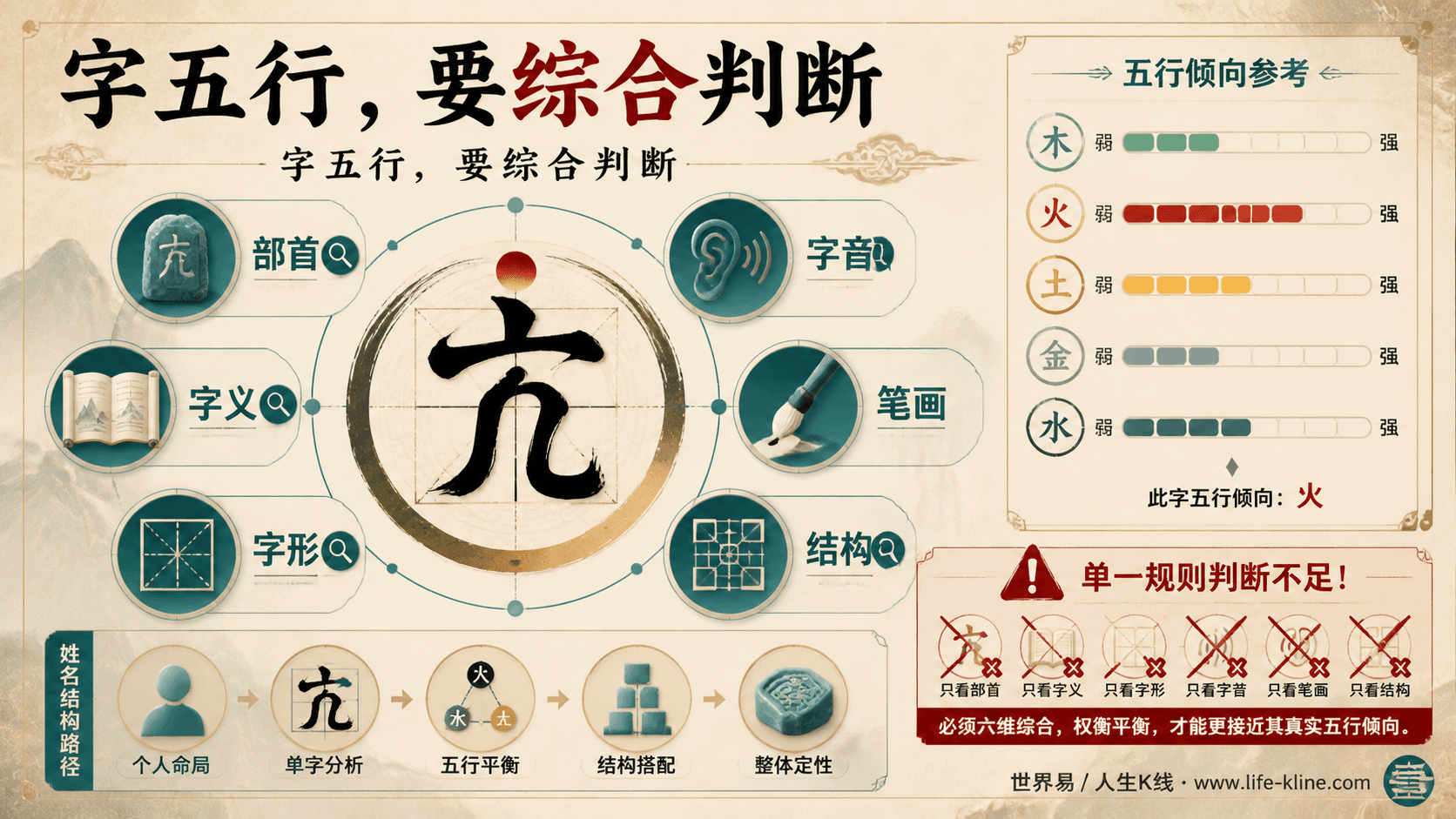
字的五行判断方法图
这张图把《Complete Guide to Baby Naming: Using Metaphysics to Support Your Child’s Future Development》里的命理概念转成关系、边界和应用场景,适合先看图建立结构,再回到知识文章正文理解细节。
字的五行属性需置于多维框架中观察。部首、字义、字形、字音、笔画与整体结构共同构成判断依据,避免简化归因,注重时位与环境适配。
查看图片解读