In-Depth Analysis and Practical Guide to Changing Names and Five Elements Metaphysics
把这篇文章落到自己身上验证:先看结构,再进入个人分析,不做泛泛阅读。
What Is Changing Names
Changing names involves replacing characters in a personal name to adjust the Five Elements attributes of the name, aiming to assist in balancing or remedying deficiencies in the Five Elements within one’s metaphysical chart. As an important symbol for social interaction and self-identity, the Five Elements attributes of a name are traditionally believed to subtly influence an individual’s fortune.
Historically, changing names has a long tradition in Chinese culture. Many celebrities, emperors, or common people have changed their names due to metaphysical needs, taboos, or social changes. Modern name studies are based on BaZi (Eight Characters) metaphysics, combining the Five Elements numerology of Tian Ge (Heavenly Grid), Di Ge (Earthly Grid), Ren Ge (Personality Grid), Wai Ge (Outer Grid), and Zong Ge (Total Grid) to conduct scientific naming and renaming practices.
Changing names is not a simple character replacement but a careful selection of characters and strokes that supplement the Five Elements based on the individual’s Day Master strength, Yong Shen (favorable element), and Ji Shen (unfavorable element) in their BaZi chart. This approach not only avoids Five Elements clashes but also leverages the frequency effect of the name in daily life to assist fortune.
Modern metaphysics emphasizes the continuity and environmental compatibility of changing names. A suitable name needs to be used consistently in important social contexts over time to form a stable 'frequency imprint,' thereby influencing personality aura and external interactions, helping to improve deficiencies in the BaZi chart.
How to View Changing Names: Core Elements
The core of changing names lies in combining the individual’s BaZi chart to accurately assess the Day Master’s strength and the required Yong Shen Five Elements. The Day Master represents the individual’s own Five Elements attribute; its strength determines which elements need to be supplemented or restrained. Yong Shen is the most needed element to support in the chart, while Ji Shen is the element that should be avoided or weakened.
Secondly, understanding the individual’s pattern type is crucial. Different patterns such as Yang Ren (Goat Blade) pattern or Bi Jian (Peer) pattern represent different personality traits and fortune trends. When changing names, one must consider the pattern characteristics to avoid introducing conflicting Five Elements, ensuring the name interacts positively with the BaZi chart.
The Five Elements of a name come not only from stroke numerology but also from the meaning and phonetic Five Elements attributes of the characters. A comprehensive consideration of the Five Elements configuration of Tian Ge, Ren Ge, Di Ge, Wai Ge, and Zong Ge is essential. Selecting characters and strokes that supplement Yong Shen and suppress Ji Shen is a key operational step in changing names.
Additionally, changing names should be combined with the current Da Yun (decade luck cycle) and Liu Nian (annual fortune) status. Da Yun represents the ten-year fortune trend, and Liu Nian the annual fortune. A reasonable name change should align with the interaction of Da Yun and Liu Nian to enhance favorable factors and reduce adverse influences, achieving stable fortune.
Three Real BaZi Case Studies
Case One is a female aged 35-40, with a Day Master of Xin (辛, Metal) that is relatively strong, and her pattern is Yang Ren (Goat Blade) pattern. Her Yong Shen are Fire and Wood, and Ji Shen is Earth. She is currently in the Ren Shen (壬申) Da Yun (31-40 years old), a stable period suitable for consolidation, with the Liu Nian being Bing Wu (丙午). When changing her name, priority should be given to increasing the Fire and Wood elements while avoiding strengthening Earth, which helps her steadily develop during the current Da Yun and improves her ability to cope with changes in the Liu Nian.
Case Two is a male aged 40-45, with a Day Master of Geng (庚, Metal) that is relatively weak, and his pattern is Bi Jian (Peer) pattern. His Yong Shen is Earth, and Ji Shen are Water and Wood. He is currently in the Yi Hai (乙亥) Da Yun (41-50 years old), which is an unfavorable period requiring caution against major changes. The Liu Nian is also Bing Wu (丙午). When changing his name, emphasis should be placed on supplementing Earth and suppressing Water and Wood to strengthen the Day Master, helping him resist the adverse effects of the unfavorable Da Yun and enhancing overall risk resistance.
Case Three is a male aged 35-40, with a Day Master of Ji (己, Earth) that is relatively strong, and his pattern is Yang Ren (Goat Blade) pattern. His Yong Shen are Wood and Water, and Ji Shen is Fire. He is currently in the Yi Chou (乙丑) Da Yun (35-44 years old), a fortunate period with progress in career and wealth, and the Liu Nian is Bing Wu (丙午). When changing his name, Wood and Water elements should be increased while suppressing Fire, aligning with the auspicious Da Yun atmosphere to further promote steady improvement in career and wealth and to follow the trend of the Liu Nian.
Common Misconceptions
Many people mistakenly believe that changing a name can immediately change their destiny. In fact, the name itself cannot directly alter fate; rather, the name’s Five Elements attributes interact energetically with the original BaZi chart over time. The effect of a name change requires consistent use in daily life to gradually manifest and is not immediately visible.
Additionally, overemphasizing auspicious numerology while neglecting the match with the BaZi Five Elements is a common error. Although numerological auspiciousness is important, if the name’s Five Elements conflict with the Day Master or strengthen the Ji Shen, it may cause fortune fluctuations or adverse effects.
Some also ignore the influence of Da Yun and Liu Nian on name changes. Blindly changing names without considering the current fortune cycle may miss the optimal timing to enhance fortune or may reinforce unfavorable factors. Therefore, scientific renaming must integrate dynamic Da Yun and Liu Nian assessments.
Finally, practical factors such as ease of reading and writing, cultural connotations, and avoiding overly common names are often overlooked. A good name should balance metaphysical considerations with practical usability to maximize its effectiveness.
Practical Suggestions
Before changing a name, a comprehensive BaZi analysis must be conducted to accurately determine the Day Master’s strength, Yong Shen, and Ji Shen, combined with pattern characteristics to clarify which Five Elements should be supplemented or suppressed. Only then can the name’s Five Elements be scientifically selected to avoid blind imitation.
When selecting characters, besides their Five Elements attributes, attention should be paid to stroke numerology to ensure coordination among Tian Ge, Ren Ge, Di Ge, Wai Ge, and Zong Ge, achieving a dual balance of numerology and Five Elements. Additionally, the name should be easy to read and write, melodious in pronunciation, and avoid obscure characters or ambiguous meanings.
After changing the name, it is recommended to use it consistently in important social contexts for at least one year to form a stable 'frequency imprint,' allowing the name’s Five Elements energy to operate subconsciously and in the external environment. Coordinating with the current Da Yun and Liu Nian and following the fortune trend will better assist destiny development.
FAQ
Question 1: Can changing a name really change one’s fortune? Answer: The name itself cannot directly change fate, but because it is continuously used and called in daily life, it forms a 'frequency imprint.' When the original name’s Five Elements conflict with the BaZi chart, adopting a name that supplements the Yong Shen and has reasonable numerology can assist in improving fortune trends. The changed name needs to be used consistently in important occasions for over a year to gradually show effects.
Question 2: What should be considered when naming a baby? Answer: When naming a baby, avoid following trends that cause many people to have the same name, avoid names tabooed by elders, and supplement the baby’s Yong Shen Five Elements based on their BaZi. Also, consider the numerology of Tian Ge, Ren Ge, Di Ge, Wai Ge, and Zong Ge to ensure auspiciousness. The name should be easy to read and write and avoid names that may lead to unpleasant nicknames, balancing practicality and metaphysical harmony.
Question 3: How to combine Da Yun and Liu Nian when changing names? Answer: Name changes should consider the individual’s current Da Yun and Liu Nian status, aligning with the luck trends to supplement Yong Shen and suppress Ji Shen, enhancing favorable luck and mitigating adverse effects. For example, during an unfavorable Da Yun, more caution is needed in selecting the name’s Five Elements to avoid exacerbating negative factors. Following the fortune trend maximizes the effectiveness of the name change.
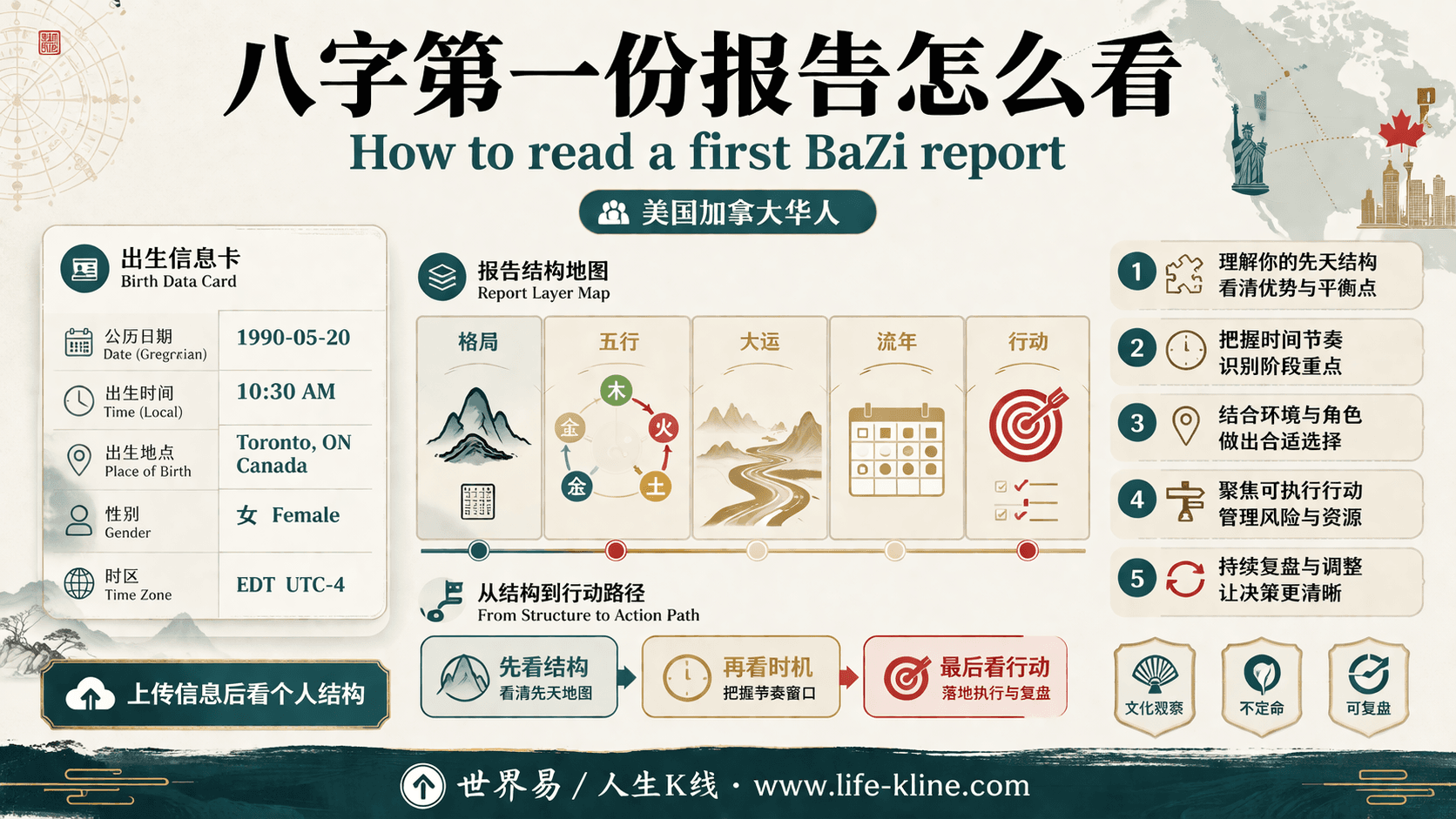
八字第一份报告怎么看|美国加拿大华人
这张图把《In-Depth Analysis and Practical Guide to Changing Names and Five Elements Metaphysics》里的命理概念转成关系、边界和应用场景,适合先看图建立结构,再回到知识文章正文理解细节。
八字第一份报告怎么看不应被写成固定结论。更适合美国加拿大华人的读法,是把传统术语翻译成结构、时机、环境、行动和复盘。
查看图片解读