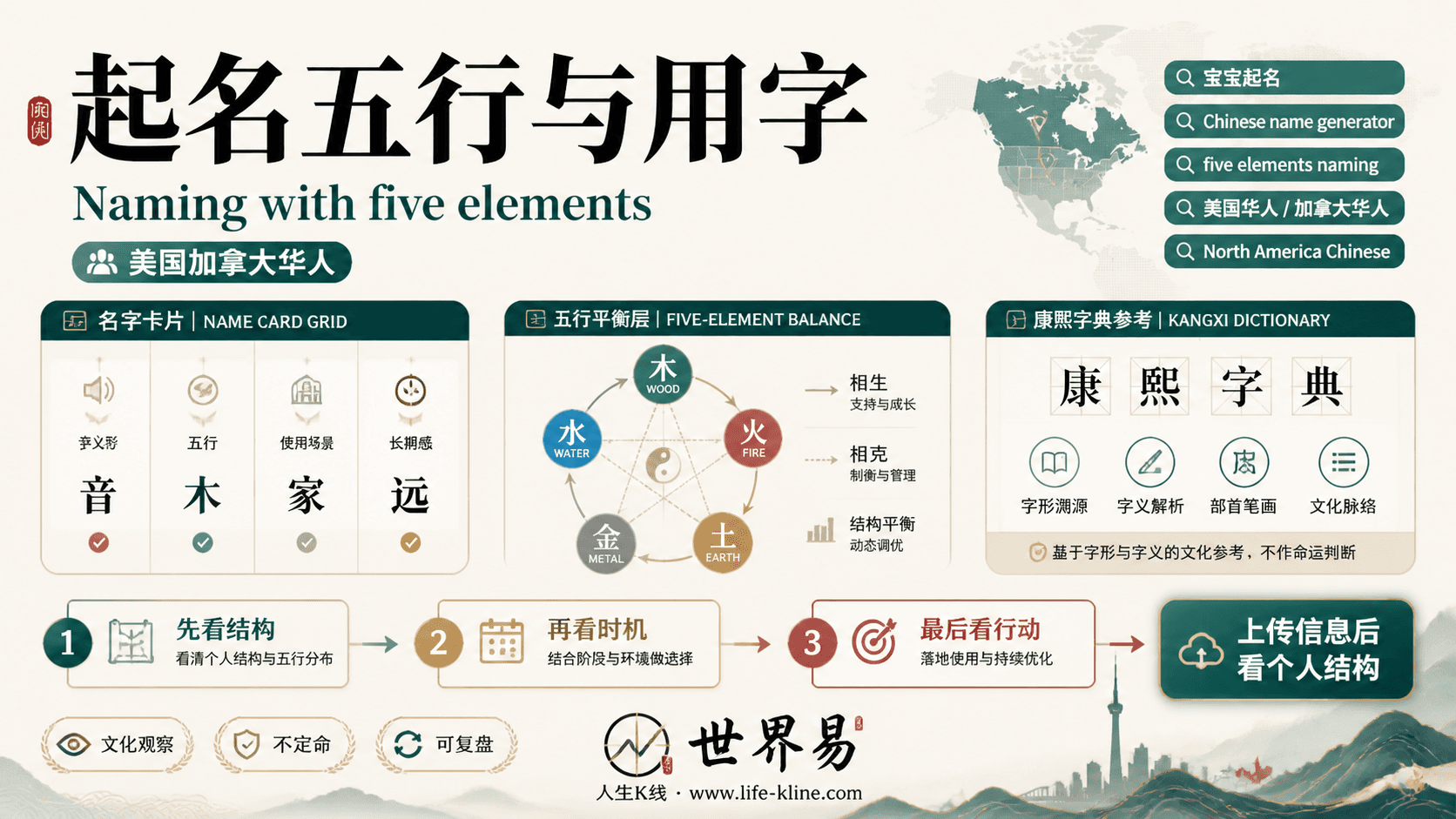
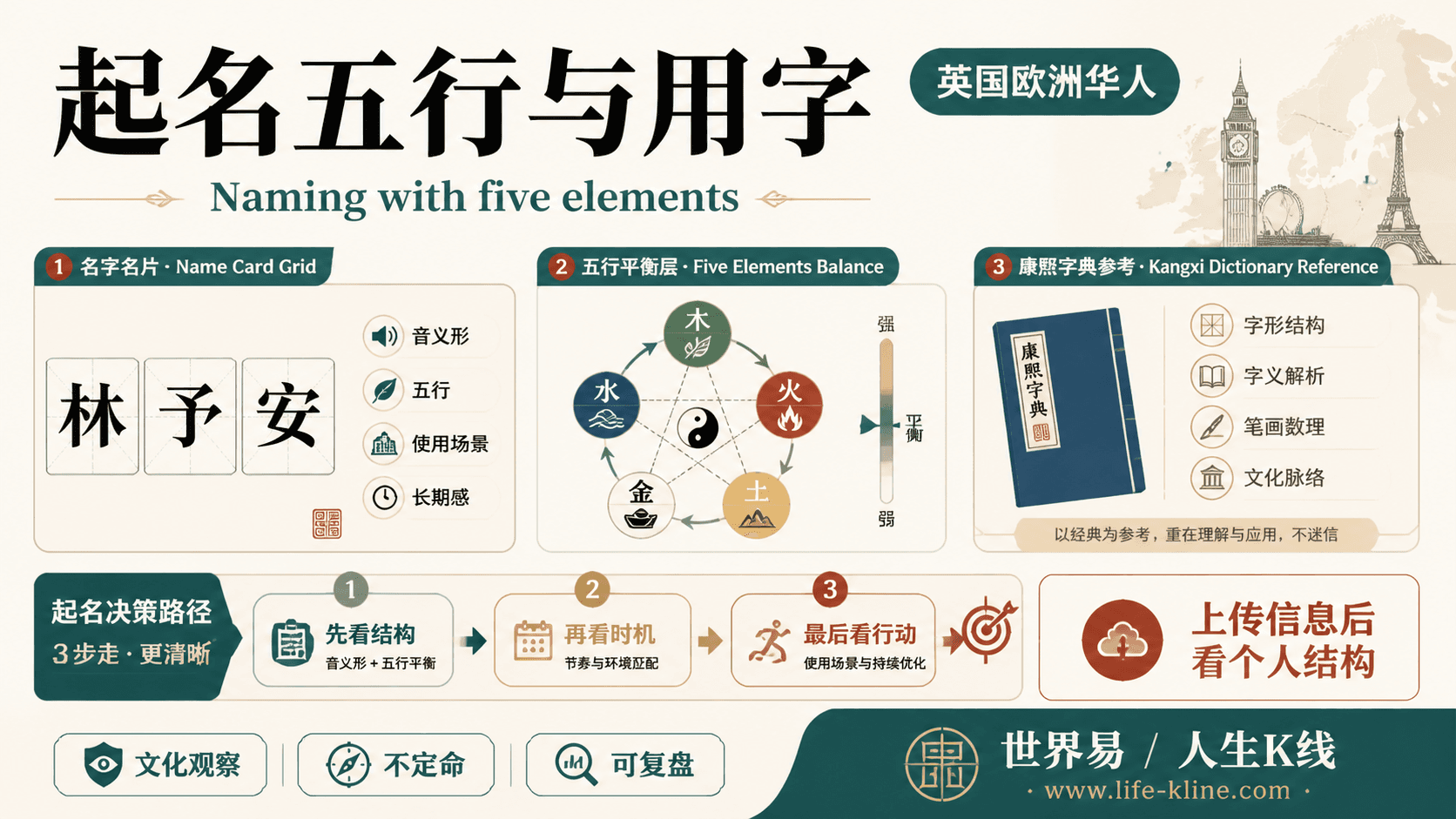
Complete Guide to Name Stroke Counts and Their Integration with Destiny Analysis
把这篇文章落到自己身上验证:先看结构,再进入个人分析,不做泛泛阅读。
What Are Name Stroke Counts
Name stroke counts refer to the number of strokes in each Chinese character that makes up a person's name. In traditional Chinese name studies, stroke counts are not merely the form of writing but carry the Five Elements attributes and numerological meanings. Through the combination of stroke counts, one can reflect the auspiciousness, inauspiciousness, and changes in fortune of a name.
The origin of name stroke counts can be traced back to ancient Chinese character culture. Ancients believed that the structure of Chinese characters corresponds to the cosmic Five Elements, and the numerological relationships of stroke counts are closely related to an individual's destiny. A good combination of name stroke counts requires balancing the Five Elements, avoiding extreme偏颇 (imbalance), and achieving yin-yang harmony.
In name studies, stroke count numerology is divided into different layers such as Tian Ge (Heavenly Grid), Di Ge (Earthly Grid), Ren Ge (Personality Grid), Wai Ge (External Grid), and Zong Ge (Total Grid), representing respectively the innate background, family environment, personal character, external interpersonal relations, and overall fortune. Each stroke count numerology has its unique auspicious or inauspicious meaning, and reasonable combinations can enhance personal fortune.
Name stroke counts not only potentially influence aspects such as career, health, and relationships but also form a 'frequency imprint' through frequent writing and calling, subtly affecting the person's psychology and environment. Therefore, choosing appropriate name stroke counts has practical significance and value.
How to Interpret Name Stroke Counts: Core Elements
The first step in examining name stroke counts is to combine them with the individual's BaZi (Four Pillars), especially clarifying the Five Elements attribute and strength of the Day Master. The strength of the Day Master determines the direction of Five Elements supplementation in the name stroke counts. For a weak Day Master, the Yong Shen (favorable element) should be strengthened; for a strong Day Master, the Ji Shen (unfavorable element) needs to be controlled.
Name stroke counts must consider the numerological auspiciousness of Tian Ge, Ren Ge, Di Ge, Wai Ge, and Zong Ge. Tian Ge represents innate qualities, Di Ge symbolizes the growth environment, Ren Ge concerns personal fortune, Wai Ge relates to interpersonal relationships, and Zong Ge reflects overall destiny. Each grid’s stroke count numerology must comply with the metaphysical principle of Five Elements harmony.
Yong Shen (favorable elements) and Ji Shen (unfavorable elements) are important guiding principles in configuring name stroke counts. The Yong Shen Five Elements should be reinforced in the name, while the Ji Shen Five Elements should be avoided or weakened. By combining stroke count numerology with the Five Elements, the name can help balance deficiencies or excesses in the BaZi’s Five Elements, assisting the person to avoid misfortune and attract good luck.
Additionally, the influence of Da Yun (decade luck cycles) and Liu Nian (annual fortune) on the person's luck should not be overlooked. The auspicious or inauspicious nature of Da Yun and the changes in Heavenly Stems and Earthly Branches of Liu Nian indicate how name stroke counts should be flexibly adjusted over time to ensure the Five Elements ratio in the name complements the current fortune, maximizing its effectiveness.
Three Real BaZi Case Studies
Case One involves a female aged 50-55, with a 丁火 (Ding Fire) Day Master that is relatively strong. Her chart shows a Yang Ren pattern, with Yong Shen being Water and Ji Shen being Wood. Her current Da Yun is 己丑 (Ji Chou), representing a stable period suitable for maintaining achievements. Regarding name stroke counts, emphasis should be placed on supplementing the Water element and suppressing Wood influence, avoiding increasing strokes associated with the Ji Shen Wood. By reasonably distributing the Five Elements attributes of the strokes, the balance of the 丁火 Day Master can be maintained, supporting stable fortune development.
Case Two is a male aged 35-40, with a 己土 (Ji Earth) Day Master that is relatively strong, showing a Qi Sha (Seven Killings) pattern. His Yong Shen are Wood and Water, and Ji Shen is Fire. He is currently in the 辛卯 (Xin Mao) Da Yun, which is auspicious, with progress in career and wealth. The choice of name stroke counts should emphasize the Wood and Water elements to reinforce the Yong Shen and weaken the Ji Shen Fire influence. This approach aligns with the favorable trend of the current Da Yun and promotes further career and financial improvement.
Case Three concerns a female aged 40-45, with a 癸水 (Gui Water) Day Master that is relatively weak, exhibiting a Zheng Guan (Proper Authority) pattern. Her Yong Shen is Metal, and Ji Shen are Wood and Fire. She is in the 壬午 (Ren Wu) Da Yun, which is stable and suitable for maintaining achievements. The name stroke counts should focus on enhancing the Metal element and reducing strokes related to Wood and Fire, helping to compensate for the deficiency of the 癸水 Day Master and strengthen the advantages of the Zheng Guan pattern. A reasonable numerological configuration of strokes will help stabilize and improve her overall fortune, forming a positive cycle with the stable Da Yun.
Common Misconceptions
Many people mistakenly believe that simply changing name stroke counts can completely alter their destiny. In reality, name stroke counts are only auxiliary factors in metaphysics and cannot replace the fundamental information of the BaZi. Changing a name must be combined with the Yong Shen and Ji Shen of the natal BaZi; modifying stroke counts without considering metaphysics may backfire.
Another misconception is blindly pursuing numerologically auspicious stroke counts while ignoring the balance of the Five Elements and the coordination with Da Yun and Liu Nian. Auspicious numerology that does not align with the person’s Yong Shen may bring adverse effects, so comprehensive consideration is necessary.
Some also neglect the ease of reading and writing the name and its social adaptability, overly pursuing complex or rare characters, resulting in names that are difficult to write or recognize, which can negatively impact daily life and career development. Reasonable name stroke counts should balance usability and metaphysical requirements.
Finally, the effectiveness of name stroke counts requires time to accumulate. If the new name is not used consistently, it is difficult to form an effective 'frequency imprint.' Therefore, after changing the name, it should be used in important occasions for at least one year to gradually manifest its metaphysical auxiliary effects.
Practical Recommendations
When selecting name stroke counts, first precisely analyze the individual’s BaZi to clarify the strength of the Day Master, Yong Shen, and Ji Shen, ensuring the stroke numerology effectively supplements the Yong Shen Five Elements and suppresses the Ji Shen Five Elements. This fundamentally harmonizes the Five Elements in metaphysics and enhances the name’s auxiliary role.
Secondly, the Tian Ge, Di Ge, Ren Ge, Wai Ge, and Zong Ge stroke counts must be comprehensively considered. It is important not only to pursue auspicious numerology but also to ensure the balance and coordination of the Five Elements, avoiding extreme偏颇. The name should be simple and easy to read, facilitating writing and memory, thereby improving convenience in life and social interactions.
Finally, after changing the name, it should be consistently used in important life occasions for over one year to form a stable 'frequency imprint,' allowing the Five Elements attributes of the name to gradually integrate into the person’s fortune environment and exert real auxiliary effects. Meanwhile, adjusting the naming strategy in response to changes in Da Yun and Liu Nian ensures the name and fortune optimize synchronously.
FAQ
Question 1: Can changing a name really change one’s fortune? Answer: A name itself cannot directly change destiny, but the stroke counts and Five Elements attributes of a name create a 'frequency imprint' through continuous writing and calling, influencing the person’s aura and environment. When the original name’s stroke numerology conflicts with the natal BaZi’s Five Elements, especially clashing with the Day Master or lacking the Yong Shen, reasonable supplementation and adjustment of Five Elements in the new name can assist the person’s fortune. The new name must be used consistently in important occasions for at least one year to show effects.
Question 2: What should be considered when naming a baby? Answer: Naming should avoid chasing trends that cause high name duplication rates, ensuring uniqueness and recognizability; avoid names identical to elder family members, respecting family traditions; combine the baby’s BaZi Five Elements to reasonably supplement the Yong Shen and balance the Five Elements; consider the auspiciousness of Tian Ge, Ren Ge, Di Ge, Wai Ge, and Zong Ge stroke counts; the name should be pleasant in pronunciation and easy to write, avoiding names prone to teasing or negative nicknames.
Question 3: How do name stroke counts correspond to the Five Elements? Answer: The Five Elements attributes of name stroke counts are determined based on traditional numerological Five Elements classifications in name studies. Different stroke counts correspond to different Five Elements attributes. The specific allocation method should be adjusted according to classical name study theories and the individual’s BaZi Yong Shen. By reasonably matching the Five Elements of stroke counts, one can supplement the Yong Shen or suppress the Ji Shen, optimizing the person’s Five Elements balance and improving fortune.
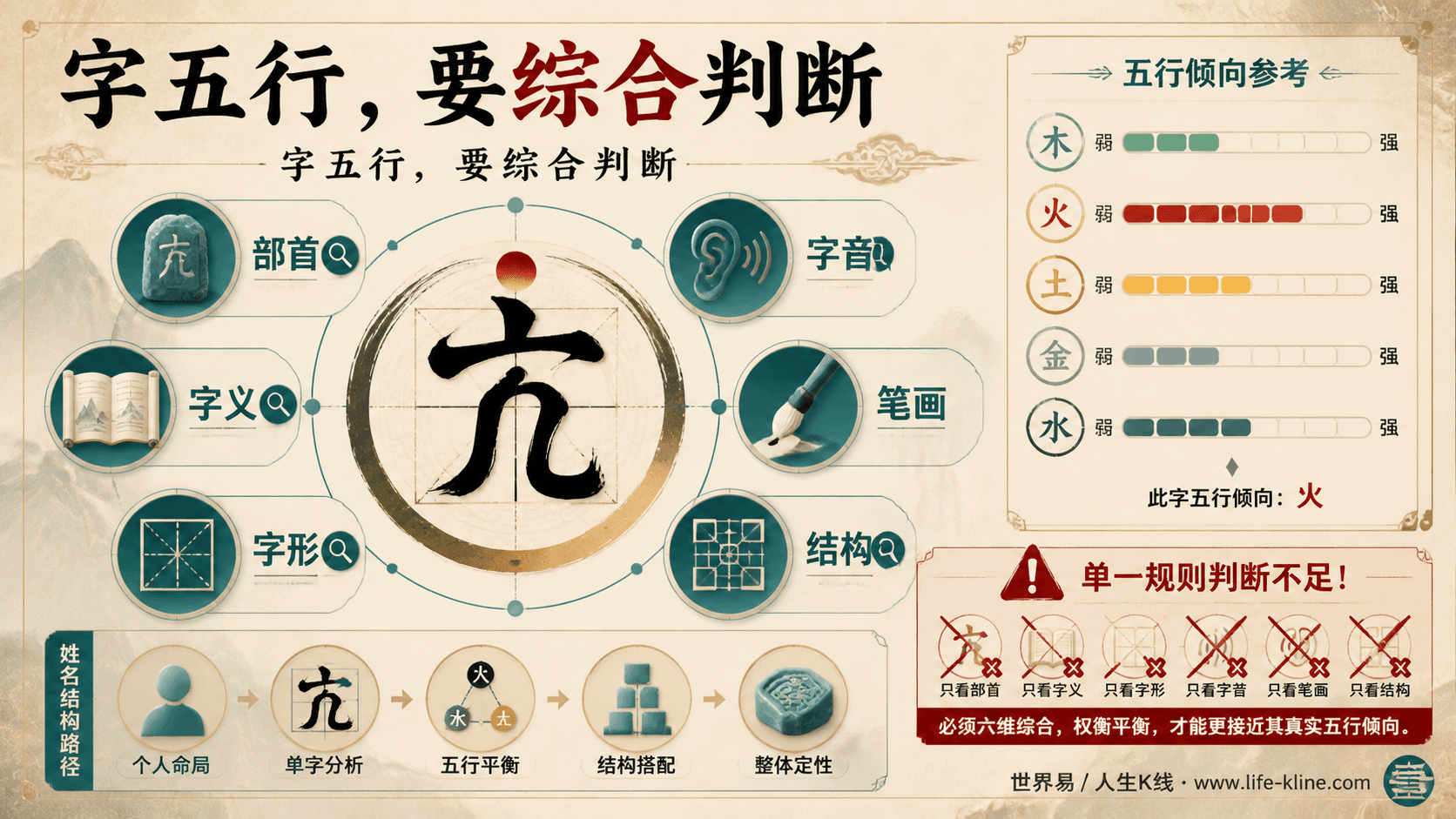
字的五行判断方法图
这张图把《Complete Guide to Name Stroke Counts and Their Integration with Destiny Analysis》里的命理概念转成关系、边界和应用场景,适合先看图建立结构,再回到知识文章正文理解细节。
字的五行属性需置于多维框架中观察。部首、字义、字形、字音、笔画与整体结构共同构成判断依据,避免简化归因,注重时位与环境适配。
查看图片解读