Analysis of He-Chong (Combination-Clash) Relationships and Exclusive Agreement Risks in Partnerships
先看完案例关键信息,再进入分析页验证自己的结构与阶段。
Client Background
The client is a woman in her thirties, at a critical stage of career development, involving close cooperation with upstream and downstream enterprises. She is currently facing an important decision—whether to sign an exclusive binding agreement with partners upstream and downstream, which is crucial for her business expansion and risk control. On the family front, the client leads a stable life but feels concerned about future career risks, especially potential He-Chong issues within the partnership.
At present, the client hopes to clarify the nature of her relationship with the partners through BaZi analysis, focusing particularly on whether a He-Chong (combination-clash) relationship exists between both parties. This will help scientifically assess the risks of the exclusive agreement and avoid uncontrollable conflicts and losses arising from cooperation. She aims to find a practical solution that ensures stable cooperation while circumventing potential contradictions.
BaZi Chart Structure Interpretation
The client’s Day Master is Geng Metal (庚金, Geng), which is relatively weak. This suggests she may exhibit a certain softness and caution in cooperation, lacking overly strong dominance. The chart is primarily of the Bi Jian (比肩) pattern, indicating a degree of self-competitive awareness and peer cooperation spirit. However, due to the weak Day Master, she needs to rely on Yong Shen Earth to stabilize her own energy, strengthening the foundation and stability of her career.
Yong Shen is Earth, symbolizing being down-to-earth and the ability to maintain stability. In cooperation, this suggests the client should focus on a steady and practical cooperation model, avoiding excessive risk-taking. Ji Shen are Water and Wood; Water represents flow and variability, while Wood implies movement and conflict. The presence of these two elements may exacerbate instability in cooperation, so caution is required when dealing with cooperation conditions or counterpart characteristics involving Water and Wood attributes.
Currently, the client is in the 5th year of the Ding Hai (丁亥) Da Yun, a phase generally tending towards stability, favoring maintaining rather than large-scale changes. The Liu Nian (annual fortune) is Bing Wu (丙午), which brings some adaptability but does not recommend aggressive actions. The interaction between Da Yun and Liu Nian suggests the client should maintain stability while flexibly responding to changes, especially leaving room for flexibility in cooperation agreements.
Focused Issue Assessment
Regarding the client’s main concern about the He-Chong relationship with the counterpart, the BaZi analysis should focus on the Five Elements interaction and the Heavenly Stems and Earthly Branches (干支) combinations and clashes between both parties. From the client’s chart perspective, the presence of Ji Shen Water and Wood warns that if the counterpart has strong Water or Wood attributes, it may form clashes that lead to tension or escalating conflicts of interest.
Exclusive binding agreements in partnerships often involve resource monopolization and concentrated power. If the counterpart’s Five Elements are strong in Water and Wood, they will restrict the client’s Yong Shen Earth, weakening her ability to stabilize the foundation and causing opposition of interests or cooperation obstacles. At this time, the counterpart should be regarded as a potential He-Chong party in the partnership, requiring preemptive risk assessment and prevention.
Considering the current Ding Hai Da Yun and Bing Wu Liu Nian characteristics, the client is in a phase to maintain stability. However, the adaptability brought by the Liu Nian indicates possible sudden situations in cooperation. Especially if the counterpart and client have He-Chong relations, conflicts may be amplified. It is recommended that the client include reasonable risk-sharing and exit mechanisms in the cooperation agreement to avoid unfavorable situations.
Recommended Actions and Timing
First, the client should thoroughly understand the counterpart’s Five Elements attributes, especially their main Heavenly Stems and Earthly Branches structure, to determine if there is a strong presence of Ji Shen Water and Wood. If the counterpart shows obvious Water and Wood tendencies, the client should cautiously advance the exclusive binding agreement or include flexible clauses in the contract to prevent intensified conflicts.
Second, aligning with the Ding Hai Da Yun’s stability characteristic, the current period is most suitable for steady cooperation advancement, avoiding aggressive expansion and high-risk gambles. The client should focus on consolidating the cooperation foundation over the next one to two years, optimizing the cooperation model to ensure balanced interests and prevent tensions caused by He-Chong relationships from escalating.
Third, the Bing Wu Liu Nian grants the client certain adaptability. It is advised that when encountering cooperation conflicts, the client flexibly adjusts strategies, employing non-confrontational communication and negotiation methods to actively seek win-win solutions. Especially in future Liu Nian, the client should pay attention to interactions between Da Yun and Liu Nian changes, timely adjusting cooperation strategies to avoid being dragged down by He-Chong relationships.
Review and Reminders
He-Chong relationships in partnerships often conceal risks, particularly when exclusive agreements bind upstream and downstream parties, easily leading to disputes over interests. BaZi analysis indicates the client should prioritize steady maintenance, avoiding rushing for success or blindly rejecting partners, to prevent cooperation breakdown caused by emotional decisions.
Additionally, caution is needed regarding strong Water and Wood factors during cooperation, which may manifest not only in the counterpart’s chart but also in contract terms and external environments. Making good use of timing, combined with Da Yun and Liu Nian trends, and timely adjusting cooperation strategies are key to preventing He-Chong risks.
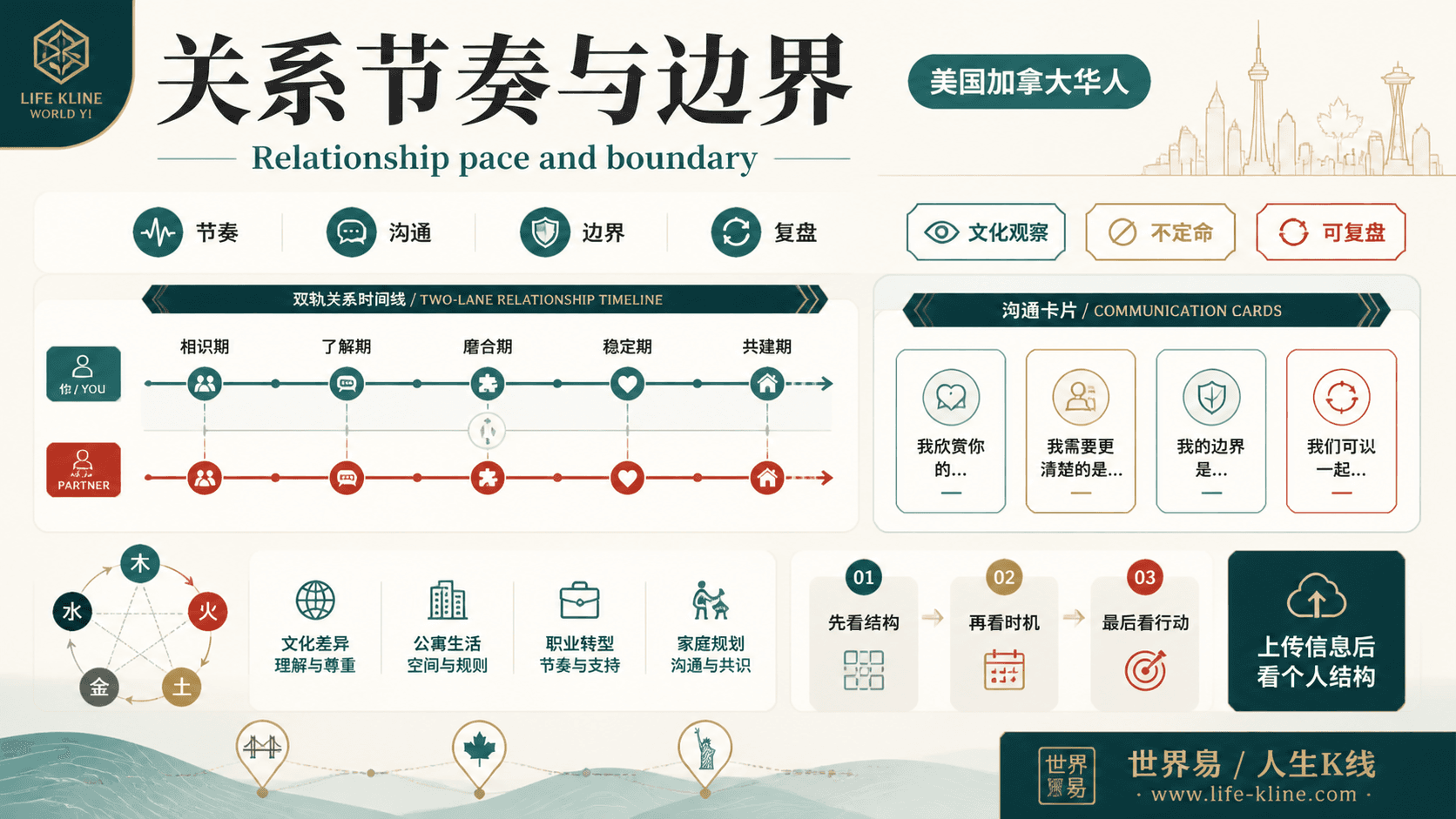
关系节奏与边界|美国加拿大华人
这张图把《Analysis of He-Chong (Combination-Clash) Relationships and Exclusive Agreement Risks in Partnerships》里的命理概念转成关系、边界和应用场景,适合先看图建立结构,再回到案例正文理解细节。
关系节奏与边界不应被写成固定结论。更适合美国加拿大华人的读法,是把传统术语翻译成结构、时机、环境、行动和复盘。
查看图片解读