Analysis and Decision Guidance on He-Chong (Combination-Clash) Relationships in Partnerships and Cooperation
先看完案例关键信息,再进入分析页验证自己的结构与阶段。
Client Background
The client is a female aged between thirty and thirty-five, currently at a crucial stage of career development. She is engaged in financial management-related work and is recently facing negotiations over an important customer contract. The contract terms have undergone significant concessions, causing her hesitation and uncertainty about whether to sign the contract to ensure career stability and growth.
On the family front, the client needs to balance family responsibilities with career pursuits, experiencing considerable pressure recently, especially concerns about the stability of cooperative relationships. She hopes to gain deeper insights into the He-Chong relationship with the partner through her BaZi chart analysis to make wiser decisions and avoid risks associated with cooperation.
BaZi Chart Structure Interpretation
The client's Day Master is Wu Earth (戊土, Wu), which is relatively strong, forming a Pian Cai (偏财, indirect wealth) pattern. Her Yong Shen (favorable elements) are Wood and Water, while Ji Shen (unfavorable element) is Fire. This structure indicates that her financial luck and cooperation relationships are closely connected and sensitive to the harmony of Wood and Water energies; excessive Fire element may cause obstacles and conflicts in her career.
Currently, she is at the initial stage of the Bing Xu (丙戌, Bing Fire - Xu Earth) Da Yun (decade luck cycle), which is relatively weak, suggesting that she needs to exercise particular caution during this period and avoid rash decisions. The Liu Nian (annual fortune) is Bing Wu (丙午, Bing Fire - Wu Fire), where Fire energy remains strong. The combination with the Da Yun results in an overall weaker fortune, indicating many unfavorable factors in the current environment and the need to guard against hidden risks in cooperation.
Focused Issue Judgment
Regarding the He-Chong (combination-clash) relationship between the partner and the client, from a BaZi perspective, the client's Pian Cai pattern emphasizes the importance of cooperation and resource exchange, but the influence of Ji Shen Fire warns of possible conflicts and frictions in the partnership. Especially in the Bing Wu Liu Nian, the excessive Fire energy easily triggers misunderstandings and disputes, increasing cooperation risks.
The core of the He-Chong relationship lies in whether the partner's attributes intensify the client's Ji Shen Fire influence. If the partner belongs to the Fire element or stimulates Fire energy, disputes and instability are likely, and the significant concessions in the contract may conceal the partner's strong stance or unfavorable conditions. Conversely, if the partner is of Wood or Water element, which supports the client's Yong Shen, the cooperation has greater potential and stability.
Considering the relatively weak Da Yun status at this moment, it is strongly recommended that the client avoid rashly signing the contract during this phase. Particularly when the contract terms involve major concessions, vigilance is needed to ensure the partner is not exploiting the instability of the He-Chong relationship to gain greater benefits at the expense of the client's long-term interests.
Recommended Actions and Timing
Based on the BaZi analysis of the He-Chong relationship, it is advised that the client first clarify the partner's Five Elements attributes, especially whether Fire characteristics are present, as a key factor in assessing cooperation risks. If the partner's Fire element is evident, signing should be postponed, seeking to adjust contract terms or explore alternative solutions to mitigate the impact of the Ji Shen Fire.
Regarding timing, the client is advised to remain cautious during the remainder of the Bing Wu Liu Nian, avoiding major decisions. Waiting until the next Liu Nian or Da Yun phase, when Fire influence diminishes, to reevaluate the cooperation possibility is preferable. This approach helps reduce conflicts and losses caused by the He-Chong relationship.
Additionally, during this period, the client should strengthen support for her Yong Shen Wood and Water elements, such as improving the working environment or adjusting cooperation modes, to enhance the nurturing forces in her BaZi chart, increase resilience against clashes, and improve negotiation leverage, creating more favorable conditions for future cooperation.
Review and Reminders
He-Chong relationships in cooperation often conceal dual factors of interests and conflicts. The client must be wary of impulsive decisions driven by emotions or pressure. The influence of Ji Shen Fire reminds her to maintain calmness during negotiations and avoid being swayed by the partner's strong attitude.
Moreover, while BaZi analysis offers valuable guidance, it should not be solely relied upon. Practical contract details and legal risks are equally important. The client should integrate BaZi advice with professional legal counsel to make rational judgments and avoid long-term consequences of blind signing.
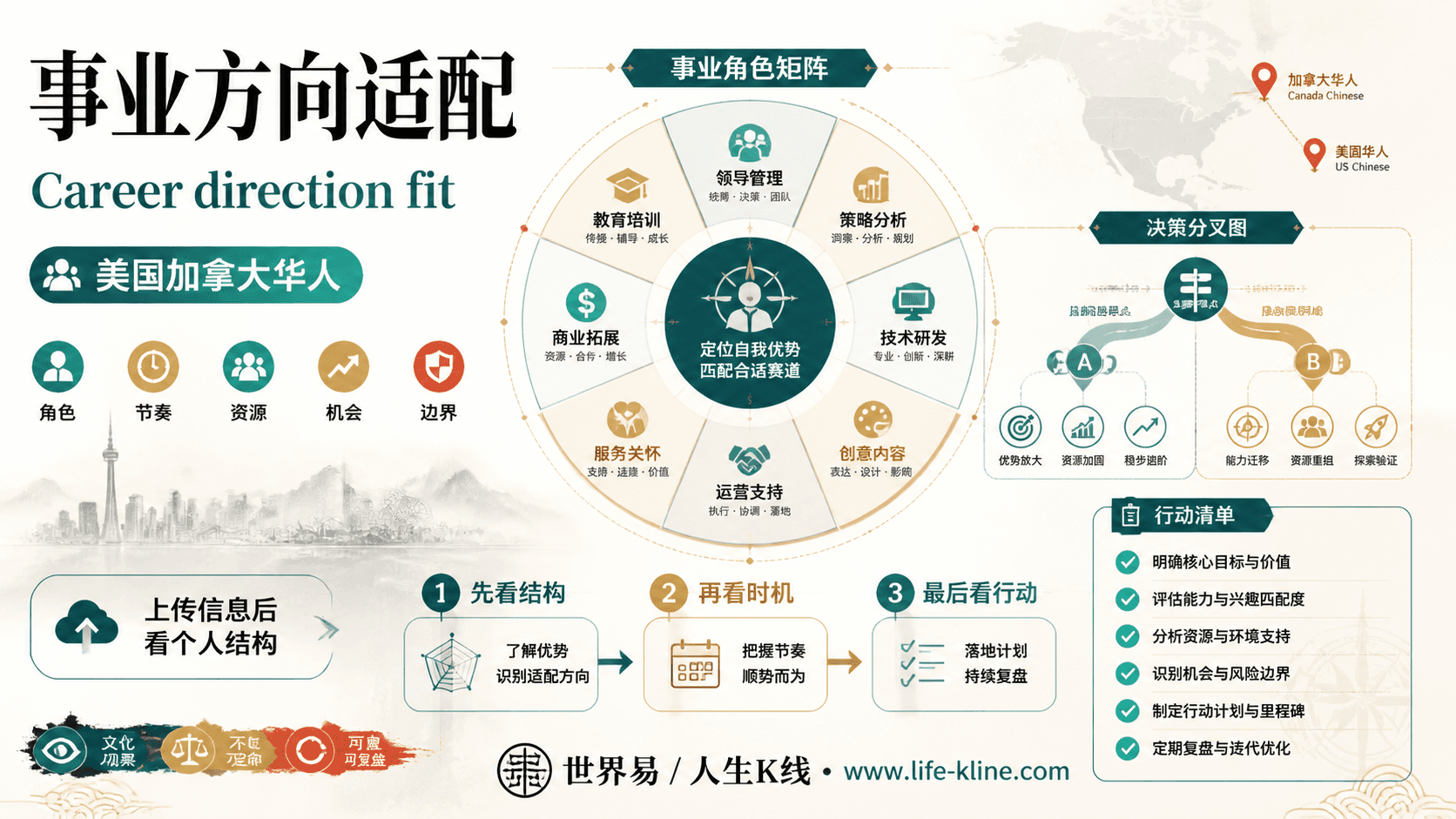
事业方向适配|美国加拿大华人
这张图把《Analysis and Decision Guidance on He-Chong (Combination-Clash) Relationships in Partnerships and Cooperation》里的命理概念转成关系、边界和应用场景,适合先看图建立结构,再回到案例正文理解细节。
事业方向适配不应被写成固定结论。更适合美国加拿大华人的读法,是把传统术语翻译成结构、时机、环境、行动和复盘。
查看图片解读