Risk Analysis of Exclusive Upstream-Downstream Binding Agreements in Partnerships with He-Chong (Combination-Clash) Relationships
先看完案例关键信息,再进入分析页验证自己的结构与阶段。
Client Background
The client is a female entrepreneur in her 50s who has long been deeply involved in the upstream and downstream segments of the manufacturing industry. Recently, she faced a situation where her business partner proposed an exclusive supply and sales agreement binding both parties. Although this cooperation model helps form a stable market chain, the client harbors doubts about the risks embedded in the agreement and the partner's cooperative attitude, especially feeling uneasy about the stability of the partnership.
She hopes to examine the He-Chong (combination-clash) relationship between both parties from a BaZi perspective, to assess potential conflicts and risks in the cooperation, and to seek feasible strategies to safeguard her interests and ensure long-term stability of the partnership. Currently, she is in the late stage of the Ji Chou (己丑) Da Yun (decade luck cycle), with the Liu Nian (annual fortune) being Bing Wu (丙午). The overall fortune favors maintaining achievements and making adjustments, urgently requiring suitable countermeasures.
BaZi Chart Structure Interpretation
The client's Day Master is Jia Wood (甲木), in a balanced state, belonging to the Bi Jian (比肩) pattern. Although Jia Wood has inherent strength in the chart, it requires Fire to generate support. Fire is the Yong Shen (favorable element) that enhances Jia Wood's vitality and liveliness, while Metal is the Ji Shen (unfavorable element) that tends to weaken Jia Wood's strength. The current Da Yun is in the Ji Chou (己丑) phase, a relatively stable period suitable for maintaining achievements but not for aggressive moves.
The appearance of Bing Wu (丙午) Fire in the Liu Nian signals a need for flexible adaptation. The Fire element can stimulate Jia Wood's vitality, encouraging the client to maintain a flexible attitude in cooperation. The Four Pillars (Heavenly Stems and Earthly Branches) include Yi Mao (乙卯), Jia Shen (甲申), Jia Chen (甲辰), and Jia Xu (甲戌), forming a complex Wood-Metal clash, indicating potential interest conflicts or cooperation frictions between the parties that require close attention.
Overall, although the client's BaZi chart is balanced, the influence of Ji Shen Metal and the presence of He-Chong (combination-clash) patterns mean that potential contradictions in the partnership cannot be ignored. The regulating effect of Yong Shen Fire reminds her to maintain a leading position in the cooperation while appropriately compromising and adjusting.
Focused Issue Assessment
Regarding the client's concern about the 'He-Chong relationship between herself and the partner,' BaZi analysis shows a clear clash between the client's Jia Wood Day Master and the partner's Metal attribute. This conflict manifests not only as friction over resources and interests but also as differences in cooperation mindset and operational methods. The exclusive agreement binding intensifies this He-Chong possibility by limiting both parties' flexibility and options.
However, the current Da Yun Ji Chou (己丑) is Earth, which generates Metal, and the Liu Nian Bing Wu (丙午) Fire can restrain excessive Metal strength, forming a dynamic balance. This suggests that the client can effectively mitigate He-Chong risks by strengthening her leading role (via the Yong Shen Fire) and reasonably compromising (to control the Ji Shen Metal).
Additionally, the presence of the Bi Jian pattern reinforces the client's self-awareness and autonomy. It is advised that she uphold her principles during negotiations while flexibly utilizing the energy of the Liu Nian Fire to adapt as needed, avoiding passively accepting cooperation terms, especially the restrictions of exclusivity.
Recommended Actions and Timing
Given that the BaZi chart indicates He-Chong risks in the cooperation, the client should prioritize maintaining stability while leveraging the favorable Liu Nian Bing Wu Fire conditions to proactively optimize cooperation terms. Specific recommendations include limiting the exclusive agreement to a shorter term and establishing reasonable exit mechanisms to ensure room for adjustment if the partnership situation changes.
At the same time, during the 9th to 10th year of the Ji Chou (己丑) Da Yun—i.e., within the next 1-2 years—the client should closely monitor the actual execution of the cooperation, conducting timely risk assessments and adjustments. Supported by the Liu Nian Fire, she should engage in active communication to seek a balance of interests, avoiding escalation of conflicts caused by the Wood-Metal clash.
This period is also critical for strengthening her own resources and capabilities. It is recommended that the client invest necessary time and effort to improve internal enterprise control and market adaptability, preparing fully for possible changes in the partnership.
Review and Reminders
BaZi indicates that the Metal-Wood He-Chong in the cooperation is unavoidable, but with the regulating effect of Yong Shen Fire and the coordination of Da Yun and Liu Nian, the risks are controllable. The client must be cautious not to lose initiative through excessive compromise, nor cause partnership breakdown by being inflexible. The most common pitfall is neglecting the flexibility design and risk contingency in the cooperation agreement.
Furthermore, partnership stability relies not only on contracts but also on continuous communication and trust building. BaZi provides trends and potential energies; flexible responses and reasonable precautions in action are key to risk avoidance. The client can combine BaZi advice to formulate practical cooperation strategies to ensure long-term mutual benefit.
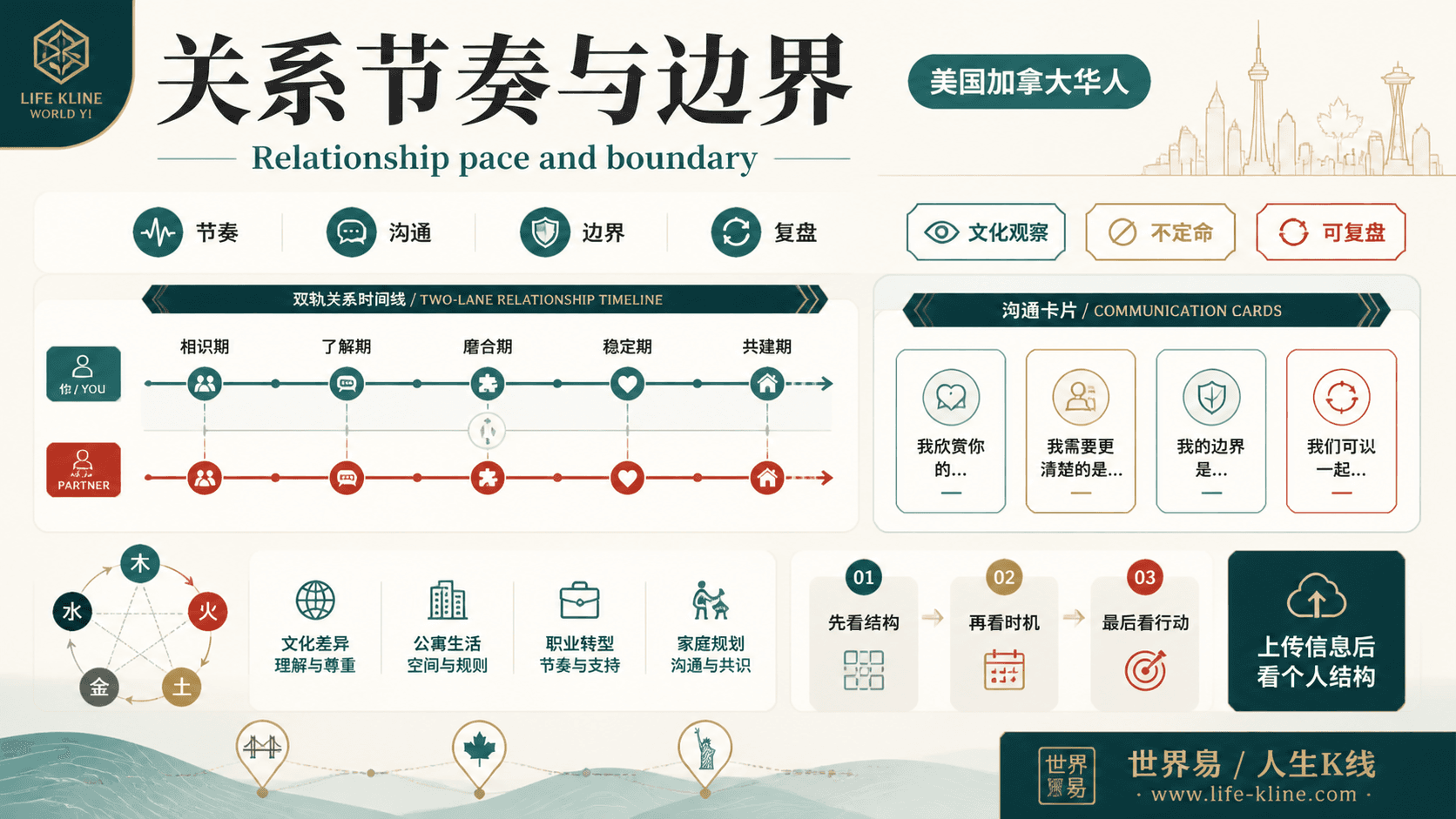
关系节奏与边界|美国加拿大华人
这张图把《Risk Analysis of Exclusive Upstream-Downstream Binding Agreements in Partnerships with He-Chong (Combination-Clash) Relationships》里的命理概念转成关系、边界和应用场景,适合先看图建立结构,再回到案例正文理解细节。
关系节奏与边界不应被写成固定结论。更适合美国加拿大华人的读法,是把传统术语翻译成结构、时机、环境、行动和复盘。
查看图片解读