Detailed Analysis of Tian Xiang Star: The Stable Assistant Star in Zi Wei Dou Shu
把这篇文章落到自己身上验证:先看结构,再进入个人分析,不做泛泛阅读。
Concept Definition
Tian Xiang Star is one of the fourteen main stars in Zi Wei Dou Shu, originating from the Southern Dipper, specifically the fifth star of the Southern Dipper. In terms of Five Elements, Tian Xiang belongs to Yang Water. This attribute grants it a quality of flowing yet retaining strength, allowing it in the birth chart to represent not only wisdom and principles but also a dynamic balancing force.
In the system of Zi Wei Dou Shu, Tian Xiang transforms its Qi into Yin (Yin Star). In traditional culture, Yin (Yin Star) symbolizes authority, documents, laws, and protection. Therefore, Tian Xiang is not merely simple assistance; it represents the ability to carry and inherit power. It governs stability, meaning the Day Master (日主) often acts according to rules without rash action, possessing high reliability and responsibility.
Traditional Metaphysical Significance
In metaphysics, Tian Xiang primarily corresponds to the Career Palace (官禄宫), regarded as the star of official luck (官禄之星). It represents the Day Master's social status, career performance, and management style. Since Tian Xiang governs stability, the Day Master tends to choose fields in career that require long-term accumulation, emphasize order, and follow regulations. Whether in administrative management, judicial law, or the operation of large enterprises, Tian Xiang can display its unique coordinating ability.
Tian Xiang possesses an extremely strong assisting nature, often regarded as the best partner for the Zi Wei Star. In the ancient official system, Zi Wei was the Emperor, while Tian Xiang was the Prime Minister. This relationship of ruler and minister manifests in the birth chart as an efficient team collaboration model. Tian Xiang can assist the main star in implementing decisions, handling complex affairs, and ensuring the smooth operation of the overall situation. Its traits are not limited to the workplace; in family and social relationships, Tian Xiang also represents a capable wife or assistant who can protect the family and maintain order.
Practical Configuration and Interpretation
The fortune and misfortune of Tian Xiang are not fixed but depend on the rules of the four transformations (Hua Lu, Hua Quan, Hua Ke, Hua Ji) when the fourteen main stars reside in the twelve palaces of Zi Wei Dou Shu. If Tian Xiang encounters Hua Lu, its assisting power increases significantly, indicating broad sources of wealth and the ability to help the main star profit; if it encounters Hua Quan, execution is stronger, allowing for the creation of new management scenarios; Hua Ke indicates good reputation and document luck; while Hua Ji requires attention to document disputes or the impact of decision-making errors.
In practical configurations, the combination of Tian Xiang with various auxiliary stars forms a complete pattern. When Tian Xiang shares a palace or meets Zuo Fu (左辅) and You Bi (右弼), its stable traits are greatly strengthened, forming a noble pattern of double or triple assistance, indicating the Day Master can receive noble assistance in career and rise smoothly. If Tian Xiang meets Wen Chang (文昌) and Wen Qu (文曲), it increases literary talent and academic luck, making it suitable for work in culture, education, or fields requiring deep theoretical foundations. If paired with Tian Kui (天魁) and Tian Yue (天钺), it indicates encountering many nobles, receiving strong external support at critical moments.
Common Misconceptions
Beginners often mistakenly believe Tian Xiang is simply an accessory star, thinking it lacks the strength of a main star. In fact, as Tian Xiang transforms into Yin (Yin Star), its influence is profound, especially in the Career Palace and Spouse Palace, where it often determines the ultimate achievement level and management style of the Day Master (日主). Viewing Tian Xiang simply as a supporting role ignores its core role in building structures and stabilizing situations.
Another misconception is interpreting Tian Xiang's stability as a lack of flexibility. Although Tian Xiang governs stability, its Five Element attribute is Yang Water, and water is adaptable. When facing sudden situations, a Tian Xiang Day Master often resolves crises through flexible means rather than sticking rigidly to dogmas. Only when Tian Xiang falls into decline or meets Sha stars and Ji Shen (忌神) in the birth chart should one be wary of the rigidity brought by conservatism; however, even then, the underlying stable foundation is difficult to completely erase.
FAQ
Q: Tian Xiang transforms into Yin (Yin Star); what does this specifically represent in life? A: Yin (Yin Star) represents authority, laws, and protection. Tian Xiang transforming into Yin means the Day Master is suitable for work in management, law, administration, or fields requiring the establishment of rule systems. It also represents that the Day Master's personality has strong principles and responsibility, making them a reliable support for others.
Q: What is the pattern if Tian Xiang shares a palace with Zi Wei? A: When Tian Xiang shares a palace with Zi Wei, it is known as the Fu Xiang Chao Yuan Ge (府相朝垣格) or similar patterns, which is one of the top patterns in Zi Wei Dou Shu. Zi Wei is the Lord, and Tian Xiang is the Minister; they work together seamlessly, indicating the Day Master can concentrate power and receive capable assistance. In career, they can achieve great success and hold a prominent status.
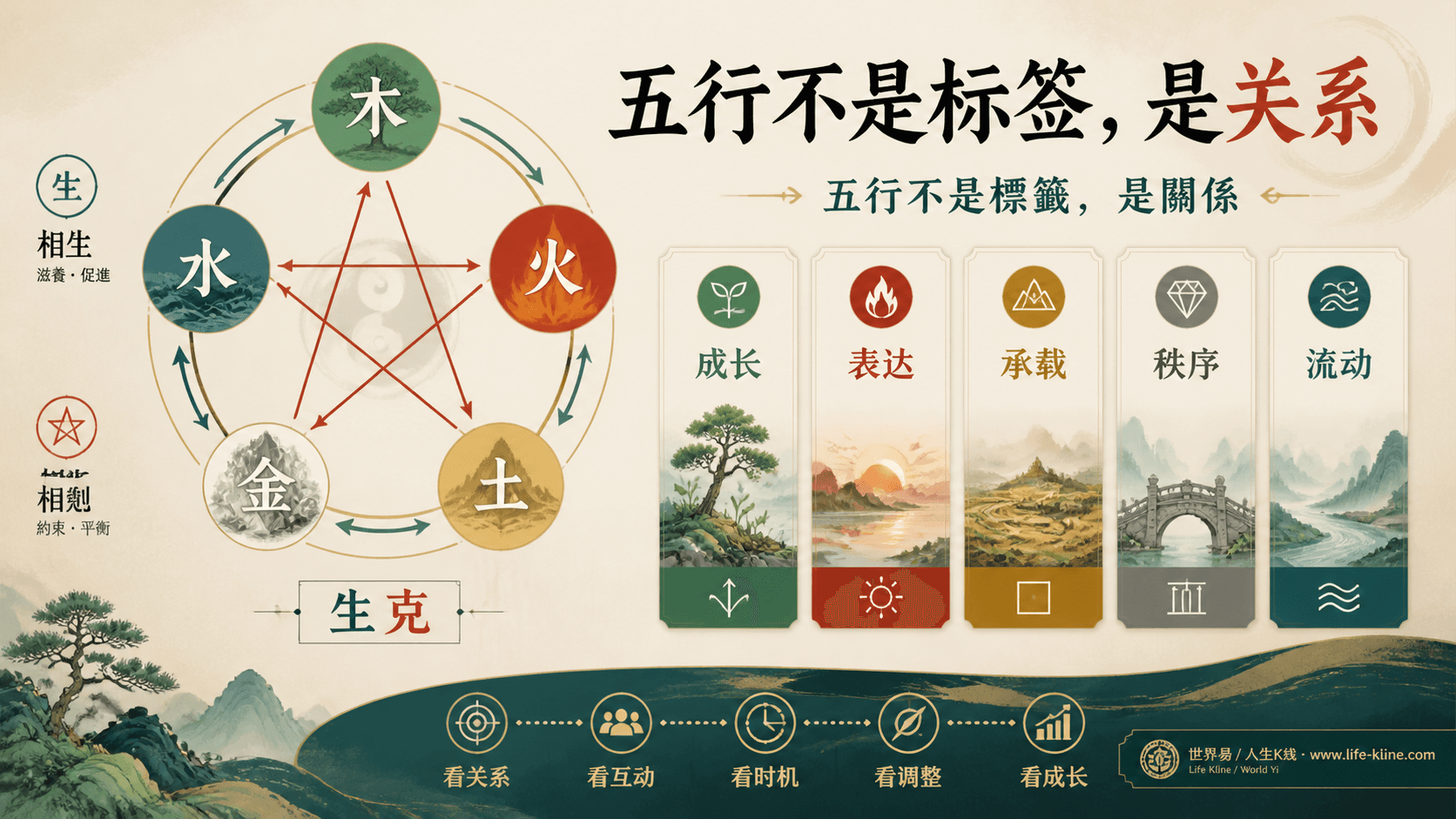
五行现代翻译图
这张图把《Detailed Analysis of Tian Xiang Star: The Stable Assistant Star in Zi Wei Dou Shu》里的命理概念转成关系、边界和应用场景,适合先看图建立结构,再回到知识文章正文理解细节。
五行图把金木水火土从人格标签翻译成系统关系,帮助用户理解生克、承载和转化。