Why True Solar Time Matters for Accurate Bazi Charts: A Guide for Overseas Chinese and Global Readers
把这篇文章落到自己身上验证:先看结构,再进入个人分析,不做泛泛阅读。
Which variables build a real framework
A solid Bazi framework rests on three interconnected layers that prevent common charting mistakes, especially for those born outside China. The baseline structure is the unchanging solar calendar foundation, where pillars derive from the actual position of the sun at your birthplace rather than arbitrary clock readings. Time-based triggers then introduce dynamic elements like the hour pillar shifting every two hours and luck cycles unfolding over decades, while real-world constraints account for variables that differ by individual case such as longitude offsets, historical daylight saving adjustments, and the equation of time that can alter recorded birth time by up to thirty minutes or more. Missing any layer risks turning a precise system into guesswork, as many overseas readers discover when their charts fail to match lived experience.
Stable factors include the solar-based calendar and the fundamental relationships among heavenly stems and earthly branches, which remain consistent regardless of location. Temporary influences arise from time zone conventions and daylight saving policies that vary by country and historical period, often requiring manual correction to reach true solar time. Personal constraints, evaluated only through your specific birth details and current life pressures, determine how these adjustments actually shift pillars and interpretations in practice. This layered approach helps readers prioritize what deserves immediate attention—starting with accurate time calibration—while recognizing that public explanations provide orientation rather than final answers best confirmed in a tailored analysis.
What problem sits underneath the trend
Interest in "Why true solar time changes chart accuracy for overseas-born Chinese and global Bazi readers" keeps rising because readers are not really looking for jargon. They are looking for a more stable way to think through uncertainty, timing, and judgment without getting lost in oversimplified claims.
Strong evergreen content should therefore explain why the topic matters now, what kind of decisions it affects, and where readers are most likely to misunderstand it.
How a practical reader should interpret it
The most useful reading approach is to focus on structure, timing conditions, and decision boundaries instead of isolated labels or dramatic one-line predictions. That is how abstract metaphysical language becomes decision language.
In other words, readers need a framework that helps them translate theory into application, rather than collect fragments that sound insightful but do not improve judgment.
How to turn public knowledge into personal use
Public content should build orientation, not pretend to replace personal judgment. The next useful move is to test the framework against one’s own birth timing, location, and current decision pressure.
That is how a knowledge page becomes conversion-ready without turning into hard sell copy: it gives enough clarity for readers to know why a personal reading would answer a different level of question.
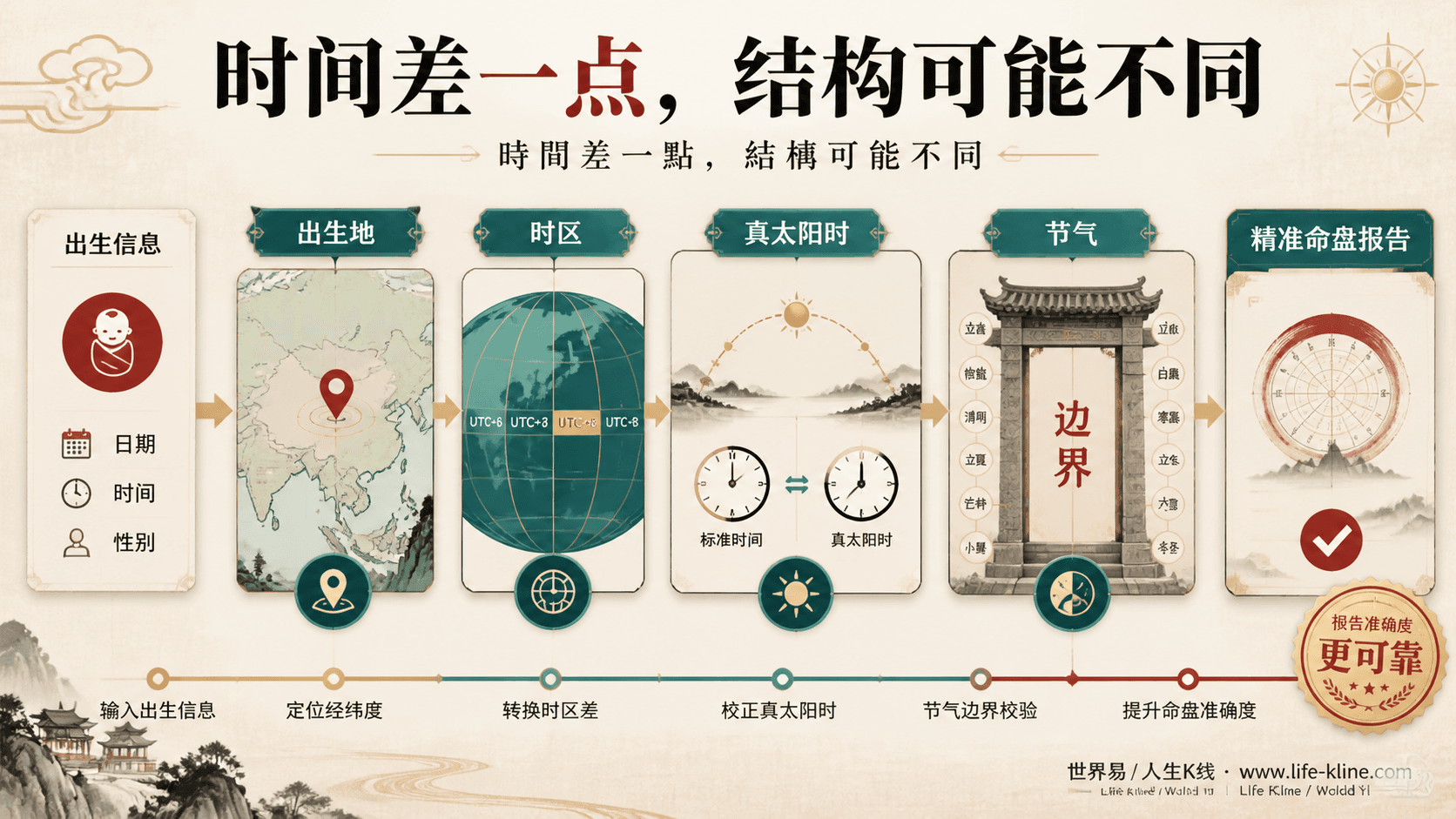
真太阳时与节气边界图
这张图把《Why True Solar Time Matters for Accurate Bazi Charts: A Guide for Overseas Chinese and Global Readers》里的命理概念转成关系、边界和应用场景,适合先看图建立结构,再回到知识文章正文理解细节。
说明出生时间、地点、时区、真太阳时和节气切换如何影响排盘精度。