Analysis of US Migration Decisions: Timing for Work Visas, Investment Immigration, and Student Visa Status Changes
把这篇文章落到自己身上验证:先看结构,再进入个人分析,不做泛泛阅读。
Why This Decision Is Particularly Difficult in This Destination
Cross-border migration to the United States involves a complex legal and social environment, especially in the areas of work visas, investment immigration, and student visa status changes. Applicants face multiple challenges such as long visa backlogs, strict tax transparency, high medical expenses, gun-related security concerns, and uneven distribution of educational resources. These practical factors make migration decisions not purely driven by personal will but require comprehensive consideration of economic, legal, and social risks and opportunities.
Psychologically, applicants are often influenced by a mix of anxiety and expectations, leading to decision-making biases that are either overly urgent or excessively conservative. Long waits for visa backlogs may cause psychological pressure, while premature actions risk policy changes and adaptation difficulties. Therefore, precisely grasping the timing of migration becomes critical.
From the perspective of BaZi, the strength of the individual's Day Master, their pattern (geju), and Yong Shen (favorable elements) reflect their internal energy structure in facing external environments. Notably, the Wealth Stars represent financial capability, Bi Jian and Jie Cai indicate competition and personal resources, Guan Sha stars relate to identity pressure and external rules, Yin Stars symbolize support and resources, and Yi Ma (Traveling Horse) signifies migration motivation. The interaction between Da Yun (decade luck) and Liu Nian (annual fortune) further adjusts the timing rhythm of personal actions.
Overall, the complexity of US migration decisions combined with individual BaZi structures creates unique rhythms and mechanisms that either amplify or suppress risks. Rational judgment must consider both aspects to avoid blind actions or unnecessary delays.
Three Core Dimensions of BaZi Judgment
First, the strength of the Day Master and its associated pattern determine the foundation and coping strategies an individual uses to face external challenges. For example, a relatively weak Day Master usually requires external support (Yong Shen) for balance, while a strong Day Master has more autonomous driving force. The Yi Ma combination serves as a migration motivation signal; if it complements the Yong Shen, the timing for migration is relatively favorable, otherwise caution is advised.
Second, Wealth Stars are closely related to the ability to generate income in a foreign land. If the Wealth Stars are strong and supported by the Yong Shen, it indicates a greater potential to obtain economic returns in the US through work or investment. However, if the Ji Shen (unfavorable elements) are too strong, it implies increased resistance due to cross-border taxation, investment risks, and status restrictions, requiring careful assessment.
Third, Guan Sha stars connect to foreign identity pressure and policy regulations, while Yin Stars represent legal support and resource guarantees. The clash and harmony interactions between Da Yun and Liu Nian reflect the timing rhythm; when favorable luck cycles align with the annual fortune, obstacles to action are reduced. Conversely, one should wait prudently or adjust strategies. Combining these three factors helps identify the rhythm nodes for 'when to move out' or 'when to settle down.'
Three Real BaZi Case Studies
Case 1: The Day Master is Wu (戊, Earth), relatively weak, with a Shang Guan (Hurting Officer) pattern. The Yong Shen is Fire, and the Ji Shen are Metal and Water. Currently in the Bing Chen (丙辰) Da Yun (favorable luck cycle) and the Liu Nian is Bing Wu (丙午), both mutually supportive. This structure shows that external resources (Fire) positively promote career and financial luck, and both Da Yun and Liu Nian favor action. Combined with US visa backlogs and tax environment, the Shang Guan pattern represents creativity and desire for expression, suitable for actively applying for work visas or investment immigration during the current favorable policy window. The current Da Yun and Liu Nian support cross-border actions, signaling a strong indication that 'it's time to move out.' However, attention should be paid to the Ji Shen Metal and Water, which may reflect visa policy and tax complexities causing resistance. It is recommended to coordinate with legal and tax professionals to mitigate potential risks.
Case 2: The Day Master is Ji (己, Earth), relatively strong, with a Bi Jian (Peer) pattern. The Yong Shen is Metal, and the Ji Shen is Fire. Currently in the Bing Xu (丙戌) Da Yun, which is relatively weak, and the Liu Nian is Bing Wu (丙午), requiring caution. The Bi Jian pattern symbolizes competition and peer pressure; Metal as Yong Shen indicates the need to rely on rules and resource support. The current weak Da Yun suggests greater environmental resistance. Combined with long US work visa backlogs and political uncertainties, acting rashly at this time carries high risk, potentially encountering visa delays or strict identity verification. It is advised to settle locally, strengthen personal resource accumulation and legal compliance, and consider cross-border migration when Da Yun improves or the Liu Nian turns auspicious.
Case 3: The Day Master is Ren (壬, Water), relatively strong, with a Zheng Cai (Direct Wealth) pattern. The Yong Shen are Earth and Fire, and the Ji Shen is Metal. Currently in the Geng Yin (庚寅) Da Yun, with stable luck, and the Liu Nian is Bing Wu (丙午), requiring adaptability. The Zheng Cai pattern represents stable financial sources and investment ability. Earth and Fire as Yong Shen suggest actively building foundations and driving forces. During US investment immigration and student visa status changes, a stable Da Yun is favorable for preservation and gradual development, but Ji Shen Metal may reflect identity verification and tax pressures. Practically, it is recommended to carefully evaluate policy changes, act timely but avoid impulsiveness, and focus on educational and healthcare protections to ensure a smooth cross-border transition.
These three cases collectively demonstrate the differences in migration rhythms under various BaZi structures, emphasizing the integration of Da Yun and Liu Nian auspiciousness and inauspiciousness with the unique legal and social environment of the US to assist rational decision-making.
Common Misjudgments and Blind Spots in This Destination
First, many applicants overlook the dynamic changes in US visa backlogs and overly rely on their own willingness to decide the timing of action, which easily leads to applications being shelved or getting stuck in unfavorable policy situations. If the Yong Shen in BaZi does not align with the real policy environment, the 'migration motivation' cannot effectively translate into actual success.
Second, the complexity of taxation and medical expenses is often underestimated. Even if the BaZi shows strong Wealth Stars, without adequate preparation for US tax transparency and out-of-pocket medical costs, economic pressure after migration may increase sharply, affecting quality of life and family stability.
Third, cultural adaptation and social security issues are often considered secondary. Guan Sha stars in BaZi reflect identity pressure; ignoring cultural differences and social environment changes may exacerbate psychological burdens and reduce migration success rates.
Finally, blindly pursuing rapid action while neglecting the rhythm of Da Yun and Liu Nian cooperation often results in 'poor timing,' causing frequent plan changes that increase costs and risks.
Practical Judgment Sequence
Step one: Assess the strength of the Day Master and Yong Shen in the personal BaZi chart, combined with whether the current Da Yun and Liu Nian are auspicious, to judge if internal driving force and external support are matched. If the Da Yun and Liu Nian are favorable and the Yong Shen is effective, this provides foundational momentum for cross-border action; otherwise, caution or strengthening of personal conditions is necessary.
Step two: Integrate real-world factors such as US visa backlogs, tax compliance, and education and healthcare considerations to evaluate the practical resistance corresponding to the Ji Shen in BaZi. If Ji Shen is prominent and corresponds to policy restrictions, priority should be given to resolving legal and financial issues to avoid adverse consequences from blind actions.
Step three: Pay attention to the interaction between Yi Ma (Traveling Horse) and Guan Sha stars to anticipate migration motivation and identity pressure. If Yi Ma is active and Guan Sha is moderated by Yin Stars, the migration environment is relatively favorable, and short-term visa application or status change can be considered; otherwise, it is advisable to maintain stability and wait for environmental changes before acting.
In summary, migration decisions should be based on the dual confirmation of BaZi rhythms and real legal, tax, and policy environments, avoiding isolated judgments to ensure timing and resource preparation are well aligned.
FAQ
Question 1: How do Yong Shen and Ji Shen in BaZi specifically correspond to US visa and tax environments? Answer: Yong Shen represents favorable elements in the BaZi chart, such as Fire symbolizing career motivation and resources, and Metal representing rules and identity support. Ji Shen corresponds to resistance factors, for example, Metal may involve tax complexities, and Water may imply policy changes. By analyzing whether Yong Shen can effectively neutralize Ji Shen in the context of US visa backlogs and tax laws, one can assist in judging the timing of action.
Question 2: How should one balance migration decisions when the Da Yun is auspicious but the Liu Nian is unfavorable? Answer: Da Yun provides long-term trends, while Liu Nian reflects short-term changes. When auspicious Da Yun aligns with favorable Liu Nian, it is suitable to actively advance migration plans. If Liu Nian is unfavorable but Da Yun remains good, it is advisable to postpone key decisions and use the time to optimize conditions. During adverse Liu Nian, focus on consolidating local resources and avoid risks.
Question 3: Can BaZi fully replace professional immigration and financial consulting? Answer: BaZi serves as a rhythm-based auxiliary tool to help understand personal energy cycles and their interaction with external environments, providing timing references for action. However, cross-border migration involves complex issues such as law, taxation, visas, and foreign exchange compliance, which require the specific guidance of professional immigration lawyers, tax consultants, and financial experts. BaZi cannot substitute for professional advice.
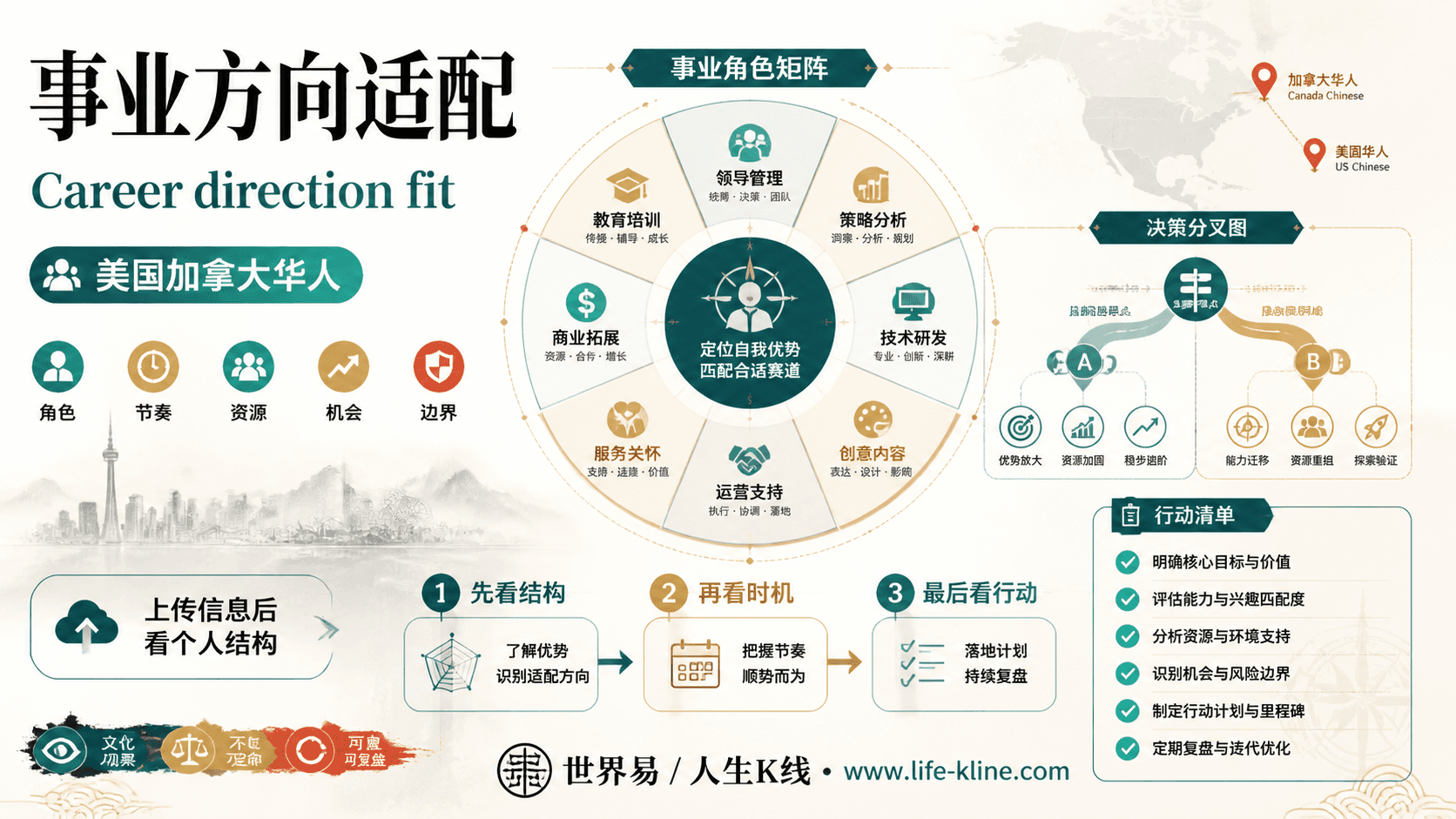
事业方向适配|美国加拿大华人
这张图把《Analysis of US Migration Decisions: Timing for Work Visas, Investment Immigration, and Student Visa Status Changes》里的命理概念转成关系、边界和应用场景,适合先看图建立结构,再回到知识文章正文理解细节。
事业方向适配不应被写成固定结论。更适合美国加拿大华人的读法,是把传统术语翻译成结构、时机、环境、行动和复盘。