U.S. Migration Decisions: Analyzing Whether to Move Alone First or Bring the Whole Family in Work, Study, and Investment Immigration
把这篇文章落到自己身上验证:先看结构,再进入个人分析,不做泛泛阅读。
Why This Decision Is Especially Difficult for This Destination
The United States, as a popular immigration destination, has varying visa wait times, complex and penetrative tax laws, predominantly self-paid and costly healthcare, potential safety risks due to gun-related crime, distinctly stratified educational resources, and an uncertain political environment. These factors combined make migration decisions particularly complicated, especially when involving multiple identity transitions such as work visas, investment immigration, and study visa status changes, where the distribution of interests and risks among family members becomes the core challenge.
Psychologically, many families prefer to move together to maintain family unity and support. However, in practice, uncertainties in visa approvals and economic burdens often make moving alone first a realistic choice. At this point, the BaZi structure involving Bi Jian (Peer), Cai Xing (Wealth Stars), and Guan Sha (Officer and Killing Stars) combinations can assist in analyzing whether an individual is better suited to independently bear risks or if moving as a whole family is more appropriate, providing guidance on coping strategies under multiple pressures.
From the migration structure perspective, work and study visas emphasize matching individual abilities and educational resources, while investment immigration relies more on financial strength and policy sensitivity. In BaZi, Cai Xing represents the inflow and stability of wealth resources, Bi Jian reflects competition and resource sharing, and Guan Sha symbolizes pressure and identity transformation. The interaction among these three determines the migration pace and the rational allocation of family members' roles.
Therefore, in U.S. migration decisions, combining BaZi judgment can scientifically identify signals indicating whether it is suitable for one person to move ahead to explore or for the whole family to move together, avoiding legal, tax, and lifestyle risks caused by acting too early or too late, while promoting coordination among family members to maximize immigration success rates and quality of life.
Three Core Dimensions of BaZi Judgment
First, the strength of the Day Master (Ri Zhu) and the pattern positioning determine the individual's self-resource sufficiency during migration. The Bi Jian star, representing same-type energy, often reflects the dual role of resource competition and support. If the Day Master is relatively strong and Bi Jian is effective, it indicates that the individual can better independently bear pressure and is suitable to move alone first to explore.
Second, Cai Xing (Wealth Stars) represent wealth and external resource introduction, which is especially crucial in investment immigration and financial arrangements. When Cai Xing is strong and the Yong Shen (favorable element) is utilized, it shows a stable economic foundation, making moving as a whole family more suitable because the possibility of sharing resources among all family members is greater, effectively dispersing risks.
Third, Guan Sha (Officer and Killing Stars) symbolize identity pressure, rule constraints, and external environmental challenges. Complex Guan Sha combinations, especially during visa waitlists and identity transitions, bring significant pressure. If Guan Sha is overly strong while the Day Master is weak, caution should be exercised by moving alone first to test the waters, avoiding the whole family facing high risks simultaneously. The interaction between Guan Sha and Yi Ma (Traveling Horse star) in the Liu Nian (annual fortune) and Da Yun (decade luck cycle) also indicates critical timing for action or waiting.
Finally, Yi Ma star represents the motivation for migration and change. Combined with Liu Nian and Da Yun, it can indicate the best timing for action. The clash and combination relationships between Liu Nian and Da Yun serve as a guide to adjust the migration rhythm, helping to judge whether the current environment is suitable for major moves or if a steady and conservative approach should be prioritized.
Three Real BaZi Chart Cases
Case 1: This female Day Master is Bing Fire (丙, Bing), relatively strong, belonging to the Pian Yin (偏印) pattern. The Yong Shen is Fire, and the Ji Shen (unfavorable element) is Wood. Currently, she is in the Ji Hai (己亥) Da Yun, with stable luck suitable for maintaining status quo. The Liu Nian is Bing Wu (丙午), suitable for flexible adaptation. The chart shows strong Bi Jian stars, reflecting abundant personal resources and strong adaptability. Considering the U.S. work visa and investment immigration environment, she is suitable to move alone first to explore, leveraging her relatively strong Day Master and Bi Jian resources to handle visa waitlists and tax complexities initially, then consider bringing the family after the Da Yun stabilizes. It is recommended that she cooperate with professional immigration lawyers for visa risk assessment before action, reasonably arrange fund flows, ensure stable independent living initially, and gradually promote family members' follow-up migration.
Case 2: This female Day Master is Ren Water (壬, Ren), relatively weak, with a Shi Shen (食神) pattern. Cai Xing is Metal, the Yong Shen, with Wood and Fire as Ji Shen. She is currently in the Ding Si (丁巳) unfavorable Da Yun, requiring caution against major incidents, with Liu Nian Bing Wu (丙午). The chart shows weak Cai Xing and significant Ji Shen influence, indicating insufficient economic foundation and resource support, with considerable Guan Sha pressure. Considering the complexity of U.S. study visa status changes and long visa waitlists, it is advised to delay moving the whole family, adopting a strategy of living apart in two locations. On one hand, use the cautious period indicated by Da Yun and Liu Nian to stabilize studies and identity transitions; on the other hand, reduce risks through professional financial and tax planning. At this stage, neither moving alone aggressively nor moving the whole family simultaneously is suitable; a phased approach with gradual identity transition is recommended.
Case 3: This female Day Master is Yi Wood (乙, Yi), relatively weak, with a Shi Shen pattern. Water is the Yong Shen, with Fire and Earth as Ji Shen. She is currently in the Ren Chen (壬辰) Da Yun with stable luck and Liu Nian Bing Wu (丙午) suitable for flexible adaptation. The chart shows that although Cai Xing is not prominent, Guan Sha pressure is relatively low, and the Da Yun is stable. Considering the U.S. investment immigration and work visa background, moving the whole family together is recommended. Although Cai Xing is weak, the effective Yong Shen Water helps integrate family resources and tax planning, reducing uncertainties during immigration. Especially regarding continuous investment in healthcare and education resources, unified family action can effectively alleviate individual pressures. At this time, cooperating with professional teams to ensure tax transparency and education planning is essential to maximize overall family benefits.
Common Misjudgments and Blind Spots for This Destination
Many families overly rely on the smoothness of short-term visa approvals in U.S. migration decisions, neglecting the heavy long-term tax compliance and healthcare costs, resulting in sudden economic pressure after migration. Individuals with insufficient Cai Xing or excessive Ji Shen influence in their BaZi charts who fail to timely adjust migration strategies are prone to financial chain breaks.
Another blind spot is ignoring the identity and legal pressures represented by Guan Sha stars, especially the psychological and legal risks brought by multiple identity transitions and long waitlists. When Guan Sha is strong, blindly moving the whole family together may cause the entire family to face difficulties if visas are rejected or policies suddenly change, making moving alone first to disperse risks a better option.
Additionally, overemphasizing emotional appeals for family reunification while neglecting the resource competition and individual capability differences implied by Bi Jian stars can lead to insufficient support among family members after migration. Particularly in the U.S.'s multicultural and highly competitive environment, a lack of individual independence is magnified, affecting overall adaptation.
Finally, ignoring the clash and combination relationships between Liu Nian and Da Yun and failing to adjust action plans based on timing is a common misjudgment. Migration is a dynamic process; BaZi rhythm assists in judging the action tempo, corresponding to U.S. policy changes and family resource status, thereby avoiding the dual risks of acting hastily or delaying excessively.
Practical Judgment Sequence
Step one: Examine the individual's BaZi chart for the strength of the Day Master, and the combinations of Bi Jian, Cai Xing, and Guan Sha, combined with the current Da Yun and Liu Nian status, to assess the individual's capacity for independent resource support and the family's overall resource condition. If the Day Master is relatively strong and Bi Jian is effective, prioritize moving alone first to explore; if Cai Xing is stable and Guan Sha pressure is moderate, moving the whole family together is more appropriate.
Step two: Combine actual conditions such as U.S. visa waitlists, tax transparency, and healthcare and education costs, and cooperate with professional immigration lawyers and financial advisors for comprehensive risk assessment. At this stage, BaZi rhythm signals serve as auxiliary references to guide visa application timing, fund arrangements, and the migration sequence of family members, avoiding overlapping legal and financial risks.
Step three: Adjust the action rhythm based on the clash and combination relationships between Liu Nian and Da Yun. When Liu Nian and Da Yun are stable and the Yong Shen is effectively utilized, it is suitable to initiate large-scale migration plans; if encountering unfavorable Da Yun changes or Liu Nian clashes, it is recommended to delay moving the whole family, adopt strategies such as living apart or moving alone first, and wait for more favorable timing before overall planning.
FAQ
Question 1: How does the Bi Jian star in BaZi influence the choice between moving alone first or moving the whole family in U.S. immigration? Answer: Bi Jian represents competition and support among similar resources. When the Day Master is relatively strong and Bi Jian is effective, the individual's independent ability is strong, making moving alone first suitable. If Bi Jian is weak or constrained by Ji Shen, resource sharing is difficult, and moving the whole family carries greater risks, requiring cautious decision-making.
Question 2: What role does Cai Xing play in U.S. investment immigration and study visa status changes? Answer: Cai Xing symbolizes wealth and the introduction of external resources. When Cai Xing is strong and the Yong Shen is effective, the family's economic foundation is stable, making moving the whole family more suitable. When Cai Xing is weak or affected by Ji Shen, phased actions are advised to avoid concentrated financial pressure.
Question 3: How to cope with the pressure of U.S. visa waitlists and identity transitions when Guan Sha stars are strong? Answer: Guan Sha represents identity pressure and regulatory constraints. When strong, visa waitlists are long and policy risks are high. At this time, moving the whole family together is not advisable; it is better to move alone first to test the market and policy changes, cooperating with professional legal support to reduce overall risks.
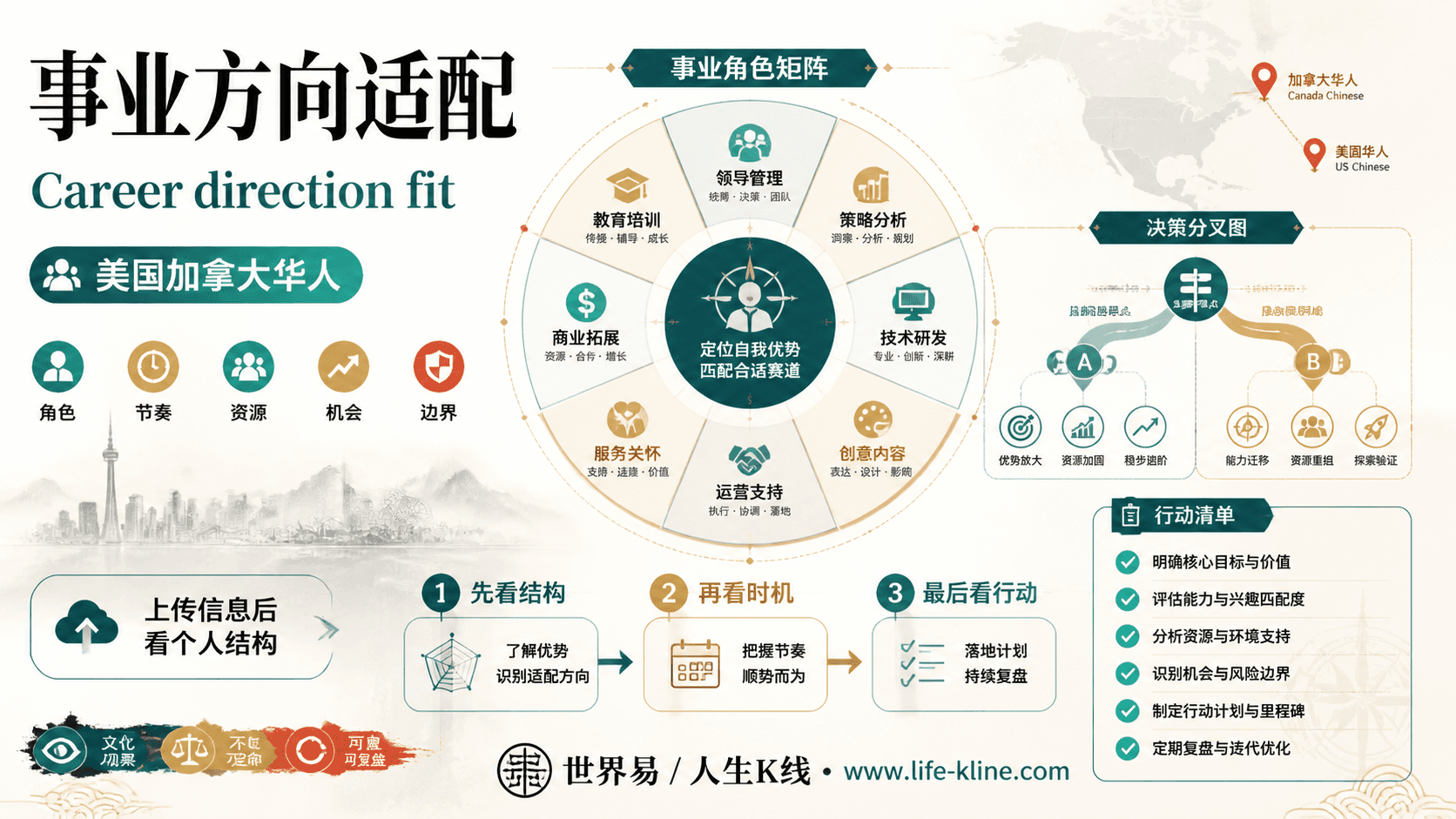
事业方向适配|美国加拿大华人
这张图把《U.S. Migration Decisions: Analyzing Whether to Move Alone First or Bring the Whole Family in Work, Study, and Investment Immigration》里的命理概念转成关系、边界和应用场景,适合先看图建立结构,再回到知识文章正文理解细节。
事业方向适配不应被写成固定结论。更适合美国加拿大华人的读法,是把传统术语翻译成结构、时机、环境、行动和复盘。
查看图片解读