The Metaphysical Attributes and Practical Analysis of the Heavenly Stem Gui (癸)
把这篇文章落到自己身上验证:先看结构,再进入个人分析,不做泛泛阅读。
Concept Definition
Gui (癸) is the tenth Heavenly Stem (天干) among the Ten Heavenly Stems, classified as a Yin Stem with the Five Element attribute of Water, and associated with the North direction. As a Yin Stem, Gui embodies qualities of softness, subtlety, and nourishment. Its representative colors include black, blue, and gray, which symbolize the flowing and profound nature of Water in metaphysics.
In the combination and clash relationships among Heavenly Stems, Gui forms a harmonious combination with Wu (戊), known as Gui-Wu He (癸戊合). This combination reflects the interaction between Water and Earth, capable of resolving limitations and achieving balance and harmony. Conversely, Gui clashes with Ding (丁), representing a Water-Fire conflict that is pronounced and requires careful consideration in metaphysical analysis.
Gui’s seasonal strength ratings indicate it is strongest in spring, especially during the Hai (亥) and Zi (子) months, both scoring 3, signifying that the energy of Water reaches its peak during these periods, demonstrating Gui’s vitality as a Water representative in spring.
Metaphysical Characteristics and Symbolic Meaning
As a Yin Stem Water, Gui symbolizes flowing, nourishing, and latent power, representing a gentle yet profound influence. In the Five Elements, Water stands for wisdom, emotion, and fluidity; Gui’s Yin nature inclines it towards introspection, flexibility, and strong adaptability.
Gui’s association with the North direction corresponds to the Water element. In ancient Feng Shui, the North is often regarded as a place of wind storage and energy accumulation, implying Gui’s function of gathering and containing energy. The colors black, blue, and gray, representing Gui, also reflect the tranquility and depth of deep waters at night, symbolizing wisdom and the subconscious.
The Gui-Wu (癸戊) combination exemplifies the natural law of Water nourishing Earth and Earth nurturing Water. This combination in metaphysics means the ability to harmonize conflicting energies and promote balance and coordination. In contrast, Gui’s clash with Ding (丁) represents the Water-Fire antagonism, indicating conflict and instability within the Five Element dynamics, warranting particular attention.
Practical Configuration and Interpretation
In practical metaphysical applications, Gui’s attributes are often used to assess a person’s introspective and wise characteristics. Gui is especially strong in spring, notably for those born in the Hai (亥) and Zi (子) months, where Gui’s Water energy is fully expressed, manifesting sensitivity, gentleness, and insightful qualities.
The Gui-Wu (癸戊) combination is considered auspicious, signifying Water and Earth generating each other, which can resolve unfavorable factors and enhance overall fortune. For example, when Gui Water encounters Wu Earth, it can promote harmony in career and interpersonal relationships, making it useful for adjusting conflicts between Earth and Water in the BaZi chart.
However, when Gui clashes with Ding (丁), the Water-Fire opposition often brings conflict and instability. Metaphysical practitioners need to focus on such combinations, advising individuals to maintain balance in emotional and social interactions to avoid exacerbating disputes.
Common Misconceptions
Some metaphysics enthusiasts mistakenly believe Gui Water only represents weakness and passivity, overlooking its Yin Stem Water’s flexibility and latent strength. In fact, although Gui Water is Yin and gentle, it possesses deep wisdom and regulatory capabilities and should not be simplistically categorized as weak.
Another misconception is treating Gui as absolutely conflicting with all Fire elements, ignoring that Gui’s clash specifically occurs with Ding (丁). Gui’s relationship with other Fire stems like Bing (丙) or Wu (戊) differs; metaphysical analysis should be case-specific to avoid overgeneralization.
FAQ
Question: What specific influence does Gui Water’s Yin Stem attribute have on metaphysics? Answer: As a Yin Stem Water, Gui manifests as softness, subtlety, and wisdom, influencing personality traits such as introspection, strong adaptability, delicate emotions, and regulatory ability.
Question: What is the difference between Gui’s combination with Wu and its clash with Ding? Answer: Gui’s combination with Wu represents Water and Earth generating each other, resolving conflicts and promoting harmony; whereas Gui’s clash with Ding is a Water-Fire antagonism that can cause conflict and instability, requiring careful differentiation and cautious handling in metaphysical configurations.
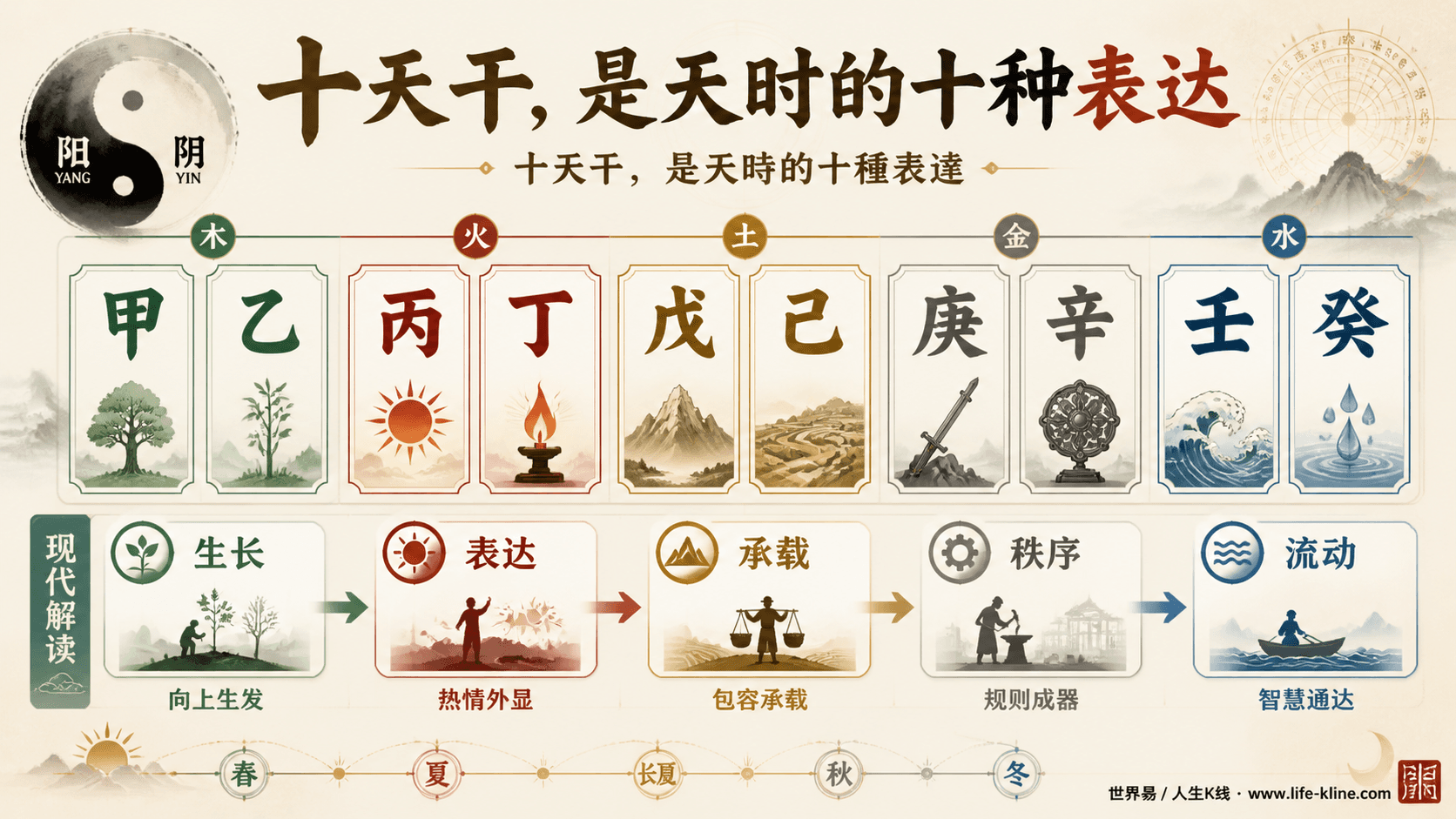
十天干总览图
这张图把《The Metaphysical Attributes and Practical Analysis of the Heavenly Stem Gui (癸)》里的命理概念转成关系、边界和应用场景,适合先看图建立结构,再回到知识文章正文理解细节。
十天干是时间与环境变化的十种基础模式。理解其阴阳、五行属性,能帮助我们在不同时位中找到清晰的结构入口,而非预测结果。
查看图片解读