Victory and Risk Assessment in Partnership Equity Disputes: Integrating Metaphysics and Legal Practice
把这篇文章落到自己身上验证:先看结构,再进入个人分析,不做泛泛阅读。
Why This Decision Is Especially Difficult in This Legal Scenario
Partnership and equity disputes inherently involve intertwined interests of multiple parties, including issues such as equity dilution, uneven profit distribution, withdrawal liquidation, and confirmation of hidden shareholder rights. The legal procedures are complex and evidence collection is difficult. Constraints such as civil litigation statutes of limitations, mediation priority principles, and attorney fees require parties to carefully weigh whether to litigate or settle.
In this context, BaZi structures can provide auxiliary timing awareness, especially the strength of the Day Master and the relationships among the Ten Gods such as Zheng Guan (official authority), Qi Sha (seven killing), Shang Guan (Hurting Officer), Bi Jian (Peer), and Jie Cai (Rob Wealth), reflecting the party’s psychological state and coping ability in the dispute. For example, a strong Zheng Guan or Qi Sha suggests suitability for tough legal measures; a prominent Shang Guan warns of escalating expression conflicts; clashes and combinations in Liu Nian and Da Yun indicate changes in litigation timing and risk points.
Since legal disputes ultimately depend on qualified lawyers and statutory procedures, BaZi serves only as an auxiliary tool to help parties judge when to proactively strike, when to defend and observe, and how to optimize evidence collection and mediation strategies. Combining legal realities with metaphysical timing can increase the probability of victory and effectively avoid risks in complex disputes.
Therefore, victory and risk assessment in partnership equity disputes is not only a legal professional issue but also a dynamic decision management challenge. The metaphysical perspective provides a unique and pragmatic auxiliary judgment dimension.
Three Core Dimensions of Metaphysical Judgment
First, the Day Master and its strength determine the party’s core energy in the dispute. A relatively weak Day Master often indicates limited personal resources; such parties need to focus on preventing risk expansion when facing equity dilution or hidden shareholder disputes. A relatively strong or balanced Day Master has more initiative and is better suited to actively protecting rights through legal measures.
Second, the combination of Zheng Guan (Official), Qi Sha (Seven Killing), Shang Guan (Hurting Officer), and Bi Jian (Peer) is especially critical. Zheng Guan and Qi Sha represent authority and legal deterrence; when strong, litigation is appropriate, especially when facing contractual betting clauses and liquidation disputes. Shang Guan represents expression and conflict; if strong but uncontrolled, it may cause imbalance in litigation strategy and communication, requiring cautious negotiation and mediation. Bi Jian represents competition and cooperation; when flourishing, it can enhance coordination ability, but excessive strength may intensify internal conflicts.
Third, the interaction between Da Yun (decade luck cycle) and Liu Nian (annual fortune) indicates the current litigation rhythm and risk fluctuations. A stable Da Yun suggests maintaining the status quo, while clashes or combinations in Liu Nian require flexible strategy adjustments. For example, the Bing Wu (丙午) Liu Nian brings adaptability, signaling that during litigation one should pay attention to changes in evidence and procedural nodes, avoiding blind aggression or excessive concession.
In summary, metaphysical judgment mainly revolves around the Day Master’s strength, the Ten Gods relationships among Zheng Guan, Qi Sha, Shang Guan, and Bi Jian, and the interaction of Da Yun and Liu Nian. Combined with practical legal factors such as evidence collection difficulty, litigation costs, and negotiation priority strategies, it provides auxiliary reference for victory and risk assessment in partnership equity disputes.
Three Real BaZi Chart Cases
Case 1: The Day Master is Yi Wood (乙木, Yi), relatively weak, with a Bi Jian (Peer) pattern. The Yong Shen (favorable element) is Water, and the Ji Shen (unfavorable elements) are Fire and Earth. Currently in the 9th year of the Ding Hai (丁亥) Da Yun, with a Bing Wu (丙午) Liu Nian. The relatively weak Yi Wood Day Master combined with the Bi Jian pattern indicates the party has a strong competitive awareness in partnerships but limited own resources, relying on Water as the Yong Shen to regulate. In partnership equity disputes, this BaZi suggests the party should focus on the capital chain and information transparency when facing risks of equity dilution and withdrawal liquidation. The Ji Shen Fire and Earth indicate risks related to Fire and Earth (such as contract loopholes or strong opposing actions) may amplify the dispute. The Ding Hai Da Yun is stable, suitable for maintaining the status quo, while the Bing Wu Liu Nian requires flexible responses to sudden changes. The legal recommendation is to prioritize mediation, strengthen evidence collection, avoid escalating conflicts, and prepare litigation timing with reference to Liu Nian changes.
Case 2: The Day Master is Ren Water (壬水, Ren), balanced, with a Pian Cai (偏财, Indirect Wealth) pattern. The Yong Shen is Metal, and the Ji Shen is Earth. Currently in the 5th year of the Gui Chou (癸丑) Da Yun, with a Bing Wu (丙午) Liu Nian. The balanced Ren Water Day Master represents certain resources and coordination ability in legal battles; the Pian Cai pattern shows sensitivity to wealth interests. The Metal Yong Shen benefits protecting monetary rights, while the Earth Ji Shen warns of potential obstacles in contract clauses or legal procedures. This structure is suitable for actively adopting legal measures in equity distribution and hidden shareholder disputes, especially through lawyers meticulously reviewing contract details and betting clauses. The Gui Chou Da Yun is stable; the Bing Wu Liu Nian emphasizes adaptability, signaling the need to closely monitor evidence changes and opposing strategy adjustments during litigation. The suggestion is to seek legal consultation early and litigate timely to avoid missing favorable opportunities due to passive waiting.
Case 3: The Day Master is Wu Earth (戊土, Wu), relatively strong, with a Zheng Guan (正官, Direct Officer) pattern. The Yong Shen are Wood and Water, and the Ji Shen is Fire. Currently in the 2nd year of the Wu Xu (戊戌) Da Yun, with a Bing Wu (丙午) Liu Nian. The relatively strong Wu Earth Day Master with a Zheng Guan pattern shows the party has good authority and legal enforcement power; strong Zheng Guan favors following proper legal procedures. The Wood and Water Yong Shen help regulate relationships and avoid conflict escalation. The Fire Ji Shen indicates the need to avoid emotional confrontations during litigation. This BaZi is suitable for active litigation in partnership equity disputes, especially when facing betting clauses and liquidation disputes, leveraging legal advantages. Both the Wu Xu Da Yun and Bing Wu Liu Nian are stable, indicating litigation rhythm should seek steady progress. The recommendation is to strictly follow legal procedures, strengthen lawyer involvement, actively collect evidence, and avoid irrational conflicts that increase litigation costs.
Common Misjudgments and Blind Spots in This Scenario
One common misjudgment in partnership equity disputes is underestimating the importance of mediation and evidence preparation. Most parties tend to rush into litigation but overlook the burden of proof and time limits in civil litigation, increasing the risk of losing. In BaZi, those with strong but uncontrolled Shang Guan often act impulsively in communication; legally, this manifests as broken evidence chains or unbalanced strategies, reminding parties to plan litigation rhythm rationally.
Another blind spot is ignoring the influence of Da Yun and Liu Nian on litigation timing. Legal procedures are lengthy and uncertain. The metaphysical indication that a stable Da Yun favors maintaining the status quo helps parties judge whether to hold current interests and avoid greater risks triggered by aggressive litigation. Lack of awareness of this rhythm often leads to frequent strategy changes mid-litigation, increasing costs and risks.
Additionally, some parties neglect the risk signals from Ji Shen, such as contract loopholes or strong opposing interventions. Ji Shen in BaZi corresponds to legal weak points, reminding parties to proactively prevent potential risks by improving contract clauses and increasing legal safeguards. Ignoring these signals easily results in passivity and higher chances of losing in litigation.
Practical Judgment Sequence
First, analyze the Day Master’s strength and pattern type in the BaZi chart, combined with the specific case context to assess personal resources and legal advantages. A weak Day Master suggests maintaining the status quo; a strong Day Master and strong Zheng Guan or Qi Sha support active litigation but must be coordinated with professional legal advice to avoid reckless actions.
Second, analyze the interaction between Da Yun and Liu Nian to identify current litigation windows and risk fluctuation periods. When Da Yun is stable, prioritize mediation and negotiation. When Liu Nian shows clashes or combinations, pay attention to evidence and opposing strategy changes, adjusting legal action plans accordingly.
Finally, incorporate Ji Shen risk signals to strengthen evidence collection and contract improvements, avoiding procedural or material deficiencies that could cause disadvantages in litigation. Lawyer involvement is essential; BaZi judgment offers psychological rhythm references, but all legal decisions must rely on formal procedures and legal provisions.
FAQ
Question 1: Can BaZi determine the outcome of legal litigation? Answer: BaZi cannot determine victory or defeat; it only assists in identifying the party’s psychological state and litigation rhythm, helping arrange evidence preparation and decision timing reasonably. Ultimately, the outcome depends on legal procedures and professional lawyers.
Question 2: How to combine BaZi judgment to choose between mediation and litigation? Answer: When Da Yun is stable and the Day Master is relatively weak, mediation to maintain the status quo is recommended first; when the Day Master is strong and Zheng Guan or Qi Sha is strong, active litigation can be considered, but must be coordinated with evidence and legal strategies and adjusted flexibly.
Question 3: What legal risk hints does Ji Shen in BaZi provide? Answer: Ji Shen often corresponds to contract loopholes, procedural obstacles, or strong opposing interventions, reminding parties to strengthen risk prevention and contract improvements to avoid passivity in litigation.
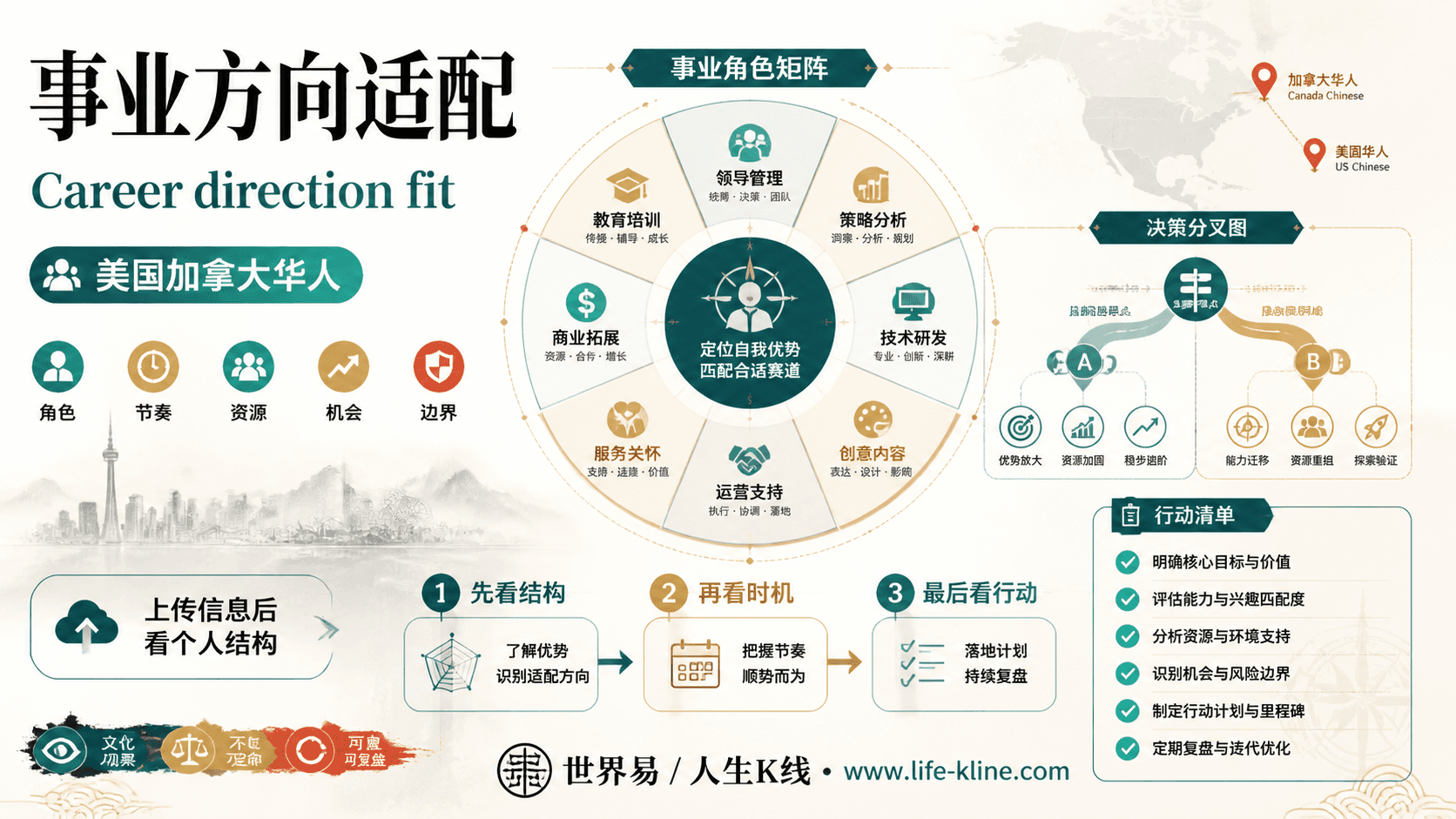
事业方向适配|美国加拿大华人
这张图把《Victory and Risk Assessment in Partnership Equity Disputes: Integrating Metaphysics and Legal Practice》里的命理概念转成关系、边界和应用场景,适合先看图建立结构,再回到知识文章正文理解细节。
事业方向适配不应被写成固定结论。更适合美国加拿大华人的读法,是把传统术语翻译成结构、时机、环境、行动和复盘。
查看图片解读