BaZi and Legal Practice Analysis of Optimal Timing and Rhythm in Partnership Equity Disputes
把这篇文章落到自己身上验证:先看结构,再进入个人分析,不做泛泛阅读。
Why This Decision Is Particularly Difficult in Partnership Equity Disputes
Partnership and equity disputes often involve intertwined interests of multiple parties, with core difficulties centered on equity dilution, unfair profit distribution, withdrawal liquidation, and issues with nominal shareholders. Legal litigation cycles are long, evidence collection is complex, and enforcement is challenging. Litigation costs and psychological burdens are significant, especially under unclear contractual terms and rights and obligations. The choice of timing for decisions directly affects the efficiency and outcome of dispute resolution.
Civil litigation time limits and legal policies prioritizing mediation require parties to weigh the potential time and cost advantages of mediation before filing lawsuits. At the same time, attorney fees and the difficulty of evidence preparation pose practical obstacles. The rigor of legal procedures demands that parties precisely grasp timing to avoid rights being compromised or litigation failure due to inappropriate timing.
BaZi structure, as an auxiliary reference, can indicate emotional fluctuations, communication barriers, and litigation momentum rhythms by analyzing the party’s current luck, the interactions between Da Yun and Liu Nian, and the Four Pillars combinations. For example, a strong presence of Zheng Guan (Proper Authority) or Qi Sha (Seven Killings) may reflect strong antagonism, while a prominent Shang Guan (Hurting Officer) can indicate tension in expression and communication. Such information aids in adjusting the timing and strategy of legal actions to avoid emotional decisions that increase legal risks.
Therefore, legal decisions in partnership equity disputes rely not only on professional legal judgment but also on metaphysical rhythms, precisely timing the filing, mediation, and appeal stages to maximize legal rights protection.
Three Core Dimensions of BaZi Judgment
First, the relationship between the Day Master and Guan Sha (Authority and Killing stars) is a key indicator of the party’s attitude and initiative in legal disputes. A Day Master with a Zheng Guan pattern typically exhibits rationality, fairness, and rule consciousness, suitable for steady litigation; a strong Guan Sha presence warns that the party may maintain strong defense and control desires, requiring caution to avoid excessive confrontation that raises litigation risks.
Second, the interaction between Shang Guan (Hurting Officer) and expression/antagonism reflects the party’s communication ability and emotional expression tension. In partnership disputes, a strong Shang Guan often means intense expression that may escalate conflicts but can also effectively argue for rights; conversely, a restrained Shang Guan suggests cautious legal actions to avoid missing opportunities due to poor expression.
Third, the clash and harmony between Da Yun (decade luck cycle) and Liu Nian (annual fortune) provide temporal references for decision rhythm. Da Yun represents medium- to long-term fortune trends, while Liu Nian reflects the annual energy changes. When Da Yun is stable and Liu Nian harmonizes with the Yong Shen (favorable element), it is an auspicious time for legal actions; if Da Yun or Liu Nian clash with the Ji Shen (unfavorable element), parties are advised to act cautiously, prioritizing negotiation or mediation to avoid adverse outcomes from head-on confrontation.
Combining these three dimensions with the party’s specific BaZi chart’s Yong Shen and Ji Shen, alongside professional legal advice, can scientifically guide the rhythm of legal decisions in partnership equity disputes, reducing blind litigation and unnecessary time and financial costs.
Three Real BaZi Chart Case Studies
Case 1: The female party’s Day Master is Ren Water (壬, Ren) with a slightly strong disposition, in a Zheng Guan pattern, currently in the Bing Shen (丙申, Bing Shen) Da Yun, with the Bing Wu (丙午, Bing Wu) Liu Nian. The Yong Shen are Earth and Fire, and the Ji Shen is Metal. The Zheng Guan pattern shows her emphasis on rules and legal principles. The Guan Sha combination is stable, indicating her legal actions should be mainly defensive to avoid extreme confrontation. The fire and earth energy of the Bing Shen Da Yun and Bing Wu Liu Nian strengthen the Yong Shen, suggesting mediation is more likely to gain the other party’s recognition at this stage. It is advisable to prioritize mediation during the current Liu Nian and choose filing lawsuits when the Liu Nian’s Metal Ji Shen is relatively weak to reduce confrontation costs. It is recommended to first improve the evidence chain and prioritize mediation; if the other party refuses reasonable terms, then combine with lawyer advice to select the timing for litigation.
Case 2: The female party’s Day Master is Gui Water (癸, Gui) with a relatively weak disposition, in a Pian Cai (偏财, Indirect Wealth) pattern, currently in the Yi Chou (乙丑, Yi Chou) Da Yun, year 9, with the Bing Wu (丙午, Bing Wu) Liu Nian. The Yong Shen is Metal, and the Ji Shen are Wood and Fire. The Pian Cai pattern indicates she may focus on profit distribution and financial control in the partnership, but a weak Day Master and weak Da Yun imply a passive stance in legal decisions, requiring caution. The Liu Nian’s strong fire is unfavorable to the Ji Shen, increasing the possibility of conflict. At this stage, it is not advisable to rush to file lawsuits; priority should be given to mediation to reduce conflict intensity while strengthening Metal energy to consolidate financial evidence and legal support. It is recommended to consider litigation when the Da Yun shifts to favor the Metal Yong Shen to improve chances of success and enforcement.
Case 3: The male party’s Day Master is Ding Fire (丁, Ding) with a balanced disposition, in a Cong Sha (从杀, Following Killing) pattern, currently in the Wu Wu (戊午, Wu Wu) Da Yun, year 2, with the Bing Wu (丙午, Bing Wu) Liu Nian. The Yong Shen are Water and Metal, and the Ji Shen are Wood and Fire. The Cong Sha pattern indicates strong resistance and leadership desire in disputes. The interweaving of Guan Sha gives his legal actions some initiative. Although the Da Yun and Liu Nian are fire and earth, providing opportunities for adaptability, the strong Ji Shen fire may trigger emotional confrontations. Legally, it is advised to prepare fully during the current stable Da Yun period and select months within the Liu Nian when the Water and Metal Yong Shen are stronger for filing lawsuits or appeals, avoiding periods of intense confrontation. Priority should be given to lawyer-led mediation; if the opposing party is uncooperative, then choose timing to initiate litigation according to law.
These three cases illustrate how BaZi structure influences the rhythm of legal decisions in partnership equity disputes. Combined with legal procedures and evidence rules, they help parties scientifically plan the best timing for litigation or mediation.
Common Misjudgments and Blind Spots in This Scenario
First, treating BaZi judgment as a decisive basis while neglecting legal procedures and evidence rules. BaZi serves only as an auxiliary rhythm reference and cannot replace professional legal advice and statutory litigation procedures. Blind reliance on BaZi may cause missing the best evidence collection period or statutory litigation deadlines, adversely affecting case progress.
Second, ignoring litigation time limits and mediation-first legal provisions, filing lawsuits either too early or too late can bring unfavorable consequences. Especially in equity disputes, the completeness and timeliness of the evidence chain are critical. Legal actions must be scheduled reasonably by integrating BaZi Da Yun and Liu Nian.
Third, failing to distinguish characteristics of different BaZi patterns leads to chaotic decision rhythms. For example, Zheng Guan patterns suit steady and defensive strategies; Pian Cai patterns require cautious action; Cong Sha patterns need emotional and impulsive control. Without combining the specific strength of the Day Master and the relationship between Yong Shen and Ji Shen, parties may fall into emotional legal actions, increasing litigation risks.
In summary, legal decisions should center on statutory procedures and evidence, with BaZi as an auxiliary reference. Avoid single-dimensional judgments causing misjudgments, and pay special attention to reasonably coordinating litigation rhythm and communication strategies.
Practical Judgment Sequence
First, clarify the litigation time limits and the status of evidence preparation, which are the foundational guarantees of legal procedures. Combine the strength of Yong Shen in the current Da Yun and Liu Nian to judge whether it is suitable to initiate litigation, avoiding unnecessary resource consumption due to poor timing.
Second, prioritize promoting mediation procedures, especially when Liu Nian and Da Yun are stable and Yong Shen is strong, as mediation is more likely to reach consensus, saving time and costs. When Shang Guan performs well in BaZi, active communication is favorable to avoid escalating conflicts.
Finally, when mediation fails and evidence is sufficient, select the best timing for filing lawsuits or appeals based on favorable months or Liu Nian indicated by BaZi. At this stage, combine professional lawyer advice to reasonably plan litigation rhythm, ensuring maximum litigation efficiency and enforcement effectiveness.
FAQ
Question 1: Can BaZi determine my chances of winning a partnership dispute? Answer: BaZi provides auxiliary references on the party’s luck and emotional rhythm but cannot replace legal professional judgment and evidence rules. Winning mainly depends on legal facts and procedures; BaZi only helps grasp the timing of filing and mediation.
Question 2: If my current Da Yun is unfavorable, should I give up litigation? Answer: You should not blindly give up. An unfavorable Da Yun suggests greater caution, prioritizing mediation or strengthening evidence, adjusting litigation rhythm reasonably, and waiting for more favorable Liu Nian or Da Yun before litigating.
Question 3: How to combine lawyer advice and BaZi judgment for decision-making? Answer: Lawyer’s professional legal opinion should be primary, combined with BaZi judgment to determine action rhythm. BaZi can indicate emotional control and timing, while lawyers handle evidence, procedures, and legal strategies. Together, they improve overall dispute resolution efficiency.
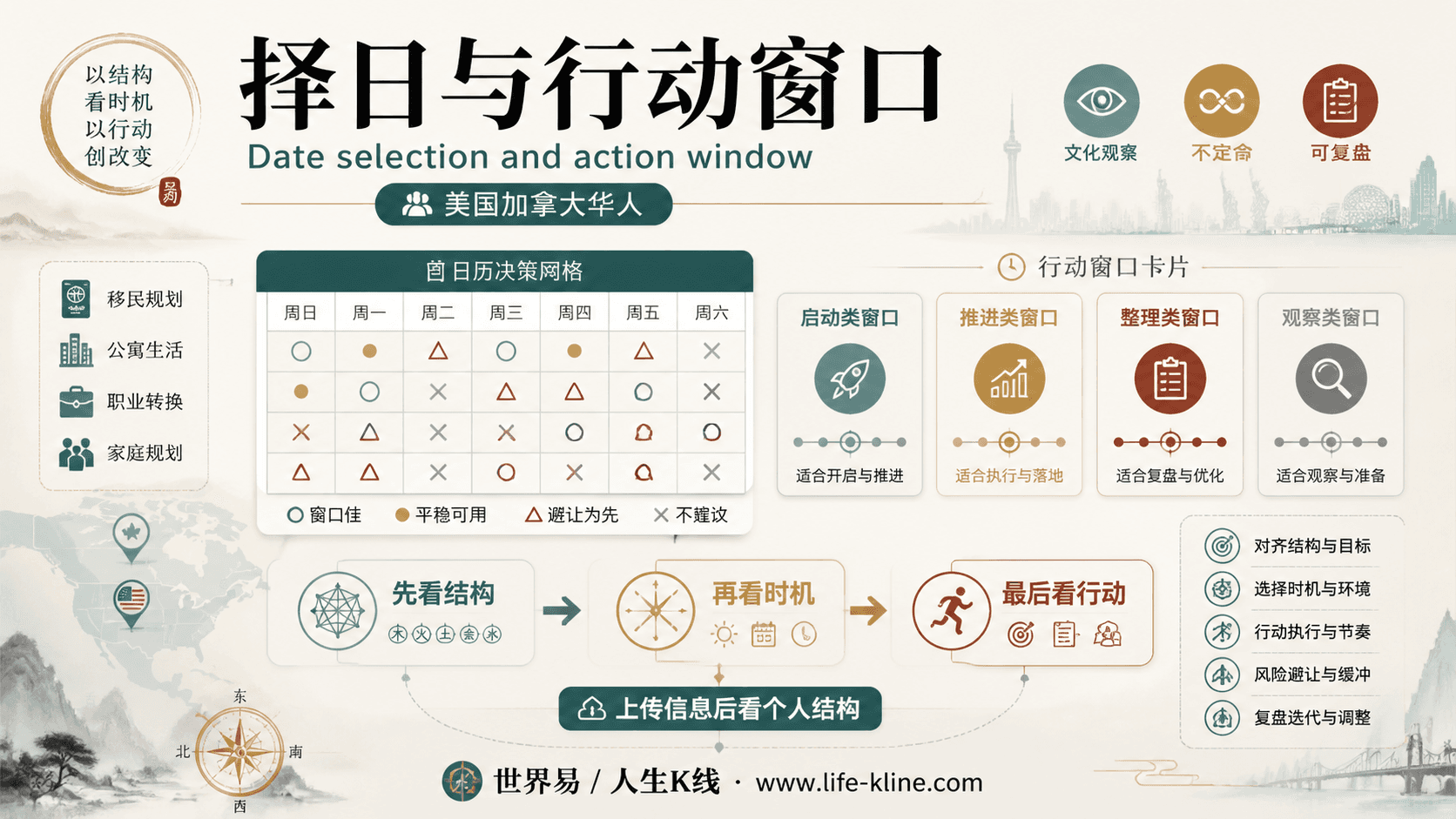
择日与行动窗口|美国加拿大华人
这张图把《BaZi and Legal Practice Analysis of Optimal Timing and Rhythm in Partnership Equity Disputes》里的命理概念转成关系、边界和应用场景,适合先看图建立结构,再回到知识文章正文理解细节。
择日与行动窗口不应被写成固定结论。更适合美国加拿大华人的读法,是把传统术语翻译成结构、时机、环境、行动和复盘。
查看图片解读