Metaphysical Assessment and Practical Guidance for Career Reorientation During the Parenting Phase
把这篇文章落到自己身上验证:先看结构,再进入个人分析,不做泛泛阅读。
Why This Decision Is Especially Difficult at This Life Stage
The parenting phase from 30 to 42 years old is one of the life stages where individuals bear the most social roles. At this time, most people not only have to take on childcare responsibilities but also balance family rhythms and career development, significantly increasing dual pressures. When considering a second career reorientation, the allocation of time and energy becomes the core challenge, and every decision must weigh the balance between family stability and professional growth.
Moreover, societal expectations impose clear role definitions on parents in this age group, generally expecting stable and continuous investment in both family and career. Shifting to a new career path often entails risks and uncertainties, creating tension with conservative expectations from society and close relations, making the decision more complex.
From a metaphysical perspective, the Da Yun (decade luck) and Liu Nian (annual fortune) during this stage often reflect the intertwined influences of career and family. The Day Master’s strength, pattern stability, and the regulation by Yong Shen all affect an individual’s capacity to bear pressure and adapt to directional changes. Favorable or unfavorable changes shown in the BaZi chart are often amplified or suppressed by real-life stage issues, leading to emotional fluctuations and judgment biases during decision-making.
Therefore, career reorientation during the parenting phase from 30 to 42 years old is not only a professional choice but also a comprehensive consideration of physical and mental adjustment and responsibility balance. Integrating metaphysical judgment with real-world constraints is key to successful decision-making.
Three Core Dimensions of Metaphysical Assessment
First, the strength of the Day Master is the foundation for judging whether an individual can bear the pressure of career reorientation. A relatively strong Day Master usually indicates strong personal capability and resilience to independently face challenges; a relatively weak Day Master may more easily feel fatigued under pressure and require regulation by the Yong Shen.
Second, the pattern type reflects the individual’s destiny structure and inner motivation. The Yang Ren (Sheep Blade) pattern typically manifests decisiveness and drive, suitable for proactive change; the Qi Sha (Seven Killings) pattern represents external pressure and challenges, requiring cautious timing; the Zheng Cai (Proper Wealth) pattern emphasizes stability and accumulation, so reorientation decisions need to consider risk control.
Third, the relationship between Yong Shen (favorable element) and Ji Shen (unfavorable element) reveals the direction of regulation. Support from the Yong Shen helps alleviate obstacles and fatigue during reorientation, while the Ji Shen may increase burdens or resistance. The current Da Yun and Liu Nian interactions reflect external auspicious or inauspicious changes; following favorable trends can enhance the success rate of reorientation, while adverse conditions call for steadiness.
By integrating these three dimensions and considering specific family responsibilities and social environments, one can scientifically evaluate the rationality and timing of a second career reorientation, avoiding risks caused by blind actions.
Three Real BaZi Chart Case Studies
Case 1: This chart’s Day Master is Wu (戊, Earth), relatively strong, with a Yang Ren pattern. The Yong Shen are Wood and Water. The current Da Yun is Yi Wei (乙未, ages 23-32, auspicious luck). This is the early part of the parenting phase where family responsibilities begin to emerge, but both Da Yun and Liu Nian favor career development. The decisiveness and drive brought by the Yang Ren pattern manifest as strong initiative during the second reorientation, but caution is needed regarding the Ji Shen Fire element which may consume enthusiasm. In reality, dual family and career pressures amplify the desire for reorientation in such charts but may also cause fatigue-induced judgment errors. It is recommended to first check the auspiciousness of the Da Yun and Liu Nian to confirm if the current environment supports reorientation, then combine with the Yong Shen regulation status to decide whether to act.
Case 2: This chart’s Day Master is Geng (庚, Metal), relatively strong, with a Qi Sha (Seven Killings) pattern. The Yong Shen are Fire and Wood. The current Da Yun is Geng Yin (庚寅, ages 37-46, suitable for consolidation). This is the later part of the parenting phase with heavy family responsibilities and social expectations tending towards stability. The external pressures from the Qi Sha pattern require cautious timing for reorientation decisions, and the Ji Shen Earth element may increase resistance. The Da Yun is stable, and Liu Nian demands adaptability, implying that reorientation should follow favorable trends and avoid impatience. The chart characteristics constrain the second reorientation; in reality, a strong tendency to maintain stability often causes missed transformation windows. Practical advice is to first assess whether the Yong Shen is sufficient, confirm family support, and favor steady adjustments rather than radical changes.
Case 3: This chart’s Day Master is Gui (癸, Water), relatively strong, with a Zheng Cai (Proper Wealth) pattern. The Yong Shen is Water. The current Da Yun is Jia Zi (甲子, ages 14-23, auspicious luck), slightly earlier than the parenting phase. Although younger, if entering the 30-42 age range, the Zheng Cai pattern tends toward steady accumulation, so reorientation decisions must consider risk management. Support from the Yong Shen Water element helps relieve pressure, while the Ji Shen Metal element should be avoided to prevent energy dissipation. In this chart, temporary fatigue during the second reorientation is easily misinterpreted as a necessary change, but it is better to wait for more favorable Da Yun and Liu Nian. It is recommended to first check if the Yong Shen is impaired, then confirm the energy support from self and family, favoring gradual progress rather than abrupt changes.
Common Misjudgments and Blind Spots at This Stage
A common misjudgment when considering a second career reorientation during the parenting phase is mistaking temporary fatigue for a signal that a career path must change. In many cases, fatigue results from the accumulation of family responsibilities and social pressures; a relatively strong Day Master with impaired Yong Shen often indicates a need for recuperation rather than abrupt change.
Another blind spot is ignoring the interactive influences of Da Yun and Liu Nian auspiciousness. Making major reorientation decisions during unfavorable Da Yun or Liu Nian often leads to imbalance in both career and family. The regulating role of the Yong Shen is overlooked, increasing physical and psychological burdens.
Additionally, societal expectations and pressures from close relationships tend to reinforce a conservative mindset, causing the individual to miss optimal transformation opportunities. People with Qi Sha or Yang Ren patterns may become overly conservative under pressure, thereby missing development chances. Correctly understanding the interaction between metaphysical structure and real-world constraints is key to avoiding misjudgments.
Practical Judgment Sequence
First, check whether the current Da Yun and Liu Nian are auspicious to confirm external environmental support. Favorable Da Yun and Liu Nian years are advantageous for reorientation, while unfavorable or conflicting periods suggest maintaining stability or adjusting pace.
Second, evaluate the Day Master’s strength and pattern characteristics to judge personal stress tolerance and motivation for change. Individuals with relatively strong Day Masters and proactive patterns are more suited for active transformation, while those with weaker or conservative patterns should proceed steadily.
Finally, analyze the regulation relationship between Yong Shen and Ji Shen to confirm one’s physical, mental, and spiritual state as well as family support. If the Yong Shen is impaired, it suggests the need for recuperation before taking action to avoid blind moves. Combining all these with real-life responsibilities and social expectations allows for scientific judgment on when to act and when to observe.
FAQ
Question 1: How to distinguish between career fatigue and a metaphysical signal for reorientation? Answer: This requires combining the auspiciousness of Da Yun and Liu Nian with the regulation status of the Yong Shen. Fatigue often accompanies impaired Yong Shen and unfavorable Liu Nian, while true reorientation timing usually occurs during auspicious Da Yun and Liu Nian with sufficient Yong Shen support.
Question 2: What impact does the Ji Shen have on reorientation decisions? Answer: Ji Shen represents obstacles and depletion. When the Ji Shen is strongly clashed or flourishing, the risk of reorientation increases, potentially causing physical and mental exhaustion and family conflicts, so caution is necessary.
Question 3: How to balance family responsibilities and career reorientation during the parenting phase? Answer: Fully assess the Yong Shen’s regulating ability in the chart and the environmental conditions of Da Yun and Liu Nian, confirm real-world support, choose timing that follows favorable trends, avoid radical changes, and ensure family stability.
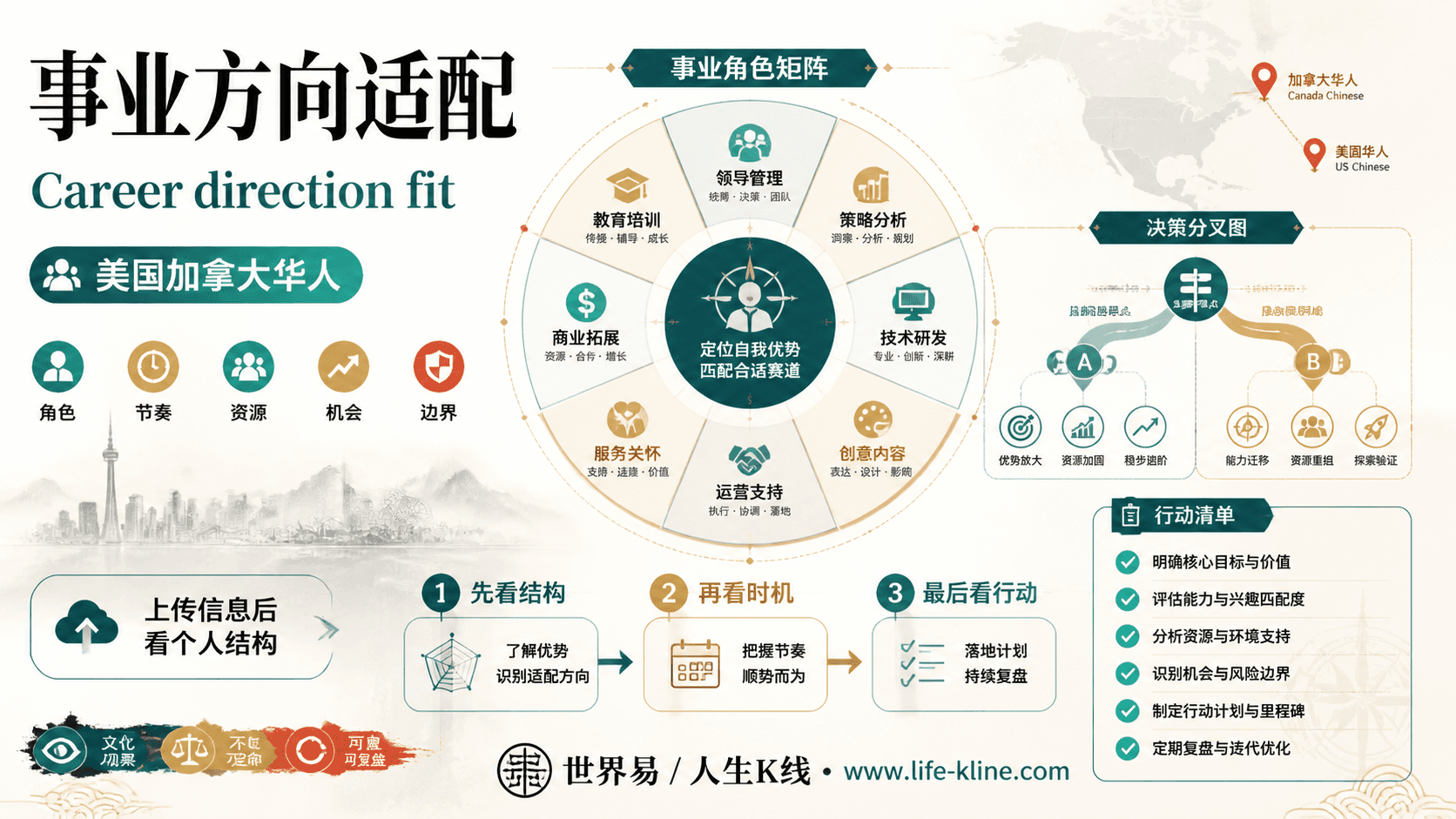
事业方向适配|美国加拿大华人
这张图把《Metaphysical Assessment and Practical Guidance for Career Reorientation During the Parenting Phase》里的命理概念转成关系、边界和应用场景,适合先看图建立结构,再回到知识文章正文理解细节。
事业方向适配不应被写成固定结论。更适合美国加拿大华人的读法,是把传统术语翻译成结构、时机、环境、行动和复盘。
查看图片解读