Lidong Solar Term Metaphysics Encyclopedia: Detailed Analysis of Rising Water Qi and Month Pillar Boundary
把这篇文章落到自己身上验证:先看结构,再进入个人分析,不做泛泛阅读。
Concept Definition
Lidong is the nineteenth solar term among the twenty-four solar terms and also marks the beginning of winter. From a temporal perspective, it usually appears on November 7th or 8th of the Gregorian calendar annually, marking the key node where the Solar Yellow Longitude precisely runs to 225 degrees. At this time, the earth transitions from cool to cold, all things are collected, and natural energy begins to shift from the birth and sprouting of summer and autumn to the condensation and storage of winter.
In the metaphysical system of space and time, Lidong has strict definition standards. It is not only the change of seasons but also the switch of time coordinates. For BaZi arrangement, Lidong is the sole accurate basis for dividing months. Its core lies in the precise matching of solar yellow longitude degrees and time. This concept has deep origins in ancient texts; it is the wisdom crystallized by ancients observing celestial phenomena to guide agriculture and daily life, and in modern metaphysical applications, it becomes the benchmark point for calculating the trajectory of fate.
In the field of Five Elements energy, Lidong represents the initial thriving of water qi. As solar energy runs to the position of the Hai palace, yang qi in the ground hides, and yin qi gradually grows, the characteristics of water begin to dominate the climate and phenology. This energy conversion is not achieved in one step but undergoes a qualitative leap at the moment the Lidong solar term arrives, laying the energy foundation for the subsequent 'One Yang is Born at Winter Solstice'.
Traditional Metaphysical Significance
In the traditional metaphysical system, the primary significance of Lidong lies in establishing the change of the Month Pillar (Yue Jian). The Month Pillar represents the framework of the Parent Palace and Age/Travel Luck in the four pillars of BaZi. Its establishment must be based on solar terms rather than the first day of the lunar month. This is a strict rule formulated by ancient sages and sages to accurately correspond with heaven's time and earth's qi. Only by taking Lidong as the precise time boundary can we ensure the stems and branches of the Month Pillar are accurate, thereby deriving the correct Five Elements pattern.
From the perspective of Hexagram meaning and energy, Lidong corresponds to the Hai month. Hai is the extreme of northern water, governing collection and closure. At this time, with the Month Pillar set to Hai, it means the environmental energy field of the entire natal chart begins to tilt towards cold water qi. Hai conceals Ren water and Jia wood; Ren water is the main qi of the month command, representing the purest and strongest energy of water at this time, while Jia wood serves as the place of birth (Chang Sheng),预示着 that beneath the severe cold, there is still hidden vitality. This configuration determines that those born during the Lidong period are deeply influenced by the cold water qi in their innate natal chart.
As the boundary point for the flow of Da Yun, the importance of Lidong cannot be ignored. Da Yun represents the ups and downs of fortune that change every ten years. Its start must be strictly locked onto the instant of solar term handover. Due to slight differences in the Earth's orbital revolution, the specific landing time of Lidong fluctuates between November 7th and 8th of the Gregorian calendar by 1 to 2 days. This means that whether a person is born before or after the Lidong solar term, their Month Pillar may be completely different, leading to huge differences in the start time of Da Yun and the likes/dislikes of Five Elements.
Practical Configuration and Interpretation
In practical BaZi arrangement, determining whether Lidong has arrived is the first step and the most important step. Metaphysicians must consult the precise solar term timetable to confirm the exact handover time. If a person is born in the last minute before the Lidong solar term handover, their Month Pillar remains that of the previous month; but once crossing that moment of handover, the Month Pillar immediately changes to the Hai month. This obsession with seconds and minutes reflects the scientific nature and rigor of metaphysical arrangement, leaving no room for carelessness.
For those born during Lidong, their natal chart configuration needs to focus on the strength of water qi and the need for climate adjustment (Tiao Hou). In the Hai month, water is strong; if the original chart has weak fire and earth, one must consider the Yong Shen (favorable element) for climate adjustment to warm the chart. If the original chart has excessive metal and water, one must pay attention to the image of cold freezing bones. Ren water concealed in Hai is used to express in the stems, and Jia wood is the place of roots; if Jia wood appears in the chart, it helps to drain the cold water, allowing cold qi to be transformed and vitality to be preserved. This configuration analysis is key to interpreting the Lidong natal chart.
In the practical application of starting Da Yun, the boundary point of Lidong determines the beginning of the luck cycle. The arrangement of Da Yun stems and branches must strictly follow the changes of the solar term Month Pillar. For example, if someone is born after Lidong, their Month Pillar is Hai, and Da Yun must determine the direction (forward or backward) and stem-branch combination for starting the luck based on the Five Elements attributes of the Hai month. This rule ensures that the flow of Da Yun synchronizes with heaven's time and earth's qi, making fortune deduction more in line with natural laws.
Common Misconceptions
The most common misconception is taking the first day of the lunar month as the benchmark for arranging the Month Pillar and starting Da Yun. Many people, influenced by traditional habits, believe that the first day is the start of a new month, thus ignoring the true time of the solar term. In reality, the lunar calendar is a lunisolar calendar, and solar terms are the precise reflection of the solar yellow longitude. Taking the first day as the boundary leads to errors in the Month Pillar, resulting in a completely wrong overall chart. This is the most common mistake beginners make and must be corrected.
Another misconception is neglecting the fluctuation range of the Lidong date. Due to minor errors in calendar calculation, Lidong may occur on the 7th or the 8th. If a person is born exactly on the critical point of November 7th or 8th, their Month Pillar may be completely different. Ignoring this 1 to 2 day fluctuation will lead to deviations in Five Elements judgment of the natal chart, especially causing serious misguidance when judging cold, warm, dry, or moist conditions. Therefore, precise calculation of the solar term time is crucial.
FAQ
Question: Is the Month Pillar for Lidong always Hai? Answer: Yes. As the first solar term of winter, Lidong's Month Pillar is fixed as Hai. Hai is the palace of northern water; at this time, the solar yellow longitude runs to 225 degrees, water qi begins to thrive, and this is an iron law for metaphysical arrangement.
Question: Why must BaZi arrangement be based on the Lidong solar term rather than the first day of the lunar month? Answer: Because BaZi is calculated based on the Solar Ecliptic (Sun's position), and must follow the Sun's position on the ecliptic. The first day of the lunar month is affected by lunar calendar arrangement and may not match the solar position. The switch of the Lidong solar term is the true boundary for the Month Pillar and starting Da Yun, ensuring that metaphysical deduction synchronizes with heaven's time.
Question: Which specific day is Lidong? Answer: Lidong is usually on November 7th or 8th of the Gregorian calendar. The specific date fluctuates by 1 to 2 days due to slight differences in the Earth's orbital revolution. Metaphysical arrangement must consult the specific solar term timetable, precise to the minute and second, and cannot be roughly estimated.
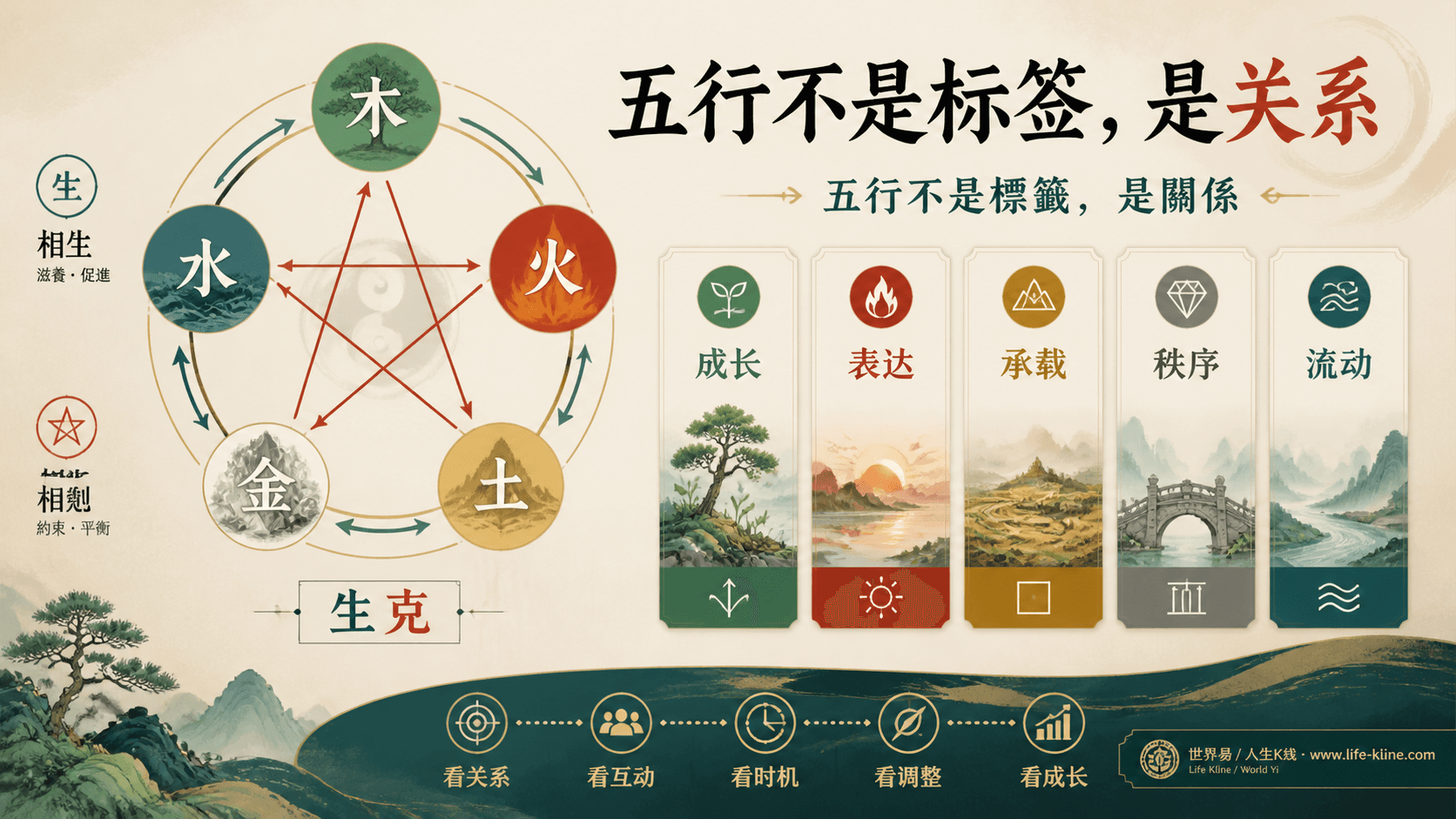
五行现代翻译图
这张图把《Lidong Solar Term Metaphysics Encyclopedia: Detailed Analysis of Rising Water Qi and Month Pillar Boundary》里的命理概念转成关系、边界和应用场景,适合先看图建立结构,再回到知识文章正文理解细节。
五行图把金木水火土从人格标签翻译成系统关系,帮助用户理解生克、承载和转化。