Migration Decision-Making in Japan: Analysis of Staying or Returning for Business Manager Visa Holders, Highly Skilled Professionals, and Students Transitioning to Work
把这篇文章落到自己身上验证:先看结构,再进入个人分析,不做泛泛阅读。
你现在搜索的,
其实是一个要落到自己身上的判断。
当前页面主要回答「Japan」这类搜索问题;真正有价值的下一步是把这套结构带进自己的报告、工具与案例验证。
Why This Decision Is Especially Difficult in This Destination
Japan, as a major Asian economy, attracts numerous Business Manager visa holders, Highly Skilled Professionals, and students transitioning to work due to its rigorous social system and stable rule of law. However, high language barriers, prolonged visa-to-citizenship processes, and slow social integration become core challenges faced by foreigners. Years of effort often fail to yield results due to cultural gaps and complex administrative procedures, leading to increased psychological pressure.
Moreover, frequent earthquakes and economic structural adjustments caused by an aging society add complexity to migration decisions. Foreign populations often require stronger psychological resilience and external support to adapt to environmental and workplace changes, which are precisely weaknesses for many expatriates.
From a metaphysical perspective, when facing external uncertainties and pressures, the individual's Day Master strength, BaZi pattern, and Yong Shen relationships become key indicators of their ability to endure long-term challenges. BaZi structures such as Pian Cai (Indirect Wealth), Jie Cai (Rob Wealth), or Guan Sha (Officer and Killing stars) combinations reflect financial capability, competitiveness, and identity pressure in a foreign environment, assisting in judging how to adjust direction amid setbacks.
Integrating migration structure with metaphysical rhythms, decision-makers should beware of psychological biases, avoiding blind persistence or hasty return. BaZi serves only as rhythm-based auxiliary reference; actual decisions must combine legal, tax, and market conditions to maximize migration goals.
Three Core Dimensions of Metaphysical Judgment
First, the Day Master and its strength directly reflect the individual's internal energy and adaptability. For example, a Ren Shui (壬水, Ren Water) Day Master with relative strength often possesses flexibility and adaptability, making it easier to find new opportunities in Japan's changing social environment; a weaker Day Master may face greater pressure and requires focused Yong Shen adjustment.
Second, the Wealth stars are closely related to the ability to generate wealth in a foreign land. Holders of Business Manager and Highly Skilled Professional visas rely on the balance between Pian Cai (Indirect Wealth) and Bi Jian (Peer) stars to demonstrate their capacity for capital and resource integration. A Pian Cai pattern under Japan's tax and visa restrictions, if supported by effective Yong Shen, favors stable business operations; otherwise, caution is needed against potential cash flow disruptions.
Finally, Guan Sha stars relate to foreign identity pressure. Zheng Guan (Proper Officer) or Pian Guan (偏官, Qi Sha or Seven Killings) stars often represent social norms, identity recognition, and authority pressure, which are particularly significant in Japan's rigorous legal and cultural atmosphere. The interaction of Da Yun (decade luck cycle) and Liu Nian (annual fortune) with Guan Sha stars signals external policy changes and visa risks, serving as key references for migration stability.
Considering the interaction of Da Yun, Liu Nian, and Yi Ma (驿马, Traveling Horse star) influence allows observation of active and passive factors in migration rhythm. Timely adaptation to Da Yun and Liu Nian changes helps reduce collision risks and enhances resilience in Japan.
Three Real BaZi Case Studies
Case 1: This BaZi chart has a Ren Shui (壬水) Day Master, relatively strong, with a Pian Cai (Indirect Wealth) pattern. The Yong Shen is Metal, and the Ji Shen (unfavorable element) is also Metal. The current Da Yun is Gui You (癸酉, 28-37 years old), which is stable and suitable for consolidation, with the Liu Nian being Bing Wu (丙午). The Ren Water Day Master reflects strong adaptability and fluidity, while the Pian Cai pattern indicates significant financial operational potential under the Business Manager or Highly Skilled Professional context in Japan. Metal as both Yong Shen and Ji Shen suggests cautious capital flow management, especially under Japan's strict tax and foreign exchange compliance environment. The Gui You Da Yun is stable and favors maintaining achievements, and the Bing Wu Liu Nian brings opportunities for flexible strategy adjustments. When facing language barriers or slow social integration in Japan, the relatively strong Water element helps find alternative paths, but the Metal Ji Shen attribute warns that if the cash flow is blocked, short-term strategic adjustment or considering return migration should be evaluated. It is recommended that when encountering visa policy or market difficulties, priority be given to assessing capital flow and compliance risks, avoiding blind persistence, and making adjustments combined with professional legal and tax advice.
Case 2: This BaZi chart has a Ji Earth (己土) Day Master, relatively strong, with a Jie Cai (Rob Wealth) pattern. The Yong Shen are Wood and Water, while the Ji Shen is Fire. The current Da Yun is Jia Wu (甲午, 35-44 years old), stable and suitable for consolidation, with the Liu Nian being Bing Wu (丙午). The Ji Earth Day Master represents stability and bearing capacity; the Jie Cai pattern symbolizes competition and resource contention, suitable for leveraging networks and resources under Japan's Highly Skilled Professional visa context. The Yong Shen Wood and Water help harmonize the Earth element, enhancing the ability to cope with changes. The Ji Shen Fire warns against risks from excessive energy and emotional consumption. The Jia Wu Da Yun is stable, while the Bing Wu Liu Nian adds variability, indicating the need for flexible response. Considering Japan's slow social integration and aging population pressures, this BaZi is suitable for using Yong Shen to regulate mindset and actively expand social circles to alleviate stress when facing cultural conflicts or intense workplace competition. If major policy changes or visa obstacles arise, return migration should be considered to avoid overconsumption of resources. It is advised to regularly assess physical and mental state and career development trends, combined with professional immigration, tax, and legal advice for scientific decision-making.
Case 3: This BaZi chart has a Wu Earth (戊土) Day Master, relatively weak, with a Zheng Guan (Proper Officer) pattern. The Yong Shen is Fire, and the Ji Shen are Metal and Water. The current Da Yun is Ji Hai (己亥, 54-63 years old), stable and suitable for consolidation, with the Liu Nian being Bing Wu (丙午). The relatively weak Wu Earth Day Master indicates insufficient personal energy; the Zheng Guan pattern symbolizes identity pressure and normative demands. The Fire Yong Shen helps increase vitality and dispel obstacles caused by Ji Shen. Although the Ji Hai Da Yun is stable, the weak Day Master combined with heavy Guan Sha pressure reflects pronounced stress under Japan's long-term visa-to-citizenship process and social norms. This individual is likely to feel strained when facing language barriers and cultural gaps, especially amid workplace competition and health risks in an aging society. When weighing staying versus returning, priority should be given to restoring personal energy and resource integration, combined with professional immigration and healthcare consultation, to avoid physical and psychological burdens caused by excessive persistence.
Common Misjudgments and Blind Spots in This Destination
Many foreigners mistakenly believe that academic qualifications and visa status alone can ensure smooth integration into Japanese society, neglecting the long-term impact of language barriers and cultural differences. Metaphysically, if the Day Master is weak or Ji Shen is prominent without real-world adjustments, one easily falls into difficulties without self-awareness.
Another blind spot is insufficient psychological preparation for the prolonged visa-to-citizenship timeline. BaZi patterns with heavy Guan Sha stars often feel identity pressure, but relying solely on willpower while ignoring external legal and policy changes may exacerbate risks.
Some also overlook objective risks such as Japan’s aging population and earthquakes impacting career and life stability. If Yong Shen configuration cannot effectively harmonize Ji Shen, prolonged persistence may lead to energy depletion or financial strain, making blind perseverance an irrational choice.
In summary, when using BaZi to assist decision-making, it is essential to identify warning signals in one's chart, combine with real migration structures and professional advice, and avoid decision errors caused by emotional stubbornness or cognitive biases.
Practical Judgment Sequence
Step one: Examine the Day Master strength and Yong Shen/Ji Shen relationships in your BaZi chart, combined with current Da Yun and Liu Nian, to assess the match between personal energy and external pressures. If Yong Shen is strong and Da Yun stable, it is suitable to persist and actively adjust strategies; if Ji Shen is prominent and Da Yun/Liu Nian cause clashes, raise caution.
Step two: Consider Japan’s visa policies, tax environment, and social integration status to judge whether the external environment supports the expression of existing metaphysical advantages. If language barriers and cultural differences prevent effective resource utilization, consider partial adjustments or seek professional help.
Step three: When encountering career or life obstacles, observe changes in Wealth stars, Bi Jian, and Guan Sha in BaZi to determine if there are signals of turning points or increased pressure. Use Yi Ma star and other migration rhythms reasonably to choose suitable timing for action or waiting.
In summary, migration decisions must not rely solely on BaZi; they must integrate professional immigration, legal, tax, and financial advice to ensure decisions are both rational and aligned with personal realities.
FAQ
Question 1: What do Pian Cai (Indirect Wealth) and Jie Cai (Rob Wealth) patterns represent in job seeking and business operations in Japan? Answer: Pian Cai patterns generally represent capital and resource flow capabilities, suitable for business management and financial roles; Jie Cai patterns symbolize competitiveness and networking resources, suitable for Highly Skilled Professionals leveraging social networks to expand opportunities. Both require Yong Shen regulation to effectively exert advantages in Japan’s complex environment.
Question 2: How can BaZi assist in deciding whether to return when facing Japan’s long-term visa-to-citizenship and social integration difficulties? Answer: By assessing Day Master strength, Yong Shen and Ji Shen relationships, and Da Yun/Liu Nian clashes, one can judge the capacity to endure internal and external pressures. If BaZi indicates damaged Yong Shen and unfavorable Da Yun/Liu Nian, combined with real difficulties, return or adjustment should be considered; otherwise, persistence through difficulties is possible.
Question 3: Can BaZi judgment replace professional immigration and legal-tax advice? Answer: No. BaZi serves only as rhythm-based auxiliary reference, indicating potential risks and timing. Cross-border migration involves legal, tax, visa, and foreign exchange compliance; professional advice is indispensable. BaZi should be used together with expert opinions to avoid blind decisions.
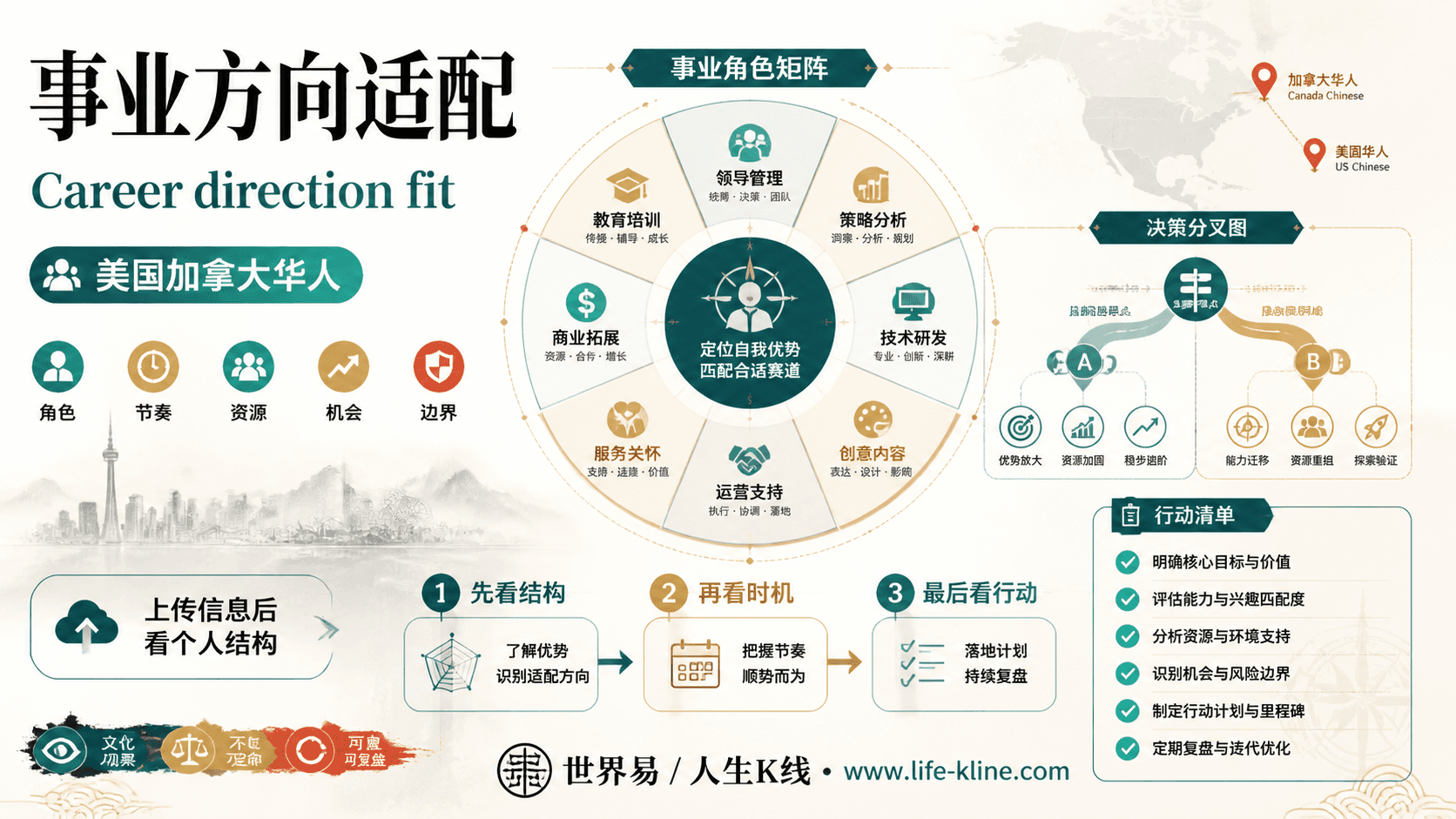
事业方向适配|美国加拿大华人
这张图把《Migration Decision-Making in Japan: Analysis of Staying or Returning for Business Manager Visa Holders, Highly Skilled Professionals, and Students Transitioning to Work》里的命理概念转成关系、边界和应用场景,适合先看图建立结构,再回到知识文章正文理解细节。
事业方向适配不应被写成固定结论。更适合美国加拿大华人的读法,是把传统术语翻译成结构、时机、环境、行动和复盘。
查看图片解读