Detailed Explanation of Feng Di Guan Hexagram and Its Application in the 64 Hexagrams
把这篇文章落到自己身上验证:先看结构,再进入个人分析,不做泛泛阅读。
Concept Definition
The Feng Di Guan Hexagram is one of the 64 hexagrams in traditional Chinese Yi Jing (I Ching) studies, composed of the Kun (坤, Earth) hexagram below and the Xun (巽, Wind) hexagram above. The entire hexagram imagery represents wind moving over the earth, symbolizing a process of observation and introspection. The core meaning of Feng Di Guan is “observation and reflection,” emphasizing gaining profound insight through meticulous observation.
The 64 hexagrams are formed by stacking two of the eight fundamental trigrams, each hexagram consisting of six lines (yao) arranged from bottom to top as the first line (初爻), second line (二爻), third line (三爻), fourth line (四爻), fifth line (五爻), and top line (上爻). In Feng Di Guan, the earth element represented by Kun symbolizes softness and receptivity, while wind represented by Xun symbolizes penetration and flow. Their combination signifies using subtle changes in the external environment to facilitate internal reflection.
In divination systems, Feng Di Guan emphasizes observation and introspection, advising people to quietly observe the essence of matters and avoid superficial judgments. The hexagram’s judgment (gua ci) reminds diviners to adopt a cautious attitude, focusing on self-examination and moral cultivation.
Traditional Fate Significance
The Feng Di Guan Hexagram symbolizes wind moving over the earth, implying observation and reflection. Kun represents earth, symbolizing compliance and tolerance; Xun represents wind, symbolizing penetration and dissemination. Their combination emphasizes achieving deep understanding through detailed observation. In traditional fate studies, Feng Di Guan is often used to guide individuals toward introspection and promote self-cultivation and moral education.
The hexagram advocates “宜静观” (should quietly observe), meaning that when facing complex situations, diviners are advised to remain calm and patient, carefully observing changes without rushing to conclusions. Conversely, “忌浅看” (avoid superficial viewing) warns against shallow or cursory understanding to prevent decision-making errors caused by hasty judgments.
The introspective and educational significance of Feng Di Guan has deep roots in ancient culture, often used to guide officials and scholars in self-cultivation, family governance, and state management. It emphasizes achieving self-improvement and social harmony through observing and reflecting on both internal and external conditions.
Practical Configuration and Interpretation
In Liu Yao (six-line) divination, interpreting Feng Di Guan depends on the relationships of Sheng-Ke (generating and overcoming) among the Shi Yao (世爻, the self line), Ying Yao (应爻, the responding line), and Yong Shen (用神, favorable element), combined with the overall hexagram imagery. When observing the hexagram, special attention is paid to the dynamic interaction between wind (Xun) and earth (Kun) to judge the trend of events. The advice to quietly observe means that when Feng Di Guan appears, one should increase observation and avoid rash actions.
In Plum Blossom Numerology (Mei Hua Yi Shu), the relationship between Ti (体, root) and Yong (用, use) is also determined by Sheng-Ke to assess auspiciousness. Ti represents the fundamental aspect, Yong represents change. As a hexagram symbolizing observation and reflection, Feng Di Guan advises diviners to focus on details and avoid being misled by superficial appearances. By analyzing the Sheng-Ke relationship between Ti and Yong, one can more accurately grasp the benefits and losses of a situation.
In practical application scenarios, Feng Di Guan is suitable for situations requiring careful analysis and reflection, such as career changes, family relationship adjustments, and academic planning. Diviners should use the symbolic meaning of Feng Di Guan to adopt a stance of quiet observation, avoiding hasty decisions and enhancing rational judgment.
Common Misunderstandings
Feng Di Guan emphasizes observation and reflection, but it is often misunderstood as passive waiting or inaction. In fact, Feng Di Guan advocates active, meticulous observation and profound introspection, which is a positive internal process rather than passive stagnation.
Another misunderstanding is to interpret Feng Di Guan simply as surface-level observation, neglecting the important warning of “avoid superficial viewing.” Superficial understanding leads to bias and misjudgment. One must integrate the overall hexagram information and Sheng-Ke relationships to deeply analyze and accurately grasp the true meaning of the hexagram.
FAQ
Question: How is Feng Di Guan Hexagram specifically applied in Liu Yao divination? Answer: In Liu Yao divination, Feng Di Guan focuses on the Sheng-Ke relationships among the Shi Yao, Ying Yao, and Yong Shen. By combining these core elements with the hexagram’s meaning of observation and reflection, it helps diviners clarify the situation and guide rational decision-making.
Question: Why does Feng Di Guan emphasize “should quietly observe” and “avoid superficial viewing”? Answer: Feng Di Guan symbolizes wind moving over earth, implying detailed observation and reflection. “Should quietly observe” means maintaining calmness and deeply observing the essence of matters; “avoid superficial viewing” warns against judging based only on surface phenomena to prevent misjudgment and blind actions.
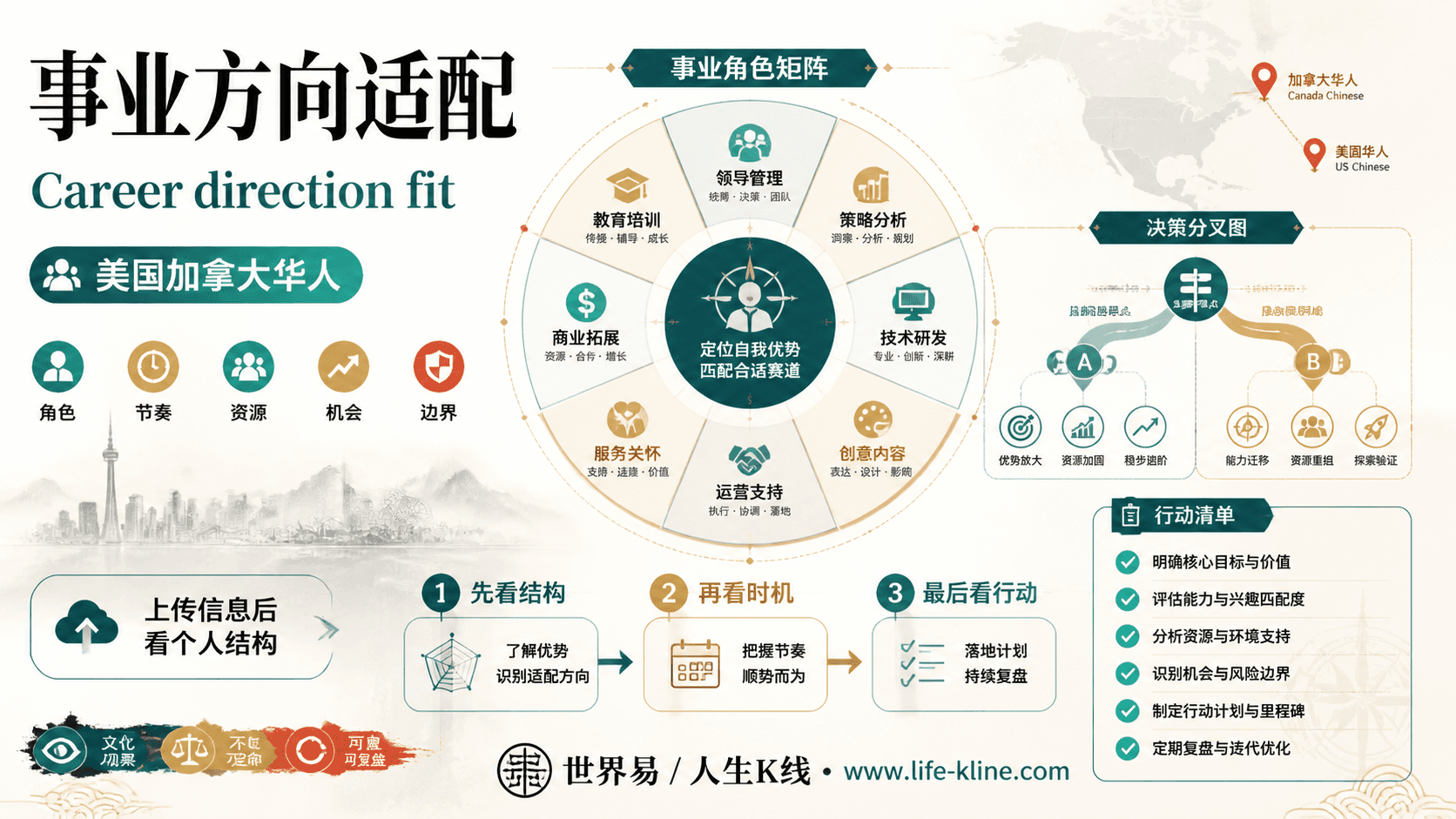
事业方向适配|美国加拿大华人
这张图把《Detailed Explanation of Feng Di Guan Hexagram and Its Application in the 64 Hexagrams》里的命理概念转成关系、边界和应用场景,适合先看图建立结构,再回到知识文章正文理解细节。
事业方向适配不应被写成固定结论。更适合美国加拿大华人的读法,是把传统术语翻译成结构、时机、环境、行动和复盘。
查看图片解读