Analysis of Hexagram Water-Wind Well: Metaphysical Wisdom of Quiet Cultivation and Adherence to the Ordinary
把这篇文章落到自己身上验证:先看结构,再进入个人分析,不做泛泛阅读。
Concept Definition
The Hexagram Water-Wind Well is formed by the overlap of two basic hexagrams, Xun below and Kan above. Xun represents wind, and Kan represents water, totaling six lines arranged from bottom to top. The well is stillness; its virtue lies in nourishing all things without ever drying up, symbolizing quiet cultivation and adherence to the ordinary.
Within the system of the sixty-four hexagrams, each hexagram is constructed by the combination of two basic hexagrams. Water-Wind Well is a unique combination outside of Feng-Li Tun and Ze-Feng Da Guo, emphasizing inner stability and outer circulation.
Traditional Metaphysical Meaning
The core meaning of the Well Hexagram is to nourish without exhaustion, emphasizing nourishment, stability, and emulating the virtue of the well. It teaches people to remain like well water, constant regardless of external changes, with inner clarity always available, suitable for stages requiring settling and accumulation.
The hexagram meaning explicitly states to adhere to the ordinary and avoid a barren well. If the human heart is like a barren well, though structurally sound, it lacks the vitality of water and cannot perform its nourishing function. Therefore, metaphysically, it emphasizes maintaining inner vitality and the continuous renewal of resources.
Practical Configuration and Judgment
In Liu Yao divination, judging fortune and misfortune centers on the Shiyong (world and response lines), Yong Shen (favorable deity), and Five Elements generation and control. One must examine whether the Yong Shen is supported by the ground and timing. If the Shiyong line is prosperous and generates or harmonizes the Yong Shen, it indicates smooth nourishment and stable career; if the Yong Shen is restrained, it is like the well water being blocked, making it difficult to reach the state of nourishment.
Plum Blossom Divination determines fortune and misfortune based on the generation and control relationship between the Ti (body) and Yong (use) hexagrams. The Ti hexagram represents the self, and the Yong hexagram represents the matter being inquired about. If the Ti hexagram controls or generates the Yong hexagram, it aligns with the virtue of the well, resulting in double the effort for half the result; if the Yong hexagram controls the Ti hexagram, it is like water flooding the well, causing harm instead of benefit.
Common Misconceptions
Many mistakenly believe the Well Hexagram refers solely to remaining motionless. In reality, the well also possesses the nature of circulation. Although the hexagram meaning emphasizes stillness, it is stillness for the purpose of nourishing without exhaustion; if completely rigid, it violates the original intent of nourishment and easily leads to the pitfall of a barren well.
Another misconception is viewing the Well Hexagram merely as a hexagram for seeking wealth. Although the well can nourish people, its core lies in virtue and stability. If one forces change or engages in speculation, they lose the foundation of emulating the virtue of the well, leading to completely incorrect fortune and misfortune judgments.
FAQ
Question: What is suitable for the Water-Wind Well Hexagram? Answer: It is suitable for maintaining the ordinary, ideal for settling and accumulating in career or studies. One should not change frequently and needs to maintain the continuous renewal and nourishment of inner resources.
Question: How to judge if the Well Hexagram becomes misfortune? Answer: If the hexagram image shows the Yong Shen being restrained or the Ti and Yong hexagrams clashing, with no support, it is like a barren well without water, indicating that affairs will not succeed. One must be vigilant against resource depletion or environmental deterioration.
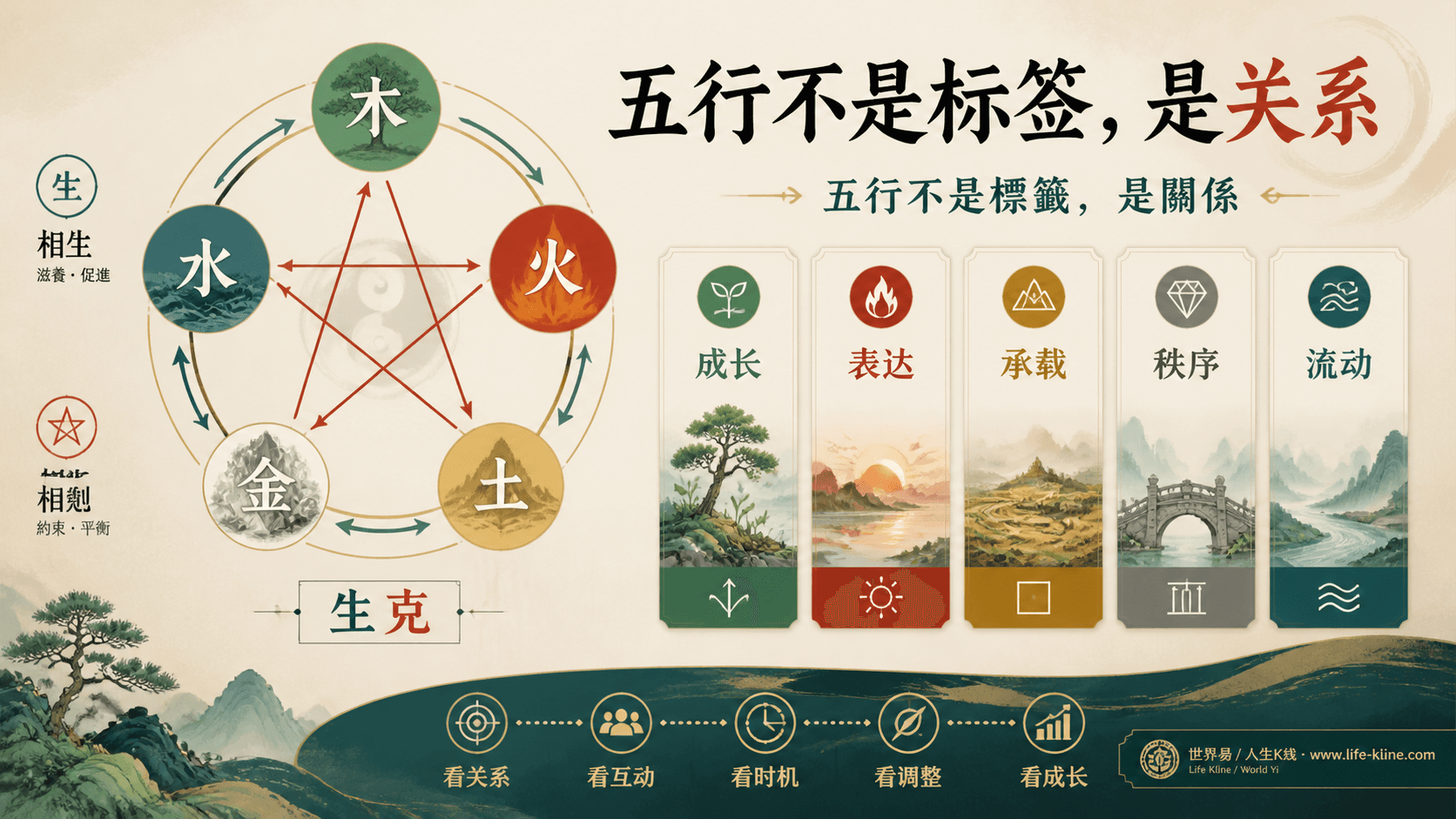
五行现代翻译图
这张图把《Analysis of Hexagram Water-Wind Well: Metaphysical Wisdom of Quiet Cultivation and Adherence to the Ordinary》里的命理概念转成关系、边界和应用场景,适合先看图建立结构,再回到知识文章正文理解细节。
五行图把金木水火土从人格标签翻译成系统关系,帮助用户理解生克、承载和转化。