Hexagram Fire-Wind Ding: Metaphysical Insights on New Establishment, Stability, and Dedication
把这篇文章落到自己身上验证:先看结构,再进入个人分析,不做泛泛阅读。
Concept Definition
Hexagram Ding is the 56th hexagram among the sixty-four, formed by stacking two eight-line hexagrams. Each hexagram contains six line positions, called from bottom to top as the Initial Line through the Upper Line. Its structure consists of Xun below and Li above; Xun represents wind, while Li represents fire, with wind below and fire above.
The word Ding refers to a vessel. This hexagram uses the image of a cooking vessel, symbolizing placing food in a Ding to heat it, thereby shaping the ingredients and transforming them into edible items. This process symbolizes transforming an originally unordered or vague state into an ordered, stable form, emphasizing the importance of positioning and establishment.
Traditional Metaphysical Significance
Within the evolutionary system of the sixty-four hexagrams, Hexagram Ding follows immediately after Hexagram Da Guo, inheriting the task of reconstruction after change. The hexagram meaning explicitly indicates new establishment, meaning a new order is being established, with old unstable structures broken down and replaced by a solid foundation.
Ding also signifies stability, just as cooking requires constant heat to form a vessel. In metaphysics, this hexagram is considered favorable for stabilizing situations and is suitable for careers requiring long-term investment and accumulation. Furthermore, the hexagram meaning emphasizes dedication, suggesting that those who possess this hexagram often possess noble virtues of selflessness and achieving others.
Practical Configuration and Interpretation
In Six Lines Divination, judgment centers on the World Line, Response Line, Yong Shen (favorable deity), and the generating/restraining relationships. If the World Line is in its proper position and supports the Yong Shen, or if the hexagram image shows Li Fire and Xun Wind supporting each other, it is judged as an auspicious sign, predicting that matters of new establishment will unfold stably.
Mei Hua Yi Shu focuses on the generating/restraining relationship between the Body and Use to determine fortune and misfortune. Taking the main hexagram as the Body and the changing hexagram as the Use, if the Body is supported by the Use, or if Li Fire and Xun Wind in the Fire-Wind Ding hexagram form a benign interaction, it indicates good fortune. Conversely, if the Use restrains the Body, one must beware that the foundation of new things may be unstable.
Common Misunderstandings
People often mistakenly believe that Hexagram Ding refers solely to wealth accumulation or the stabilization of power, ignoring its core connotations of dedication and respect for etiquette. In fact, the success of Hexagram Ding often rests on giving to others and abiding by the laws of propriety; pursuing private gain alone rarely fulfills the meaning of the hexagram.
Another misunderstanding is ignoring the warning against frivolity in the hexagram meaning. As a cooking vessel, Ding requires precise heat control; if actions are rash and lack planning, even the image of new establishment will fail to endure due to a shallow foundation, ultimately leading to the disaster of the Ding overturning.
FAQ
Q: Is Hexagram Ding suitable for starting a business? A: Yes, but one must focus on the stability of new establishment and the team's spirit of dedication. Frivolous and rash advancement is to be avoided; actions should be guided by respect for etiquette to gather support.
Q: What is the special meaning of the structure of Xun below and Li above in the Ding hexagram? A: Xun Wind enters Li Fire, symbolizing a gentle wind fostering the fire, while the fire stirs the wind. This implies internal and external coordination, which is favorable for the growth and shaping of new things.
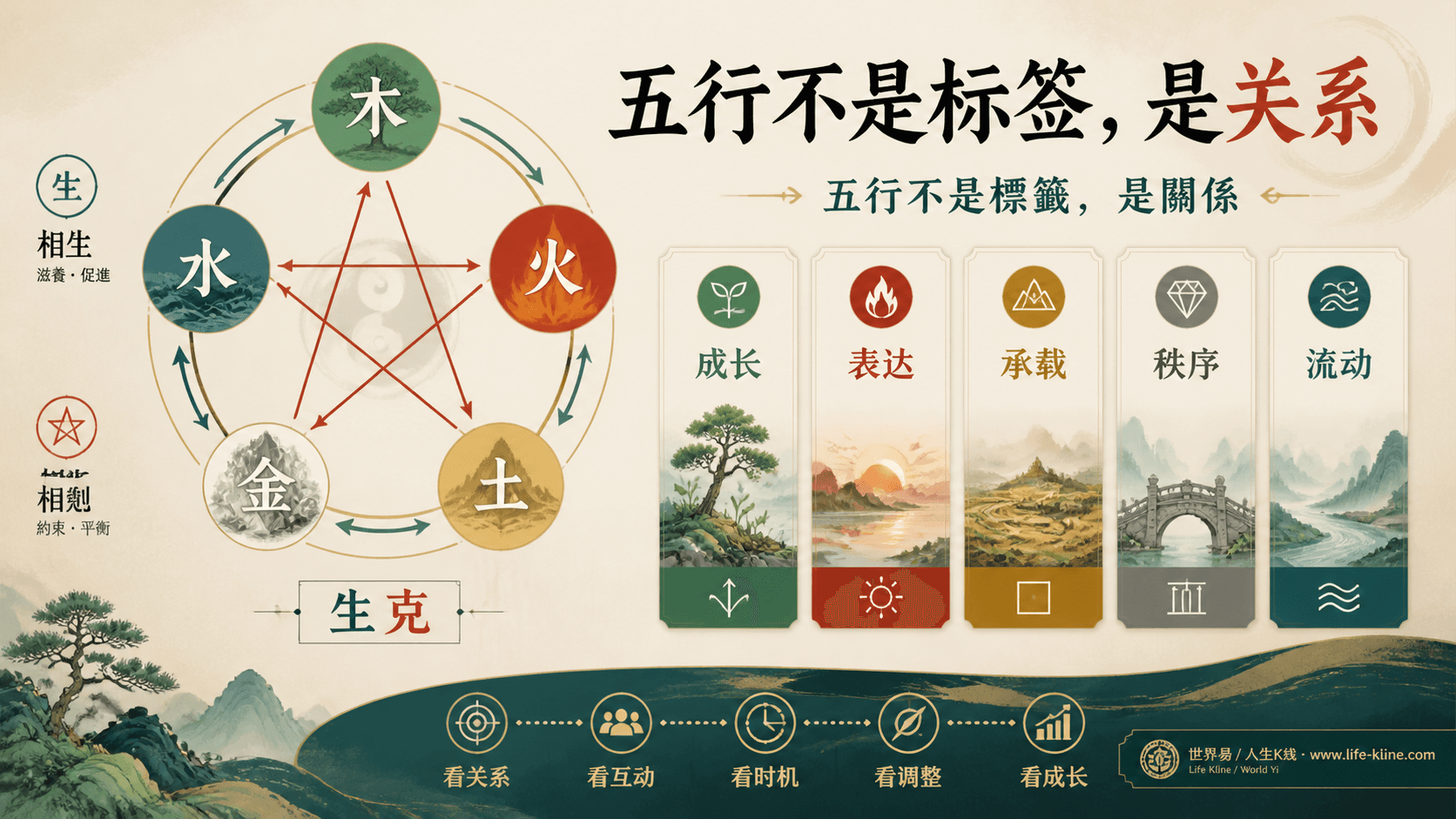
五行现代翻译图
这张图把《Hexagram Fire-Wind Ding: Metaphysical Insights on New Establishment, Stability, and Dedication》里的命理概念转成关系、边界和应用场景,适合先看图建立结构,再回到知识文章正文理解细节。
五行图把金木水火土从人格标签翻译成系统关系,帮助用户理解生克、承载和转化。