The Meaning and Application Analysis of the Tian Shui Song Hexagram — The Symbol of Disputes in the 64 Hexagrams
把这篇文章落到自己身上验证:先看结构,再进入个人分析,不做泛泛阅读。
Concept Definition
The Tian Shui Song hexagram is one of the 64 hexagrams in the I Ching, composed by stacking the lower trigram Kan (Water) and the upper trigram Qian (Heaven). According to the construction rules of the 64 hexagrams, each hexagram consists of two three-line trigrams stacked together, totaling six lines, named from bottom to top as the first line (初爻), second line (二爻), third line (三爻), fourth line (四爻), fifth line (五爻), and top line (上爻). In the hexagram image of Tian Shui Song, Kan below symbolizes water, and Qian above symbolizes heaven, forming a specific symbolic meaning.
The character “讼” (Song) originally means dispute, contention, or disharmony. Therefore, the Tian Shui Song hexagram implies disagreement and conflict. The main theme governed by this hexagram is disputes, lawsuits, and verbal arguments, reminding people to adopt an attitude of cessation and moderation when facing conflicts, avoiding forceful demands that may escalate tensions. The core meaning of Tian Shui Song hexagram is a warning that disputes are difficult to reconcile and require cautious handling.
In I Ching divination, the Tian Shui Song hexagram serves as an important symbol for judging the state of disputes. It alerts the diviner to potential conflicts and disagreements, reflecting tense relationships and conflict situations within the event.
Traditional Metaphysical Significance
The Tian Shui Song hexagram holds clear symbolic significance in traditional metaphysics. Kan represents water, symbolizing danger and traps, while Qian represents heaven, symbolizing strength and authority. The combination of the upper and lower trigrams forms a scenario of dispute, implying that the person involved may encounter opposition and conflict in actions or decisions.
Ancient texts regard the Song hexagram as unfavorable for forceful pursuit, emphasizing harmony as precious. Disputes and disharmony, if one stubbornly insists on their own view, often lead to greater conflicts. Therefore, traditional metaphysics suggests adopting strategies of cessation and concession when encountering the Song hexagram to seek peaceful resolution. This hexagram is also commonly used to judge the auspiciousness or inauspiciousness of lawsuits, indicating a high possibility of legal disputes.
The Tian Shui Song hexagram embodies the I Ching philosophy of “change” (变易, Bian Yi) and “moderation” (中和, Zhong He), reminding people to assess the situation in disputes, adapt to changes, avoid forcible intervention, and ultimately achieve harmony.
Practical Configuration and Interpretation
In the practical application of Liu Yao (Six Lines) divination, the interpretation of the Tian Shui Song hexagram focuses on the relationships among the Shi Yao (世爻, the self line), Ying Yao (应爻, the opposing line), Yong Shen (用神, favorable element), and the generating/overcoming (sheng/ke) relationships. By analyzing the yin-yang, movement, and interactions of each line, combined with the basic hexagram image of Tian Shui Song, one can judge the nature of the dispute, its development trend, and the possibility of resolution.
For example, when the Shi Yao and Ying Yao lines indicate obvious conflict, and the Yong Shen is restrained or controlled, it usually suggests that the dispute is difficult to reconcile and that cessation or moderation measures should be taken. Conversely, if the Yong Shen is supported or generated, although there is a dispute, it is likely to be resolved properly. The Plum Blossom Numerology (Mei Hua Yi Shu) further determines auspiciousness and event direction through the generating and overcoming relationships between the main and auxiliary elements.
In practical use, the Tian Shui Song hexagram is often applied to predict lawsuits, business disputes, and family quarrels. Diviners should follow the principle indicated by the hexagram “cease rather than force” to adjust strategies reasonably and avoid escalating conflicts.
Common Misunderstandings
Many people mistakenly believe that the Tian Shui Song hexagram necessarily means losing a lawsuit or absolute misfortune. In fact, this hexagram emphasizes the state of dispute and the attitude toward handling it rather than simply good or bad fortune. Correctly understanding the meaning of “cease rather than force” is key to properly interpreting the Song hexagram.
Another misunderstanding is ignoring the generating and overcoming (sheng/ke) relationships among the six lines and judging the result solely based on the hexagram’s name. Although the Tian Shui Song hexagram represents disputes, the specific auspiciousness or inauspiciousness must be comprehensively judged by combining the Shi Yao, Ying Yao, Yong Shen, and the generating/overcoming relationships to avoid one-sided interpretations.
FAQ
Question: Why does the Tian Shui Song hexagram govern disputes and lawsuits? Answer: The Tian Shui Song hexagram is composed of Kan (Water) below and Qian (Heaven) above. Kan symbolizes danger, and Qian symbolizes strength. Their combination represents disputes and disharmony, thus governing conflicts, lawsuits, and verbal disputes.
Question: How should one respond when encountering the Tian Shui Song hexagram? Answer: According to the hexagram’s meaning, Tian Shui Song advises cessation and warns against forceful pursuit. When facing this hexagram, one should adopt a conciliatory and yielding attitude to avoid intensifying disputes and seek peaceful resolution.
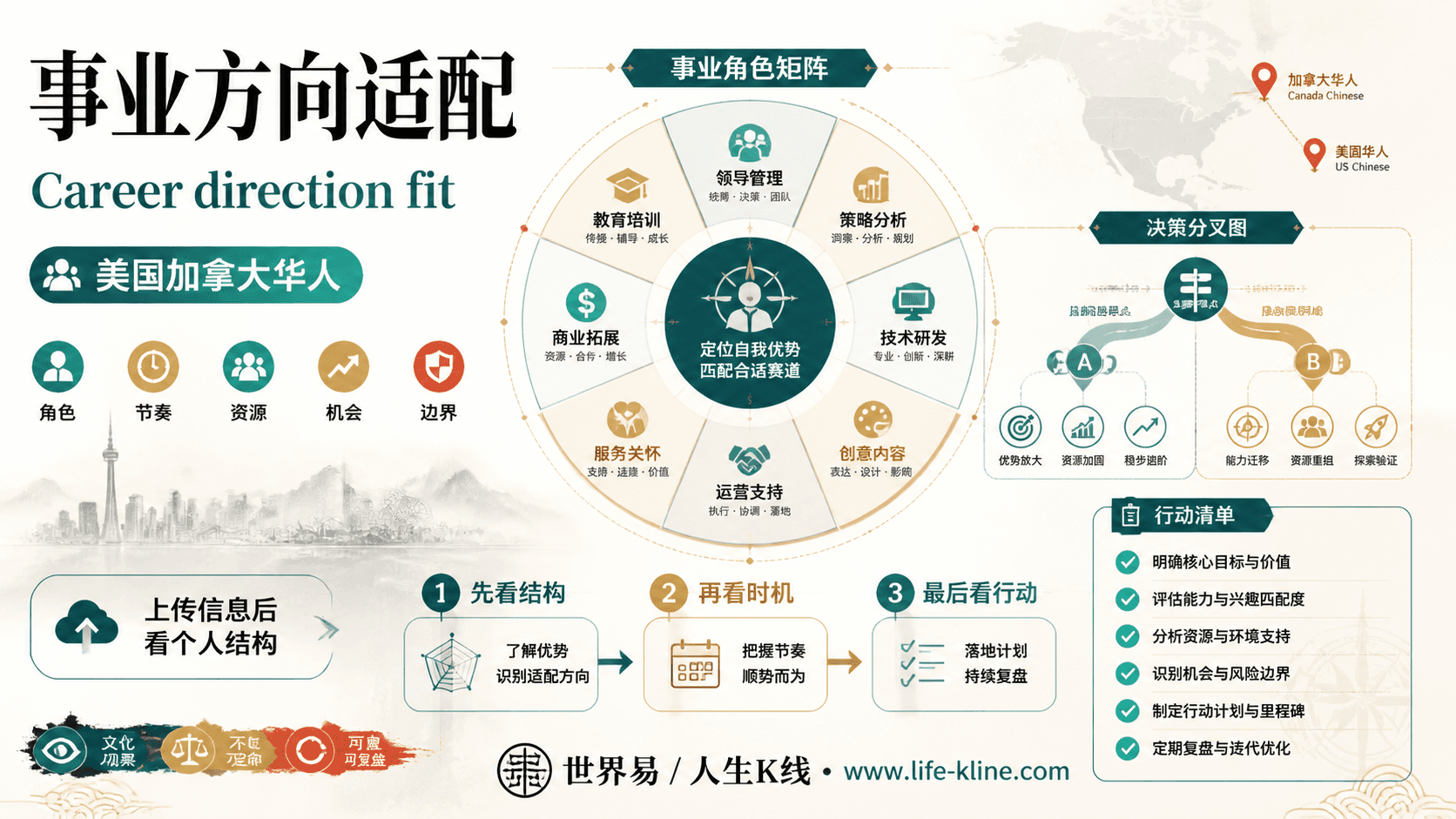
事业方向适配|美国加拿大华人
这张图把《The Meaning and Application Analysis of the Tian Shui Song Hexagram — The Symbol of Disputes in the 64 Hexagrams》里的命理概念转成关系、边界和应用场景,适合先看图建立结构,再回到知识文章正文理解细节。
事业方向适配不应被写成固定结论。更适合美国加拿大华人的读法,是把传统术语翻译成结构、时机、环境、行动和复盘。
查看图片解读