Engineer Industry Suitability Decision-Making: A Metaphysical Perspective on Career Matching
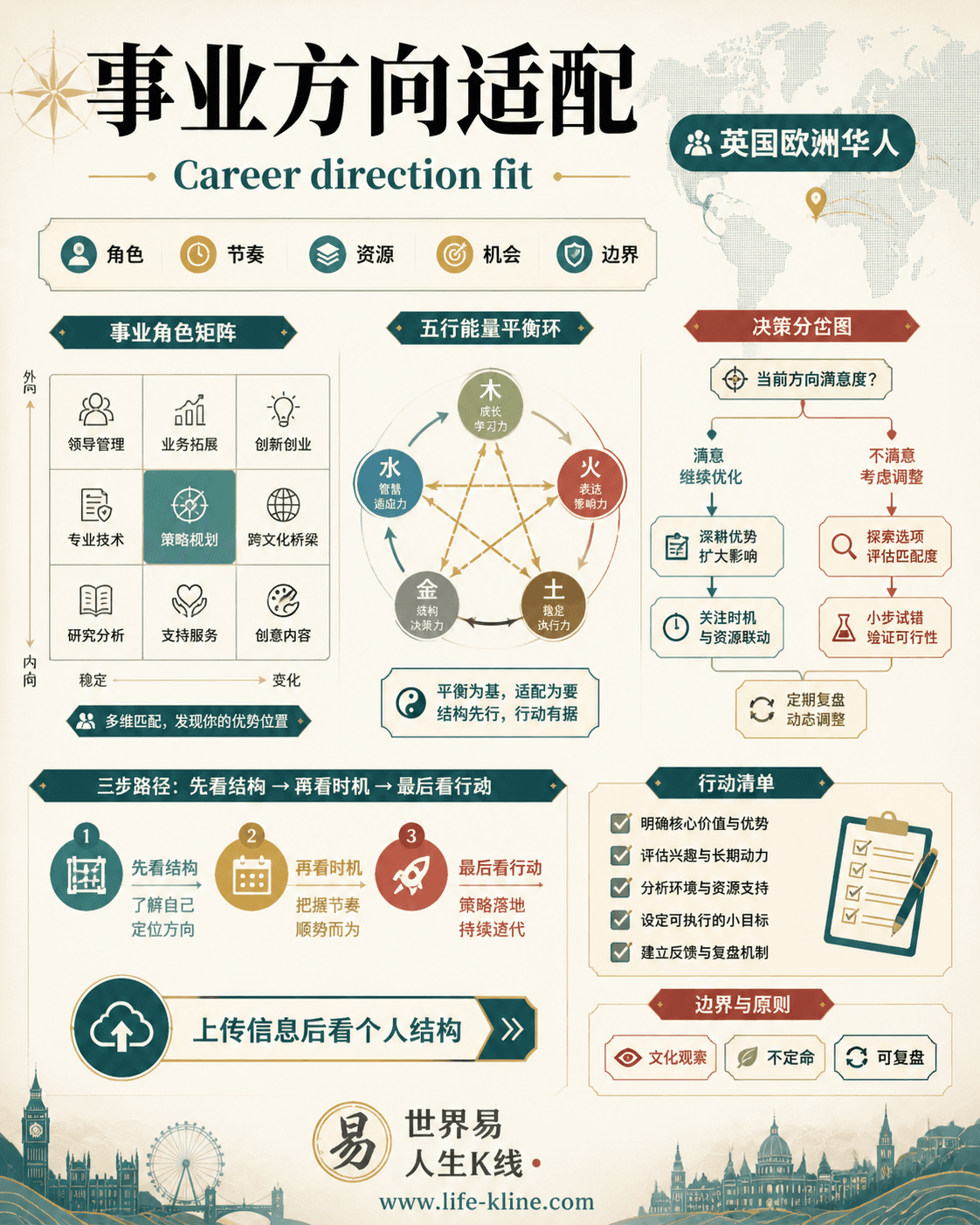
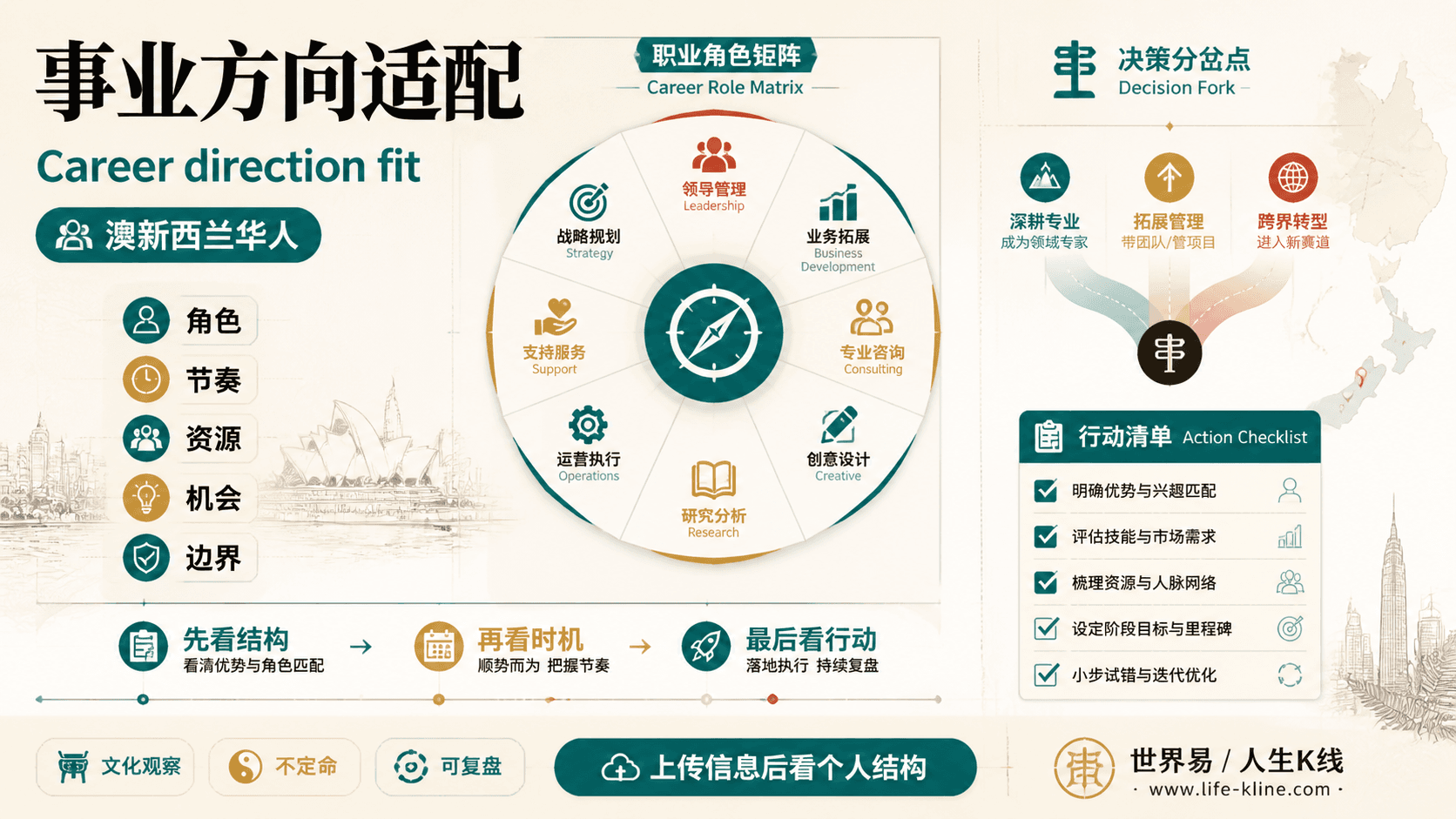
把这篇文章落到自己身上验证:先看结构,再进入个人分析,不做泛泛阅读。
Why This Decision Is Especially Difficult in This Field
The engineering profession is highly specialized and carries great responsibility, especially in on-site operations and project management where safety boundaries must not be crossed. The work pace is fast and fluctuates significantly. Engineers often need to commute between construction sites and home, making the balance between family life and professional pressure a key challenge. Promotion structures usually rely on project experience and technical accumulation, which determine income stability and growth potential.
From a metaphysical perspective, engineers commonly have Pian Yin (偏印) and Zheng Guan (正官) among the Ten Gods (十神). These Ten Gods correspond to occupational traits emphasizing rules and professional competence but also come with psychological and physical depletion. Industry suitability decisions require weighing the individual's Yong Shen (favorable elements) and Ji Shen (unfavorable elements) to judge whether the Day Master can endure the high intensity and pressure of the field and whether stable development potential exists.
The length of project cycles and the uncertainty of on-site environments make the Day Master's adaptability during different Da Yun (decade luck cycles) and Liu Nian (annual fortune) especially critical. The stability of Da Yun combined with the flexibility of Liu Nian determines whether an engineer can maintain achievements during crucial periods or encounter bottlenecks due to metaphysical structural conflicts.
Therefore, when making industry suitability decisions, engineers must deeply analyze the strength of the Day Master, the pattern (格局), and the balance and clashes among Yong Shen and Ji Shen within their metaphysical structure, in addition to professional skills, to find a development path that suits them and avoid career burnout or stagnation caused by metaphysical depletion.
Three Core Dimensions of Metaphysical Judgment
Firstly, the strength of the Day Master is the foundation for evaluating career suitability. As a profession combining technical and managerial roles, engineers ideally have a neutral or slightly strong Day Master to bear work pressure and sustain continuous learning. A weak Day Master may face risks of insufficient energy and decision-making ability, affecting on-site adaptability and project management.
Secondly, the pattern (格局) type determines the Day Master's personality and behavioral mode. The Zheng Guan (正官) pattern emphasizes responsibility and rules, aligning with the normative requirements of engineering; the Shang Guan (伤官) pattern reflects innovation and expression desires, suitable for technical research but possibly conflicting with regulatory demands. The combination of Pian Yin (偏印) and Zheng Guan (正官) reflects a balance of technical accumulation and management ability, a typical metaphysical feature of engineers.
Thirdly, the choice of Yong Shen directly relates to the Day Master's energy replenishment and depletion. Wood is often the Yong Shen in engineers' metaphysics, representing growth and support, suitable for continuous learning and development; Ji Shen such as Water or Fire may cause energy conflicts, amplifying occupational pressure or harming health. Da Yun and Liu Nian should align with the Yong Shen, where stable Da Yun favors maintaining achievements, and Liu Nian’s flexibility brings opportunities and challenges to the workplace.
Integrating these three dimensions, engineers making industry suitability decisions should focus on the stable support of the Day Master, the compatibility of the pattern with occupational requirements, and the reasonable supplementation by Yong Shen, while avoiding excessive depletion by Ji Shen, thereby optimizing their career development path.
Three Real BaZi Chart Cases
Case 1: The Day Master is Bing Fire (丙火), neutral in strength, with a Zheng Guan (正官) pattern and Wood as the Yong Shen. The current Da Yun is Wu Zi (戊子) (ages 45-54). The Bing Fire Day Master symbolizes positivity and leadership in the engineering profession; the Zheng Guan pattern reinforces rules and responsibility, aligning with safety boundaries on-site and project cycle management. The Yong Shen Wood supports the Day Master’s growth, beneficial for technical and managerial skill enhancement. The Wu Zi Da Yun is stable and suitable for maintaining achievements and steady development. This chart shows strong career matching in industry suitability decisions, able to cope well with the pressure of commuting between construction sites and home. It is recommended to focus on the impact of Da Yun and Liu Nian on the Yong Shen, especially when Liu Nian changes, to assess whether adjusting project pace or work focus is appropriate.
Case 2: The Day Master is Ren Water (壬水), weak in strength, with a Shang Guan (伤官) pattern and Metal as the Yong Shen. The current Da Yun is Geng Yin (庚寅) (ages 42-51). The weak Ren Water Day Master indicates insufficient energy and decision-making ability; the Shang Guan pattern shows innovation desire and expressive ability but may conflict with the rules required in engineering. Although the Yong Shen Metal assists decision-making, the presence of Ji Shen Wood and Fire increases occupational depletion. The Geng Yin Da Yun is stable and suitable for maintaining achievements, but the overall metaphysical structure suggests this individual may face adaptation difficulties in traditional engineering roles, especially in high-pressure on-site environments. Industry suitability decisions should focus on whether transitioning to technical research or R&D management roles is more appropriate to avoid career bottlenecks caused by metaphysical conflicts. The judgment sequence should first evaluate the balance between the Day Master and Yong Shen, then combine the current Da Yun and Liu Nian to adjust the career path.
Case 3: The Day Master is Wu Earth (戊土), slightly strong, with a Zheng Guan (正官) pattern and Wood and Water as the Yong Shen. The current Da Yun is Geng Wu (庚午) (ages 47-56). The strong Wu Earth Day Master has stable bearing capacity and endurance; the Zheng Guan pattern fits the engineering profession’s demand for responsibility and rules. The complementary Yong Shen Wood and Water benefit technical innovation and interpersonal coordination in the career. The Geng Wu Da Yun is stable, suitable for maintaining achievements and has potential for upward development. This chart naturally scores high in industry suitability decisions, particularly suitable for undertaking project management and on-site coordination responsibilities. It is recommended to focus on how Da Yun and Liu Nian support the Yong Shen, reasonably arrange work pace and family life, and avoid excessive depletion.
These three cases illustrate differences in metaphysical structures affecting engineers’ career matching. The strength of the Day Master, pattern type, and the reasonable combination of Yong Shen and Ji Shen directly influence career development and adaptability. By tracking changes in Da Yun and Liu Nian, engineers can dynamically adjust career strategies, enhancing the scientific basis of industry suitability decisions.
Common Misjudgments and Blind Spots in This Field
A common misjudgment in engineers’ industry suitability decisions is over-reliance on a single metaphysical factor, such as focusing only on the Day Master’s strength while neglecting the coordination of the pattern and Yong Shen, leading to one-sided judgments. Ignoring the regulatory role of Da Yun and Liu Nian on work pace and pressure also causes decisions to lack dynamic adjustment possibilities.
Another blind spot is neglecting the particularity of the actual working environment. Engineers frequently switch between construction sites and home, so the metaphysical sensitivity to transportation, relocation, and environmental changes should be fully considered; otherwise, it is difficult to predict family conflicts and health impacts in career suitability.
Additionally, mistakenly equating Ji Shen simply with negative effects while ignoring that Ji Shen may sometimes provide motivational effects during certain phases also affects accurate grasp of career paths. The correct approach is to combine specific Da Yun and Liu Nian situations to judge the intensity and timing of Ji Shen’s influence.
Finally, since engineers’ promotion often depends on project experience accumulation, failing to integrate the metaphysical analysis with the industry’s promotion structure and income changes may cause decisions to lack practical guidance. Career suitability judgments must combine metaphysics with industry characteristics to avoid purely theoretical analyses.
Practical Judgment Sequence
To assess engineer industry suitability, the first step is to confirm whether the Day Master’s strength and pattern fit the occupational characteristics. A neutral or slightly strong Day Master with a Zheng Guan (正官) pattern usually has strong responsibility and stability, suitable for engineering positions. If the Day Master is weak or the pattern is Shang Guan (伤官), caution is needed regarding suitability for traditional engineering roles.
The second step is to analyze the balance between Yong Shen and Ji Shen, focusing on whether the Yong Shen effectively supports the energy required by the Day Master and pattern, and whether Ji Shen poses excessive depletion risks. Combining the current Da Yun and Liu Nian allows judgment of changes in occupational pressure and opportunities, deciding whether to maintain achievements or actively expand.
Finally, adjust the career path based on the match between metaphysical structure and real work pace and family situation. The suitable timing for action is when Da Yun and Liu Nian mutually support and Yong Shen is abundant. When Ji Shen is strong or Da Yun and Liu Nian conflict, it is advisable to maintain achievements or wait appropriately, avoiding overextension causing career bottlenecks.
By following these steps, engineers can scientifically evaluate the match between their metaphysical traits and career demands, formulating career development plans better aligned with their actual situation.
FAQ
Question 1: If the Day Master is weak in an engineer’s BaZi chart, does that mean they are definitely unsuitable for this profession? Answer: A weak Day Master indicates lower bearing capacity, but combined with support from the pattern and Yong Shen, one can sometimes still be competent as an engineer. The key is whether the Yong Shen can effectively replenish the Day Master’s energy and how Da Yun and Liu Nian coordinate; it is not appropriate to judge solely by the Day Master’s strength.
Question 2: Why is the Zheng Guan (正官) pattern important for the engineering profession? Answer: The Zheng Guan pattern emphasizes responsibility and rule awareness, aligning with the strict safety and standards requirements in engineering work, aiding workplace stability and promotion. However, it also needs to be combined with Yong Shen to judge whether it can effectively support the pressure associated with Zheng Guan.
Question 3: How to use Da Yun and Liu Nian to judge the timing of career decisions for engineers? Answer: When Da Yun and Liu Nian mutually support each other and Yong Shen is abundant, it is suitable to actively expand and take on new projects; conversely, when Ji Shen is strong or Da Yun and Liu Nian conflict, it is better to maintain a low profile, preserve achievements, or moderately adjust work pace to avoid workplace risks.
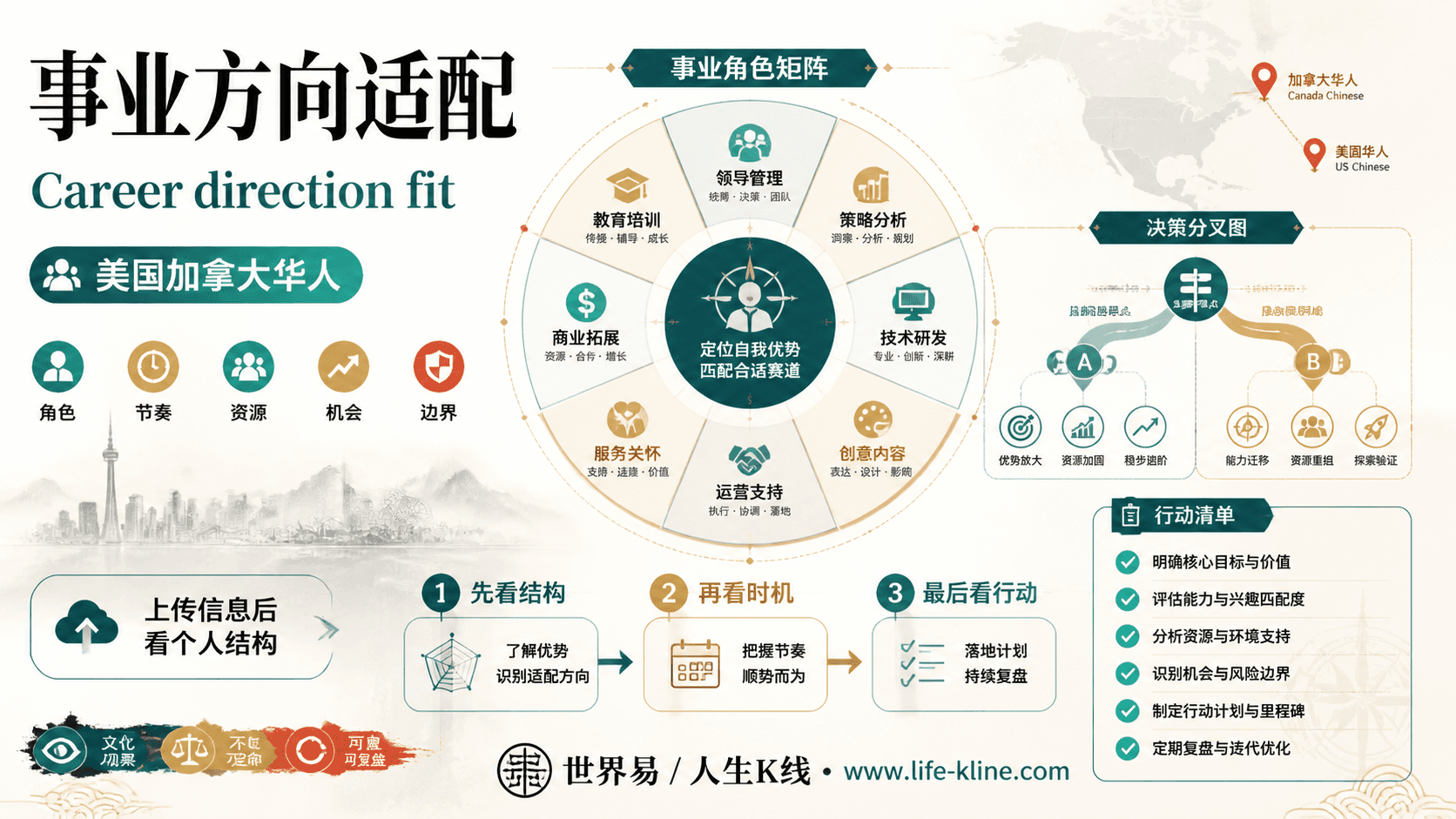
事业方向适配|美国加拿大华人
这张图把《Engineer Industry Suitability Decision-Making: A Metaphysical Perspective on Career Matching》里的命理概念转成关系、边界和应用场景,适合先看图建立结构,再回到知识文章正文理解细节。
事业方向适配不应被写成固定结论。更适合美国加拿大华人的读法,是把传统术语翻译成结构、时机、环境、行动和复盘。
查看图片解读