BaZi Analysis and Practical Guidance on Timing for Engineers' Job Changes and Career Transitions
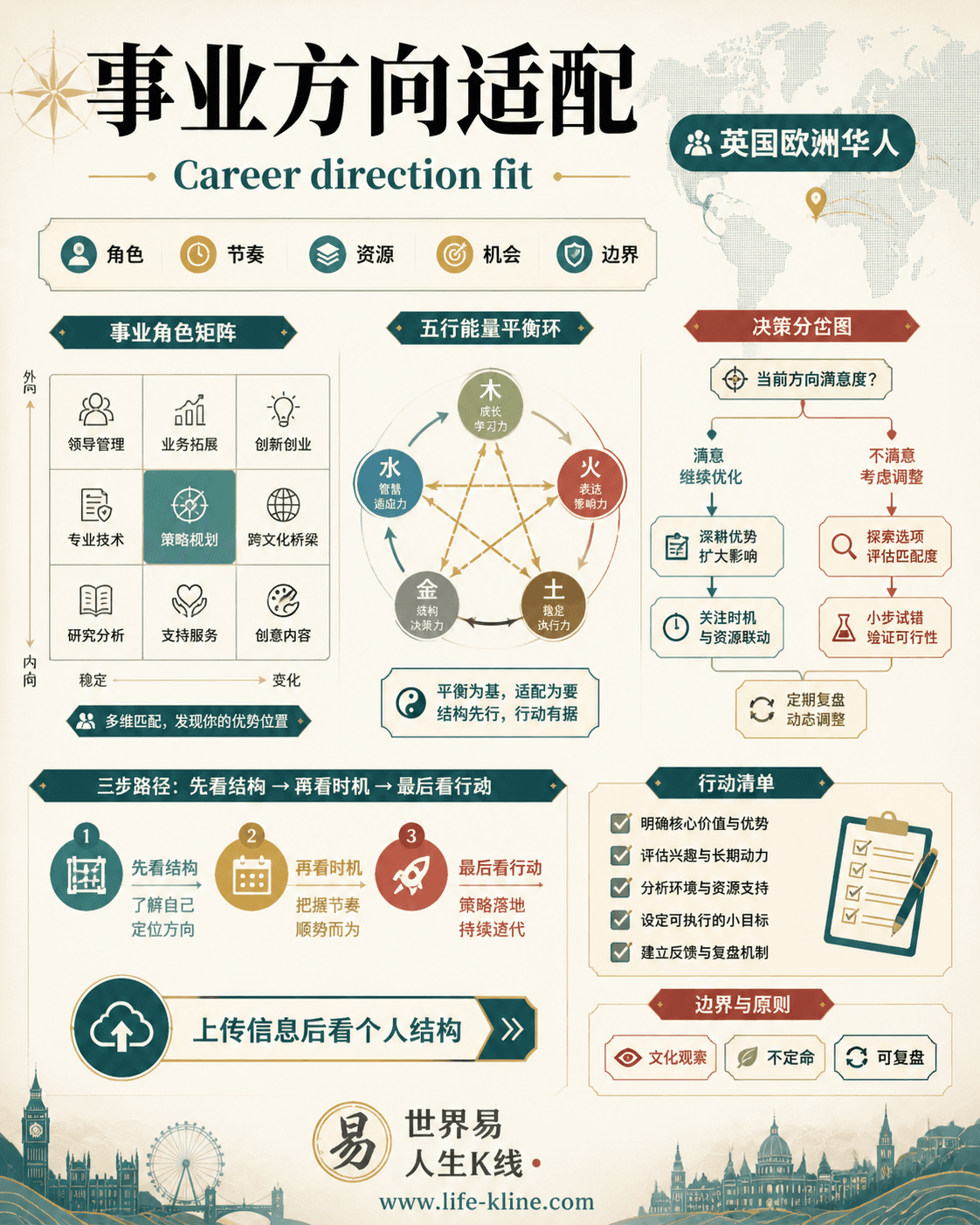
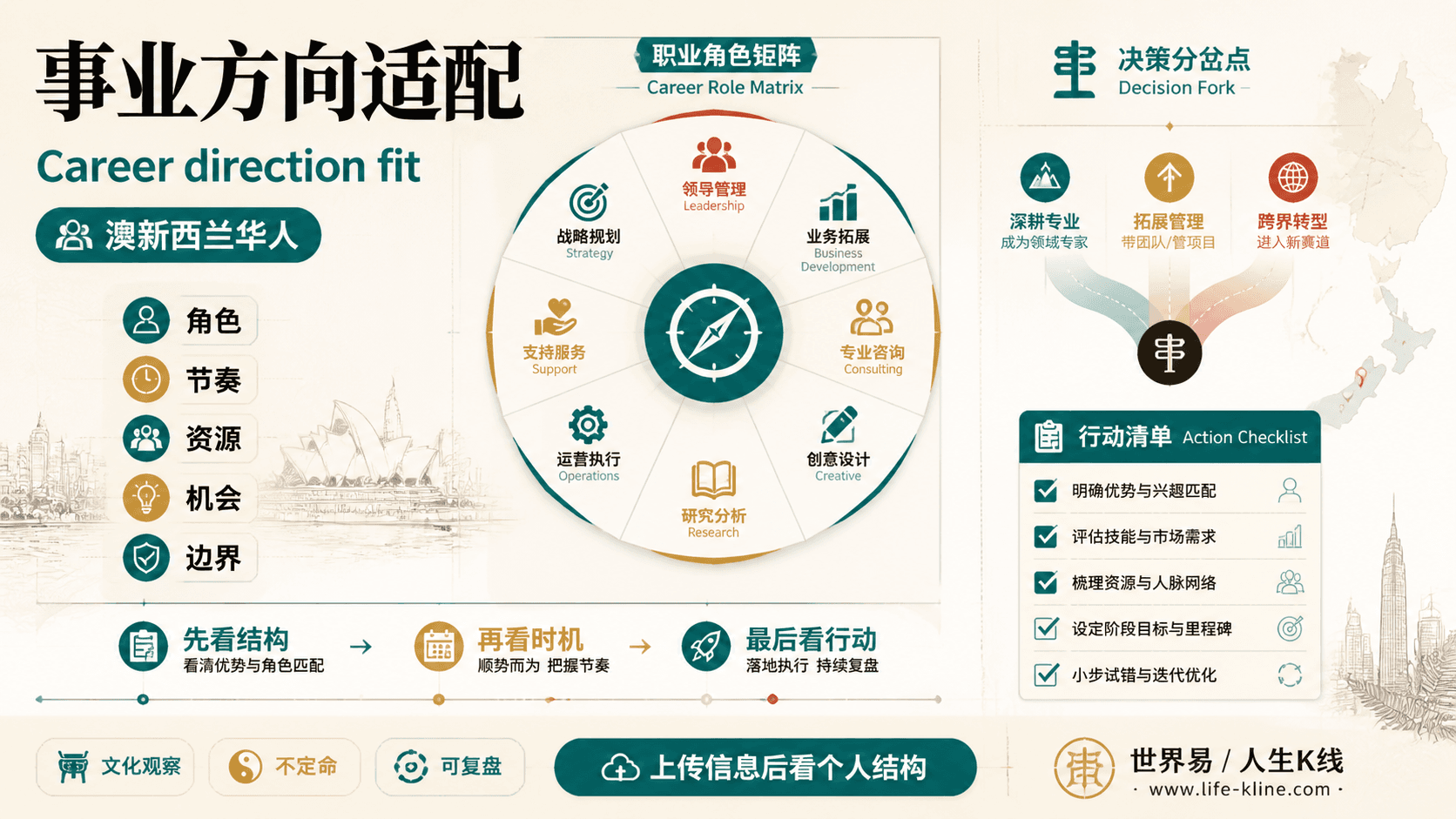
把这篇文章落到自己身上验证:先看结构,再进入个人分析,不做泛泛阅读。
Why This Decision Is Especially Difficult in This Profession
The decision for engineers to change jobs or transition careers is particularly complex, mainly due to the nature of the industry’s on-site work and project cycle characteristics. Engineers must not only face strict safety red lines and on-site management pressures but also balance between the construction site and family life, with a tight work rhythm and heavy responsibilities. These real-world constraints mean that the timing of job changes or transitions profoundly impacts both personal career development and family life.
Regarding income structure, engineers generally rely on project bonuses and salary increments from rank promotions. Job changes and transitions often come with income uncertainty and risks. Especially in engineering fields with relatively fixed promotion structures, improper choices in transitions or job changes may lead to career stagnation or even regression, creating dual psychological and financial pressures.
In BaZi structures, engineers commonly exhibit Pian Yin (偏印) and Zheng Guan (正官) main lines, reflecting the accumulation of professional skills and the need for regulated management. Pian Yin represents professional knowledge and technical support, while Zheng Guan symbolizes norms, responsibility, and authority. The configuration of Yong Shen (favorable elements) and Ji Shen (unfavorable elements), as well as the combination of Da Yun and Liu Nian, often amplifies or suppresses these occupational traits, influencing the success rate and stability during transitions and job changes.
Therefore, when engineers face decisions about job changes and career transitions, they must comprehensively consider the pressures of the real work environment and changes in their BaZi structure, accurately identifying favorable timing for transitions and stages that require perseverance, avoiding blind following of trends or premature exits, to ensure sustainable and healthy career development.
Three Core Dimensions of BaZi Judgment
The Day Master and the BaZi pattern serve as the foundation for judging the timing of engineers’ job changes and career transitions. The Day Master represents the individual’s core energy. Pian Yin and Zheng Guan patterns correspond to engineers’ technical accumulation and management responsibilities. Engineers with Pian Yin patterns mostly rely on professional knowledge support, requiring attention to the strength or weakness of the Yong Shen water element during transitions; those with Zheng Guan patterns emphasize responsibility and regulation, needing caution against interference from Ji Shen wood or earth elements.
The identification of Yong Shen and Ji Shen directly affects the success or failure of transitions. In engineers’ BaZi, Yong Shen often includes water, metal, or fire, representing technical fluidity and management capabilities, while Ji Shen such as fire, earth, or wood may bring obstacles or depletion. Changes in the combination of Da Yun and Liu Nian determine the strength or weakness of the Yong Shen. Acting in harmony with favorable trends significantly increases the success rate of transitions; acting against the trend suggests maintaining the status quo and avoiding rash moves.
The interaction between Liu Nian and Da Yun is key to judging the timing for job changes and career transitions. Da Yun represents long-term trends, while Liu Nian reflects annual changes. For example, engineers in the Xin Hai Da Yun (辛亥, 51-60 years) or Geng Zi Da Yun (庚子, 37-46 years) periods should consider the influence of Liu Nian Bing Wu (丙午) to decide whether it is suitable to take action. In stable Da Yun periods encountering variable Liu Nian, cautious evaluation is necessary; in auspicious Da Yun periods with favorable Liu Nian, proactive transitions are advisable.
The combination of the Ten Gods (Shi Shen 十神) in engineers’ BaZi reflects occupational roles and external environmental interactions. The balance between Pian Yin and Zheng Guan determines the synergy between technical skills and management. Jie Cai (劫财) and Pian Cai (偏财) patterns may introduce external resources or competitive pressures. Comprehensive analysis of the Ten Gods assists in identifying risks and advantages during job changes and transitions, providing metaphysical support for decision-making.
Three Real BaZi Case Studies
Case 1: This male engineer has a Jia Wood (甲木) Day Master with a Shang Guan (伤官) pattern, relatively weak, with Yong Shen being water and Ji Shen being fire and earth. Currently in the Xin Hai Da Yun (辛亥, 51-60 years), a stable Da Yun period suitable for maintaining status quo, with Liu Nian being Bing Wu (丙午). As a senior engineer facing on-site and safety red line pressures, the relatively weak Jia Wood Day Master and the need for Yong Shen water highlight the importance of technical support and resource supplementation. The stable nature of the Xin Hai Da Yun suggests this stage is not suitable for rash job changes or transitions but rather for consolidating and adjusting existing projects. The Bing Wu Liu Nian brings opportunities for flexible response but requires cautious risk assessment to avoid instability from impulsive changes. It is recommended that this engineer prioritize skill accumulation and networking during this stable Da Yun period and wait for more favorable Da Yun and Liu Nian combinations before considering transitions.
Case 2: This female engineer has a Ding Fire (丁火) Day Master with a Jie Cai (劫财) pattern, relatively strong, with Yong Shen being water and metal, and Ji Shen being wood. She is currently in the Xin Hai Da Yun (辛亥, 47-56 years), a very auspicious Da Yun, with Liu Nian Bing Wu (丙午). This stage is suitable for acting in harmony with the trend. The Jie Cai pattern indicates strong competitiveness and resource acquisition ability. The relatively strong Ding Fire Day Master balanced by Yong Shen water and metal reflects a good integration of management and technical skills. The auspicious Xin Hai Da Yun combined with the favorable Bing Wu Liu Nian means a higher success rate for job changes and transitions. Considering the engineering promotion structure and safety responsibilities, she is well-positioned to seize industry opportunities and actively pursue higher positions or cross-field transitions. It is advised she focus on balancing technical and managerial aspects during the Liu Nian and leverage the auspicious Da Yun period to enhance overall competitiveness.
Case 3: This female engineer has a Geng Metal (庚金) Day Master with a Pian Cai (偏财) pattern, relatively strong, with Yong Shen being fire and wood, and Ji Shen being earth. She is currently in the Geng Zi Da Yun (庚子, 37-46 years), a stable Da Yun period, with Liu Nian Bing Wu (丙午). The Pian Cai pattern represents resources and opportunities, and the relatively strong Geng Metal Day Master shows strong execution and technical capabilities. The stability of the Geng Zi Da Yun suits maintaining and accumulating, while the Bing Wu Liu Nian suggests the need for flexible adjustments. Her engineering role requires balancing on-site pressures and project cycle management. The Yong Shen fire and wood elements in her BaZi support innovation and communication skills. Regarding job changes and transitions, she should proceed steadily during the stable Da Yun and use Liu Nian opportunities for small-scale trials or internal position adjustments, avoiding drastic changes. It is recommended she first assess her Yong Shen status, align with industry demands, and formulate a phased transition plan.
Common Misjudgments and Blind Spots in This Profession
A common misjudgment among engineers during job changes and transitions is over-reliance on short-term Liu Nian auspiciousness or inauspiciousness while neglecting the Da Yun trend, leading to impulsive actions or excessive defensiveness. In practice, project cycles are long and responsibilities heavy; blind job changes may cause safety risks and damage professional reputation, affecting future development.
Another blind spot is ignoring the relationships between Yong Shen and Ji Shen in BaZi, failing to recognize core needs in technical and managerial capabilities. For example, neglecting the Yong Shen water in Pian Yin patterns may result in insufficient skill support during transitions, or being adversely affected by Ji Shen fire and earth elements may cause poor handling of work pressure and interpersonal relationships, leading to failed job changes.
The dual pressures of on-site work and family responsibilities in engineering are often underestimated. Many overlook the lifestyle changes brought by job changes or transitions, which can exacerbate family conflicts and indirectly affect professional performance. BaZi judgment should be integrated with actual life conditions for comprehensive evaluation.
Finally, the rigid promotion structure in engineering means the cost of failed transitions is high. Pursuing salary or position upgrades without considering the overall BaZi trend easily leads to career bottlenecks. The correct approach is to scientifically plan career paths by combining Da Yun and Liu Nian, avoiding blind following of trends.
Practical Judgment Sequence
First, clarify the strength of the Day Master and the BaZi pattern type, identify the individual’s core occupational energy and the Yong Shen and Ji Shen, ensuring an accurate foundation for judgment. Engineers should focus on balancing Pian Yin and Zheng Guan, as coordination between technical and managerial aspects is key to successful transitions.
Second, judge the long-term trend by the current Da Yun phase. Stable Da Yun periods are suitable for maintaining and accumulating, auspicious Da Yun for decisive actions, and adverse Da Yun for cautious waiting. Engineers should align BaZi trends with project cycles and promotion rhythms to synchronize metaphysical trends with actual work pace.
Finally, analyze the interaction between Liu Nian and Da Yun to find favorable timing for acting with the trend. Opportunities arising from Liu Nian should be evaluated against Da Yun trends to decide suitability for job changes or transitions. Engineers should prioritize decisions during auspicious Liu Nian and use unfavorable years for internal adjustments and skill improvement to overcome difficulties.
FAQ
Question 1: Why is Da Yun more important than Liu Nian for engineers when changing jobs? Answer: Da Yun represents the long-term trend, determining the overall stability and direction of career development, while Liu Nian reflects short-term changes. Engineering careers involve heavy responsibilities and long cycles, relying on stable Da Yun support to avoid impulsive decisions caused by short-term Liu Nian fluctuations.
Question 2: How to judge the impact of Yong Shen and Ji Shen on engineers’ career transitions? Answer: Yong Shen represents energies that support transitions, such as technical support or management capabilities; Ji Shen brings obstacles. By identifying Yong Shen and Ji Shen in the BaZi chart and assessing their strength or weakness through Da Yun and Liu Nian, one can scientifically evaluate the risks and opportunities of transitions.
Question 3: Is it completely unsuitable for engineers to transition during stable Da Yun periods? Answer: Stable Da Yun periods do not absolutely prohibit transitions but are not suitable for drastic risks. Internal position adjustments or skill enhancements can be pursued, while major job changes or career transitions should wait for more favorable Da Yun or Liu Nian timing.
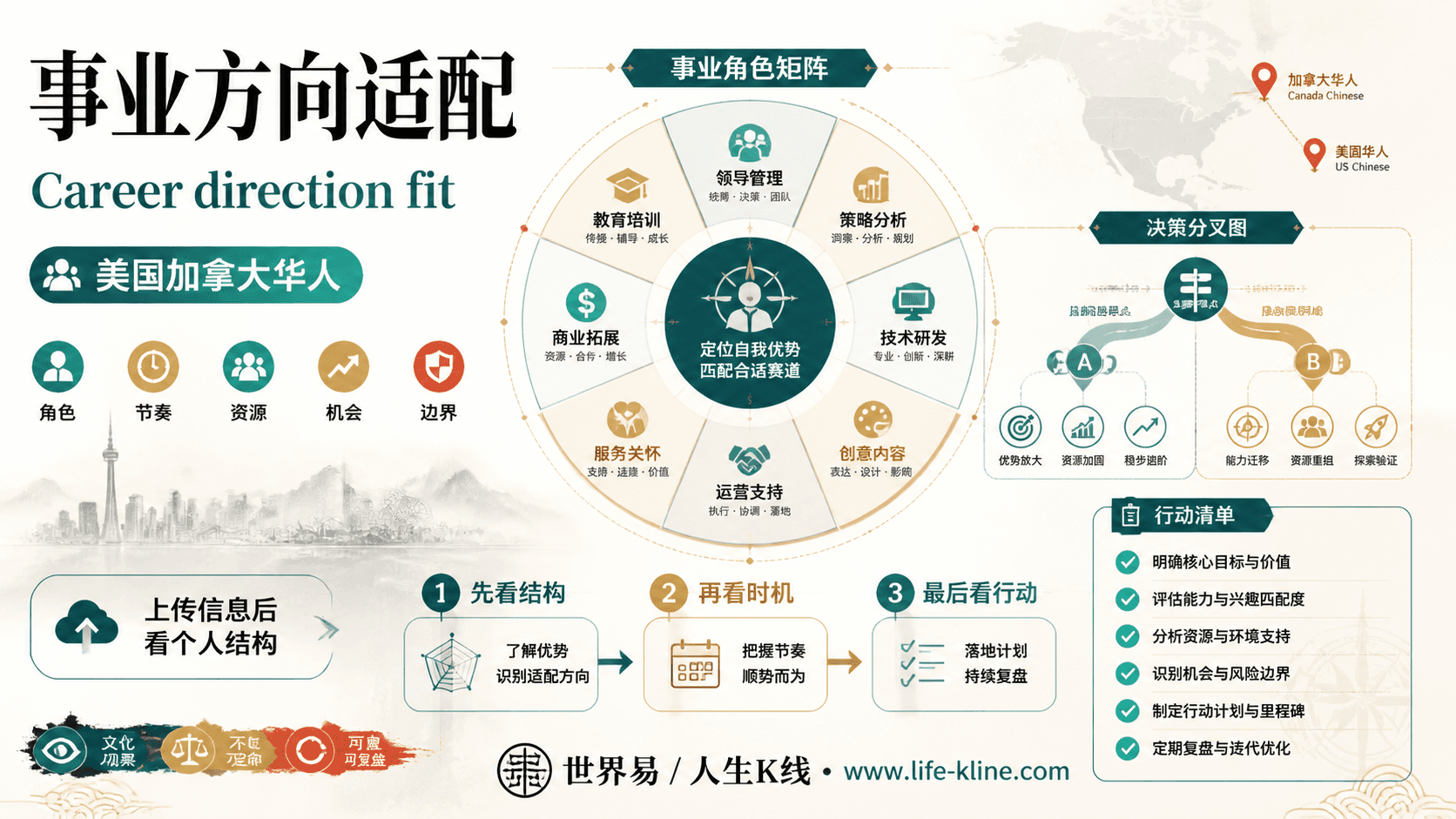
事业方向适配|美国加拿大华人
这张图把《BaZi Analysis and Practical Guidance on Timing for Engineers' Job Changes and Career Transitions》里的命理概念转成关系、边界和应用场景,适合先看图建立结构,再回到知识文章正文理解细节。
事业方向适配不应被写成固定结论。更适合美国加拿大华人的读法,是把传统术语翻译成结构、时机、环境、行动和复盘。
查看图片解读