Long-term Care Strategies for Chronic Fatigue: Rhythmic Adjustment and Five Elements Nurturing from a Metaphysical Perspective
把这篇文章落到自己身上验证:先看结构,再进入个人分析,不做泛泛阅读。
你现在搜索的,
其实是一个要落到自己身上的判断。
当前页面主要回答「Chronic Fatigue」这类搜索问题;真正有价值的下一步是把这套结构带进自己的报告、工具与案例验证。
Why This Decision Is Particularly Difficult in This Health Scenario
Chronic fatigue and sub-health states typically manifest as prolonged low energy, restless sleep, and subtle discomfort in the liver, gallbladder, and gastrointestinal systems. These symptoms often intertwine and recur, making it difficult for individuals to regain full vitality. The pace of life and regularity of routines directly affect bodily recovery, especially when mental and physical depletion persist; mismatched rhythms exacerbate symptoms.
From a metaphysical perspective, chronic fatigue often involves excesses and deficiencies in the Five Elements, particularly subtle imbalances in the liver and gallbladder (Wood), spleen and stomach (Earth), and kidney and Water-related organ functions. The body’s daily rhythms interact with the seasonal Qi of the Five Elements’ organs; improper rhythm arrangements easily intensify hidden depletion, worsening symptoms.
The challenge in decision-making lies in precisely grasping key nodes of bodily energy flow by integrating the Day Master’s strength, chart structure characteristics, and indications from the Yong Shen (favorable element) and Ji Shen (unfavorable element). Scientific adjustments to lifestyle and care priorities must avoid both excessive consumption and organ burden caused by improper nurturing.
Moreover, the interaction between Da Yun (decade luck cycle) and Liu Nian (annual fortune) also signals potential trends in current bodily states. Long-term care strategies must balance stability and flexibility, ensuring dynamic harmony between bodily rhythms and external environmental seasonal Qi.
Correspondence Between Metaphysics and Five Elements Organs
In the context of chronic fatigue and sub-health, the Five Elements attribute and strength of the Day Master directly reflect the individual’s vital energy strength or weakness. When the Day Master is weak, bodily energy is relatively insufficient and requires supplementation through the Yong Shen to restore organ balance. Different BaZi structures such as Bi Jian (Peer), Pian Cai (Indirect Wealth), Zheng Guan (Direct Officer) reflect varying emphases on Qi and blood circulation and mental state within the chart.
The organs corresponding to the Yong Shen’s Five Elements are especially important: Wood governs the liver and gallbladder, responsible for smooth Qi flow and emotional regulation. Wood deficiency or damage easily causes liver Qi stagnation, manifesting as emotional depression, indigestion, and sleep disorders. Earth governs the spleen and stomach, the source of Qi and blood production; Earth weakness often leads to insufficient Qi and blood generation, resulting in fatigue and digestive irregularities. Fire governs the heart and blood circulation; Fire balance affects mental clarity and sleep quality.
The Ji Shen’s Five Elements indicate potential bodily burdens and external environmental or lifestyle factors to avoid. Water governs the kidneys and stores essence; both excess and deficiency can cause Yin-Yang imbalance, showing as restless sleep and soreness in the lumbar and knees. The interaction of Liu Nian and Da Yun’s Five Elements reflects dynamic changes in bodily energy currently and in the near future, guiding care strategy adjustments.
Through metaphysical analysis of the Five Elements organs, more scientific rhythm adjustment plans can be formulated to align the body’s natural seasonal Qi and internal Five Elements needs, thereby promoting smooth Qi and blood flow and alleviating symptoms of chronic fatigue and sub-health.
Three Real BaZi Cases
Case 1: This gentleman’s Day Master is Geng Metal (庚, Geng) and relatively weak, with a Bi Jian (Peer) structure. The Yong Shen is Wood, and the Ji Shen is Water. He is currently in the Yi Hai Da Yun (乙亥, stable and maintaining) and Bing Wu Liu Nian (丙午). His symptoms mainly involve fluctuations in liver and gallbladder (Wood) function, accompanied by restless sleep and hidden depletion. Wood as the Yong Shen indicates his long-term care should focus on liver and gallbladder smooth flow and mental nurturing, avoiding excessive Water interference that leads to kidney Qi deficiency. Care strategies should emphasize adjusting lifestyle rhythms, increasing morning and afternoon sunlight exposure to promote liver and gallbladder recovery, while avoiding overexertion at night to ensure adequate rest. The suggested assessment sequence is to first check sleep quality and emotional state, observe diet and exercise habits related to liver and gallbladder function, and seek immediate medical attention if severe insomnia or mental abnormalities arise.
Case 2: This gentleman’s Day Master is Geng Metal (庚, Geng) and relatively weak, with a Pian Cai (Indirect Wealth) structure. The Yong Shen is Earth, and the Ji Shen are Water and Wood. He is in the Wu Wu Da Yun (戊午, auspicious) and Bing Wu Liu Nian (丙午), with career and wealth advancing but bodily energy weak. Earth as the Yong Shen corresponds to the spleen and stomach, indicating his chronic fatigue mainly stems from spleen and stomach dysfunction causing insufficient Qi and blood production, manifesting as indigestion and fatigue. Care strategies should emphasize spleen and stomach nurturing, maintaining regular diet, avoiding emotional fluctuations that cause Wood (liver) to damage Earth, and reducing kidney Water burden. Lifestyle rhythms should focus on early sleep and early rising, ensuring balanced nutrition and avoiding staying up late and excessive mental stress. The assessment sequence prioritizes digestive system function; seek timely medical care if severe abdominal pain or digestive symptoms occur.
Case 3: This lady’s Day Master is Wu Earth (戊, Wu) and relatively weak, with a Zheng Guan (Direct Officer) structure. The Yong Shen is Fire, and the Ji Shen are Metal and Water. She is currently in the Ren Zi Da Yun (壬子, unfavorable) and Bing Wu Liu Nian (丙午), with overall weak energy and risk of major upheavals. Fire as the Yong Shen governs the heart and blood and mental state, indicating her chronic fatigue is accompanied by heart blood deficiency and mental tension, manifesting as restless sleep and palpitations. Care strategies should focus on nurturing heart Fire, balancing mental stress, and avoiding excessive Metal and Water effects that disrupt heart-kidney communication. Lifestyle rhythms should include afternoon naps and nighttime calming measures, with moderate outdoor exercise to promote blood circulation. The assessment sequence emphasizes heart blood condition and emotional fluctuations; immediate medical attention is required if obvious palpitations or chest tightness occur.
Common Misjudgments and Blind Spots in This Scenario
Chronic fatigue and sub-health are often mistakenly attributed solely to poor lifestyle habits or psychological stress, neglecting subtle imbalances in the Five Elements organs and their impact on bodily rhythms. This leads to one-sided care strategies that fail to fundamentally improve symptoms.
Another blind spot is over-reliance on metaphysical judgment while ignoring medical examinations. Metaphysics provides rhythm adjustment references but cannot replace professional medical diagnosis, especially when severe sleep disorders, cardiac issues, or acute digestive symptoms arise, which require immediate medical attention.
Some individuals misuse metaphysics as the sole basis, overlooking the combined influence of living environment, diet, and psychological state, resulting in care plans that are difficult to implement or ineffective. The correct approach is to use metaphysics as an auxiliary tool combined with scientific lifestyle adjustments and necessary medical support.
Therefore, long-term care for chronic fatigue should avoid crossing the red line of substituting metaphysics for medical diagnosis. Instead, it should rationally utilize metaphysical indications, scientifically adjust lifestyle rhythms, and achieve multidimensional comprehensive management.
Practical Assessment Sequence
First, observe the basic symptoms of the chronic fatigue patient, focusing on sleep quality, mental state, and digestive function. Combine this with the Day Master’s strength and the Yong Shen in the BaZi chart to assess the Five Elements’ excesses and deficiencies corresponding to organ function status, clarifying care priorities.
Second, integrate the current Da Yun (decade luck cycle) and Liu Nian (annual fortune) to evaluate dynamic trends in bodily energy. Determine whether the care strategy should emphasize maintaining stability or flexible adjustment, and adjust lifestyle rhythms to align with internal Five Elements rhythms, avoiding rhythm disorders that cause hidden depletion.
Finally, if red-flag symptoms such as severe insomnia, palpitations, intense pain, or worsening digestive issues appear, seek immediate medical care. Metaphysics serves only as a rhythm reference. Normally, care can be gradually adjusted according to metaphysical guidance, monitoring bodily feedback and timely modifying care plans.
FAQ
Question 1: How to determine which organs need the most nurturing based on the BaZi chart during chronic fatigue? Answer: Mainly based on the Day Master’s Five Elements strength and the Yong Shen’s element, combined with the Ji Shen’s element to identify which organs are overburdened or impaired. For example, if the Yong Shen is Wood, focus on nurturing the liver and gallbladder; if Earth, the spleen and stomach; if Fire, the heart. The Ji Shen indicates which organs’ burdens should be avoided.
Question 2: How do Da Yun and Liu Nian affect chronic fatigue care strategies? Answer: Da Yun represents long-term trends, while Liu Nian reflects the current year’s state. Their interaction shows dynamic changes in bodily energy. When Da Yun is auspicious and stable, care should focus on maintaining; when Liu Nian changes, care strategies need flexible adjustments to prevent rhythm disorders and hidden depletion.
Question 3: Can metaphysics replace medical diagnosis? Answer: Metaphysics can only serve as an auxiliary reference to understand bodily rhythms and Five Elements organ conditions; it cannot replace doctors’ diagnoses. If severe symptoms such as intense pain, persistent insomnia, or palpitations occur, immediate medical attention is necessary.
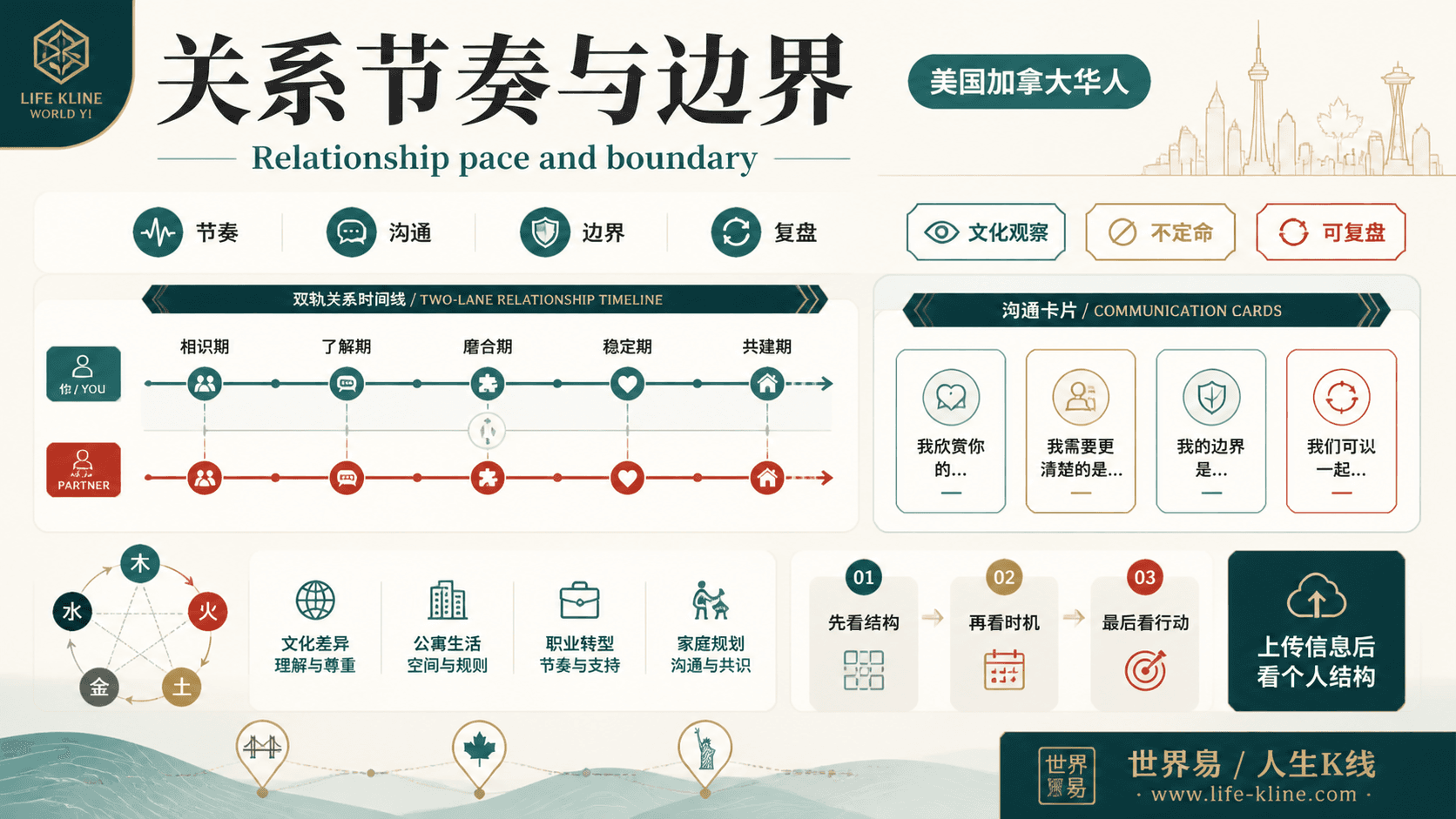
关系节奏与边界|美国加拿大华人
这张图把《Long-term Care Strategies for Chronic Fatigue: Rhythmic Adjustment and Five Elements Nurturing from a Metaphysical Perspective》里的命理概念转成关系、边界和应用场景,适合先看图建立结构,再回到知识文章正文理解细节。
关系节奏与边界不应被写成固定结论。更适合美国加拿大华人的读法,是把传统术语翻译成结构、时机、环境、行动和复盘。
查看图片解读