The Metaphysical Physical Boundary and Decision-Making Guide for Family Care in Chronic Fatigue
把这篇文章落到自己身上验证:先看结构,再进入个人分析,不做泛泛阅读。
Why This Decision Is Especially Difficult in This Health Scenario
Chronic fatigue and sub-health states often manifest as prolonged low energy, nighttime insomnia or vivid dreams, and latent discomfort in the liver, gallbladder, and gastrointestinal system. These bodily signals are often subtle yet continuously deplete the individual's overall stress resistance. When family members intervene in care, accurately grasping the primary caregiver's physical boundary becomes a key challenge, because excessive caregiving may not only worsen the caregiver's fatigue but also trigger psychological stress and emotional fluctuations, forming a vicious cycle.
In reality, primary caregivers often face multiple pressures from work, family, and caregiving duties, disrupting physiological rhythms, especially with restless sleep shortening recovery time and intensifying fatigue. If family members lack an accurate assessment of the caregiver’s true physical condition, they may blindly increase caregiving workload, neglecting the caregiver’s own recovery needs, thereby exacerbating health risks.
From a metaphysical perspective, by analyzing the Day Master’s (日主) Five Element strength, pattern (格局), Yong Shen (用神), and the current Da Yun (大运) and Liu Nian (流年), one can assist in identifying the caregiver’s energy consumption trends and organ function status. Combined with actual symptoms, metaphysics highlights the importance of focusing on key organs such as the liver, gallbladder, spleen, and stomach, which helps to reasonably adjust caregiving plans and lifestyle rhythms.
Therefore, in family care decisions for chronic fatigue and sub-health, integrating metaphysical rhythm indications to define the primary caregiver’s physical endurance limit and reasonably set caregiving boundaries is not only necessary to protect individual health but also crucial to improving overall caregiving efficiency.
Correspondence Between Metaphysics, Five Elements, and Organs
The strength or weakness of the Day Master’s Five Elements directly reflects the individual’s vital energy (元气) condition. A Wood Day Master (木日主) who is relatively weak often indicates insufficient liver and gallbladder qi and blood, manifesting as emotional fluctuations, indigestion, and sleep problems. Conversely, a Wood Day Master who is relatively strong has more energy, but if the Five Elements are imbalanced, it may lead to excessive liver fire, causing anxiety and insomnia. An Earth Day Master (土日主) who is relatively strong typically has robust spleen and stomach function, but if overly strong, it may cause stagnation, affecting energy transformation and physical recovery.
For primary caregivers in family care, if the Day Master is weak, special attention should be paid to nurturing the liver, gallbladder, spleen, and stomach to prevent fatigue accumulation from causing organ dysfunction. Reasonable supplementation of the Yong Shen (favorable elements) and suppression or transformation of the Ji Shen (忌神, unfavorable elements) are key to adjusting bodily rhythms. For example, Metal as Yong Shen can help a Wood Day Master harmonize liver and gallbladder qi; Fire as Yong Shen can assist Wood Day Master in generating vital energy; Water as Yong Shen can moisten the spleen, stomach, and nourish the kidney essence.
The clash and combination relationships of the Da Yun and Liu Nian Five Elements reveal the caregiver’s current energy trends and potential risks. When the Da Yun is weak, the body and mind are more susceptible to external influences, and recovery ability declines. If the Liu Nian also brings clashes, extra caution is needed to avoid overexertion. Conversely, a stable Da Yun combined with Liu Nian is conducive to coping with caregiving pressures and timely plan adjustments.
By integrating the Five Elements and organ rhythms, family caregivers can scientifically arrange daily routines and diets based on metaphysical indications, ensuring adequate rest, avoiding liver and gallbladder stagnation and spleen-stomach weakness, promoting physical recovery, and ensuring the sustainability of caregiving.
Three Real BaZi Case Studies
Case 1: This female has a relatively weak Yi Wood (乙木, Yi) Day Master, with a Zheng Guan (正官) pattern, Yong Shen is Metal, and Ji Shen are Fire and Earth. Currently in the Ding Wei (丁未) Da Yun, which is an unfavorable luck period, and the Liu Nian Bing Wu (丙午) intensifies the weak Da Yun, indicating significant overall energy consumption and stress on liver, gallbladder, spleen, and stomach functions. Her chronic fatigue manifests as restless sleep, liver and gallbladder discomfort, and emotional fluctuations. Care decisions must strictly define physical limits to avoid damage caused by excessive Fire and Earth Ji Shen. It is recommended to focus on supplementing Metal elements, such as appropriate metallic items or cooling foods to assist organ nourishment, ensuring rest is prioritized. The assessment sequence should first evaluate sleep quality and liver-gallbladder qi flow; if emotional control is lost or physical strength declines significantly, caregiving tasks should be paused to guarantee recovery time and prevent major health incidents. Please note, if acute pain or severe insomnia occurs, seek immediate medical attention.
Case 2: This female has a relatively strong Jia Wood (甲木, Jia) Day Master, with a Shang Guan (伤官) pattern, Yong Shen is Fire, and Ji Shen is Water. She is in the Jia Shen (甲申) Da Yun, with stable luck, and the Liu Nian Bing Wu (丙午) increases Fire strength. Her chronic fatigue mainly shows rapid energy consumption but with retained recovery ability; excessive liver and gallbladder fire may cause anxiety and nighttime insomnia. During family care, the primary caregiver has relatively abundant energy, but the strong Fire can easily deplete physical strength, so overexertion must be avoided to prevent spleen and stomach weakness. It is advised to use Fire as Yong Shen to moderately stimulate vital energy, while carefully regulating the influence of Water Ji Shen to maintain emotional stability. The assessment sequence should start from mental state, observing anxiety and sleep conditions, reasonably allocating caregiving time, and avoiding excessive emotional fluctuations. If severe anxiety or digestive disorders appear, caregiving intensity should be promptly adjusted. For serious symptoms, seek immediate medical care.
Case 3: This male has a relatively strong Ji Earth (己土, Ji) Day Master, with a Shi Shen (食神) pattern, Yong Shen are Wood and Water, and Ji Shen is Fire. He is in the Bing Chen (丙辰) Da Yun, with weak luck, and the Liu Nian Bing Wu (丙午) Fire clashes with the Ji Shen, indicating limited physical recovery capacity and liver-gallbladder fire easily harming the spleen and stomach. His chronic fatigue manifests as obvious physical exhaustion, unstable sleep, and latent gastrointestinal pain. Family care decisions should focus on spleen and stomach functions, preventing Fire Ji Shen from increasing organ burden. By supplementing Wood and Water as Yong Shen, spleen-stomach transformation and liver-gallbladder nourishment are supported. The assessment sequence should first check digestive function and sleep quality, observe changes in physical strength, and avoid high-intensity caregiving. If pain worsens or severe insomnia occurs, seek immediate medical attention.
These three cases all demonstrate how the Day Master’s Five Element strength and pattern affect the primary caregiver’s physical energy and organ conditions. Combined with current Da Yun and Liu Nian analysis, reasonably determining caregiving boundaries and scientifically arranging rest and nutrition are key to safeguarding the health of both chronic fatigue patients and their primary caregivers.
Common Misjudgments and Blind Spots in This Scenario
A common misjudgment in family care for chronic fatigue and sub-health is ignoring the primary caregiver’s hidden fatigue and blindly assuming that good mental state equals sufficient physical strength. This cognitive bias easily leads to overexertion and worsened fatigue. Although metaphysics can assist in identifying physical strength trends, it cannot replace medical diagnosis. Red-flag signals such as severe pain, persistent insomnia, or mental abnormalities require immediate medical attention.
Another blind spot is treating metaphysics as an absolute basis, neglecting individual differences and actual living environment influences. The Five Elements and organ rhythms provide references for energy flow, but specific interventions must be combined with clinical symptoms and professional advice. Family members should avoid substituting metaphysical judgments for medical recommendations, especially when facing sudden severe symptoms.
Additionally, neglecting the impact of emotional and psychological factors on chronic fatigue is a frequent error. Imbalances in the Five Elements often reflect psychological state fluctuations. Proper understanding and guidance of psychological stress are equally important; overreliance on metaphysics while ignoring psychological support will affect overall recovery outcomes.
Practical Assessment Sequence
First, start with the primary caregiver’s basic physical signals, focusing on sleep quality, emotional state, and digestive function, as these are direct reflections of chronic fatigue and organ imbalance. Combine this with the Day Master’s Five Element strength and Yong Shen direction to assess current physical energy consumption and recovery potential, and reasonably arrange caregiving intensity and rest periods.
Second, monitor the energy trends brought by Da Yun and Liu Nian, especially when the Da Yun or Liu Nian is weak or involves clashes and combinations. More cautious adjustment of caregiving strategies is needed to avoid overexertion. If significant physical decline or aggravated emotional fluctuations occur, caregiving burden should be reduced promptly to allow sufficient recovery.
Finally, when encountering red-flag signals such as severe pain, persistent insomnia, mental abnormalities, or sudden deterioration, immediate medical treatment is mandatory. Metaphysics serves only as a rhythm reference and must not delay professional care. Under normal circumstances, metaphysical Five Element nurturing advice can be combined with scientific lifestyle and nutritional support to enhance recovery capacity and ensure the sustainability of family caregiving.
FAQ
Question 1: How to determine the primary caregiver’s physical limit based on metaphysics during chronic fatigue? Answer: By assessing the strength or weakness of the Day Master’s vital energy, combined with the Yong Shen Five Element for energy supplementation direction, and integrating the clash and combination relationships of the current Da Yun and Liu Nian Five Elements, one can comprehensively evaluate physical energy consumption and recovery rhythm to assist in determining reasonable caregiving load and rest time.
Question 2: What impact do Ji Shen (unfavorable elements) have on the primary caregiver’s health? Answer: Ji Shen correspond to excessive consumption or imbalance of certain organs. If Ji Shen are overly strong, they exacerbate fatigue and discomfort, affecting recovery. Caregiving should avoid stimulating the Ji Shen Five Elements, adjusting lifestyle and environment to promote supplementation by the Yong Shen Five Elements.
Question 3: Can metaphysics replace medical advice to guide chronic fatigue caregiving? Answer: Metaphysics can only serve as an auxiliary reference for rhythm and physical strength trends and cannot replace medical diagnosis or treatment. Red-flag signals such as severe pain or mental abnormalities require immediate medical attention. Family caregiving should be combined with professional medical guidance.
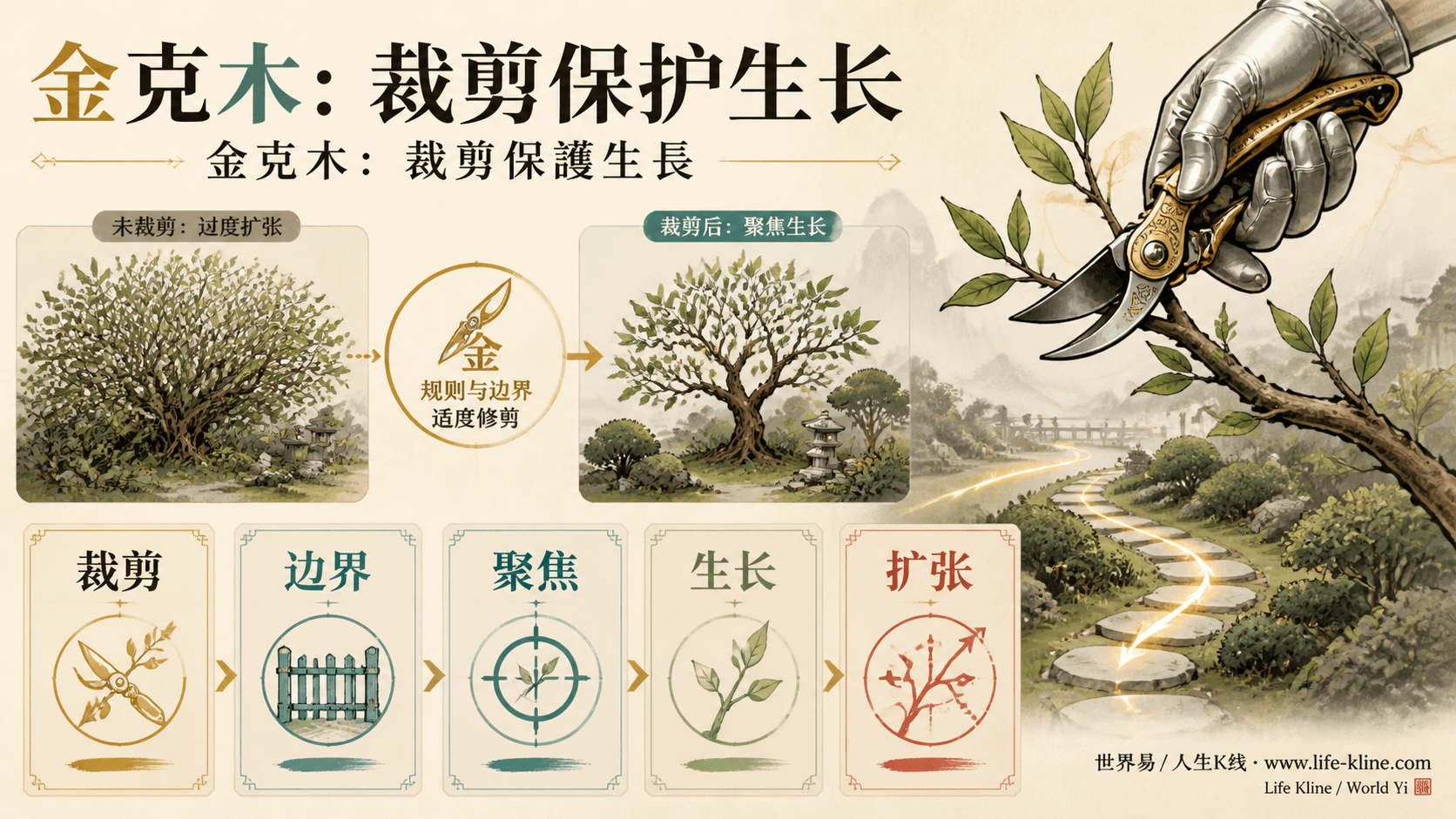
金克木调节图
这张图把《The Metaphysical Physical Boundary and Decision-Making Guide for Family Care in Chronic Fatigue》里的命理概念转成关系、边界和应用场景,适合先看图建立结构,再回到知识文章正文理解细节。
在人生K线与世界易的框架中,金克木并非限制,而是通过规则与边界实现聚焦,让生长保持结构与效率。理解这一调节机制,能帮助我们在不同时位中主动优化路径。
查看图片解读