The Role of Metaphysics in Asset Inheritance Decisions: Analyzing the Logic Behind Retirement and Perseverance
把这篇文章落到自己身上验证:先看结构,再进入个人分析,不做泛泛阅读。
Why This Decision Is Especially Difficult in This Scenario
During the preparation phase of asset inheritance and will trusts, retirement decisions face multiple structural challenges. First, inheritance laws and tax planning often become complicated due to complex family member relationships, especially when designing insurance beneficiaries and trust structures, requiring precise control of legal risks and tax burdens. Second, psychological dependencies and differing expectations among family members frequently cause emotional fluctuations during decision-making, affecting rational judgment.
In retirement structures, medical and long-term care needs may increase with age, adding financial and psychological pressure and intensifying the difficulty of deciding whether to retire now or persevere longer. The stability of social security and insurance cash flows, along with tax implications, must also be considered simultaneously, creating a multidimensional decision-making environment.
Metaphysical structures serve as a rhythmic auxiliary tool in this scenario, helping to identify an individual’s energy state during late-life Da Yun (decade luck cycles) and Liu Nian (annual fortune) changes, thereby indicating rhythms of risk or opportunity. However, metaphysical judgment cannot replace professional financial, legal, and medical advice; it provides timing assistance to avoid blind actions or procrastination.
Therefore, the difficulty of this decision lies in balancing family relationships, legal and tax risks, and physical and psychological health, combined with metaphysical signals to scientifically arrange inheritance and retirement timing, achieving the dual goals of asset preservation and emotional harmony.
Three Core Dimensions of Metaphysical Judgment
First, the Day Master and late-life Da Yun status form the foundation of metaphysical judgment. The strength or weakness of the Day Master reflects an individual’s vitality and psychological endurance, while the stability of the late-life Da Yun directly impacts the steadiness of decision execution. A relatively weak Day Master protected by the Yong Shen in late Da Yun should maintain the status quo and avoid aggressive moves; conversely, a relatively strong Day Master may consider moderately expanding asset inheritance strategies.
Second, the manifestation of wealth stars is closely related to disposable assets. A strong Zheng Cai (direct wealth) or Cong Cai (following wealth) pattern indicates good asset accumulation, but Ji Shen (unfavorable elements), such as Wood and Fire depleting Metal, should raise awareness of potential tax and inheritance law pressures to avoid passive asset loss. Proper support from the Yong Shen can improve the safety margin of asset allocation.
Third, the combination of Shi Shen (output stars), Yin stars (resource stars), and Guan Sha (officer and kill stars) reflects late-life preferences, medical dependencies, and relationships with children. When Shi Shen is strong, late life tends toward active enjoyment but may increase medical and psychological burdens. When Guan Sha and Yin stars are closely related, support from children and medical resources is relatively sufficient, facilitating smooth inheritance through wills and trusts; however, interference from Ji Shen requires cautious handling of potential risks.
Overall, metaphysical judgment reveals the rhythmic changes in an individual’s late-life state through these three dimensions, assisting in the timing selection for retirement asset inheritance and will trusts, indicating when to exit steadily and when to persevere longer.
Three Real Case Studies
Case 1: This female’s Day Master is Ren (壬, Water), relatively weak, with a Zheng Cai pattern. Her Yong Shen is Metal, and Ji Shen are Wood and Fire. She is currently in the Ren Xu (壬戌) Da Yun (ages 49-58), which is stable and favors maintaining the status quo. The Liu Nian is Bing Wu (丙午), requiring flexible adaptation. Her chart shows the wealth star in a proper position and the Yong Shen protected, but Ji Shen Wood and Fire exert depleting pressure on the Metal Yong Shen. In the retirement asset inheritance and will trust preparation game, she is suited for steady maintenance, avoiding aggressive asset structure changes due to Ji Shen disturbances. At this time, attention should be paid to legal and tax risks, improving insurance beneficiary design to prevent family disputes from escalating.
The metaphysical characteristics amplify the signal to maintain the status quo because the relatively weak Day Master requires Yong Shen protection, and the Da Yun is stable, discouraging rash moves. The suggested judgment sequence is: first, check whether existing trusts and insurance beneficiary arrangements comply with legal and tax planning; second, assess the stability of inheritance relationships among family members; third, combine medical and psychological conditions to decide whether to moderately adjust asset allocation. The metaphysical indication is to “close the mountain” at this stage and steadily advance the inheritance plan.
Case 2: This female’s Day Master is Yi (乙, Wood), balanced, with a Cong Cai pattern. Her Yong Shen are Earth and Fire; Ji Shen are Water and Wood. She is currently in the Xin Wei (辛未) Da Yun (ages 30-39), which is stable and favors maintaining the status quo. The Liu Nian is Bing Wu (丙午), requiring flexible adaptation. The balanced Day Master and Cong Cai pattern tend to rely on wealth stars, but Ji Shen Water and Wood exert some pressure on the Day Master. She is in the late career transition to retirement phase. Although wealth stars are strong, Ji Shen influence cannot be ignored, suggesting a balance between stability and moderate expansion in asset inheritance planning.
The metaphysical structure indicates she still has some capacity for action and adjustment, but Ji Shen interference requires caution. Decision-making should evaluate the flexibility of trust structures within legal and tax frameworks, avoiding aggressive or chaotic asset allocation caused by emotional and family pressure. The suggested judgment sequence is: first, clarify the support of Yong Shen Earth and Fire to the wealth stars and assess asset risk tolerance; second, evaluate family relationship stability to determine if early trust initiation is appropriate; finally, coordinate with financial planning to decide whether to “persevere a bit longer.”
Case 3: This male’s Day Master is Yi (乙, Wood), relatively weak, with a Zheng Guan (direct officer) pattern. His Yong Shen is Water; Ji Shen are Fire and Earth. He is currently in the Yi Si (乙巳) Da Yun (ages 49-58), first year, with Liu Nian Bing Wu (丙午). The Da Yun is stable and favors maintaining the status quo. The chart shows a steady Guan Sha combination, and the Yong Shen Water helps balance the Ji Shen Fire and Earth impact, indicating relatively good relationships with children and medical support. Entering the early stage of late-life Da Yun, asset and inheritance planning should emphasize stability.
In the retirement asset inheritance game, he should prioritize steadiness, avoiding family disputes or health risks triggered by Ji Shen Fire and Earth. Metaphysical indications favor maintaining the status quo, especially at the beginning of a Da Yun transition when risks and opportunities coexist. The suggested judgment sequence is: first, review the legal compliance of trusts and insurance beneficiaries; second, assess medical resource preparedness and family support; then, reasonably arrange the asset inheritance rhythm considering tax burdens. Overall, the recommendation is to “close the mountain” and steadily advance the inheritance plan.
Common Misjudgments and Blind Spots in This Scenario
A common misjudgment in asset inheritance and will trust preparation is neglecting the depletion impact of Ji Shen on Yong Shen in metaphysics, blindly making aggressive asset allocation adjustments that lead to legal disputes or increased tax burdens. Meanwhile, overreliance on metaphysical rhythms while ignoring professional financial and legal advice can easily result in emotional decisions, overlooking the actual constraints of inheritance law and tax policies.
Another blind spot is insufficient consideration of family relationship complexities. Although the combination of Guan Sha and Yin stars in metaphysics suggests support from children and medical care, in reality, trust and cooperation among family members are key to successful inheritance, and metaphysical signals alone cannot fully judge this. Additionally, neglecting changes in medical and psychological aspects may cause late-life financial arrangements to become unbalanced.
Many also mistakenly treat metaphysics as a predictive tool, expecting it to directly determine whether to “definitely retire” or “definitely persevere,” which is a misuse of metaphysics. Metaphysics should serve as an auxiliary rhythmic reference, integrated with legal, tax, medical, and psychological factors to form a comprehensive decision support system, avoiding misjudgments based on a single dimension.
Practical Judgment Sequence
Step one: Prioritize checking the Day Master’s strength and the state of the Yong Shen in the chart, combined with the stability of the late-life Da Yun, to judge the individual’s current psychological and physiological endurance. If the Day Master is relatively weak and the Yong Shen is impaired, a steady maintenance approach is recommended to avoid rash moves; if the Day Master is balanced and the Yong Shen well supported, moderate adjustments to the asset inheritance plan may be considered.
Step two: Evaluate the interaction between wealth stars and Ji Shen, especially regarding tax and inheritance law risks. Ji Shen’s depletion of wealth stars often implies increased legal and tax pressures, requiring risk hedging through trust structures and insurance beneficiary designs to prevent asset loss and family disputes.
Step three: Combine Shi Shen, Yin stars, and Guan Sha combinations to assess family support and medical dependency. When Yin stars and Guan Sha are favorable, medical resources and children’s support are sufficient, facilitating steady inheritance; if Shi Shen is strong but uncontrolled, be alert to medical burdens and psychological stress, adjusting the decision rhythm accordingly.
In summary, decisions should balance metaphysical rhythms with professional financial, legal, and medical advice, choosing the timing to “close the mountain” or “persevere a bit longer,” avoiding emotional and blind actions to ensure stable asset inheritance and harmonious family relationships.
FAQ
Question 1: Can metaphysics directly determine whether I should fully retire now? Answer: Metaphysics can only assist in judging individual rhythmic changes and risk signals; it cannot directly replace professional financial and legal advice. Retirement decisions must also consider personal health, financial status, legal environment, and family relationships comprehensively.
Question 2: If the chart shows Ji Shen interference, must I immediately adjust the asset inheritance plan? Answer: Ji Shen interference indicates potential risks, but whether to adjust immediately depends on specific legal, tax environments and family circumstances. It is recommended to consult professional planners first and then make steady decisions combined with metaphysical indications.
Question 3: How to use metaphysics to judge the timing for trust structure design? Answer: Priority should be given to assessing whether the Yong Shen is protected, the stability of the late-life Da Yun, and the state of wealth stars. When the Yong Shen is strong and Da Yun stable, it is suitable to advance trust design; when the Day Master is weak and Ji Shen interference is significant, it is advisable to maintain stability first and gradually improve the trust plan.
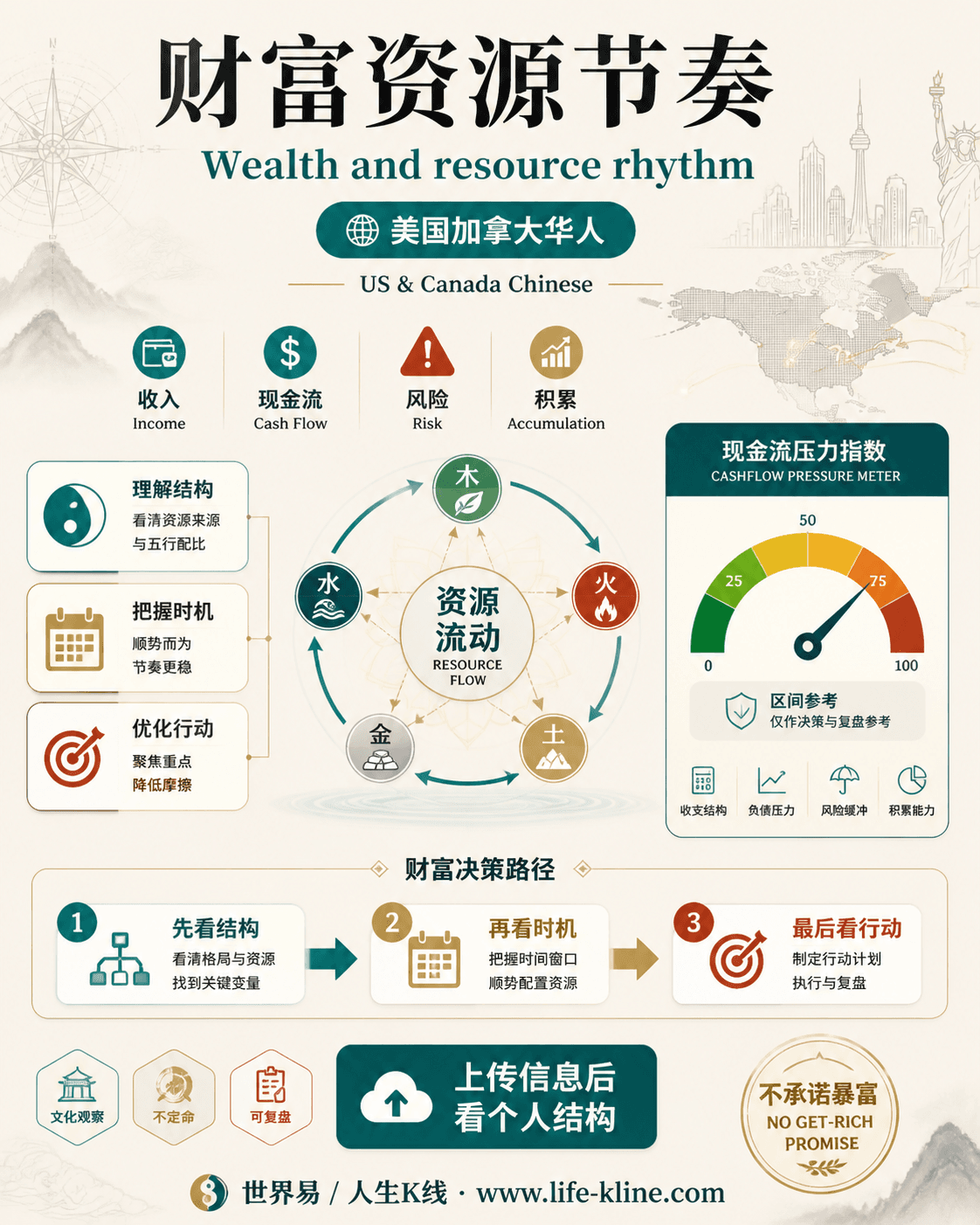
财富资源节奏|美国加拿大华人
这张图把《The Role of Metaphysics in Asset Inheritance Decisions: Analyzing the Logic Behind Retirement and Perseverance》里的命理概念转成关系、边界和应用场景,适合先看图建立结构,再回到知识文章正文理解细节。
财富资源节奏不应被写成固定结论。更适合美国加拿大华人的读法,是把传统术语翻译成结构、时机、环境、行动和复盘。
查看图片解读