Astrological Analysis of Economic and Emotional Support Boundaries in Caring for Aging Parents
把这篇文章落到自己身上验证:先看结构,再进入个人分析,不做泛泛阅读。
Why This Decision Is Particularly Difficult in This Scenario
During parents' aging, family members face not only material and economic support but also complex emotional and psychological entanglements. In family dynamics, caregiving methods and medical decision-making often involve attachment and blurred boundaries between parents and children. Especially as parental roles weaken, children may experience psychological role reversal, taking on caregiving responsibilities in a way that leads to emotional blackmail or excessive compression of their own family resources.
Within this context, the boundary of economic and emotional support intensity becomes a critical decision point. Overinvestment may cause imbalance in personal life and family structure, whereas underinvestment may trigger guilt and conflict toward the parents. At this time, astrological structures such as the Day Master strength, the configuration of Yin stars (Yin Xing, 印星, e.g., Pian Yin, Zheng Yin) and Bi Jian/Jie Cai (比肩/劫财) influence personal capacity and psychological endurance rhythmically, amplifying or suppressing family conflicts.
Meanwhile, cultural expectations and intergenerational responsibilities between parents and children often invisibly increase economic and emotional burdens. In BaZi, the Qi Sha/Zheng Guan (官杀) stars represent authority and pressure, while Cai Xing (财星) relates to resources and support. Proper identification of the strength and interaction of these elements helps clarify the boundary between emotional obligations and realistic capabilities, preventing decision imbalance caused by emotional blackmail.
Therefore, economic and emotional support decisions in caring for aging parents must integrate family dynamics with astrological cycles, balancing responsibility and self-protection to avoid unhealthy family interaction patterns caused by unresolved psychological trauma. Astrology should only serve as an auxiliary tool and must be combined with professional psychological counseling and family therapy to achieve more stable decisions.
Three Core Dimensions of Astrological Judgment
First, the strength of the Day Master and the overall pattern determine personal bearing capacity and internal resources. A relatively strong Day Master usually has robust self-support ability and can endure higher economic and emotional input; a relatively weak Day Master tends to feel pressured and needs to carefully set boundaries. Patterns such as Pian Yin (偏印) or Pian Cai (偏财) reflect differences in external support and resource mobilization capabilities, affecting resource flow and emotional interaction in decision-making.
Second, the combination of Yin stars (印星) and Bi Jian/Jie Cai (比劫) reflects support and competition relationships among family members. Yin stars symbolize parental protection and psychological dependence; if overly strong, they may cause psychological role reversal and unclear boundaries. Bi Jian/Jie Cai relate to resource competition and emotional support among siblings. Qi Sha/Zheng Guan (官杀) represent authority and pressure, often manifesting as power struggles in medical and decision contexts. Cai Xing (财星) directly involves economic support flow and distribution.
Third, Da Yun (大运) and Liu Nian (流年) represent the current rhythm background of decisions. Auspicious Da Yun and favorable Liu Nian usually facilitate active undertaking and resource growth, enhancing the capacity to bear support intensity; stable or conflicting Da Yun and Liu Nian may indicate risks, requiring cautious boundary setting to prevent family members from becoming unbalanced due to excessive pressure. Proper interpretation of Da Yun and Liu Nian interactions helps determine whether to act or wait for adjustment.
Overall, astrological judgment should closely focus on the Day Master and pattern, the Ten Gods (Shi Shen 十神) combinations, and Da Yun and Liu Nian, combined with family dynamics, to scientifically assess the boundaries of economic and emotional support intensity, avoiding family conflicts and psychological trauma caused by excessive responsibility or resource scarcity.
Three Real BaZi Chart Case Studies
Case 1: The Day Master is Wu (戊, Earth), relatively strong, with a Pian Yin (偏印) pattern. The Yong Shen (favorable elements) are Wood and Water, and the Ji Shen (unfavorable element) is Fire. Currently in Xin Hai (辛亥) Da Yun (auspicious luck cycle) and Bing Wu (丙午) Liu Nian (favorable annual fortune). The Pian Yin pattern indicates strong external support resources, and the strong Day Master shows a robust self-bearing capacity. In economic and emotional support decisions for aging parents, the individual has good resource allocation and psychological endurance, suitable for higher economic and emotional input. However, if Pian Yin is too strong, psychological role reversal should be guarded against to avoid boundary blurring due to dependence on parental resources. It is recommended to prioritize assessing emotional boundaries among family members and combine with professional counseling to ensure support investment does not excessively sacrifice self-development.
Case 2: The Day Master is Bing (丙, Fire), relatively weak, with a Pian Cai (偏财) pattern. The Yong Shen is Wood, and the Ji Shen are Earth and Metal. Currently in Yi Mao (乙卯) Da Yun (very auspicious) and Bing Wu (丙午) Liu Nian (favorable period). The Pian Cai pattern symbolizes strong external economic resource mobilization, but the weak Day Master indicates limited psychological and decision-making endurance. The family may have strong economic support motivation but insufficient emotional endurance, creating contradictions. In caregiving decisions for parents, strict boundaries on economic and emotional support should be set to avoid psychological burden from overinvestment. It is recommended to combine family therapy to strengthen self-boundary awareness and gradually adjust support intensity, avoiding resource strain caused by the influence of Ji Shen Earth and Metal.
Case 3: The Day Master is Wu (戊, Earth), relatively strong, with a Yang Ren (羊刃) pattern. The Yong Shen is Wood, and the Ji Shen is Fire. Currently in Ren Zi (壬子) Da Yun (stable) and Bing Wu (丙午) Liu Nian (requiring adaptive response). The Yang Ren pattern indicates strong internal drive and stress resistance but may also bring emotional volatility. The strong Day Master shows strong bearing capacity, but the presence of Ji Shen Fire warns to pay attention to emotional conflicts and authority pressure within the family. Facing support decisions for aging parents, the individual can bear moderate economic and emotional input but needs to guard against emotional exhaustion and boundary breakdown. It is recommended to emphasize emotional management in decision-making and cooperate with professional psychological counseling to ensure support intensity aligns with family harmony and balance.
These three cases respectively illustrate how astrological structures differently influence economic and emotional support boundaries, emphasizing that decisions must integrate family dynamics and psychological states, avoiding reliance on single astrological judgment and leveraging professional counseling to achieve more comprehensive support plans.
Common Misjudgments and Blind Spots in This Scenario
A common misjudgment is over-relying on the strength or weakness of the Day Master to determine support intensity, neglecting the emotional needs and psychological boundaries among family members. For example, a strong Day Master may be misunderstood as unlimited bearing capacity, leading to unrestrained economic and emotional support that ultimately exhausts family resources and causes psychological anxiety.
Another blind spot is ignoring the rhythmic changes of Da Yun and Liu Nian, rigidly assuming that a certain BaZi pattern’s support capacity remains unchanged. In fact, Da Yun and Liu Nian significantly affect family pressure and resource flow. Failure to dynamically adjust support boundaries during decision-making can easily trigger conflicts.
At the same time, insufficient understanding of Yin stars (印星) and Bi Jian/Jie Cai (比劫) often leads to misjudgment of dependence and competition relationships among family members, ignoring risks of psychological role reversal and emotional blackmail, causing parent-child boundary confusion and impairing decision health.
Finally, neglecting the necessity of professional psychological counseling and family therapy, treating astrology as a simple predictive tool, and ignoring deep psychological trauma processing may turn economic and emotional support decisions into ineffective or even harmful actions.
Practical Judgment Sequence
Step one: Assess the strength of the Day Master and the overall pattern to clarify personal bearing capacity and resource mobilization status. If the Day Master is relatively strong and the pattern supportive, consider higher economic and emotional input; otherwise, carefully set boundaries to avoid overload.
Step two: Analyze the combination of Yin stars (印星), Bi Jian/Jie Cai (比劫), Qi Sha/Zheng Guan (官杀), and Cai Xing (财星) to understand support relationships and authority pressure among family members, preventing psychological role reversal and emotional blackmail to ensure clear boundaries. Special attention should be paid to Da Yun and Liu Nian interactions to judge whether the current environment favors active action or requires waiting for adjustment.
Step three: On this basis, cooperate with professional psychological counseling and family therapy to gradually adjust support intensity, strengthen self-boundaries and emotional health. Through dynamic feedback and rhythm control, achieve a balance of economic and emotional support that meets parents’ caregiving needs while protecting the stability of one’s own family.
FAQ
Question 1: Does a relatively strong Day Master in BaZi mean I can support my parents without limits? Answer: A strong Day Master indicates robust bearing capacity but does not mean unlimited input. Family dynamics and psychological boundaries are equally important. Overinvestment may cause resource exhaustion and psychological burden. It is recommended to combine with professional counseling to reasonably set support boundaries.
Question 2: How to identify emotional blackmail in caregiving decisions for parents? Answer: Emotional blackmail often manifests as parents exerting pressure through dependency relationships, blurring children’s self-boundaries. In BaZi, an excessively strong Pian Yin or heavy Bi Jian/Jie Cai may exacerbate this situation. The key to identification lies in observing whether emotional interactions harm self-development; if necessary, seek family therapy intervention.
Question 3: How do Da Yun and Liu Nian affect my support intensity for parents? Answer: Da Yun and Liu Nian reflect the personal and family cycle’s favorable or adverse trends. Auspicious Da Yun and favorable Liu Nian generally support active investment, while stable or conflicting periods require cautious adjustment of support. Dynamically grasping these rhythms helps rationally plan economic and emotional boundaries and avoid escalating conflicts.
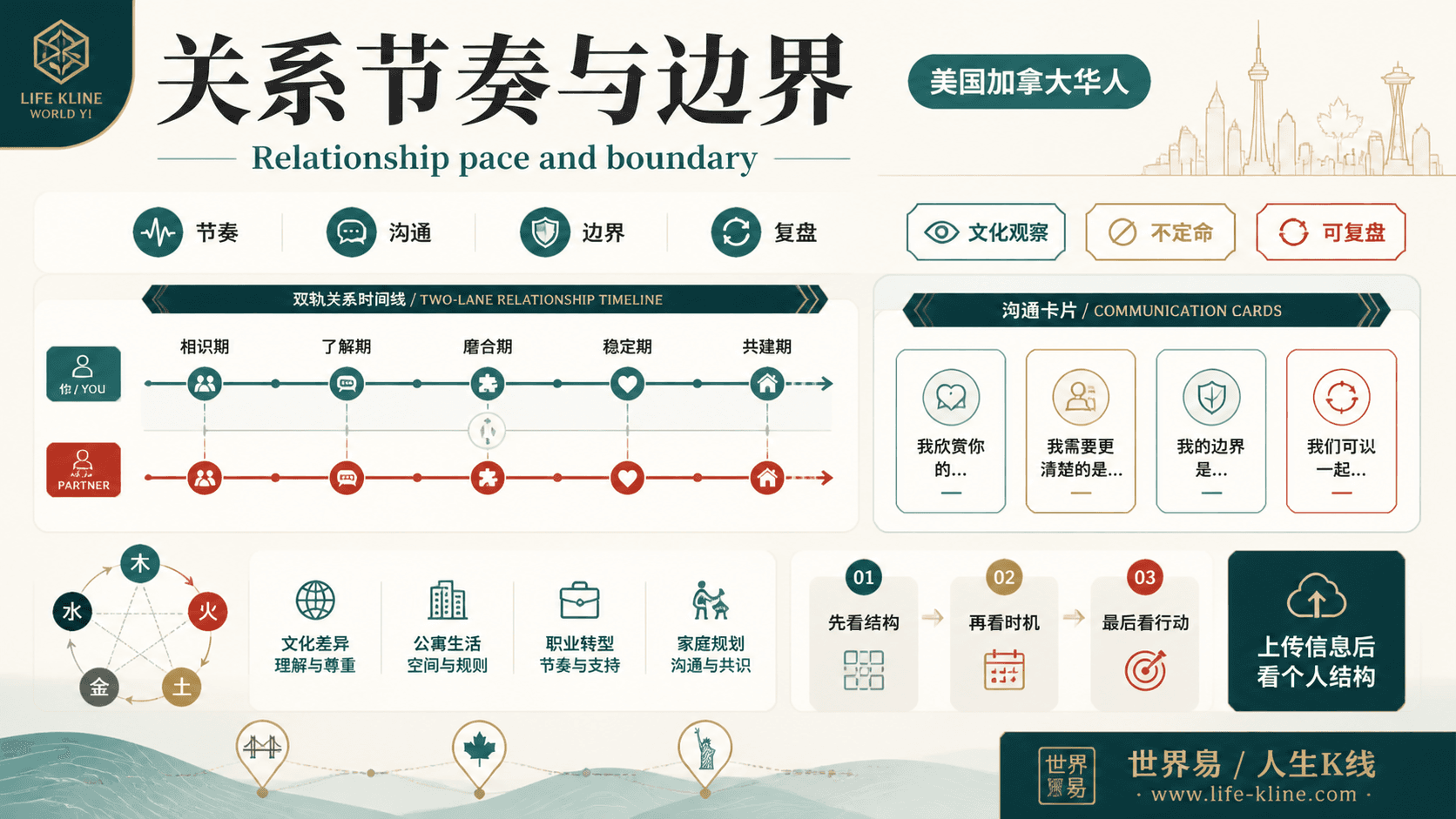
关系节奏与边界|美国加拿大华人
这张图把《Astrological Analysis of Economic and Emotional Support Boundaries in Caring for Aging Parents》里的命理概念转成关系、边界和应用场景,适合先看图建立结构,再回到知识文章正文理解细节。
关系节奏与边界不应被写成固定结论。更适合美国加拿大华人的读法,是把传统术语翻译成结构、时机、环境、行动和复盘。
查看图片解读