Astrological Assessment of Economic and Emotional Support Boundaries in Narcissistic Parents' Emotional Provision
把这篇文章落到自己身上验证:先看结构,再进入个人分析,不做泛泛阅读。
你现在搜索的,
其实是一个要落到自己身上的判断。
当前页面主要回答「Parent-Child Relationship」这类搜索问题;真正有价值的下一步是把这套结构带进自己的报告、工具与案例验证。
Why This Decision Is Especially Difficult in This Scenario
In family environments with narcissistic parents, children often face psychological pressures such as being instrumentalized, denied, and compared, leading to long-term emotional exhaustion. The parents’ strong self-centeredness and emotional needs make it difficult for children to establish healthy boundaries in economic and emotional support, easily falling into bottomless giving and depletion.
This emotional blackmail and attachment entanglement within family dynamics cause children to struggle with objectively assessing the reasonableness of their support during decision-making. Psychological biases like guilt and responsibility amplify the pressure to invest in support. The BaZi structure, including the Day Master’s strength and combinations of Yin Stars (印星, Yin) and Peer Stars (比劫, Bi Jian), invisibly affects an individual’s endurance and decisiveness.
For example, a chart with a relatively weak Day Master and strong Yin Stars may increase a child’s sensitivity and dependence on parental needs, making boundary setting difficult; whereas a chart with a relatively strong Day Master or harmonious Peer Stars may grant the child stronger self-protection awareness and resource management ability. This interplay between astrological rhythms and family dynamics makes the boundaries of economic and emotional support a highly challenging decision.
Moreover, the auspiciousness or adversity of Da Yun (decade luck cycles) and Liu Nian (annual fortune) interactions can amplify or suppress the risks of support behavior. During favorable Da Yun, children have more strength to bear support; while during clashes or penalties in Da Yun or Liu Nian, the risks and consumption of support significantly increase, requiring more cautious boundary setting. Therefore, understanding the integration of BaZi structure and family reality is key to rational decision-making.
Three Core Dimensions of Astrological Judgment
First, the strength of the Day Master reflects an individual’s vitality and self-awareness intensity. A relatively strong Day Master usually represents stronger self-protection and boundary sense, enabling more effective management of economic and emotional support input; a relatively weak Day Master is more easily constrained by external demands, especially from parents, with weaker boundary awareness.
Second, the combination of Yin Stars (印星, Yin) and Peer Stars (比劫, Bi Jian) directly influences emotional dependence on parents and willingness to support. The presence of Zheng Yin (正印) or Pian Yin (偏印) patterns often strengthens the emotional provision and psychological burden on children. Especially when Yin Stars are strong, children tend to be constrained by parents’ emotional needs and find it difficult to decisively set boundaries. Moderate Peer Stars help enhance self-awareness and resistance capability.
Third, the interaction between Officer Stars (官杀, Zheng Guan and Qi Sha) and Wealth Stars (财星, Pian Cai and Zheng Cai) reflects the struggle between authority and resources. In relationships with narcissistic parents, abundant Officer Stars often represent parental authority suppression, while Wealth Stars symbolize economic support. The clash and harmony conditions in Da Yun and Liu Nian magnify or mitigate the tension of these relationships, thereby affecting the risk tolerance and timing for adjusting economic and emotional support.
Overall, these core astrological dimensions provide rhythmic guidance for economic and emotional support boundaries in parent-child relationships, but must be combined with family psychological mechanisms and real-life situations to avoid relying solely on astrological judgment.
Three Real BaZi Chart Case Studies
Case 1: This male’s Day Master is Wu (戊, Earth), relatively strong, with a Zheng Yin (正印) pattern. The Yong Shen (用神, favorable elements) are Wood and Water, and Ji Shen (忌神, unfavorable element) is Fire. Currently in the Ren Shen (壬申) Da Yun and Bing Wu (丙午) Liu Nian, the overall Da Yun is auspicious, with progress in career and wealth. The Zheng Yin pattern symbolizes strong parental emotional provision influence, and the strong Yin Stars increase the risk of instrumentalization and emotional exhaustion. Regarding economic and emotional support, the relatively strong Day Master provides strong self-protection, but the strong Zheng Yin tends to cause excessive giving. The recommended judgment sequence is: first assess one’s own resource endurance (relatively strong Day Master), then monitor signals of boundary blurring caused by excessive Yin Stars, and finally, considering the current auspicious Da Yun, appropriately set clear limits and seek professional psychological support if necessary to clarify boundaries.
Case 2: This male’s Day Master is Ding (丁, Fire), relatively weak, with a Pian Yin (偏印) pattern. The Yong Shen is Wood, and Ji Shen are Earth and Metal. Da Yun is Gui Wei (癸未), and Liu Nian is Bing Wu (丙午), overall tending toward stability. The Pian Yin pattern combined with a weak Day Master tends to produce strong dependence and emotional exhaustion in the emotional provision from narcissistic parents, making boundary setting difficult. Economic and emotional support is easily magnified by parental needs, leading to rapid depletion of one’s own resources. The recommended judgment sequence is: focus on identifying emotional vulnerability caused by the weak Day Master, pay attention to the emotional binding effect of Yin Stars, cautiously assess the investment risks brought by the stable Da Yun, and promptly seek external psychological counseling intervention. It is not advisable to blindly increase support.
Case 3: This female’s Day Master is Gui (癸, Water), relatively strong, with a Yang Ren (羊刃) pattern. The Yong Shen is Earth, and Ji Shen is Metal. She is in the Jia Wu (甲午) Da Yun and Bing Wu (丙午) Liu Nian, with stable fortune. The Yang Ren pattern symbolizes an individual with certain aggressiveness and defensive strength. The relatively strong Day Master grants strong self-awareness and boundary sense, providing good resistance against emotional consumption from narcissistic parents. Economic and emotional support boundaries are relatively clear, and support intensity can be adjusted through rational judgment. The recommended judgment sequence is: evaluate the conflict tendency brought by the Yang Ren pattern, combine with the Yong Shen Earth to harmonize emotions, pay attention to support endurance under stable Da Yun and Liu Nian, timely adjust boundaries, and cooperate with psychological therapy to avoid emotional outbursts causing boundary loss.
Common Misjudgments and Blind Spots in This Scenario
Many children in the emotional provision consumption by narcissistic parents fall into the misjudgment of "must unconditionally support," neglecting their own resource and psychological endurance limits. Combinations of weak Day Master or strong Yin Stars in BaZi are often overlooked, leading to blurred boundaries and excessive economic and emotional support investment.
Another blind spot is over-reliance on the auspiciousness or adversity of a single Da Yun or Liu Nian to judge support intensity, ignoring the complex interweaving of BaZi and family psychological mechanisms. An auspicious Da Yun is not a sufficient reason to infinitely expand support; similarly, a stable Da Yun does not mean boundary maintenance can be ignored.
Furthermore, psychological trauma caused by emotional blackmail and attachment entanglement requires professional psychological counseling and family therapy intervention. BaZi can only serve as a rhythmic auxiliary reference. Without professional intervention, there is a risk of misusing BaZi as a decisive basis, ignoring the real risks of parental PUA (psychological abuse) or violence.
Lastly, neglecting the balance between Yong Shen (用神, favorable elements) and Ji Shen (忌神, unfavorable elements) can also cause imbalance in support intensity. For example, when Yin Stars are overly strong but Yong Shen cannot effectively harmonize, children are likely to fall into irrational emotional investment, exacerbating family conflicts and personal stress.
Practical Judgment Sequence
Step one: Assess the Day Master’s strength and pattern characteristics to clarify one’s psychological and resource endurance. A chart with a relatively strong Day Master and moderate Peer Stars (比劫, Bi Jian) has strong self-protection awareness and is suitable for setting relatively strict support boundaries; a weak Day Master or strong Yin Stars requires caution to avoid excessive depletion.
Step two: Combine the relationship between Yong Shen and Ji Shen to analyze the current interaction of Da Yun and Liu Nian. Auspicious Da Yun can be considered a favorable time for support but boundary setting should not be neglected; clash or penalty Da Yun or Liu Nian indicates the need to strengthen restrictions to prevent excessive resource loss.
Step three: Pay attention to emotional blackmail and attachment patterns in family dynamics, and use BaZi indications to identify risk signals. When feelings of being instrumentalized, denied, or compared emerge, immediately review whether the support intensity exceeds one’s endurance, and seek professional psychological counseling and family therapy if necessary to avoid self-harm.
Overall, BaZi provides rhythmic references for decision-making, while family therapy offers substantive support for emotional repair and boundary construction. The combination of both can effectively manage the boundaries of economic and emotional support.
FAQ
Question 1: Can BaZi decide whether I should continue supporting narcissistic parents? Answer: BaZi provides energy rhythms and potential tendencies but cannot directly determine specific behaviors. Whether to support should be combined with real-life situations and mental health. Professional consultation is recommended when necessary to assist decision-making.
Question 2: If my Day Master is relatively weak, does it mean I cannot bear my parents’ economic support? Answer: A relatively weak Day Master indicates relatively low endurance and requires cautious assessment of support sustainability and boundaries. It is about reasonably adjusting investment intensity, not completely avoiding support.
Question 3: Does an auspicious Da Yun mean I can relax support restrictions for my parents? Answer: An auspicious Da Yun represents generally good energy with more resources and motivation, but still needs to be combined with family reality and psychological dynamics to avoid blindly expanding support and to maintain rational boundaries.
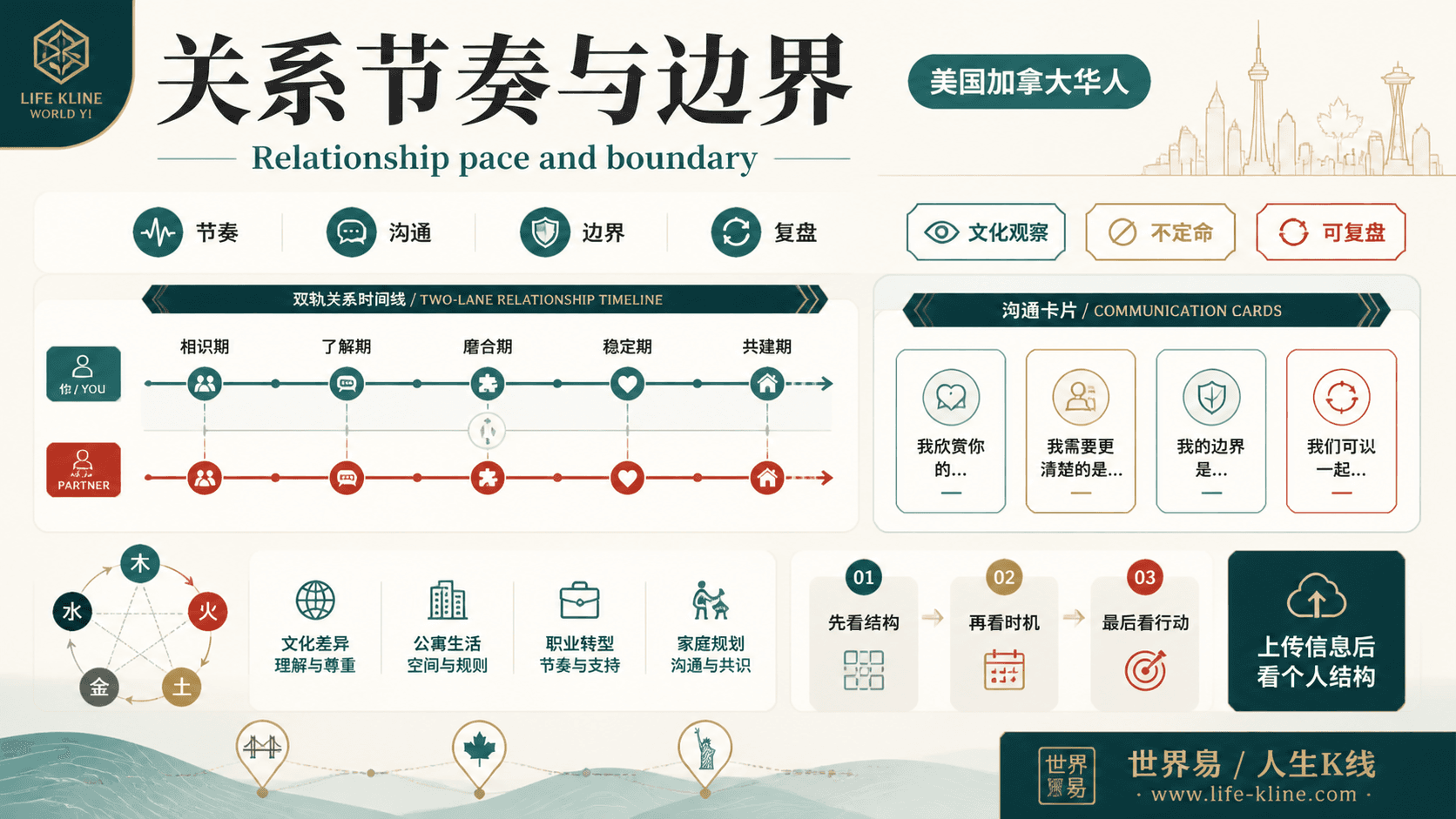
关系节奏与边界|美国加拿大华人
这张图把《Astrological Assessment of Economic and Emotional Support Boundaries in Narcissistic Parents' Emotional Provision》里的命理概念转成关系、边界和应用场景,适合先看图建立结构,再回到知识文章正文理解细节。
关系节奏与边界不应被写成固定结论。更适合美国加拿大华人的读法,是把传统术语翻译成结构、时机、环境、行动和复盘。
查看图片解读