Zi Wei Chart Analysis: Comprehensive Guide to Four Pillars Patterns and Da Yun & Liu Nian
把这篇文章落到自己身上验证:先看结构,再进入个人分析,不做泛泛阅读。
What is Zi Wei Charting
Zi Wei charting is a metaphysical charting method that combines Zi Wei Dou Shu and the Four Pillars (BaZi) system. By analyzing the Heavenly Stems (天干) and Earthly Branches (地支) of the Four Pillars, the strength of the Day Master (日主), pattern types, and the selection of Yong Shen (用神, favorable elements) and Ji Shen (忌神, unfavorable elements), it reveals an individual's destiny trajectory. Zi Wei Dou Shu centers on the twelve palaces and fourteen main stars, emphasizing specific events and interpersonal relationships, while Four Pillars focuses on the Five Elements (Wood, Fire, Earth, Metal, Water) interactions to analyze long-term fate trends.
Zi Wei charting integrates the strengths of both systems, allowing precise identification of the life palace’s main stars and observing the changes in fortune during different life stages. It also guides individuals on how to use Yong Shen and avoid Ji Shen during Da Yun and Liu Nian periods. This method holds an important position in traditional metaphysics and serves as a crucial tool for modern practitioners to provide accurate predictions and guidance.
This charting method not only considers the timing and environment at birth but also emphasizes the dynamic influence of Da Yun and Liu Nian on the personal destiny chart. It helps the chart owner understand the fluctuations in their fortune and offers practical strategies for real-life situations. Consequently, Zi Wei charting has become a popular and practical analytical system in metaphysics.
How to Read a Zi Wei Chart: Core Elements
The core elements of Zi Wei charting include the four pillars: Year Pillar, Month Pillar, Day Pillar, and Hour Pillar. Each pillar consists of a Heavenly Stem and Earthly Branch, reflecting the fundamental life structure of the chart owner. The Day Master is the Heavenly Stem of the Day Pillar and represents the individual’s core energy; its strength determines the nature of the overall pattern. Patterns such as Shang Guan (伤官格, Hurting Officer pattern), Zheng Cai (正财格, Proper Wealth pattern), and Cong Er (从儿格, Following Son pattern) are formed based on the relationship between the Day Master and other Heavenly Stems and Earthly Branches.
The selection of Yong Shen and Ji Shen depends on the Day Master’s strength and the principles of mutual generation and restriction among the Five Elements. Yong Shen is the element in the chart that most needs support, while Ji Shen is the element that must be avoided or controlled. Correctly identifying Yong Shen and Ji Shen is a key step in improving the accuracy of Zi Wei chart analysis.
Da Yun (大运) and Liu Nian (流年) represent the temporal factors in the chart’s evolution. Da Yun indicates a ten-year phase of fortune changes, while Liu Nian refers to the fortune of each specific year. The interaction of the Five Elements and Heavenly Stems & Earthly Branches of Da Yun and Liu Nian with the natal Four Pillars determines the auspiciousness or adversity during that period. Observing the current Da Yun and Liu Nian allows targeted guidance for the chart owner to seize opportunities and avoid risks.
Three Real Chart Cases
Case 1: The male chart owner’s Day Master is Ji (己, Earth), which is slightly strong, forming a Shang Guan (Hurting Officer) pattern. This indicates a personality inclined towards expression and innovation. The Yong Shen are Wood and Water, while the Ji Shen is Fire. He is currently in the Bing Shen Da Yun (丙申, ages 33 to 42), a phase of stable fortune suitable for consolidation; the Liu Nian is Bing Wu (丙午), requiring adaptability. This shows that in Zi Wei charting, a slightly strong Day Master combined with a Shang Guan pattern requires balancing the Five Elements with Yong Shen Wood and Water to avoid the adverse effects of excessive Fire. Integrating Da Yun and Liu Nian information enables precise understanding of the chart owner’s fortune changes during this phase.
Case 2: This male chart owner’s Day Master is Wu (戊, Earth), which is relatively weak, forming a Zheng Cai (Proper Wealth) pattern, indicating a focus on wealth and material accumulation. The Yong Shen is Fire, and the Ji Shen are Metal and Water. He is currently in the Geng Wu Da Yun (庚午, ages 22 to 31), an overall stable period suitable for consolidation; the Liu Nian is Bing Wu (丙午), requiring flexible adjustments. Through Zi Wei charting, confirming the weak Day Master and the wealth star as Yong Shen guides the chart owner to strengthen Fire energy during key fortune periods and avoid clashes from Metal and Water, ensuring stable wealth accumulation.
Case 3: The female chart owner’s Day Master is Ding (丁, Fire), balanced in strength, forming a Cong Er (Following Son) pattern, which reflects a personality with submissive and adaptive traits. The Yong Shen are Earth and Metal, while the Ji Shen is Wood. She is currently in the Ding Hai Da Yun (丁亥, ages 17 to 26), a stable fortune phase suitable for consolidation; the Liu Nian is Bing Wu (丙午), requiring adaptability. Zi Wei charting reveals that during this age range, the chart owner should emphasize support from Earth and Metal elements and avoid Wood influence to maintain steady progress through Da Yun and Liu Nian periods.
Common Misconceptions
One common misconception in applying Zi Wei charting is neglecting the foundational role of Day Master strength in selecting Yong Shen. Some metaphysics enthusiasts judge fortune solely by pattern names without adjusting Yong Shen based on the Day Master’s strength, resulting in less accurate analysis.
Another misconception is interpreting Da Yun and Liu Nian too mechanically without integrating the dynamic relationships among the Five Elements in the natal chart. Although Da Yun and Liu Nian are important, ignoring the essence of the Four Pillars makes accurate prediction difficult and prone to misjudgment.
Additionally, some readers mistakenly view Zi Wei Dou Shu and BaZi as opposing systems, overlooking their complementary characteristics. Zi Wei Dou Shu focuses on specific palaces and main stars, while BaZi emphasizes Five Elements generation and restriction laws. Using both together achieves a more comprehensive metaphysical analysis.
Practical Suggestions
When using Zi Wei charting, first accurately assess the Day Master’s strength and pattern type within the Four Pillars. Based on this, select appropriate Yong Shen and Ji Shen to ensure metaphysical balance and harmony. This approach enhances the scientific and practical value of the chart.
Second, combine the current Da Yun and Liu Nian to dynamically observe changes in the chart, avoiding fixed thinking and adapting flexibly. During stable Da Yun phases, it is advisable to consolidate; during Liu Nian challenges, prepare risk assessments and adjustments in advance.
Finally, it is recommended to integrate the strengths of Zi Wei Dou Shu and BaZi in practice. Zi Wei Dou Shu provides detailed palace and star analysis, while BaZi deciphers the power of the Five Elements. Their combined use offers more effective guidance for the chart owner’s life and decision-making.
FAQ
Question 1: What is the difference between Zi Wei Dou Shu and BaZi? Answer: BaZi centers on the generation and restriction of the Five Elements, making it more suitable for judging long-term patterns and fortune trends. Zi Wei Dou Shu is structured around the twelve palaces and fourteen main stars, better suited for analyzing specific events and interpersonal relationships. For example, the Spouse Palace reflects partner conditions, the Children Palace indicates the next generation, and the Travel Palace reveals travel and relocation. Although their focuses differ, they complement rather than contradict each other. Using both together provides a more comprehensive metaphysical analysis.
Question 2: What does the Tian Fu star represent as the main star of the Life Palace? Answer: The Tian Fu star symbolizes consolidation, compassion, and steadiness, often called the “Command Star.” People with Tian Fu in their Life Palace tend to be practical and steady, not prone to rash actions. However, excessive conservatism may cause missed opportunities. It is necessary to consider supporting stars such as Zuo Fu, You Bi, Wen Chang, Wen Qu, and the Four Transformations (Hua Lu, Hua Quan, Hua Ke, Hua Ji) to judge the clarity and auspiciousness of the pattern.
Question 3: What happens if Hua Ji clashes with the Life Palace? Answer: Hua Ji represents danger, obstacles, and changes. If the Liu Nian or Da Yun Hua Ji clashes with the Life Palace, it may cause internal energy depletion, manifesting as low mood, health concerns, or self-doubt. However, Hua Ji also serves as an awakening opportunity. Strong emotional fluctuations often prompt personal reflection and transformation, providing a chance for destiny breakthroughs.
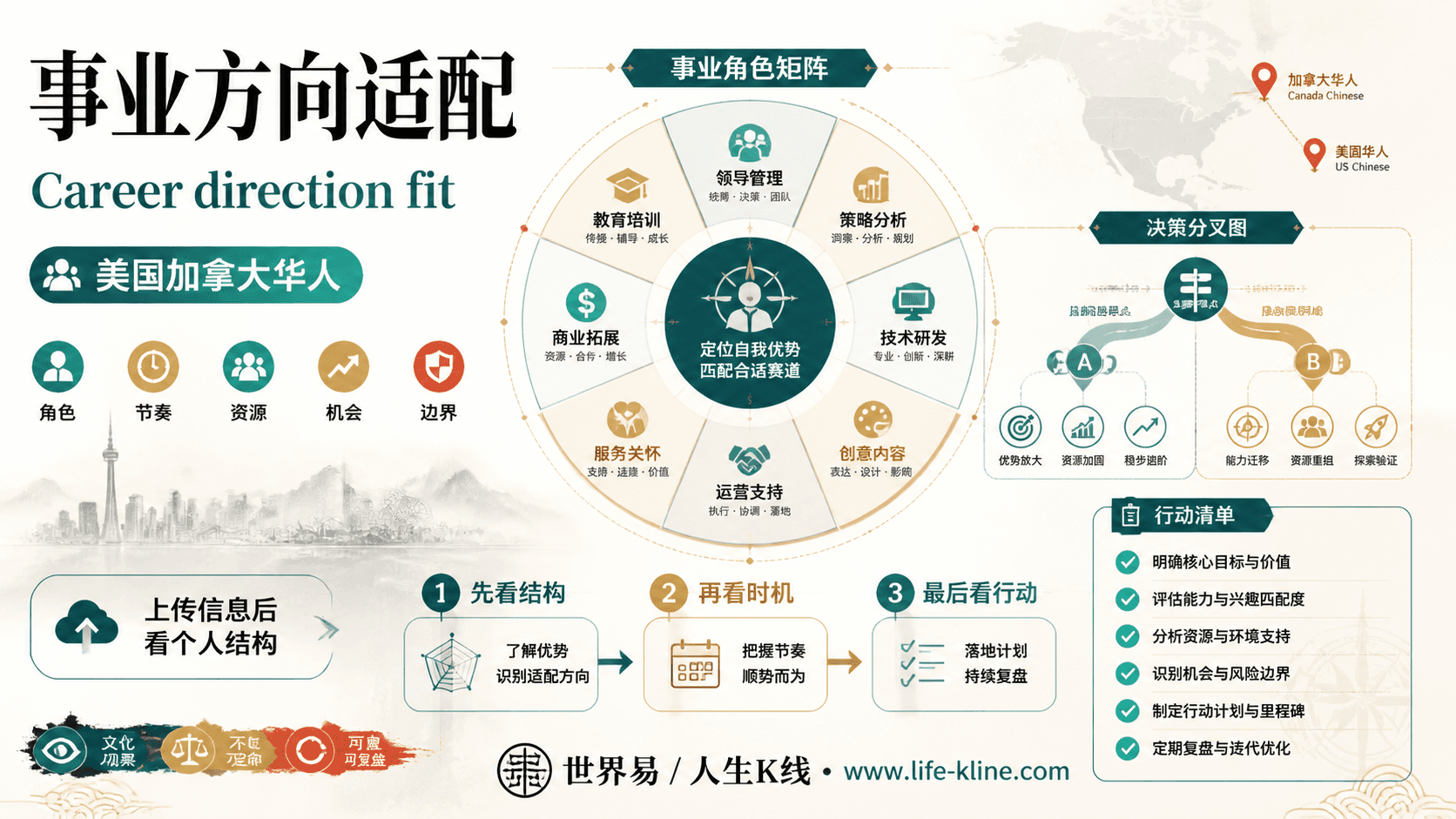
事业方向适配|美国加拿大华人
这张图把《Zi Wei Chart Analysis: Comprehensive Guide to Four Pillars Patterns and Da Yun & Liu Nian》里的命理概念转成关系、边界和应用场景,适合先看图建立结构,再回到知识文章正文理解细节。
事业方向适配不应被写成固定结论。更适合美国加拿大华人的读法,是把传统术语翻译成结构、时机、环境、行动和复盘。
查看图片解读