Complete Guide to Tarot Recent Fortunes: Integration with Four Pillars Analysis and Practical Advice
把这篇文章落到自己身上验证:先看结构,再进入个人分析,不做泛泛阅读。
What Is Tarot Recent Fortunes
Tarot recent fortunes refer to predictions of the trend of one’s fortune over a near future period by using tarot card divination combined with the individual’s current energetic state and external environmental changes. It emphasizes grasping recent events and emotions to help people make more reasonable decisions amid complex changes.
Tarot cards, as an ancient divination tool originating in Europe, have been passed down and developed over centuries, integrating elements of psychology, symbolism, and mysticism, possessing strong symbolic guidance functions. By drawing different card spreads, tarot reflects a person’s subconscious, environmental influences, and future tendencies.
The interpretation of recent fortunes relies not only on the symbolic meanings of the tarot cards themselves but also requires integration with personal metaphysical information such as the Day Master, pattern, Yong Shen (favorable element), Ji Shen (unfavorable element), and current Da Yun and Liu Nian in the Four Pillars (BaZi) chart to enhance prediction accuracy and practicality.
How to Read Tarot Recent Fortunes: Core Elements
When interpreting tarot recent fortunes, it is essential first to clarify the divination question, as the clarity of the question directly affects the accuracy of the interpretation. For specific events or choices, using a 'Past-Present-Future' spread effectively captures the development trajectory of the matter.
Combining the strength of the Day Master, pattern type, and Yong Shen/Ji Shen from Four Pillars metaphysics provides deeper contextual support for tarot fortunes. The Day Master represents the individual’s core self, the pattern reflects the structural power of the chart, and the Yong Shen is the key element harmonizing the chart; all influence the flow of personal energy and event outcomes.
The current Da Yun (10-year luck cycle) and Liu Nian (annual fortune) are important temporal dimensions affecting recent fortunes. Da Yun represents the overall trend over a decade, while Liu Nian reflects the specific fortune of the current year. Their interaction determines the stability and variability of recent fortunes and should be a focus during tarot interpretation.
In practical divination, the interpreter’s experience and concentration during card drawing are also key factors influencing accuracy. The interpreter should combine metaphysical information with rational analysis of the tarot card meanings, avoiding subjective assumptions and overinterpretation.
Three Real BaZi Chart Case Studies
Case One is a male aged 45 to 50, with a Day Master 戊 (Wu, Earth) that is somewhat strong, belonging to the Yang Ren pattern, requiring Wood and Water as Yong Shen, and avoiding Fire as Ji Shen. He is currently in the third year of the 乙巳 (Yi Si) Da Yun, which is a stable luck cycle suitable for maintaining achievements. The Liu Nian is 丙午 (Bing Wu), whose interaction with the Da Yun indicates a need for adaptability. Combining tarot recent fortunes, because the Day Master is somewhat strong and Fire is unfavorable, attention should be paid to the influence of Fire elements during card drawing to avoid impulsive decisions. The overall fortune tends to be stable, but the changes brought by the Liu Nian suggest tarot guidance to flexibly adjust strategies and maintain inner balance.
Case Two is a male aged 20 to 25, with a Day Master 癸 (Gui, Water) that is balanced, belonging to the Zheng Cai (Proper Wealth) pattern, with Metal as Yong Shen and Earth as Ji Shen. He is currently in the second year of the 癸丑 (Gui Chou) Da Yun, a stable luck cycle suitable for maintaining achievements. The Liu Nian is also 丙午 (Bing Wu). The Water Day Master combined with Metal Yong Shen indicates favorable recent fortunes in finance or resources. Tarot divination can focus on the Metal element symbolizing wealth and opportunities. The Fire energy of the Liu Nian brings some challenges, requiring rational decisions to maintain stability and avoid obstacles caused by the Earth Ji Shen.
Case Three is a female aged 25 to 30, with a Day Master 丙 (Bing, Fire) that is somewhat strong, belonging to the Shi Shen (Eating God) pattern, with Water and Metal as Yong Shen and Wood as Ji Shen. She is currently in the fifth year of the 乙卯 (Yi Mao) Da Yun, which is an unfavorable luck cycle requiring caution against major changes. The Liu Nian is 丙午 (Bing Wu), which also demands prudence. The Fire Day Master is strong, with Wood as Ji Shen and Water/Metal as harmonizing Yong Shen. The overall Da Yun is weak, and the Liu Nian is unfavorable. Combining tarot recent fortunes, the card drawing should emphasize the regulating power symbolized by Water and Metal, carefully responding to possible changes. Tarot guidance is especially important at this stage to provide early risk warnings and avoid losses caused by impulsive actions.
Common Misconceptions
Many people mistakenly believe that tarot cards themselves have absolute prophetic power, ignoring the importance of question formulation and the interpretation process. In fact, tarot’s accuracy largely depends on the clarity of the question and the interpreter’s experience level. Vague or general questions rarely yield precise guidance.
Another misconception is frequently drawing cards for the same question within a short time, thinking this can verify answers. Traditional tarot rules caution that repeatedly drawing cards for the same question within 24 hours leads to confusing results because the subconscious is already influenced by the first draw. It is recommended to wait at least a week or approach the question from a different angle.
Additionally, neglecting personal metaphysical background is a common issue. The symbolic meanings of tarot need to be combined with the individual’s Four Pillars Day Master, Yong Shen, pattern, and Da Yun/Liu Nian to more accurately reflect recent fortunes. Ignoring metaphysical information often results in partial or biased interpretations.
Practical Advice
When conducting tarot recent fortune divination, always clarify specific and focused questions to avoid vague discussions, which enhances the relevance and practicality of interpretations. It is recommended to use a 'Past-Present-Future' three-card spread to clarify the development trajectory of events and improve the coherence of predictions.
Combine the strength of the Day Master, Yong Shen and Ji Shen, and current Da Yun/Liu Nian from the Four Pillars (BaZi) to assist in understanding the symbolic information of tarot cards, making fortune judgments more scientifically grounded. Especially when facing unfavorable Da Yun or Liu Nian, interpretations should be cautious to avoid blind optimism or pessimism.
Maintain concentration and a calm mindset during card drawing, avoiding excessive subjective emotions or expectations. The interpreter should respect the rules of metaphysics and tarot, analyze card information rationally, and provide practical advice based on real situations to help the querent better cope with future challenges.
FAQ
Question 1: Is tarot divination accurate? Answer: The accuracy of tarot highly depends on three factors: the clarity of the question, the interpreter’s experience, and concentration during card drawing. Drawing a card casually with a vague question often yields inaccurate results; focusing on specific choices and carefully drawing a 'Past-Present-Future' three-card spread significantly improves reference value.
Question 2: Can the same question be drawn repeatedly? Answer: Traditional tarot rules hold that repeatedly drawing cards for the same question within 24 hours causes confusion because the subconscious is influenced by the first draw. It is recommended to wait at least a week or approach the question from a different perspective to ensure clarity and accuracy.
Question 3: How to integrate metaphysics to understand tarot recent fortunes? Answer: Combining the Day Master, pattern, Yong Shen, and Da Yun/Liu Nian from Four Pillars (BaZi) helps provide a more comprehensive grasp of an individual’s energy state and fortune trends. For example, whether the Day Master is strong or weak, if the Yong Shen is in favorable position, and whether the current Da Yun/Liu Nian is stable or unfavorable all directly influence the recent fortune information reflected by tarot cards.
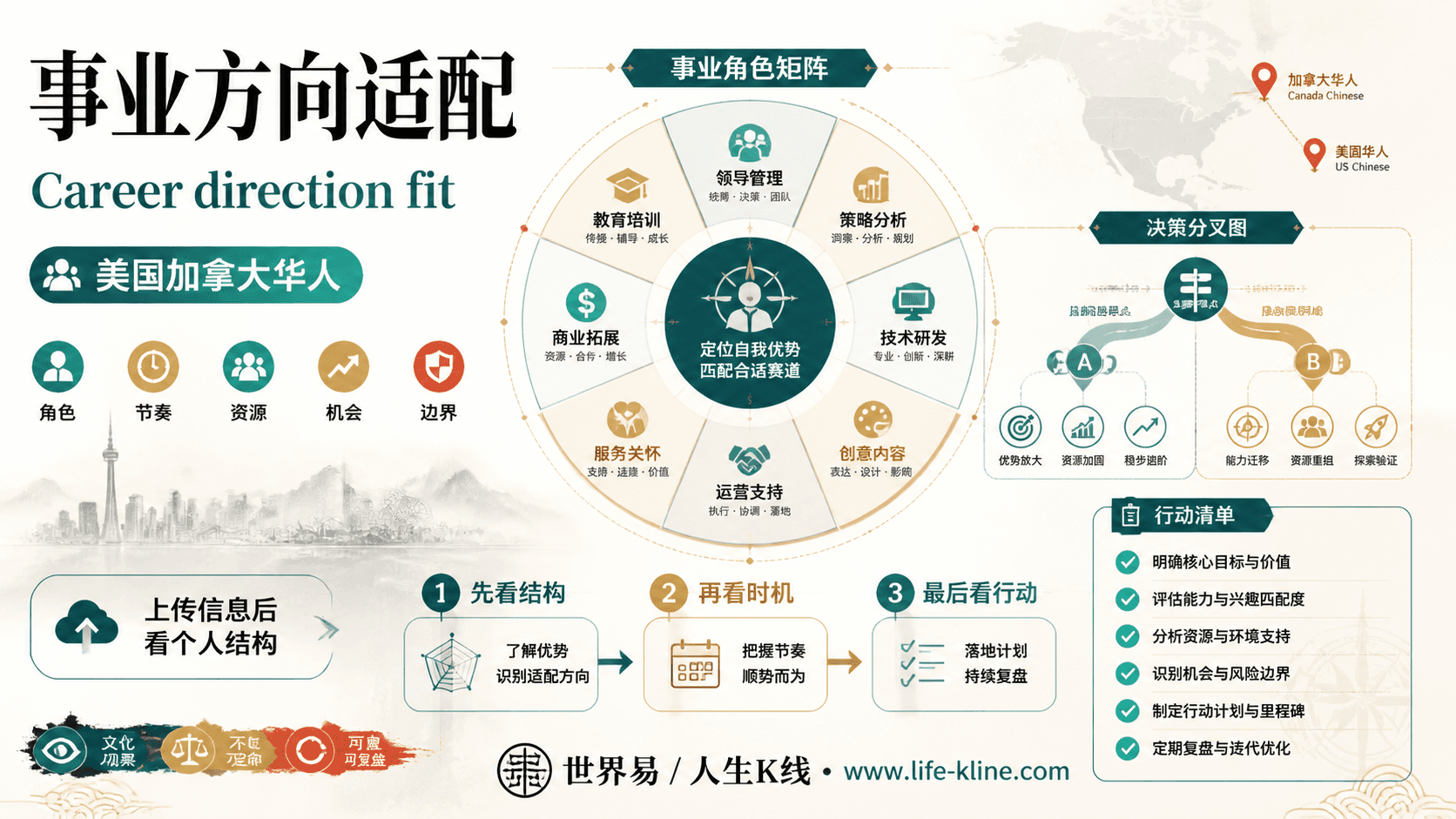
事业方向适配|美国加拿大华人
这张图把《Complete Guide to Tarot Recent Fortunes: Integration with Four Pillars Analysis and Practical Advice》里的命理概念转成关系、边界和应用场景,适合先看图建立结构,再回到知识文章正文理解细节。
事业方向适配不应被写成固定结论。更适合美国加拿大华人的读法,是把传统术语翻译成结构、时机、环境、行动和复盘。
查看图片解读