Comprehensive Guide to Zi Wei Da Yun: Life Patterns and Fortune Changes
把这篇文章落到自己身上验证:先看结构,再进入个人分析,不做泛泛阅读。
What is Zi Wei Da Yun
Zi Wei Da Yun is a fortune cycle in Zi Wei Dou Shu that divides a person’s life into different phases, usually in ten-year periods, reflecting overall fortune changes during specific timeframes. Changes in Da Yun affect career, wealth, health, and also have profound impacts on psychological state and interpersonal relationships.
Zi Wei Dou Shu originated in ancient China, integrating astronomy, calendar systems, and philosophical thought. Through the combination of twelve palaces and fourteen principal stars, it finely depicts an individual’s destiny trajectory. Da Yun, as a key component, carries the metaphysical energy transformation of each phase and serves as a core basis for predicting and adjusting life.
In interpreting Zi Wei Da Yun, combining the Four Pillars’ Day Master strength, life pattern, Yong Shen (favorable element), and Ji Shen (unfavorable element) enables a more comprehensive understanding of Da Yun’s auspicious and inauspicious trends. The interaction between Da Yun and Liu Nian (annual fortune) reflects fortune fluctuations over time, indicating appropriate action strategies for different phases.
How to Read Zi Wei Da Yun: Core Elements
To accurately interpret Zi Wei Da Yun, one must first clarify the Day Master and its strength in the Four Pillars. The Day Master represents the individual’s core energy; whether it is relatively strong or weak determines the capacity to endure and regulate forces during Da Yun. A strong Day Master can actively face challenges in Da Yun, while a weak one relies more on Yong Shen support.
Life pattern is the second core element, describing the overall combination state of the Day Master with other Heavenly Stems (天干) and Earthly Branches (地支), such as Zhuan Wang pattern, Bi Jian pattern, or Yang Ren pattern. Different patterns reflect the basic temperament and fortune structure of the individual in the Da Yun phase, influencing the form and intensity of auspicious or inauspicious manifestations.
Analysis of Yong Shen and Ji Shen is equally important. Yong Shen is the key element that balances the Five Elements (Wood, Fire, Earth, Metal, Water) for the individual, enhancing positive energy in Da Yun and bringing smoothness; Ji Shen may cause obstacles and shocks, indicating risks to be cautiously guarded against during Da Yun.
Da Yun and Liu Nian are indispensable temporal variables in Zi Wei Da Yun. Da Yun represents the general trend over a ten-year cycle, while Liu Nian is the specific fortune manifestation each year. The interaction between Da Yun and Liu Nian determines the strength or weakness of the fortune in that year, serving as an important basis for detailed interpretation of Da Yun changes.
Three Real Chart Case Studies
Case One is a female aged 30-35, with a relatively strong Day Master Ji (己, Earth), life pattern is Zhuan Wang pattern, Yong Shen is Wood, Ji Shen is Metal. Currently in Xin Wei Da Yun (辛未, 24-33 years old), the Da Yun is relatively weak and requires cautious behavior; the Liu Nian is Bing Wu (丙午). The combination of Xin Wei Da Yun and Bing Wu Liu Nian is relatively weak, indicating a tense fortune phase. It is advisable to avoid rash actions, focus on regulating the Day Master’s Earth excess by strengthening the Yong Shen Wood, and be alert to the negative influence of Ji Shen Metal. This case exemplifies how the interaction of Da Yun and Liu Nian affects fortune practically, emphasizing the importance of adapting to circumstances and cautious response.
Case Two is also a female aged 30-35, with a relatively strong Day Master Ding (丁, Fire), life pattern is Bi Jian pattern, Yong Shen are Water and Metal, Ji Shen is Wood. The current Da Yun is Jia Wu Da Yun (甲午, 24-33 years old), also relatively weak, with the Liu Nian again being Bing Wu. The overlay of Jia Wu Da Yun and Bing Wu Liu Nian both show weakness, indicating significant fortune fluctuations in this Da Yun phase. It requires reliance on the nourishing and supportive Yong Shen Water and Metal, avoidance of depletion from Ji Shen Wood, and cautious handling of interpersonal and career challenges. This case again highlights the principle of caution during weak Da Yun and Liu Nian phases and serves as a model for adjusting Yong Shen strategies.
Case Three is a female aged 31-40, with a relatively strong Day Master Xin (辛, Metal), life pattern is Yang Ren pattern, Yong Shen are Fire and Wood, Ji Shen is Earth. The current Da Yun is Jia Zi Da Yun (甲子), a favorable luck phase with progress in career and wealth; the Liu Nian remains Bing Wu. The Jia Zi Da Yun and Bing Wu Liu Nian align favorably, resulting in overall good fortune. It is recommended to actively seize opportunities, leverage the Yong Shen Fire and Wood advantages to promote career development, while paying attention to potential limitations from Ji Shen Earth. This case demonstrates the positive influence of a favorable Da Yun supporting the Liu Nian, guiding the individual to follow the trend and enhance fortune quality.
Common Misconceptions
Many people mistakenly believe Zi Wei Da Yun only relates to changes in stars, neglecting the influence of Day Master strength, life pattern, Yong Shen, and Ji Shen. In fact, Zi Wei Da Yun analysis must integrate Four Pillars information; otherwise, conclusions tend to be one-sided or incorrect.
Another misconception is simply stacking Da Yun and Liu Nian as auspicious or inauspicious without considering their interaction. For example, when Da Yun is weak, even if Liu Nian has auspicious stars, the insufficient strength may manifest as caution or obstacles. The correct approach is to comprehensively analyze the strength and interaction of Da Yun and Liu Nian.
Some also misunderstand the relationship between Zi Wei Dou Shu and Ba Zi (Four Pillars), thinking they conflict or replace each other. Actually, Zi Wei Dou Shu is better suited for detailed analysis of specific events and interpersonal relationships, while Ba Zi focuses on the long-term Five Elements generation and overcoming trends. The two complement each other, and combined application yields the best metaphysical interpretation.
Practical Recommendations
In practical application of Zi Wei Da Yun, the primary task is to accurately assess the Day Master’s strength and life pattern characteristics, identify Yong Shen and Ji Shen, and formulate targeted adjustment plans. Especially when Da Yun is weak or Liu Nian unfavorable, more attention should be paid to supporting Yong Shen and resolving Ji Shen.
During weak Da Yun and Liu Nian phases, it is advisable to adopt cautious and steady strategies, avoid major risks and impulsive decisions, and focus on health and emotional management. At such times, attention should also be given to the Life Palace’s principal stars and the Four Transformations (Si Hua), seeking potential turning points for fortune.
When Da Yun is favorable and Liu Nian aligns well, one should actively seize opportunities, reasonably plan career and financial development, and enhance personal influence and competitiveness. At the same time, maintain humility and caution to prevent overlooking potential risks due to overconfidence, ensuring fortune remains stable and continuous.
FAQ
Question 1: What is the difference between Zi Wei Dou Shu and Ba Zi? Answer: Ba Zi centers on the Five Elements’ generation and overcoming relationships, making it more suitable for judging long-term patterns and fortune trends. Zi Wei Dou Shu uses the framework of twelve palaces and fourteen principal stars, making it better for analyzing specific events and interpersonal relationships, such as the Spouse Palace to observe partner conditions, Children Palace to understand offspring, and Travel Palace for journeys. The two complement each other and combined use provides a more comprehensive metaphysical interpretation.
Question 2: What does the principal star Tian Fu represent in the Life Palace? Answer: Tian Fu represents stability, benevolence, and steadiness, hence known as the “Command Star.” People with Tian Fu in their Life Palace usually have a solid personality and do not act rashly, but may miss good opportunities due to excessive conservatism. It is necessary to consider auxiliary stars such as Zuo Fu, You Bi, Wen Chang, Wen Qu, and the Four Transformations (Hua Lu, Hua Quan, Hua Ke, Hua Ji) to assess the overall clarity and auspiciousness of the pattern for accurate destiny evaluation.
Question 3: What happens if Hua Ji clashes with the Life Palace? Answer: Hua Ji symbolizes misfortune, obstruction, and change. When Hua Ji clashes with the Life Palace, the core energy experiences internal friction, manifesting as emotional lows, health warnings, or self-doubt. However, Hua Ji also represents an awakening opportunity; intense emotional fluctuations often become the starting point for destiny changes, reminding the individual to timely adjust mindset and behavior to embrace new turning points.
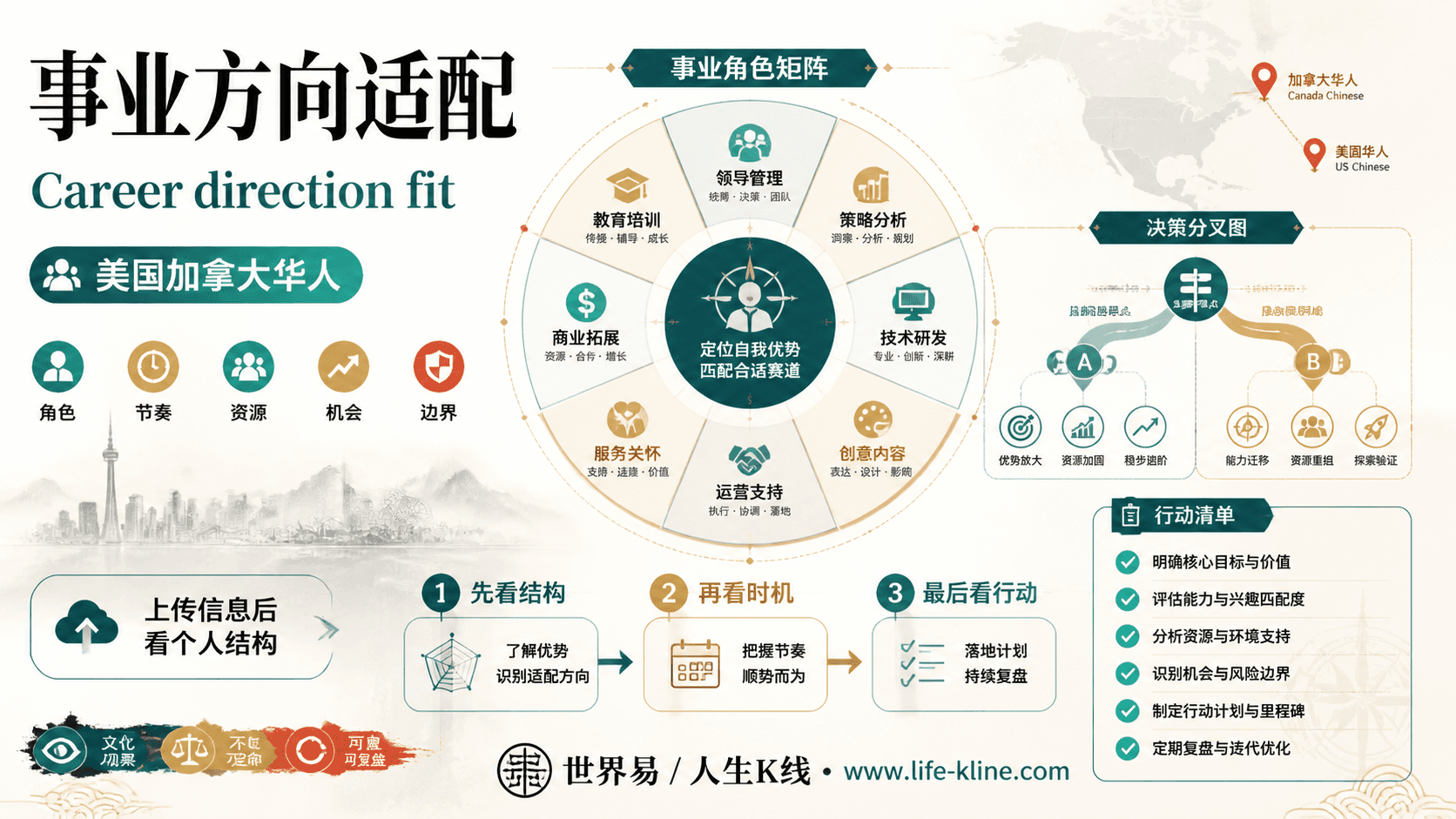
事业方向适配|美国加拿大华人
这张图把《Comprehensive Guide to Zi Wei Da Yun: Life Patterns and Fortune Changes》里的命理概念转成关系、边界和应用场景,适合先看图建立结构,再回到知识文章正文理解细节。
事业方向适配不应被写成固定结论。更适合美国加拿大华人的读法,是把传统术语翻译成结构、时机、环境、行动和复盘。
查看图片解读