Detailed Explanation of the Lifeline: A Symbol of Vitality in Physiognomy and Palmistry with Metaphysical Analysis
把这篇文章落到自己身上验证:先看结构,再进入个人分析,不做泛泛阅读。
What is the Lifeline
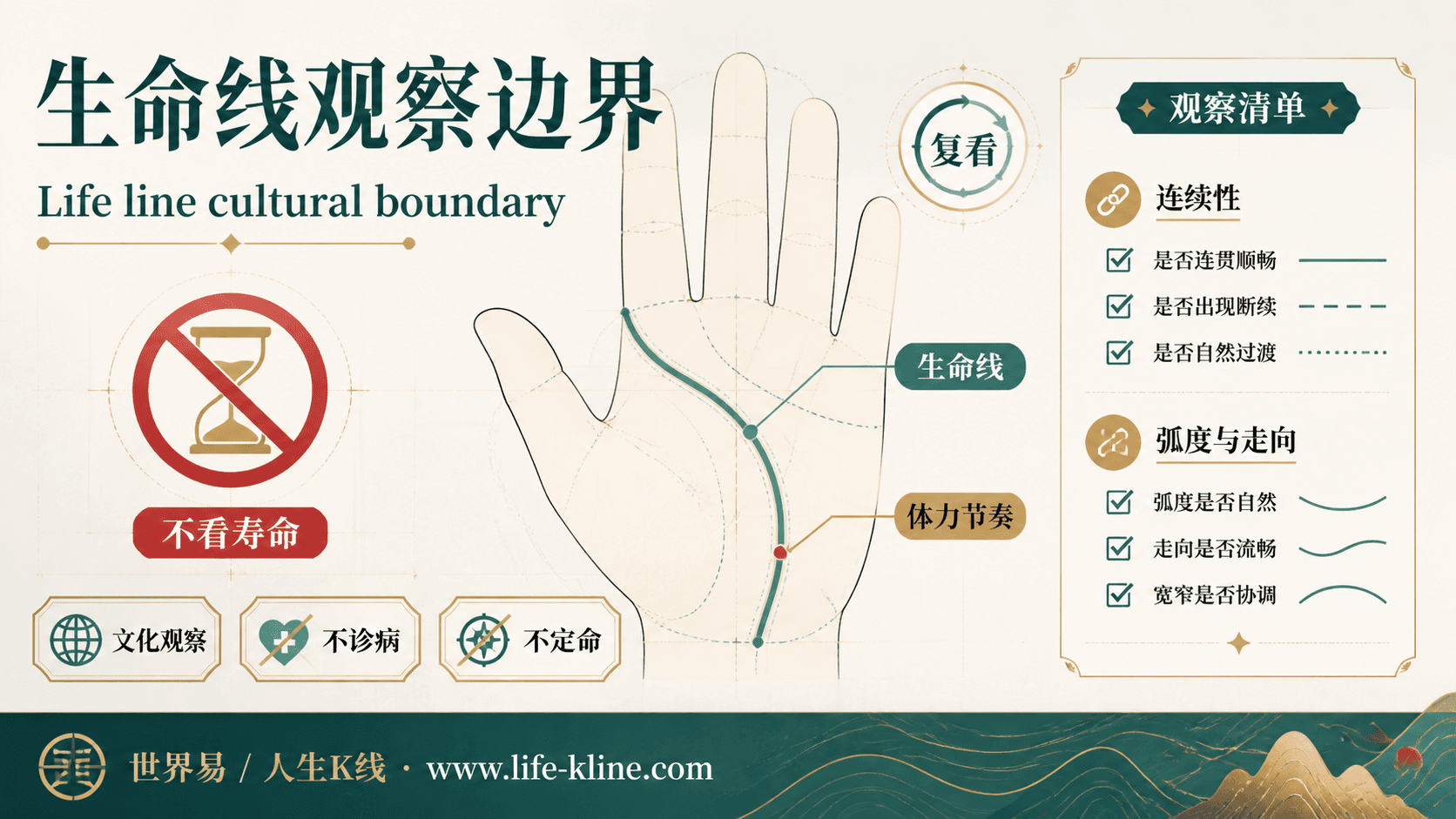
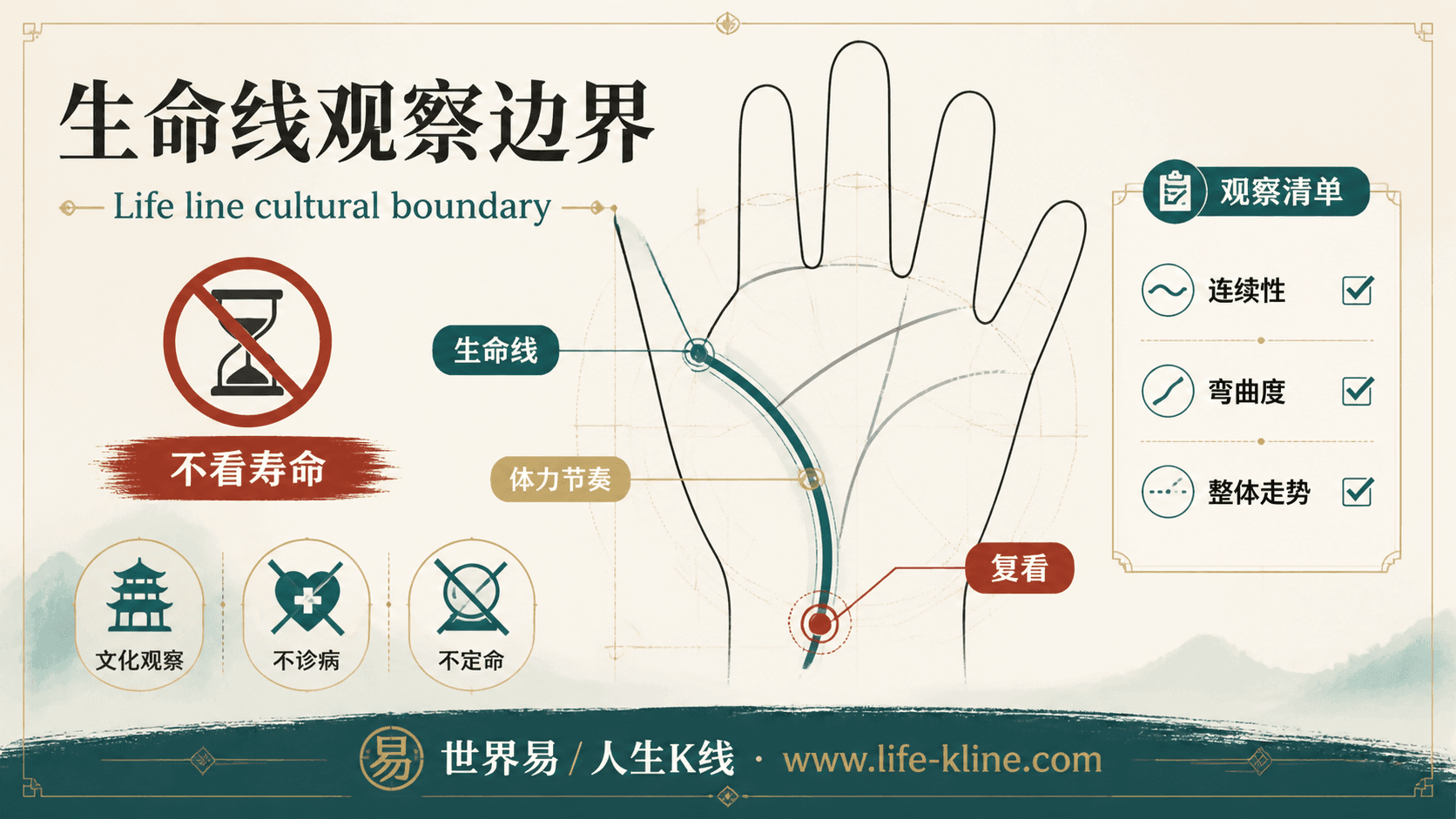
The lifeline is the main line that curves around the base of the thumb on the palm. Its shape, length, depth, and other characteristics are believed to reflect a person's vitality, health condition, and significant events in life. As one of the core indicators in palmistry, the lifeline not only reveals physical vigor but also hints at an individual's mental state and quality of life.
The study of the lifeline has a long history, originating from ancient Eastern and Western physiognomic traditions. It is widely used to predict health trends and changes in life stages. Particularly in Chinese traditional metaphysics, the symbolic meaning of the lifeline becomes richer when combined with BaZi (Four Pillars) elements.
Within the physiognomy and palmistry system, the lifeline serves not only as a window to observe an individual's physical strength but is also closely related to metaphysical factors such as the strength of the Day Master, patterns, and Yong Shen (favorable elements). Through comprehensive analysis of the lifeline alongside metaphysical information, one can more accurately grasp health risks and the trajectory of life fortune.
Changes in the lifeline also reflect the influences of personal growth, living environment, and mindset. As one ages, the lifeline undergoes changes, making it both an innate symbol and a form of acquired feedback.
Therefore, the lifeline is not just a simple line; it is an important link connecting the body's vitality and metaphysical fortune, serving as an indispensable key factor in understanding personal health and destiny.
How to Read the Lifeline: Core Elements
When observing the lifeline, the first focus should be on its length and shape. Generally, a long and deep lifeline indicates strong constitution and abundant vitality, while a short and shallow line may suggest weaker physical strength or health concerns. However, this is only superficial; accurate judgment requires combining the strength of the Day Master and the Yong Shen from the BaZi chart.
Breaks, forks, or irregular changes in the lifeline often signify major incidents or health challenges in life. This aspect closely interacts with the Da Yun (decade luck cycles) and Liu Nian (annual fortune), especially when the Da Yun is unfavorable and the Liu Nian brings adverse effects. In such cases, anomalies in the lifeline deserve particular attention.
Analyzing the Four Pillars, the strength of the Day Master determines a person's basic constitution and vitality foundation. The state of the lifeline should be interpreted in conjunction with the Day Master's strength; for example, a balanced Day Master usually corresponds with a stable lifeline, while a weak or overly strong Day Master requires caution regarding potential fluctuations in the lifeline.
The choice of Yong Shen reflects the key element that harmonizes the chart. The health condition of the lifeline also indicates whether the Yong Shen is effective. If the Yong Shen is strong, the lifeline appears stable and vitality relatively abundant; otherwise, the lifeline may show unevenness or interruptions.
Furthermore, the influence of Da Yun and Liu Nian on the lifeline is especially important. Changes in the auspiciousness of Da Yun often accompany variations in the depth and direction of the lifeline. The interaction between Liu Nian and Da Yun reveals fluctuations in personal health and fortune during specific periods. Only by integrating these factors can the interpretation of the lifeline be precise and comprehensive.
Three Real BaZi Chart Cases
Case 1: This female's Day Master is 甲 (Jia) Wood, with a balanced strength. Her pattern is Shi Shen (Eating God), Yong Shen is Water, and Ji Shen (unfavorable element) is Metal. She is currently in the 庚申 (Geng Shen) Da Yun (ages 31-40), which is an unfavorable luck cycle requiring caution against major incidents. The Liu Nian is 丙午 (Bing Wu) year. The Geng Shen Da Yun is relatively weak, and the Liu Nian calls for prudence. In interpreting her lifeline, this metaphysical combination suggests possible fluctuations, especially during this unlucky Da Yun period, where the lifeline may show breaks or uneven depth, reflecting challenges in physical and mental states. Therefore, she should pay special attention to health and guard against accidents and significant misfortunes.
Case 2: This female's Day Master is 庚 (Geng) Metal, relatively weak, with a Zheng Yin (Proper Seal) pattern. Yong Shen is Fire, while Ji Shen are Water and Wood. Her current Da Yun is 壬寅 (Ren Yin) (ages 27-36), also an unfavorable luck cycle, and the Liu Nian is 丙午 (Bing Wu) year. The Da Yun is weak, and the Liu Nian requires caution. The lifeline in this chart may appear unstable or shallow, reflecting a constitution prone to weakness and susceptibility to environmental influences. Considering the Yong Shen Fire requirement, the lifeline may show significant changes during adverse Liu Nian, indicating health vulnerability. She needs to focus on nurturing and adjusting lifestyle habits to stabilize vitality.
Case 3: This male's Day Master is 辛 (Xin) Metal, relatively weak, with a Pian Cai (Indirect Wealth) pattern. Yong Shen is Earth, and Ji Shen are Water and Wood. He is currently in the 庚戌 (Geng Xu) Da Yun (ages 44-53), which is auspicious, with career and wealth progressing. The Liu Nian is 丙午 (Bing Wu) year, aligning well with the Da Yun. His lifeline is likely solid and strong, reflecting abundant vitality and a positive cycle supporting physical health. During this favorable Da Yun, the lifeline is deep and long, indicating stable health and abundant energy, conducive to sustained career and life development.
Common Misconceptions
Many people mistakenly believe that the longer the lifeline, the better. In reality, the length of the lifeline must be judged in conjunction with the Day Master's strength and Yong Shen. Even a long lifeline may still indicate health risks if the Da Yun is unfavorable or the Yong Shen is suppressed. Therefore, judging vitality solely by length is not scientific.
Some think the lifeline does not change with age. In fact, the lifeline changes in shape as one ages and as the living environment and health conditions evolve. Ignoring the dynamic nature of the lifeline can lead to misjudgments about current health and fortune trends.
Some focus only on the lifeline of one hand and neglect the comparison between both hands. Actually, the left hand represents innate qualities (congenital), while the right hand reflects acquired conditions (postnatal). Differences between the two lifelines can reveal changes in health and fortune throughout life. Neglecting this may miss important information.
Some interpreters overlook the influence of Da Yun and Liu Nian on the lifeline. Changes in Da Yun and Liu Nian directly affect the state and variations of the lifeline. Without analyzing the lifeline in the context of timing and fortune, accurate predictions and guidance are difficult to achieve.
Practical Suggestions
When observing the lifeline, it is recommended to simultaneously refer to the individual's BaZi chart, including the strength of the Day Master, pattern, and Yong Shen, combined with the current Da Yun and Liu Nian conditions for comprehensive analysis. This approach allows accurate interpretation of the deeper meanings of the lifeline and its indications for health and fortune.
Regularly observe changes in the lifelines of both hands, paying attention to their correspondence with age, living environment, and health status. When breaks, forks, or variations in depth appear on the lifeline, analyze them in the context of the current metaphysical fortune, and promptly adjust lifestyle and mindset to prevent potential risks.
Changes in the lifeline also signal the need for attention to physical and mental care, especially during unfavorable Da Yun or Liu Nian periods. Maintaining good routines, diet, and emotional management helps stabilize the lifeline, enhance vitality, and reduce the likelihood of sudden adverse events.
FAQ
Question 1: Does physiognomy change with age? Answer: Yes, and the changes can be significant. In youth, the focus is mainly on the Tian Ting (forehead); in middle age, more attention is paid to the cheekbones and nose; in old age, the chin and nasolabial folds become important. A person's facial features at different life stages may differ greatly because mindset, lifestyle, and health conditions are all reflected on the face. Therefore, physiognomy includes dynamic changes.
Question 2: Which hand is more accurate in palmistry, left or right? Answer: Traditionally, it is said “men left, women right,” but modern palmistry generally holds that the left hand represents congenital qualities (innate potentials at birth), while the right hand reflects acquired conditions (current actual state and future trends). The greater the difference between the two hands, the more changes experienced in life. Therefore, comparing lifelines on both hands is crucial for understanding personal health and fortune.
Question 3: Why combine Da Yun and Liu Nian with lifeline analysis? Answer: Da Yun and Liu Nian represent changes in personal fortune during different life stages, directly affecting physical and mental states. Changes in the lifeline often correlate closely with the auspiciousness of Da Yun and Liu Nian. Only by integrating metaphysical fortune can the lifeline's meaning be accurately interpreted, potential risks identified timely, and appropriate adjustments and precautions made.
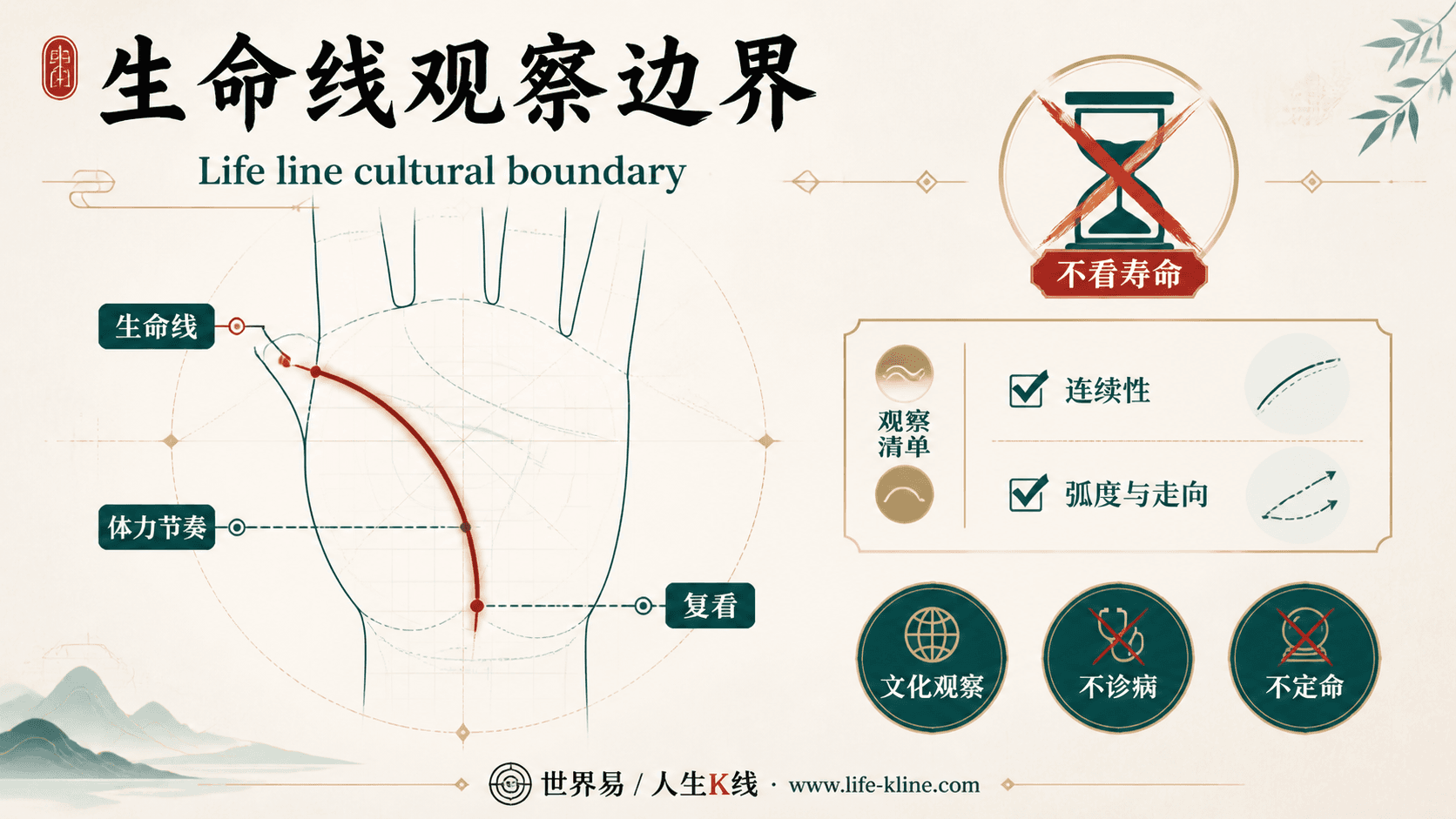
生命线观察边界|北美华人
这张图把《Detailed Explanation of the Lifeline: A Symbol of Vitality in Physiognomy and Palmistry with Metaphysical Analysis》里的命理概念转成关系、边界和应用场景,适合先看图建立结构,再回到知识文章正文理解细节。
生命线观察边界用于解释life line meaning相关的手相文化观察方法,适合北美华人用户理解掌纹术语、上传边界和现实复盘方式。
查看图片解读