Comprehensive Guide to Moon Signs: Emotions and the Subconscious in Western Astrology
把这篇文章落到自己身上验证:先看结构,再进入个人分析,不做泛泛阅读。
What Is the Moon Sign
The Moon sign is an important indicator in Western astrology used to describe an individual's emotional traits and subconscious reactions. It represents the deep inner needs, sense of security, and emotional expression style of a person, often seen as the emotional counterpart complementing the Sun sign.
The Moon sign is determined by the zodiac sign the Moon occupies at the time of birth. Since the Moon orbits the Earth approximately every 28 days, the Moon sign changes relatively quickly. Compared to the Sun sign, the Moon sign better reflects emotional fluctuations and inner feelings.
In Western astrology, the Moon symbolizes motherhood, family, and the emotional world. Its position reveals how a person handles emotional needs and interacts in intimate relationships. Understanding the Moon sign helps gain a more comprehensive self-awareness, especially regarding emotional management and underlying psychological patterns.
The Moon sign is closely related to an individual’s subconscious, often influencing their pursuit of security and behavior in close relationships. It complements the external personality of the Sun sign, creating a balance between emotion and reason.
Historically, the study of the Moon sign has gained increasing importance with the development of astrology. Modern astrologers generally agree that analyzing the Sun sign, Moon sign, and Ascendant together can more accurately portray an individual's overall image.
How to Interpret the Moon Sign: Core Elements
To determine the Moon sign, an accurate birth time and location are essential because the Moon moves quickly, and any time error directly affects the Moon’s exact position. The zodiac sign the Moon occupies reflects a person’s emotional patterns and subconscious tendencies.
The Moon sign, together with the Sun sign and Ascendant, forms the three foundational pillars in an individual’s astrological profile. The Sun sign represents the core self, the Ascendant represents outward expression, while the Moon sign focuses on inner emotions and subconscious reactions.
When analyzing the Moon sign, it is also necessary to integrate factors from the Four Pillars (BaZi) such as the Day Master, pattern (Ge Ju), and Yong Shen (favorable element). For example, the strength of the Day Master and the choice of Yong Shen can influence how one expresses emotions and their inner need for security.
The Da Yun (decade luck cycle) and Liu Nian (annual fortune) impact the Moon sign by reflecting changes in emotional fluctuations and subconscious states. A stable Da Yun usually indicates emotional steadiness, while variations in Liu Nian may bring emotional adaptability.
By synthesizing the relationships among the Moon sign, Day Master, pattern, and Yong Shen in metaphysics, one can gain a more three-dimensional understanding of an individual’s emotional world and subconscious expression, helping to reveal deep psychological drives and behavioral patterns.
Three Real Natal Chart Cases
Case One involves a male aged 40 to 45, with a 丁 (Ding) Fire Day Master that is relatively weak, a Zheng Guan (Proper Authority) pattern, Yong Shen being Fire, and Ji Shen (unfavorable elements) being Earth and Metal. His current Da Yun is Bing Chen (丙辰, 35-44 years), and Liu Nian is Bing Wu (丙午). The overall Da Yun is stable, and the Liu Nian shows adaptability. Combined with the Moon sign, the weak 丁 Fire Day Master requires Fire as Yong Shen to strengthen it. The Moon sign’s emotional traits may be supported by the Fire element, manifesting as positivity and warmth in emotions, but the influence of Ji Shen Earth and Metal may cause emotional fluctuations or inner stress. The stability of the Da Yun and Liu Nian supports emotional steadiness, making the Moon sign’s emotional expression more natural and smooth.
Case Two is a female aged 20 to 25, with a 辛 (Xin) Metal Day Master of moderate strength, a Pian Yin (Partial Resource) pattern, Yong Shen being Earth, and Ji Shen being Fire. Her current Da Yun is Xin Si (辛巳, 16-25 years), and Liu Nian is Bing Wu (丙午). The Da Yun is stable, and the Liu Nian shows adaptability. The Moon sign in this chart, combined with Earth as Yong Shen, indicates emotional tendencies toward stability and practicality, with subconscious needs emphasizing security and realism. The presence of Ji Shen Fire suggests that emotional expression should avoid being overly intense or impulsive. The stable yet adaptable nature of the Da Yun and Liu Nian reflects the Moon sign’s flexible emotional adjustment ability, demonstrating good interaction between inner feelings and the external environment.
Case Three is a male aged 35 to 40, with a weak 丁 (Ding) Fire Day Master, a Qi Sha (Seven Killings) pattern, Yong Shen being Metal, and Ji Shen being Earth. His current Da Yun is Ding Mao (丁卯, 36-45 years), and Liu Nian is Bing Wu (丙午). The overall Da Yun is stable, and the Liu Nian shows adaptability. In this chart, because Metal is the Yong Shen, the emotional and subconscious levels may exhibit rationality and resilience, with emotional expression carrying a degree of control. The influence of Ji Shen Earth warns of potential emotional suppression during fluctuations. The stability of the Da Yun and Liu Nian helps maintain emotional steadiness in the Moon sign, while the adaptability of the Liu Nian indicates strong emotional flexibility to cope with changing environments.
These three cases demonstrate how to integrate the Day Master, pattern, Yong Shen, Da Yun, and Liu Nian from metaphysics to understand the emotional role of the Moon sign, reflecting its multidimensional influence in an individual’s inner world.
Common Misconceptions
Many people mistakenly believe that the Moon sign represents the external personality in the same way as the Sun sign. In fact, the Moon sign primarily reflects inner emotions and the subconscious, differing from external behavioral patterns. Equating the Moon sign simply with the dominant personality sign can lead to misunderstandings.
Another common misconception is neglecting the impact of birth time accuracy on the Moon sign. Because the Moon moves quickly, lacking an accurate birth time can cause errors in determining the Moon sign, thereby affecting the overall chart interpretation.
Some also overemphasize the independent role of the Moon sign while ignoring its interactive relationship with the Sun sign and Ascendant. The Moon sign should be analyzed together with other major signs to fully reveal an individual’s emotional and behavioral characteristics.
Finally, many believe the Moon sign alone can predict life outcomes. In reality, the Moon sign mainly reflects emotions and the subconscious. Metaphysical judgment requires integration with systems like the Four Pillars (BaZi) to form a complete metaphysical picture.
Practical Advice
To accurately interpret the Moon sign, first obtain as complete and precise a birth time and place as possible to ensure the Moon’s position is correct. When time information is missing, official records such as hospital birth certificates or maternity handbooks can be referenced.
In practice, combine the Sun sign, Ascendant, and Four Pillars metaphysical factors such as the Day Master, pattern, and Yong Shen for a comprehensive analysis of the Moon sign’s influence on emotions and the subconscious, avoiding isolated interpretation.
Pay attention to how the Da Yun and Liu Nian affect the emotional aspects of the Moon sign. Understanding the stability and fluctuations of emotions during different phases helps better manage inner feelings and improve psychological adaptability in daily life.
FAQ
Question 1: Which is more important, the Sun sign or the Ascendant? Answer: Commonly, the “sign” people refer to is the Sun sign, representing the core self and goals. The Ascendant is the zodiac sign rising on the eastern horizon at birth, changing approximately every two hours, representing how you present yourself to the outside world. Both are important, and the Moon sign supplements the emotional and subconscious layers. Together, the three provide a comprehensive depiction of an individual’s personality.
Question 2: Can a natal chart be read without a birth time? Answer: Without a complete birth time, you can roughly determine the Sun sign, Moon sign, and planetary signs, but cannot precisely calculate the 12 houses because house calculations depend on accurate birth time. Houses determine specific areas such as career. It is recommended to find birth certificates or maternity handbooks to complete birth time for an accurate chart.
Question 3: What specific impact does the Moon sign have on personal emotions? Answer: The Moon sign reflects a person’s emotional needs, pursuit of security, and subconscious response patterns. It influences how one expresses emotions, manages intimate relationships, and handles internal states under stress. Combined with metaphysical elements like the Day Master and Yong Shen, interpreting the Moon sign can reveal deeper emotional motivations.
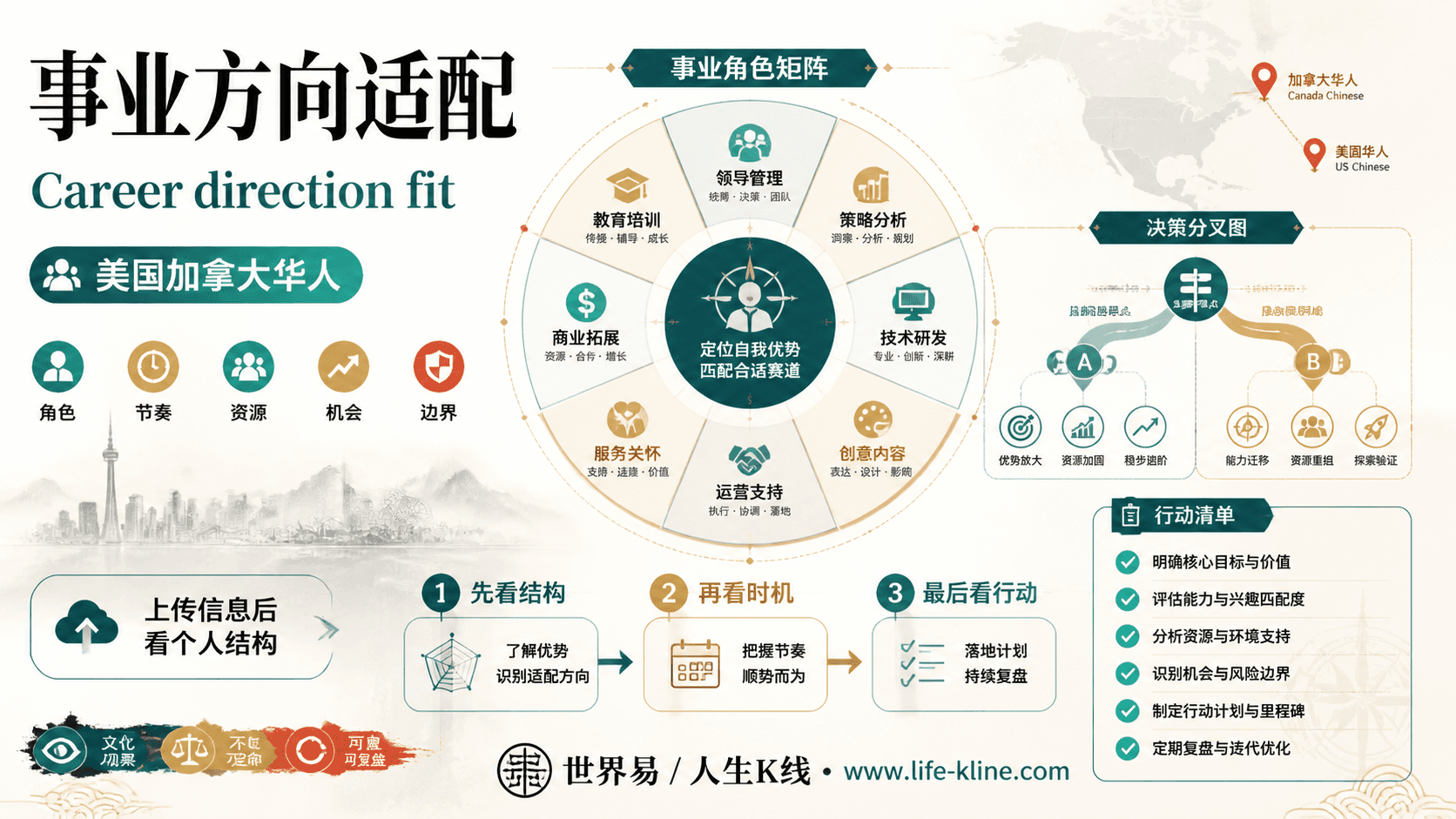
事业方向适配|美国加拿大华人
这张图把《Comprehensive Guide to Moon Signs: Emotions and the Subconscious in Western Astrology》里的命理概念转成关系、边界和应用场景,适合先看图建立结构,再回到知识文章正文理解细节。
事业方向适配不应被写成固定结论。更适合美国加拿大华人的读法,是把传统术语翻译成结构、时机、环境、行动和复盘。
查看图片解读