Complete Guide to Natal Chart Interpretation: Integrating BaZi and Western Astrology
把这篇文章落到自己身上验证:先看结构,再进入个人分析,不做泛泛阅读。
What Is Natal Chart Interpretation
Natal chart interpretation is a comprehensive analytical method combining Western astrology and traditional BaZi (Four Pillars) metaphysics. It aims to reveal an individual's personality, destiny, and development trends through celestial phenomena and birth time. Western astrology maps inner traits and external expressions via the positions of the Sun, Moon, and planets in zodiac signs and houses. BaZi analyzes the combination of Heavenly Stems (天干) and Earthly Branches (地支) in the birth year, month, day, and hour, examining the Day Master’s strength, pattern structure, and identifying Yong Shen (favorable elements) and Ji Shen (unfavorable elements) to uncover key destiny factors.
The integration of these two systems offers a more three-dimensional and detailed destiny analysis, focusing both on internal potential and external environmental influences. Natal chart interpretation not only helps individuals understand their strengths and weaknesses but also guides life decisions and timing.
Historically, Western astrology has a long tradition originating from ancient Greco-Roman culture, based on celestial movements; BaZi metaphysics stems from ancient Chinese Yin-Yang and Five Elements philosophy, forming a unique destiny prediction system. Modern natal chart interpretation fuses both to create a multidimensional metaphysical analysis tool.
How to Read a Natal Chart: Core Elements
The core of natal chart interpretation lies in accurately identifying the strength and pattern of the Day Master (or Sun sign). The Day Master represents the individual’s essence and energy, with its strength reflecting vitality and ability to respond to external circumstances. The pattern refers to the arrangement of Heavenly Stems and Earthly Branches in the Four Pillars, determining the fundamental destiny structure, such as Pian Yin (偏印) pattern, Shang Guan (伤官) pattern, or Bi Jian (比肩) pattern.
Yong Shen (favorable elements) and Ji Shen (unfavorable elements) are key factors in harmonizing the natal chart. Yong Shen are the Five Elements needed to balance Yin and Yang, resolve clashes, and enhance fortune. Ji Shen are the Five Elements that adversely affect the chart and should be avoided or mitigated. Correctly identifying Yong Shen and Ji Shen helps precisely interpret the natal chart and guide life choices and adjustments.
Da Yun (decade luck cycles) and Liu Nian (annual fortune) reflect the temporal dimension of fortune changes. Da Yun represents ten-year cycles of luck, while Liu Nian refers to specific yearly fortunes. Their interaction determines auspiciousness or challenges in career, wealth, health, and other areas. Interpretation requires combining the current Da Yun and Liu Nian to analyze their impact on the Day Master and Yong Shen/Ji Shen, thus judging the trend of fortune.
Additionally, in Western astrology, the Sun sign, Ascendant (rising sign), and Moon sign form the foundation of the personal natal chart. The Sun sign represents the core self, the Moon sign reflects emotions and subconscious, and the Ascendant indicates outward behavior and social image. Together, these three compose the complete astrological framework, supporting the in-depth analysis of BaZi metaphysics.
Three Real Natal Chart Cases
Case 1: Male, aged 35-40, Four Pillars: Wu Chen year (戊辰), Xin You month (辛酉), Gui Si day (癸巳), Gui Chou hour (癸丑). The Day Master Gui Water (癸水) is relatively strong, belonging to the Pian Yin (偏印) pattern. Yong Shen are Earth and Fire; Ji Shen is Metal. Currently in Yi Chou Da Yun (乙丑, 31-40 years), a favorable luck cycle with progress in career and wealth. The Liu Nian is Bing Wu (丙午), interacting smoothly with Da Yun. This chart shows that the strong Water Day Master requires Earth and Fire to harmonize. Proper use of Yong Shen supports the individual during the current Da Yun, leading to career and financial improvement, illustrating the importance of Yong Shen coordination and Da Yun-Liu Nian interaction in natal chart interpretation.
Case 2: Female, aged 50-55, Four Pillars: Bing Chen year (丙辰), Jia Wu month (甲午), Gui Mao day (癸卯), Xin You hour (辛酉). The Day Master Gui Water (癸水) is relatively weak, with a Shang Guan (伤官) pattern. Yong Shen is Water; Ji Shen are Wood and Fire. Currently in Ji Chou Da Yun (己丑, 45-54 years), a stable luck cycle suitable for maintaining achievements. The Liu Nian is Bing Wu (丙午), with flexible interaction between Liu Nian and Da Yun. This chart’s weak Day Master needs Water to nourish it, while Ji Shen Wood and Fire may cause obstacles. Natal chart interpretation emphasizes the nourishing effect of Yong Shen on the Day Master and the stability and adaptability of Da Yun and Liu Nian, advising the individual to focus on consolidation and flexible response during stable periods.
Case 3: Male, aged 25-30, Four Pillars: Ji Mao year (己卯), Bing Yin month (丙寅), Bing Shen day (丙申), Wu Xu hour (戊戌). The Day Master Bing Fire (丙火) is relatively strong, with a Bi Jian (比肩) pattern. Yong Shen is Fire; Ji Shen is Wood. Currently in Gui Hai Da Yun (癸亥, 23-32 years), a stable luck cycle suitable for maintaining achievements. The Liu Nian is Bing Wu (丙午), with flexible interaction between Liu Nian and Da Yun. This chart’s strong Bing Fire Day Master requires Fire for support, while Ji Shen Wood may cause depletion. Natal chart interpretation highlights the regulatory role of Yong Shen and Ji Shen on the Day Master and the comprehensive influence of Da Yun and Liu Nian, helping the individual reasonably grasp opportunities and risks during stable fortune periods.
Common Misconceptions
Many people mistakenly believe that the Sun sign alone determines destiny, neglecting the roles of the Moon sign and Ascendant. In fact, the Sun sign represents the core and goals, the Ascendant affects external expression, and the Moon sign reflects emotions and subconscious. All three are indispensable.
Another common misconception is that a natal chart cannot be read without an exact birth time. Although lacking birth time affects the precise division of houses, some information can still be obtained from the Sun sign, Moon sign, and planetary positions. In BaZi, the birth time is critical for the accuracy of the Hour Pillar, so it is recommended to complete the birth time as much as possible for a full interpretation.
There is also a misunderstanding that the classification of Yong Shen and Ji Shen is fixed and unchanging. In reality, Yong Shen and Ji Shen depend on the Day Master’s strength and pattern and require specific chart analysis. Blindly applying fixed rules often leads to incorrect judgments.
Practical Advice
When conducting natal chart interpretation, first accurately obtain the birth year, month, day, and exact hour to ensure precision in both BaZi metaphysics and Western astrology. It is recommended to check official documents such as birth certificates or maternity records to complete the information.
Interpretation should combine the Day Master’s strength, pattern, Yong Shen and Ji Shen, and the current Da Yun and Liu Nian, comprehensively analyzing the overall chart condition and temporal fortune changes. Avoid relying on a single factor. This multidimensional perspective enables a fuller understanding of personal destiny trends and potential opportunities.
Finally, natal chart interpretation is not only a predictive tool but also an aid for self-awareness and growth. Results should be viewed rationally and combined with personal circumstances to adjust life and decisions. By leveraging the positive effects of Yong Shen and mitigating the negative impact of Ji Shen, one can improve life quality and fortune.
FAQ
Question 1: Which is more important, the Sun sign or the Ascendant? Answer: The commonly referenced “zodiac sign” usually means the Sun sign, which represents a person’s core self and life goals. The Ascendant is the zodiac sign rising on the eastern horizon at birth, changing approximately every two hours, representing outward behavior and social style. The Moon sign supplements emotional and subconscious layers. All three are complementary and important; none should be emphasized exclusively.
Question 2: Can a natal chart be read without birth time? Answer: Without an exact birth time, it is still possible to analyze the Sun sign, Moon sign, and planetary positions, but the twelve houses cannot be accurately divided since houses depend on birth time, especially key houses like the Midheaven (career house). It is recommended to obtain birth time from hospital birth certificates or maternity records for a more complete natal chart interpretation.
Question 3: How are Yong Shen and Ji Shen specifically determined? Answer: Yong Shen and Ji Shen are determined based on the Day Master’s Five Element attribute and its strength, combined with the overall pattern. Yong Shen are the Five Elements that help balance the chart and adjust the energy field; Ji Shen are those that negatively affect the Day Master. Metaphysical analysis requires specific chart-by-chart evaluation to avoid simplistic application of fixed rules.
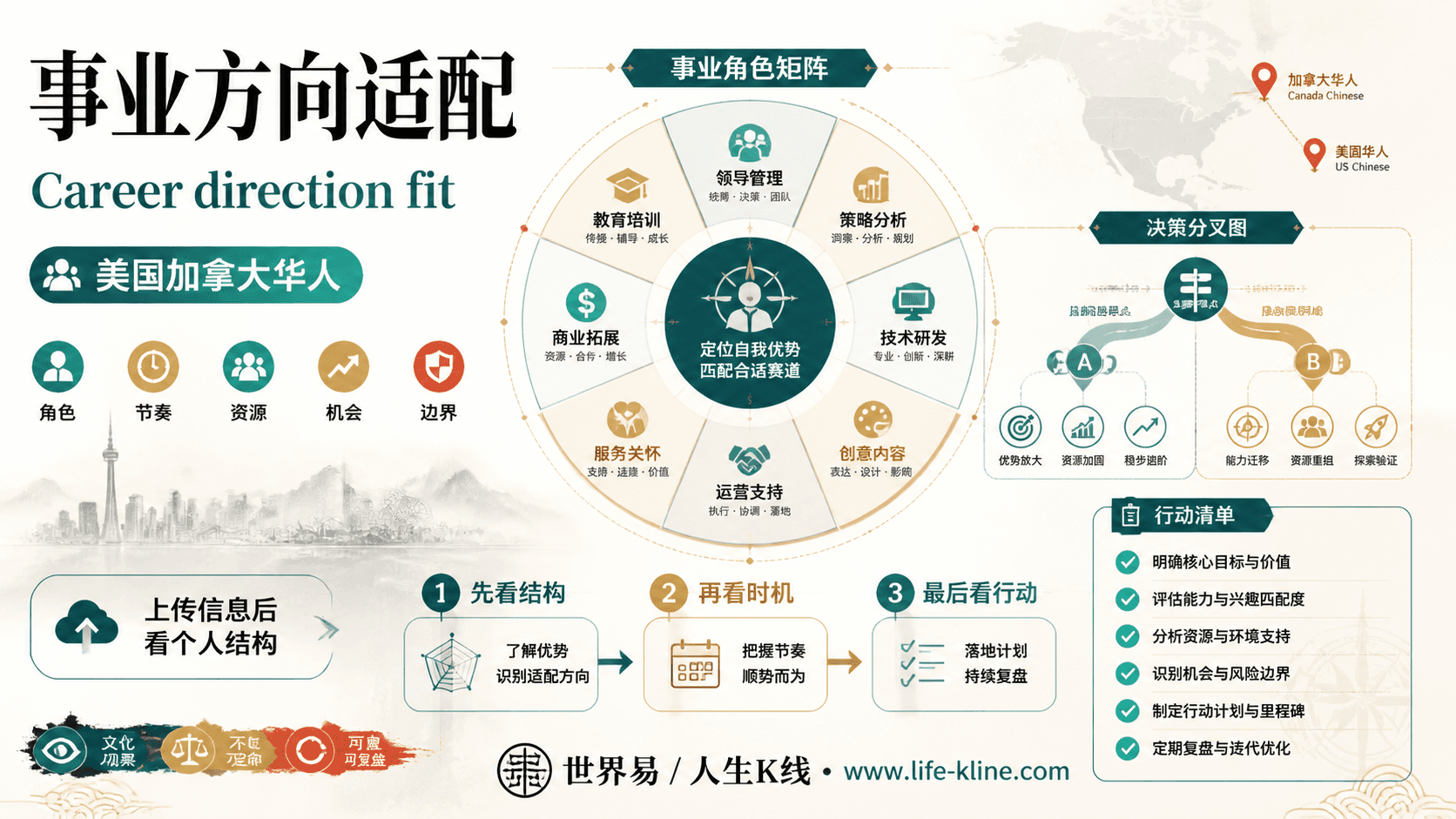
事业方向适配|美国加拿大华人
这张图把《Complete Guide to Natal Chart Interpretation: Integrating BaZi and Western Astrology》里的命理概念转成关系、边界和应用场景,适合先看图建立结构,再回到知识文章正文理解细节。
事业方向适配不应被写成固定结论。更适合美国加拿大华人的读法,是把传统术语翻译成结构、时机、环境、行动和复盘。
查看图片解读