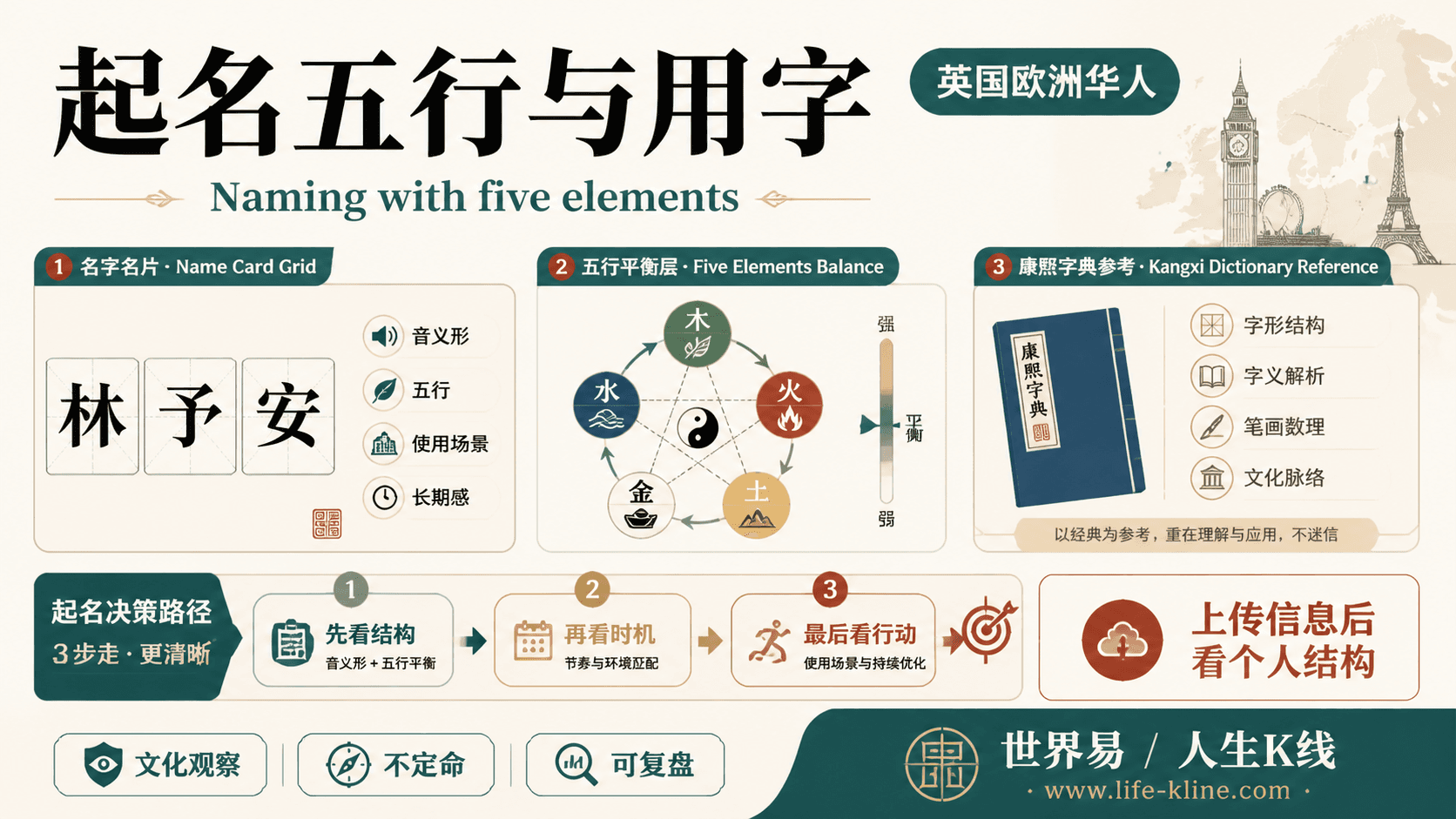
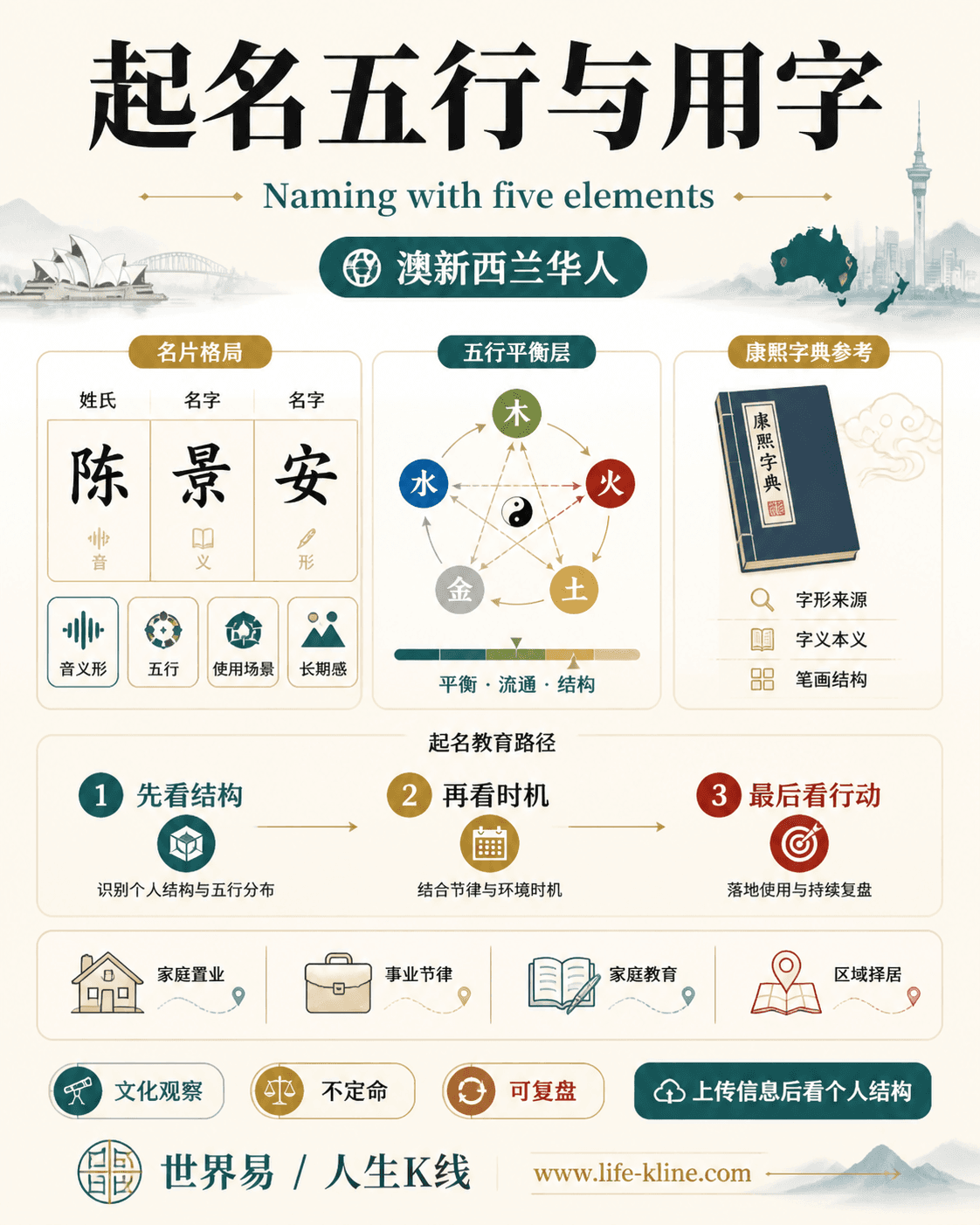
Complete Guide to Generation Name Selection: Scientific Naming Combining Destiny Patterns and Yong Shen
把这篇文章落到自己身上验证:先看结构,再进入个人分析,不做泛泛阅读。
What Is Generation Name Selection
Generation name selection is an important part of traditional Chinese naming culture. It refers to choosing specific characters for a newborn’s name according to the family’s generational order and lineage, thereby reflecting family heritage and respect. Generation characters not only mark family bloodlines but also carry the family’s cultural accumulation and values.
In metaphysics, generation naming is more than literal inheritance; it involves coordination of the Five Elements, stroke numerology, and the BaZi (Four Pillars of Destiny). By selecting characters reasonably, one can fulfill family heritage requirements while positively assisting the individual’s fortune.
The practice of generation naming combined with metaphysics originates from the ancient concept of the unity of Heaven and Man, emphasizing the mutual influence between a name and the birth BaZi. Proper arrangement of generation characters can compensate for Five Element deficiencies in the BaZi and avoid conflict with the Day Master, thus achieving auspiciousness and avoiding misfortune.
In recent years, as metaphysics has become more popular, many families have begun to value the potential impact of generation naming on personal destiny. They hope to improve life trajectories through scientific naming methods. Generation naming has evolved from simple family inheritance to a comprehensive naming system integrating modern metaphysics.
How to View Generation Name Selection: Core Elements
When choosing generation characters for a newborn, the first step is to accurately analyze the Day Master attribute and its strength in the Four Pillars BaZi. The Day Master represents the individual, and judging its strength determines which Five Elements should be supplemented or restrained in the name, guiding the selection of the generation character’s Five Element attribute.
Secondly, determining the pattern is key. The pattern reflects the overall structural characteristics of the BaZi. Different patterns have different Yong Shen (favorable elements) and Ji Shen (unfavorable elements). Generation naming should prioritize characters whose Five Elements support the Yong Shen and restrain the Ji Shen to enhance the pattern’s positive effects.
The application of Yong Shen is central to generation naming. Yong Shen is the Five Element most in need of support in the BaZi. Characters in the generation name should appropriately include the Yong Shen’s element to balance the Five Elements and smooth the Qi flow. At the same time, characters representing Ji Shen elements should be avoided to prevent conflict.
Additionally, generation naming must consider the auspiciousness of stroke numerology, including Tian Ge (Heavenly Grid), Ren Ge (Personality Grid), Di Ge (Earthly Grid), Zong Ge (Total Grid), and Wai Ge (Outer Grid), ensuring the numerology combination is favorable and meaningful. Characters should be easy to read and write, avoid complex or rare characters, and respect family elders’ naming taboos to prevent offense.
In summary, generation name selection is a discipline integrating metaphysics, culture, and aesthetics. It must respect family tradition while meeting individual metaphysical needs, achieving scientific rationality and profound meaning.
Three Real BaZi Case Studies
Case One is a female aged 35-40, with Four Pillars: 庚午 (Geng Wu), 丙戌 (Bing Xu), 癸丑 (Gui Chou), 癸亥 (Gui Hai). Her Day Master is 癸水 (Gui Water), relatively weak, belonging to the Zheng Cai (Direct Wealth) pattern. Her Yong Shen is Metal, and Ji Shen are Wood and Fire. Currently in the 壬午 (Ren Wu) Da Yun (decade luck cycle), which is stable, suitable for maintaining achievements. Based on her metaphysics, generation naming should focus on supplementing the Metal element and avoid Wood and Fire characters, supporting the Yong Shen and preventing Ji Shen interference, thereby stabilizing her wealth and overall fortune. The generation characters should convey meanings of stability and preservation while respecting family heritage.
Case Two is a male aged 50-55, with Four Pillars: 丙辰 (Bing Chen), 己亥 (Ji Hai), 己丑 (Ji Chou), 戊辰 (Wu Chen). His Day Master is 己土 (Ji Earth), relatively strong, with a Bi Jian (Peer) pattern. His Yong Shen are Wood and Water, and Ji Shen is Fire. Currently in the 甲辰 (Jia Chen) Da Yun, an auspicious cycle with career and wealth progress. According to his BaZi traits, generation naming should emphasize supplementing Wood and Water elements to strengthen the Yong Shen and avoid Fire elements. The generation characters can express vitality and proactive meanings, aligning with the favorable Da Yun to aid career development and wealth growth.
Case Three is a male aged 40-45, with Four Pillars: 丙寅 (Bing Yin), 庚寅 (Geng Yin), 戊子 (Wu Zi), 甲寅 (Jia Yin). His Day Master is 戊土 (Wu Earth), balanced, with a Cong Sha (Following Qi Sha) pattern. Yong Shen are Wood and Water; Ji Shen are Fire and Earth. Currently in the 甲午 (Jia Wu) Da Yun, a stable cycle suitable for maintaining achievements. According to his metaphysics, supplementing Yong Shen Wood and Water is particularly important. Generation characters should be chosen with corresponding Five Elements to harmonize the BaZi and avoid interference from Ji Shen Fire and Earth. The generation naming should convey steadiness and conformity to the current luck cycle, while respecting family traditions to support stable development during the maintenance phase.
Common Misconceptions
Many mistakenly believe that changing a name can directly change destiny. In fact, a name itself is not omnipotent; changing a name is only an auxiliary method to adjust the BaZi. The name’s effect comes from the continuous calling and writing, forming a certain ‘frequency imprint’ that subtly influences destiny. If the name severely conflicts with the BaZi’s Five Elements, changing it can help regulate, but long-term use is required to see effects.
Another common misconception is over-pursuing novelty and individuality in names while neglecting stroke numerology and Five Element matching. This leads to unique names that do not fit the metaphysics, possibly causing negative impacts. Generation naming should focus on Five Element balance and auspicious numerology, avoiding blind trends or overly complex characters.
Some also ignore family traditions and arbitrarily change generation characters, causing estrangement and cultural discontinuity. Generation naming must consider both personal metaphysics and family rules; balancing both achieves the best results.
Practical Advice
In practice, it is recommended to first accurately calculate the newborn’s Four Pillars BaZi, clarify the Day Master’s strength, pattern, Yong Shen, and Ji Shen, then combine the family’s generation character chart to select characters that match the Yong Shen’s Five Elements and have auspicious stroke numerology. This ensures both family heritage and metaphysical needs are met.
When naming, avoid characters of Ji Shen’s Five Elements to prevent conflict and adverse effects on future fortune. Names should be concise, easy to read and write, avoid rare characters and those prone to teasing. Also, avoid repeating names of family elders to respect family culture.
Changing names requires patience; frequent changes prevent forming a stable ‘frequency imprint’. It is recommended to use the new name continuously for at least one year to observe its auxiliary effect on destiny. For generation naming, it is best to consult a professional metaphysics practitioner for targeted guidance based on the specific BaZi.
FAQ
Question 1: Can changing a name really change one’s fortune? Answer: A name itself cannot directly change a person’s destiny, but its use creates a ‘frequency imprint’ that potentially influences one’s aura and fortune. When the original name’s Five Elements conflict with the BaZi, changing the name to supplement the Five Elements or adjust stroke numerology helps assist the natal trend. The new name must be used consistently in important occasions for over a year before effects become evident.
Question 2: What should be noted when naming a baby? Answer: First, avoid following trendy names to reduce duplication; second, avoid naming taboos of family elders to respect tradition; third, combine the baby’s BaZi Five Element needs and choose characters that supplement the Yong Shen; fourth, consider auspicious stroke numerology, including Tian Ge, Ren Ge, Di Ge, Zong Ge, and Wai Ge; finally, select characters that are easy to read and write, have good meanings, and are unlikely to be teased.
Question 3: How to combine generation naming with metaphysical Yong Shen? Answer: Generation naming requires first identifying the Yong Shen’s Five Elements in the BaZi. When choosing generation characters, priority should be given to those that support the Yong Shen’s elements and avoid Ji Shen elements. This balances the chart and enhances overall fortune. At the same time, family generation order should be respected, balancing tradition and metaphysics to ensure the name carries both family significance and personal metaphysical suitability.
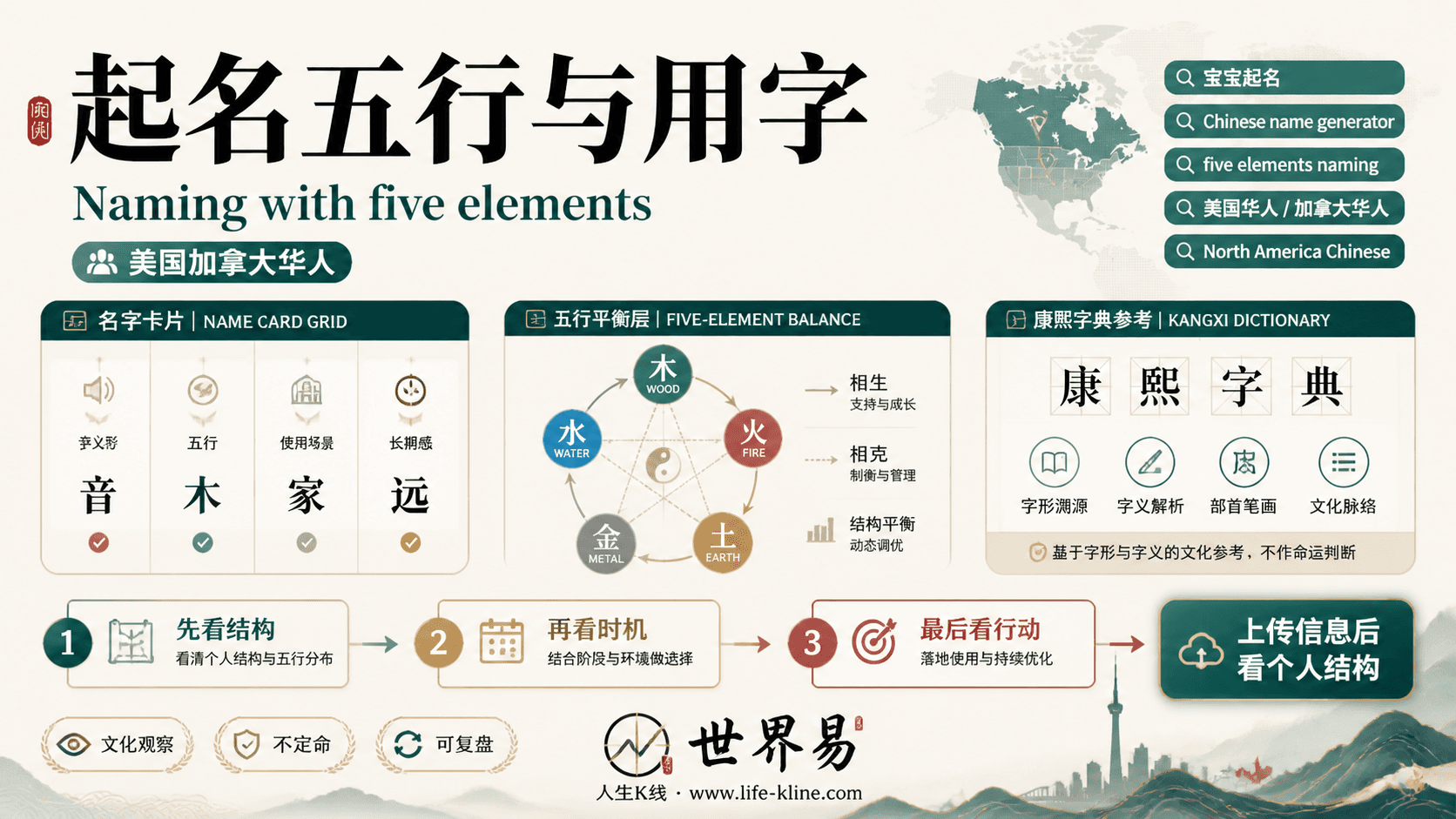
起名五行与用字|美国加拿大华人
这张图把《Complete Guide to Generation Name Selection: Scientific Naming Combining Destiny Patterns and Yong Shen》里的命理概念转成关系、边界和应用场景,适合先看图建立结构,再回到知识文章正文理解细节。
起名五行与用字不应被写成固定结论。更适合美国加拿大华人的读法,是把传统术语翻译成结构、时机、环境、行动和复盘。
查看图片解读