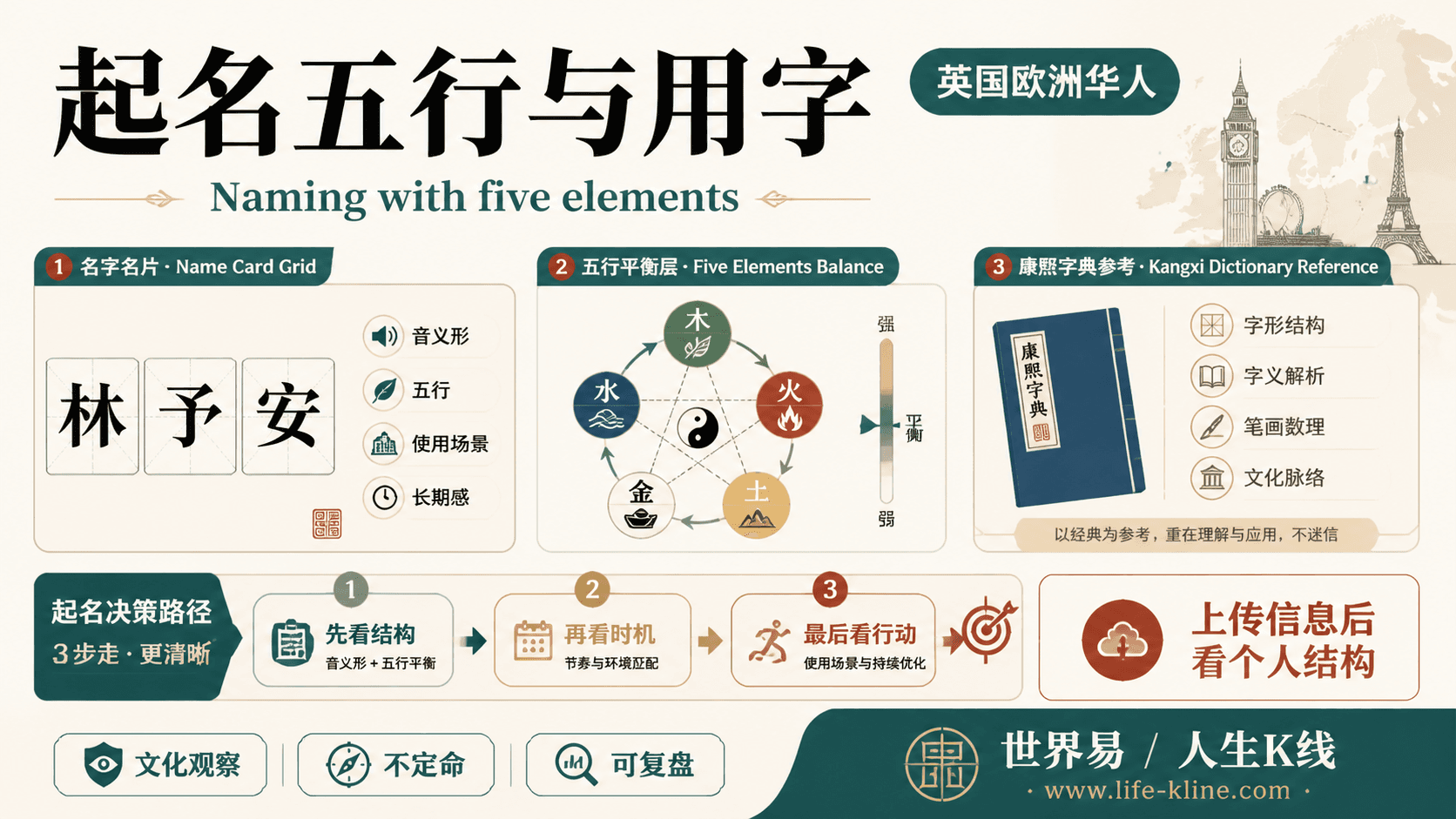
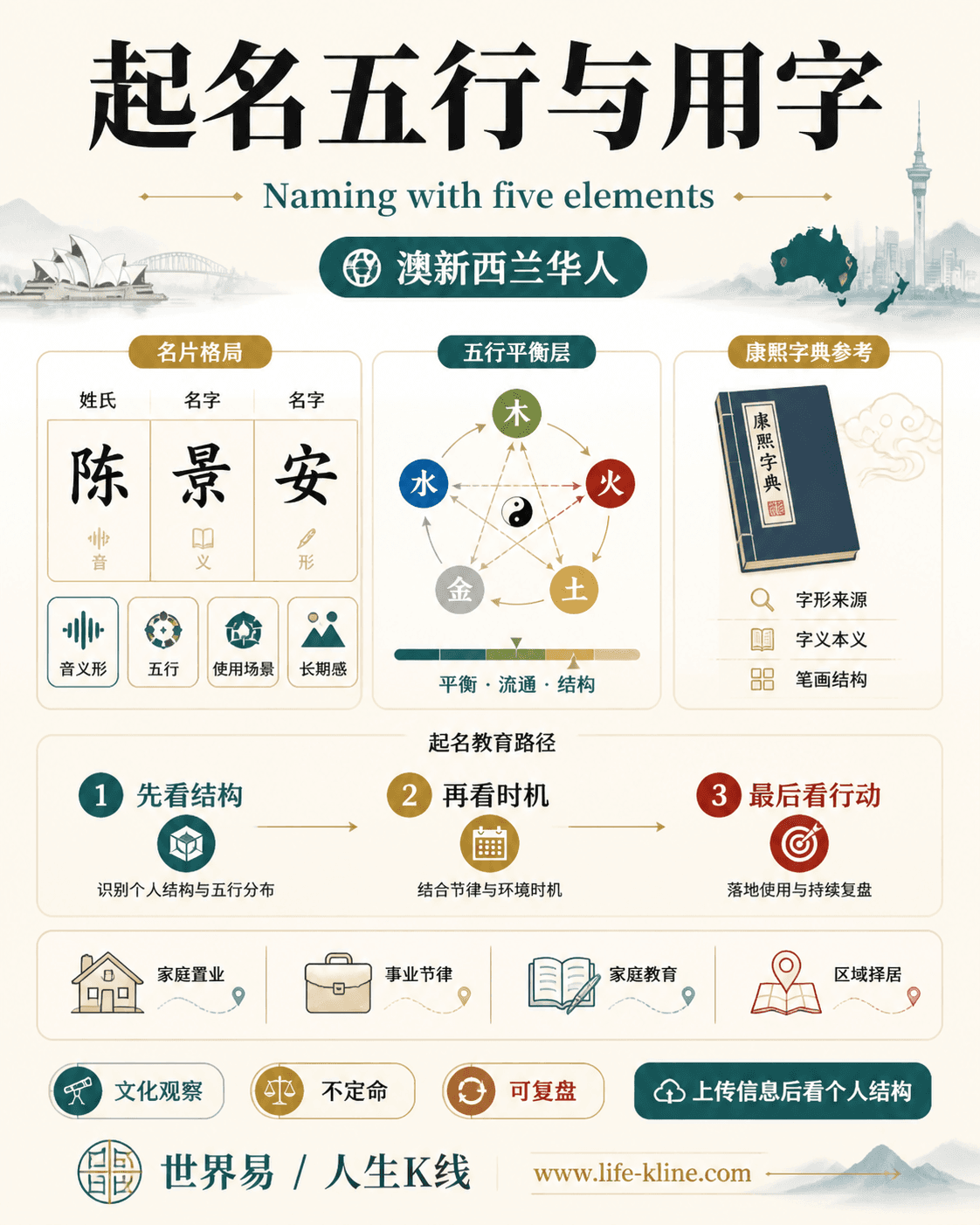
Complete Guide to Company Naming: Naming Strategies from the BaZi Metaphysics Perspective
把这篇文章落到自己身上验证:先看结构,再进入个人分析,不做泛泛阅读。
What Is Company Naming
Company naming refers to the process of selecting a name with symbolic meaning and auspicious connotations when establishing a business. A suitable company name not only reflects corporate culture and industry characteristics but also subconsciously influences the company’s development fortune.
In traditional Chinese culture, naming involves more than linguistic expression; it also incorporates metaphysical elements such as the Five Elements and Heavenly Stems and Earthly Branches (天干地支). Through reasonable combinations, one can supplement missing Five Elements and avoid unfavorable elements (Ji Shen) in the BaZi chart, thereby bringing beneficial energy to business operations.
Naming focuses not only on phonetic beauty and character meanings but also emphasizes alignment with the BaZi (Eight Characters) of the business owner or company registrant. By analyzing the strength of the Day Master, the pattern, and the Yong Shen, selecting characters with appropriate Five Element attributes can assist the company’s smooth development and reduce operational obstacles.
With increasing market competition, scientifically based metaphysical naming has become a key concern for more business owners. A well-designed name aids brand communication and subtly forms a positive 'frequency imprint,' supporting the company’s long-term stable growth.
How to View Company Naming: Core Elements
Company naming should first incorporate the BaZi information of the business owner or key decision-makers, clarifying the strength of the Day Master, overall pattern, and the Yong Shen and Ji Shen. These metaphysical factors determine the required Five Element attributes in the name. Naming should aim to supplement the Yong Shen and avoid the Ji Shen to achieve Five Element balance.
Judging the Day Master’s strength affects the choice of Yong Shen. For example, an overly strong Day Master usually requires Yong Shen to restrain it, while a weak Day Master needs Yong Shen to support it. The Five Element attribute of the Yong Shen becomes the primary reference for the Five Element of the characters used in the name, ensuring the name brings positive energy to the chart owner.
Pattern types such as Yang Ren pattern (羊刃格) or Zheng Guan pattern (正官格) indicate the overall momentum and fortune trend of the BaZi chart. Naming should consider these pattern characteristics, avoiding strengthening the Ji Shen’s Five Element, preventing conflict between the name and the chart, and ensuring harmonious resonance between the name and destiny.
Da Yun (decade luck cycles) and Liu Nian (annual fortune) influence the company’s development stages. Naming should also consider the Five Element changes in current and future Da Yun and Liu Nian, selecting characters that enhance the Yong Shen and suppress the Ji Shen. This enhances the name’s adaptability and dynamic adjustment ability, helping the company operate smoothly through different phases.
Additionally, the stroke count numerology of the name should not be overlooked. Reasonable numerological combinations can cooperate with Five Element remedies to strengthen the overall auspiciousness of the name. Easy-to-read and write characters with positive meanings are also important factors for successful company naming.
Three Real BaZi Cases
Case 1 involves a female aged 30 to 35, with a Day Master of 戊 (Wu) Earth, relatively strong Day Master, Yang Ren pattern (羊刃格), Yong Shen is Earth, Ji Shen is Fire. She is currently in the 甲午 (Jia Wu) Da Yun, with the Liu Nian being 丙午 (Bing Wu). Her fortune is stable but requires flexibility. Based on this chart, the company name should focus on supplementing the Earth element and reducing the influence of Fire, choosing characters containing the Earth Five Element to strengthen the Day Master’s foundation and stability. This helps the business maintain achievements and develop steadily, avoiding operational fluctuations caused by the Ji Shen Fire.
Case 2 concerns a female aged 50 to 55, with a Day Master of 己 (Ji) Earth, relatively strong, Zheng Guan pattern (正官格), Yong Shen are Wood and Water, Ji Shen is Fire. Her Da Yun is 己亥 (Ji Hai), and Liu Nian is 丙午 (Bing Wu), with stable fortune. This chart emphasizes Wood and Water as Yong Shen, so the name should include characters with Wood or Water Five Elements to support the Yong Shen and balance the relatively strong Earth Day Master. Fire should be avoided to prevent adverse effects from the Ji Shen on business operations. Supplementing Wood and Water helps enhance the company’s vitality and competitiveness.
Case 3 is a male aged 55 to 60, with a Day Master of 辛 (Xin) Metal, relatively strong, Yang Ren pattern (羊刃格), Yong Shen are Fire and Wood, Ji Shen is Earth. He is currently in the 庚寅 (Geng Yin) Da Yun, with the Liu Nian being 丙午 (Bing Wu), and his fortune is stable. The company name should prioritize characters with Fire and Wood Five Elements to strengthen the Yong Shen, assist the Day Master’s power, and enhance the company’s creativity and upward momentum. Earth characters should be avoided to prevent the Ji Shen from weakening the company’s foundation. Proper Five Element coordination can help the company seek breakthroughs while maintaining stability, improving market competitiveness.
These three examples demonstrate the importance of BaZi analysis in company naming. By accurately judging the Day Master’s strength, pattern, and Yong Shen, and combining current Da Yun and Liu Nian, naming can effectively supplement missing Five Elements, avoid Ji Shen interference, align the name with metaphysics, and promote steady business development.
Common Misconceptions
Many business owners mistakenly believe that a company name only needs to be catchy and have good meaning, neglecting its integration with the owner’s BaZi. In reality, a beautiful name with incompatible Five Elements can potentially bring adverse effects, causing operational obstacles over time.
Another misconception is blindly pursuing auspicious or trendy characters without considering their Five Element attributes and impact on the BaZi chart. Such names may instead strengthen the Ji Shen and weaken the Yong Shen, failing to assist the fortune.
Some companies completely ignore changes in Da Yun and Liu Nian when naming. Although the name may be suitable at present, it cannot adapt to future fortune shifts, resulting in unsustainable name energy and negatively affecting long-term business development.
Additionally, overemphasizing numerology while neglecting character meaning and pronunciation can lead to harsh and hard-to-remember names, which is unfavorable for brand communication. A comprehensive consideration of metaphysics, character meaning, pronunciation, and numerology is necessary to create high-quality company names.
Practical Suggestions
When naming a company, first accurately obtain the business owner’s BaZi information, focusing on analyzing the Day Master’s strength, pattern, Yong Shen, and Ji Shen. Combine current and future Da Yun and Liu Nian to scientifically select characters that supplement the Yong Shen’s Five Elements and avoid the Ji Shen.
When choosing characters, consider their meanings, phonetics, and writing convenience. Ensure the name is easy to read and remember, has positive and uplifting connotations, and avoid using obscure or ambiguous characters.
After naming, it is recommended that the company maintain consistency and continuity in registration and daily use of the name for over a year. This allows the gradual formation of a good 'frequency imprint,' which assists in improving the company’s fortune.
FAQ
Question 1: Can changing a name really change one’s fortune? Answer: The name itself is not a direct tool for changing fortune, but because it is continuously used, written, and spoken, it forms a 'frequency imprint.' When the original name conflicts with the natal BaZi (such as having inauspicious stroke counts, missing Five Elements, or clashing with the Day Master), changing the name by supplementing Five Elements and optimizing numerology can assist the natal trend. The new name needs to be used consistently in important scenarios for over a year to show its auxiliary effect.
Question 2: What should be noted when naming a baby? Answer: When naming, avoid following fashionable trends that cause many children to share the same name; avoid the names of elder family members to respect family traditions; supplement the Five Elements according to the BaZi to ensure the name matches the metaphysics; pay attention to stroke counts including Tian Ge, Ren Ge, Di Ge, Zong Ge, and Wai Ge for auspiciousness; ensure smooth pronunciation and easy writing; avoid names that easily generate nicknames, ensuring long-term suitability.
Question 3: How to integrate Da Yun and Liu Nian in company naming? Answer: Da Yun and Liu Nian reflect the current and future fortune changes of the business owner. Naming should consider the Five Element needs brought by these changes. Selecting characters that strengthen the Yong Shen and suppress the Ji Shen helps the company align with fortune development, achieving stable maintenance or breakthrough innovation. Adjusting the name’s Five Element attributes according to Da Yun and Liu Nian enhances the name’s adaptability and sustained support.
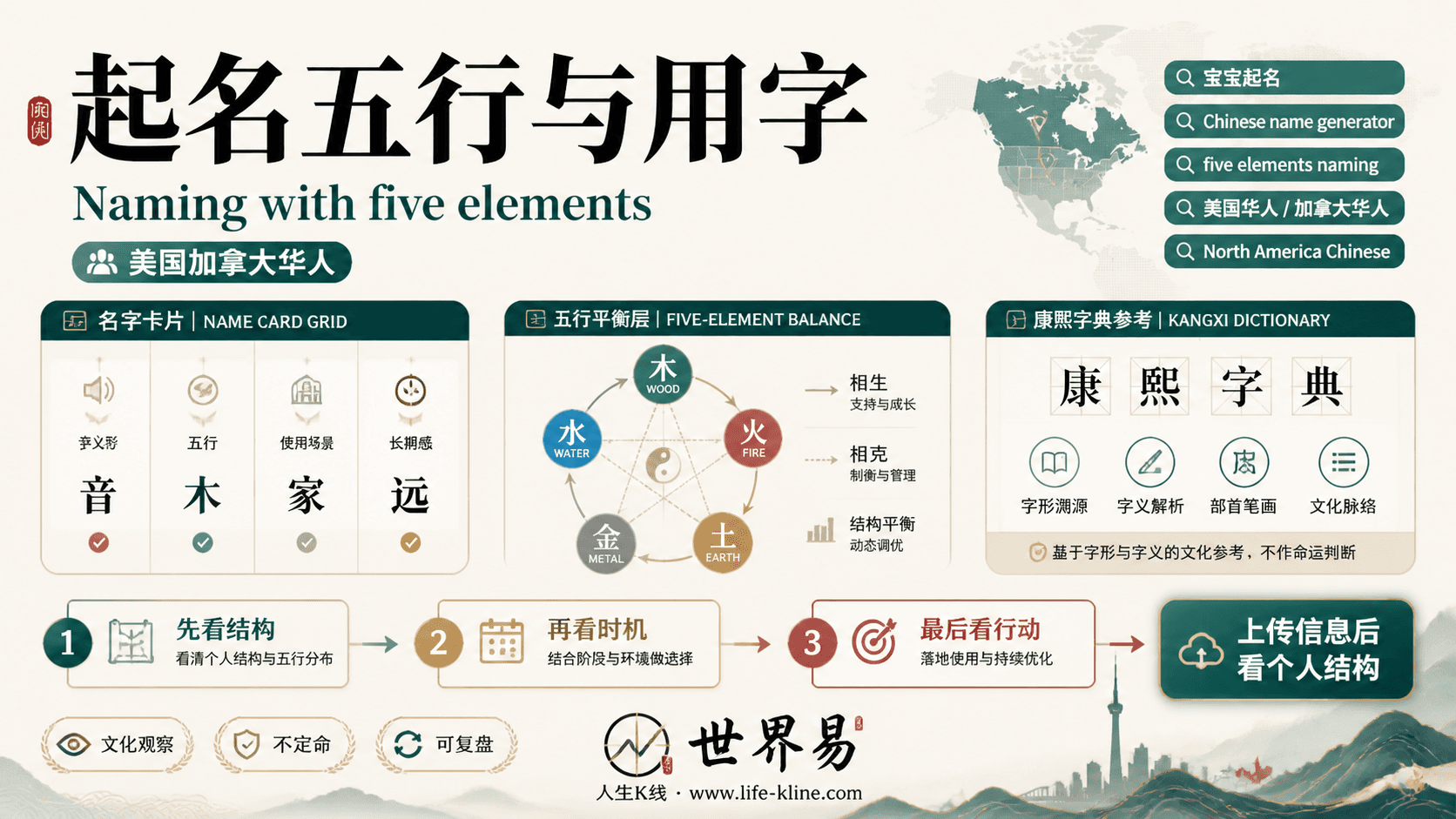
起名五行与用字|美国加拿大华人
这张图把《Complete Guide to Company Naming: Naming Strategies from the BaZi Metaphysics Perspective》里的命理概念转成关系、边界和应用场景,适合先看图建立结构,再回到知识文章正文理解细节。
起名五行与用字不应被写成固定结论。更适合美国加拿大华人的读法,是把传统术语翻译成结构、时机、环境、行动和复盘。
查看图片解读