Comprehensive Guide to Qimen Eight Doors and Analysis of Three Real BaZi Cases
把这篇文章落到自己身上验证:先看结构,再进入个人分析,不做泛泛阅读。
What Are the Qimen Eight Doors
The Qimen Eight Doors are among the most fundamental and core contents in Qimen Dunjia, referring to the eight different doors: Kai (Open), Xiu (Rest), Sheng (Life), Shang (Hurt), Du (Stop), Jing (Scenery), Si (Death), and Jing (Shock). Each door has its unique symbolic meaning and auspicious or inauspicious attributes, collectively forming an important basis for judgment within the Qimen Dunjia predictive system.
The Qimen Eight Doors originated from the combination of ancient Chinese military strategy and astronomical calendrical science. Initially used for military deployment and strategic decision-making, due to its complex structure and requirement for highly specialized knowledge, it was honored as the “Imperial Study.” Over time, the Qimen Eight Doors have gradually been applied in areas such as business investment, timing decisions, and interpersonal relationships.
Among the eight doors, Kai (Open), Xiu (Rest), and Sheng (Life) are regarded as auspicious doors, representing smoothness, development, and vitality; Shang (Hurt), Du (Stop), and Jing (Scenery) are neutral to somewhat inauspicious, symbolizing obstacles and difficulties; Si (Death) and Jing (Shock) are highly inauspicious doors, indicating danger and sudden changes. The auspiciousness or inauspiciousness of the Qimen Eight Doors must be judged not only by the door itself but also in combination with the palace (Gong Wei) where the door symbol is located and the specific pattern (Ge Ju) for a comprehensive analysis.
In the application of Qimen Dunjia, the changes of the Eight Doors are closely related to timing (Tian Shi), geographical advantage (Di Li), and human affairs (Ren Shi). Through flexible use of the Eight Doors, decision-makers can grasp opportunities, avoid risks, and achieve the goal of seeking auspiciousness and avoiding misfortune.
How to Interpret the Qimen Eight Doors: Core Elements
To determine the auspiciousness or inauspiciousness of the Qimen Eight Doors, one must first accurately identify the specific door category involved, namely Kai (Open), Xiu (Rest), Sheng (Life), Shang (Hurt), Du (Stop), Jing (Scenery), Si (Death), or Jing (Shock). Different doors correspond to different auspicious or inauspicious attributes, which is the most fundamental premise for judgment.
Next, it is necessary to consider the palace (Gong Wei) where the door symbol falls. The palace represents spatial directions and their corresponding Five Elements attributes. The combination of the Eight Doors and the palace forms the specific BaZi chart pattern, determining the effectiveness and scope of the door’s influence.
Furthermore, the strength of the Day Master and the pattern (Ge Ju) have a crucial impact on the Eight Doors. The Day Master refers to the Heavenly Stem of the Day Pillar in the Four Pillars of Birth (BaZi), representing the fundamental self-attribute. The pattern is the metaphysical structure formed by the combination of the Four Pillars, such as Zheng Yin (Proper Seal) pattern, Bi Jian (Peer) pattern, Qi Sha (Seven Killings) pattern, etc. Under different patterns, the auspiciousness or inauspiciousness of the Eight Doors will vary.
The choice of Yong Shen (favorable elements) and Ji Shen (unfavorable elements) is also a core factor. Yong Shen are the Five Elements in the chart that support the Day Master, while Ji Shen are those that weaken or harm the Day Master. The auspiciousness or inauspiciousness of the Eight Doors must be judged comprehensively considering the distribution and interaction of Yong Shen and Ji Shen, especially as reflected in the changes of Liu Nian (annual fortune) and Da Yun (decade luck cycle).
Finally, the interaction between Da Yun and Liu Nian also affects the auspiciousness or inauspiciousness of the Eight Doors. Da Yun is the ten-year major luck cycle in a person’s life, and Liu Nian refers to the specific year’s Heavenly Stem and Earthly Branch. The combination of these determines the activity level and auspiciousness of the Eight Doors in that year, helping to predict the fluctuations of annual fortune.
Three Real BaZi Cases
Case One is a female aged 35-40, with Four Pillars of Ji Si (己巳), Bing Zi (丙子), Ji Wei (己未), Bing Yin (丙寅). The Day Master is Ji Earth (己), slightly strong, with a Zheng Yin (Proper Seal) pattern. The Yong Shen are Wood and Water, and the Ji Shen is Fire. Currently in the 4th year of the Geng Chen (庚辰) Da Yun, with the Liu Nian being Bing Wu (丙午). In this chart, the Ji Earth Day Master is somewhat strong; the Zheng Yin pattern helps nourish the Day Master. Wood and Water as Yong Shen represent elements that regulate the Day Master’s strength, while Fire as Ji Shen must be avoided. In combination with the Qimen Eight Doors, auspicious doors such as Kai (Open), Xiu (Rest), and Sheng (Life) should align with the Wood and Water Yong Shen to help the Day Master function smoothly; the Fire Ji Shen doors require careful handling. The Da Yun is stable, and the Liu Nian requires adaptive responses. The flexible use of the Eight Doors is especially important here, demonstrating the key role of Qimen Eight Doors in adjusting fortune.
Case Two is a female aged 55-60, with Four Pillars of Geng Xu (庚戌), Yi You (乙酉), Yi Si (乙巳), Gui Wei (癸未). The Day Master is Yi Wood (乙), slightly weak, with a Bi Jian (Peer) pattern. The Yong Shen is Water, and the Ji Shen are Fire and Earth. Currently in the 2nd year of the Ji Mao (己卯) Da Yun, with the Liu Nian being Bing Wu (丙午). The Yi Wood Day Master is weak and needs Water to nourish it, while Fire and Earth as Ji Shen may increase pressure on the Day Master. The auspicious doors in the Qimen Eight Doors should enhance the role of Water to promote Day Master growth and avoid the impact of Fire and Earth doors. The Da Yun is stable, and the Liu Nian requires adaptive responses. Reasonable selection of the Eight Doors can help the person seek breakthroughs in adverse environments, reflecting the value of the Eight Doors in mitigating unfavorable factors.
Case Three is a male aged 30-35, with Four Pillars of Ren Shen (壬申), Yi Si (乙巳), Ji Hai (己亥), Yi Chou (乙丑). The Day Master is Ji Earth (己), somewhat strong, with a Qi Sha (Seven Killings) pattern. The Yong Shen is Metal, and the Ji Shen is Fire. Currently in the 1st year of the Ji You (己酉) Da Yun, with the Liu Nian being Bing Wu (丙午). The Qi Sha pattern usually carries strong external pressure and challenges. Metal as Yong Shen helps to control the Qi Sha’s force and maintain balance. Fire as Ji Shen must be avoided, especially Fire doors. The auspicious doors in the Qimen Eight Doors should align with the Metal Yong Shen characteristics and avoid Fire doors to ensure stable development amid challenges. The Da Yun is stable, and the Liu Nian requires adaptive responses. The flexible use of the Eight Doors helps the person rationally resolve external pressures.
These three cases all demonstrate that the judgment of the Qimen Eight Doors must be combined with the strength of the Day Master, pattern, Yong Shen and Ji Shen, as well as the interaction of Da Yun and Liu Nian to accurately grasp the auspiciousness or inauspiciousness of the Eight Doors, guiding real-life decisions and actions.
Common Misconceptions
Many people believe that the auspicious or inauspicious attributes of the Qimen Eight Doors are fixed and unchanging, and that simply knowing the door’s name is enough to judge its fortune. In reality, the auspiciousness or inauspiciousness of the Eight Doors must be comprehensively judged by combining the palace (Gong Wei) where the door symbol is located, the chart’s pattern, and the situation of Yong Shen and Ji Shen. Judging fortune solely by the door name is one-sided.
Another misconception is neglecting the influence of Da Yun and Liu Nian. The function of the Eight Doors is constrained and influenced by changes in Da Yun and Liu Nian. Ignoring this information leads to biased judgments of the Eight Doors’ fortune, failing to accurately reflect the person’s actual annual fortune.
Some also overlook the role of Day Master strength and pattern. Under different Day Masters and patterns, the auspiciousness or inauspiciousness of the same door may differ drastically. For example, a relatively strong Day Master may be more sensitive to certain doors, while a weak Day Master needs support from Yong Shen. The application of the Eight Doors must consider these factors.
Additionally, the belief that the Eight Doors’ application is limited to military or ancient prediction is also a bias. Modern Qimen Dunjia is widely applied in business, timing, negotiation, and many other fields, and the flexible use of the Eight Doors still holds important reference value.
Practical Recommendations
When learning and applying the Qimen Eight Doors, one should first master the basic auspicious and inauspicious attributes and symbolic meanings of the Eight Doors, understanding their essential characteristics to lay a solid foundation for subsequent comprehensive analysis.
In actual chart interpretation, it is essential to comprehensively analyze the strength of the Day Master, pattern, Yong Shen and Ji Shen, as well as the current Da Yun and Liu Nian, avoiding reliance solely on the superficial auspiciousness or inauspiciousness of the Eight Doors for judgment.
It is recommended that beginners practice with real BaZi cases to deepen their understanding of the changes in the Eight Doors’ auspiciousness and their interaction with metaphysical elements through practical experience, thereby improving prediction accuracy and practical value.
FAQ
Question 1: Why is Qimen Dunjia called the “Imperial Study”? Answer: In ancient times, Qimen Dunjia was mainly used for military deployment and major decision-making. Due to its complex structure and the requirement for well-trained practitioners to interpret it, it was ranked first among the “Three Techniques” and often served emperors and generals. In modern times, Qimen is mostly used for business judgment, timing, and interpersonal negotiation, retaining its profound and authoritative characteristics.
Question 2: How to judge the auspiciousness or inauspiciousness of the Eight Doors? Answer: The Eight Doors include Kai (Open), Xiu (Rest), Sheng (Life), Shang (Hurt), Du (Stop), Jing (Scenery), Si (Death), and Jing (Shock). Kai, Xiu, and Sheng are the three auspicious doors; Shang, Du, and Jing are neutral to somewhat inauspicious; Si and Jing are highly inauspicious doors. However, the auspiciousness or inauspiciousness of the Eight Doors must be judged comprehensively by combining the palace where the door symbol falls and the specific pattern. Judging solely by the door name is insufficient for accuracy.
Question 3: How do the Qimen Eight Doors combine with the Day Master and Da Yun & Liu Nian in application? Answer: The auspiciousness or inauspiciousness of the Qimen Eight Doors is influenced by the strength of the Day Master, the pattern, and the Yong Shen and Ji Shen. Additionally, changes in Da Yun and Liu Nian adjust the effects of the Eight Doors. Through comprehensive analysis of these factors, one can more accurately grasp the actual function of the Eight Doors, guiding the person to seek auspiciousness and avoid misfortune, optimizing life decisions.
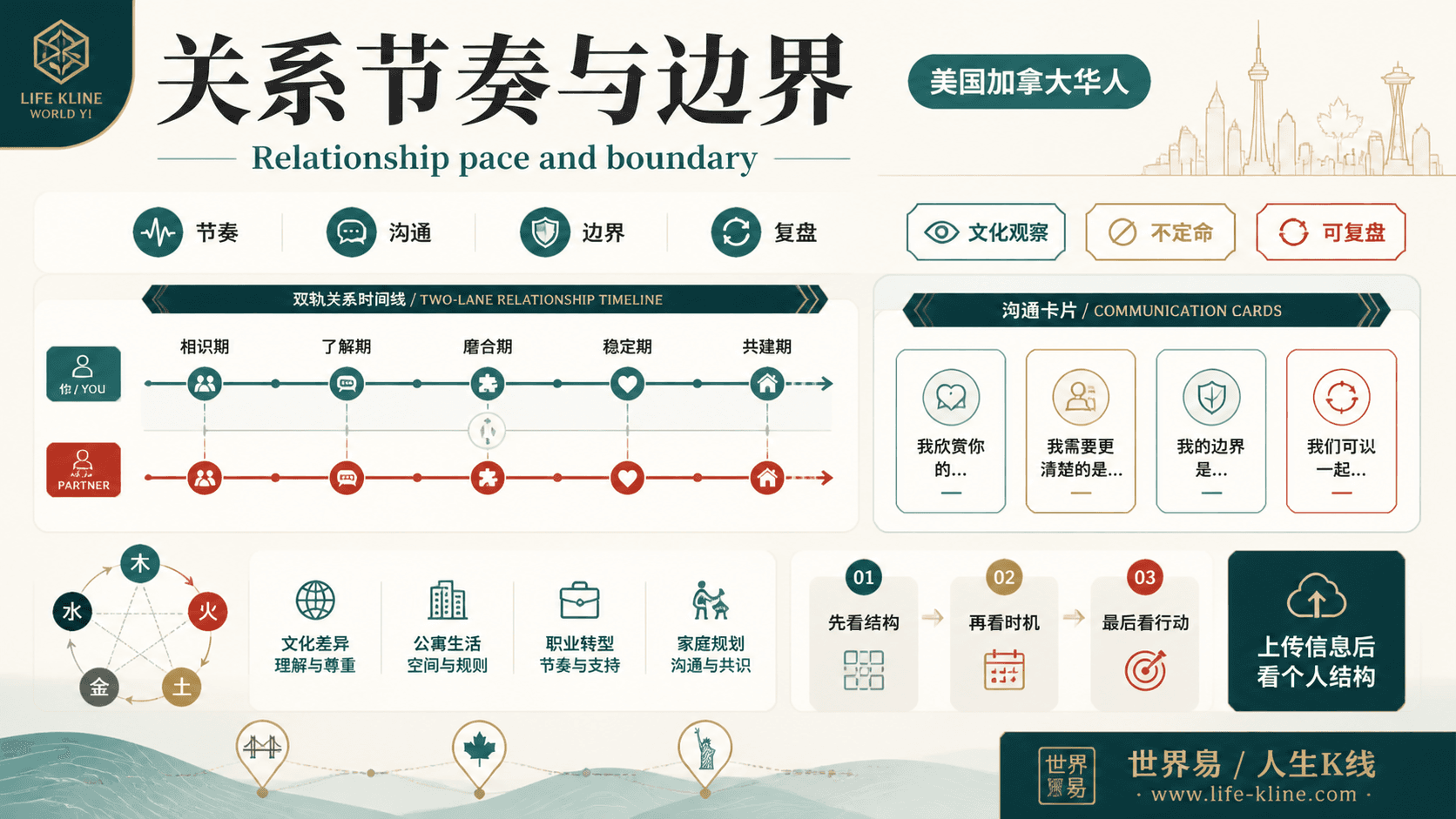
关系节奏与边界|美国加拿大华人
这张图把《Comprehensive Guide to Qimen Eight Doors and Analysis of Three Real BaZi Cases》里的命理概念转成关系、边界和应用场景,适合先看图建立结构,再回到知识文章正文理解细节。
关系节奏与边界不应被写成固定结论。更适合美国加拿大华人的读法,是把传统术语翻译成结构、时机、环境、行动和复盘。
查看图片解读