Color Taboos and Five Elements Yong Shen: A Comprehensive Guide to Fortune Improvement in Metaphysics
把这篇文章落到自己身上验证:先看结构,再进入个人分析,不做泛泛阅读。
What Are Color Taboos
Color taboos in traditional Chinese metaphysics are guiding principles for selecting and avoiding colors based on an individual's Five Elements attributes and the relationship between their Yong Shen (favorable elements) and Ji Shen (unfavorable elements). Colors correspond to Five Elements attributes: red represents Fire, blue Water, green Wood, white Metal, and yellow Earth. Therefore, color usage directly affects the balance and harmony of the Five Elements.
The origin of color taboos in metaphysics stems from the Five Elements generating and overcoming (sheng-ke) theory. Color selection assists in adjusting elements that are deficient or overly strong, aiming to attract auspiciousness and avoid misfortune. Different BaZi charts, due to variations in the Day Master's attribute and structure, require different suitable and taboo colors.
Color taboos manifest not only in clothing but also in home decoration and accessory choices. Proper use of color can help stabilize one's mindset and enhance fortune, whereas incorrect use may intensify the influence of Ji Shen, leading to fortune fluctuations.
In modern metaphysical practice, color taboos have become an important auxiliary method for comprehensive fortune improvement, emphasizing personalized color schemes based on the specific BaZi chart rather than blindly following popular or traditionally auspicious colors.
Therefore, understanding the essence of color taboos and their relationship with the Five Elements Yong Shen is key to scientifically applying metaphysical knowledge for self-regulation and fortune enhancement.
How to Interpret Color Taboos: Core Elements
The primary step in judging color taboos is to clearly identify the individual's Day Master attribute and its strength. Since colors correspond to the Five Elements, one should choose colors that either supplement the Yong Shen or suppress the Ji Shen. For a Day Master that is relatively strong, colors that control its element are suitable; for a weak Day Master, colors that generate or assist its element are preferable.
Next, it is essential to identify the individual's BaZi structure and their Yong Shen and Ji Shen. Colors corresponding to the Yong Shen's element should be used more to strengthen favorable factors in the chart; colors linked to the Ji Shen should be avoided to prevent exacerbating negative influences.
The current Da Yun (decade luck cycle) and Liu Nian (annual fortune) also influence color selection. If the Da Yun and Liu Nian are stable or auspicious, one can moderately enhance the use of Yong Shen colors; if facing clashes or unfavorable years, color choices should be cautious to avoid triggering adverse fortune fluctuations.
Color taboos must also consider real-life contexts, including how clothing and environmental colors affect personal psychology and aura. Proper color coordination can produce positive visual and psychological effects, amplifying fortune improvement.
Combining these factors, the judgment of color taboos should be based on accurate BaZi analysis, integrating the Five Elements generating and overcoming cycles with the dynamics of Da Yun and Liu Nian, to be purposeful and avoid counterproductive blind usage.
Three Real BaZi Chart Cases
Case 1 involves a female aged 35 to 40, whose Day Master is 丙 (Bing) Fire, relatively strong, with a Qi Sha (Seven Killings) structure. Her Yong Shen are Water and Metal; Ji Shen is Wood. She is currently in the 丙午 (Bing Wu) Da Yun and 丙午 (Bing Wu) Liu Nian, with stable fortune suited for consolidation. Since her Day Master Fire is strong and Wood is Ji Shen, color choices should avoid green or other Wood-representing colors to prevent strengthening the Ji Shen and worsening Wood's negative impact. Instead, it is appropriate to select Water and Metal tones such as blue and white, which help balance the strong Fire and enhance the Yong Shen, thereby stabilizing her fortune.
Case 2 is a male aged 20 to 25, with 壬 (Ren) Water Day Master, relatively weak, and a Pian Cai (Indirect Wealth) structure. His Yong Shen is Metal; Ji Shen are Wood and Fire. Currently, he is in the 己酉 (Ji You) Da Yun and 丙午 (Bing Wu) Liu Nian, with overall stable fortune. Because his Day Master Water is weak and Wood and Fire are Ji Shen, colors like red and green should be avoided to prevent activating the Ji Shen. He should use more Metal colors such as white and golden yellow to strengthen the Yong Shen Metal, while Water colors like blue can be used moderately to assist and enhance the Day Master's Water, achieving chart harmony.
Case 3 features a female aged 45 to 50, with 庚 (Geng) Metal Day Master, relatively strong, and a Bi Jian (Peer) structure. Her Yong Shen are Fire and Wood; Ji Shen is Earth. She is currently in the 乙亥 (Yi Hai) Da Yun and 丙午 (Bing Wu) Liu Nian, with auspicious fortune. Since Ji Shen is Earth, colors like yellow and earth tones should be avoided to prevent strengthening the Ji Shen. More Fire and Wood colors, such as red and green, should be chosen to enhance the Yong Shen and support the Day Master Metal's balance, benefiting career and wealth progress. Thus, the scientific application of color taboos aligns with the BaZi structure and improves fortune enhancement effects.
Common Misconceptions
Many mistakenly believe that color taboos only require following certain traditional auspicious or inauspicious colors, ignoring the specific differences in an individual's Five Elements within their BaZi chart. This leads to color choices that do not match their Yong Shen and Ji Shen, worsening the imbalance in the chart.
Another misconception is treating color taboos as absolute metaphysical laws, thinking that wearing the right color alone can change destiny, while neglecting the comprehensive influence of Da Yun, Liu Nian, and other factors. Color is only an auxiliary tool and cannot solely determine fortune.
Some blindly pursue trendy colors or so-called 'lucky colors' recommended by others without considering their own metaphysical conditions, which easily causes conflicts between colors and Five Elements, negatively affecting psychological state and aura, thus reducing fortune improvement effectiveness.
Additionally, neglecting color coordination and harmony with the actual living environment can weaken the positive effects of color taboos. Color taboos should be applied scientifically and reasonably, integrating overall metaphysics and practical life.
Practical Suggestions
When selecting colors, it is essential first to clarify the individual's Day Master attribute, BaZi structure, and Yong Shen and Ji Shen, combined with the current Da Yun and Liu Nian, to formulate a personalized color strategy. Avoid blindly following trends and base choices on metaphysical principles.
Color application should permeate clothing, accessories, and living environments. By appropriately increasing colors corresponding to the Yong Shen and reducing Ji Shen colors, one can help adjust the Five Elements balance and enhance overall aura and psychological state.
Maintain harmonious and comfortable color coordination, avoiding overly rigid or extreme color use. Combining personal preferences with life scenarios ensures psychological comfort while achieving metaphysical fortune improvement support.
FAQ
Question 1: Is the Ben Ming Year (birth zodiac year) really prone to misfortune? Answer: The Ben Ming Year, when the zodiac animal matches the Liu Nian Earthly Branch, is traditionally called 'Zhi Tai Sui' (facing the Grand Duke). It can indeed impact that year's fortune by amplifying potential issues. Customs like wearing red, tying red strings, and ancestral worship are essentially psychological reminders and stabilizers, not physical protective measures, mainly helping maintain caution and mental stability.
Question 2: Does Hua Tai Sui (Grand Duke Pacification) work? Answer: Hua Tai Sui, as a folk custom, primarily serves psychological comfort. Belief in its efficacy can reduce impulsiveness and risk-taking, aiding steady handling of challenges; indifference will not cause adverse effects. Metaphysical tools are auxiliary, focusing on mindset adjustment rather than determining fate.
Question 3: Can color taboos completely change one's fortune? Answer: Color taboos assist in balancing the Five Elements and psychological adjustment as an auxiliary method for fortune improvement but cannot solely determine fortune. Fortune changes are also influenced by Da Yun, Liu Nian, personal effort, and other factors. Proper color use combined with comprehensive metaphysical analysis yields the best results.
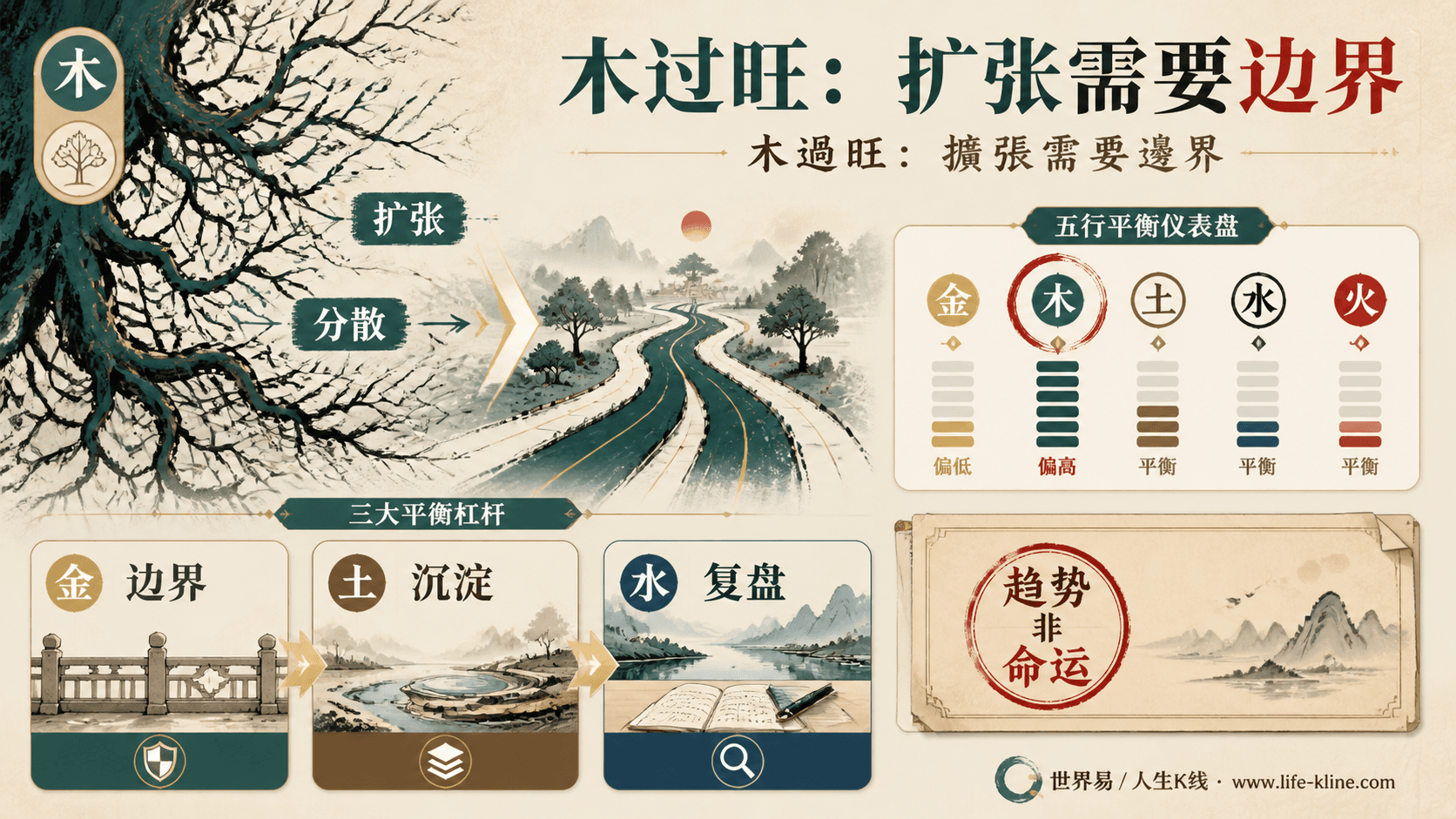
木过旺与再平衡
这张图把《Color Taboos and Five Elements Yong Shen: A Comprehensive Guide to Fortune Improvement in Metaphysics》里的命理概念转成关系、边界和应用场景,适合先看图建立结构,再回到知识文章正文理解细节。
木过旺常表现为扩张过快、计划繁多、方向分散。在人生K线系统中,这是一种时位特征,而非固定标签。通过引入边界、沉淀与复盘,可实现自然再平衡,导向更可持续的结构。
查看图片解读