Detailed Analysis of Yintang Face Reading: Meaning, Observation, and Real BaZi Case Studies
把这篇文章落到自己身上验证:先看结构,再进入个人分析,不做泛泛阅读。
What is Yintang
Yintang refers to the central area of the forehead located between the two eyebrows. In traditional face reading, it is regarded as an important symbol of a person's mental outlook and the auspiciousness or inauspiciousness of their fortune. A clear, full, and lustrous Yintang usually represents a person who is mentally vigorous, clear-headed, and has smooth fortune; conversely, a dull or sunken Yintang may indicate health issues and fluctuations in fortune.
The observation of Yintang can be traced back to ancient physiognomy classics. Generations of face reading masters have developed a systematic judgment system by observing the shape, lines, and color of Yintang, combined with a person's character, health, and destiny changes. Yintang is praised as the 'head of the heavenly court,' symbolizing blessings bestowed by heaven.
In face reading, Yintang not only reflects a person's mental state and temperament but is also closely related to the Earth element (Tu) in the Five Elements. The condition of Yintang is often seen as an important external indicator of whether a person's fortune flows smoothly, serving as a key window to assess career luck, health, and overall blessings.
As one ages, the Yintang may change, which is related not only to physical health but also to personal mood, living environment, and metaphysical fortune. Therefore, observing Yintang requires a comprehensive judgment that combines the time dimension and specific BaZi background.
How to Observe Yintang: Core Elements
The first aspect to observe in Yintang is whether its shape is full and rounded. A full Yintang represents clarity of mind, agile thinking, and smooth fortune. A sunken Yintang or one with obvious lines may indicate significant mental stress or health risks, leading to unstable fortune.
The color of Yintang is also crucial. A healthy Yintang shows a light and moist luster, with even color and no spots. A dull or yellowish Yintang often reflects internal imbalance or high life pressure, affecting one’s overall qi and health.
When combined with BaZi’s Four Pillars, attention should be paid to the Day Master’s Five Elements attribute and the influence of Yong Shen (favorable element) and Ji Shen (unfavorable element) on Yintang. For example, if the Day Master is overly strong or weak, combined with how well the Yong Shen harmonizes, one can infer whether Yintang supports the energy field of the BaZi pattern.
The Da Yun (decade luck cycle) and Liu Nian (annual fortune) also significantly affect Yintang. When Da Yun is stable and aligned with the Yong Shen, Yintang usually appears peaceful and auspicious; if the Da Yun or Liu Nian involves the Ji Shen, abnormal changes in Yintang may occur, indicating caution is needed during that period.
Finally, Yintang observation must be integrated with the overall face and living environment. Single features should not be interpreted in isolation. Only by unifying Yintang with the individual’s BaZi pattern, Da Yun, Liu Nian, and age changes can one accurately grasp its auspiciousness and actual impact.
Three Real BaZi Case Studies
Case One: This gentleman’s Four Pillars are 戊午 (Wu Wu), 甲子 (Jia Zi), 己巳 (Ji Si), 己巳 (Ji Si). The Day Master is 己 (Ji, Earth), which is relatively strong. The pattern is Zheng Guan (Proper Authority). The Yong Shen are Wood and Water; the Ji Shen is Fire. He is currently in the 己巳 (Ji Si) Da Yun (ages 41-50), which is a stable luck phase, suitable for consolidation. The Liu Nian is 丙午 (Bing Wu). Both Da Yun and Liu Nian show stability but require adaptability. Because the Day Master is strong and the Yong Shen Wood and Water harmonize well, and the Da Yun is stable, his Yintang should appear full and with good complexion, indicating stable mental state, career, and health in a consolidation phase. The Yintang condition complements the BaZi pattern.
Case Two: This lady’s Four Pillars are 乙亥 (Yi Hai), 戊子 (Wu Zi), 癸未 (Gui Wei), 丁巳 (Ding Si). The Day Master is 癸 (Gui, Water), relatively strong. The pattern is Zheng Guan (Proper Authority). The Yong Shen are Earth and Fire; the Ji Shen is Metal. She is currently in the 辛卯 (Xin Mao) Da Yun (ages 26-35), also a stable phase suitable for consolidation. The Liu Nian is 丙午 (Bing Wu). Both Da Yun and Liu Nian are stable, requiring adaptability. Her Yintang, supported by the Yong Shen Earth and Fire, helps buffer the strong Day Master. With stable Da Yun, her Yintang should appear bright yet steady, reflecting good mental temperament and fortune, consistent with a stable consolidation trend.
Case Three: This lady’s Four Pillars are 癸丑 (Gui Chou), 癸亥 (Gui Hai), 甲子 (Jia Zi), 乙亥 (Yi Hai). The Day Master is 甲 (Jia, Wood), relatively strong. The pattern is Zhuan Wang (Specially Strong). The Yong Shen is Water; the Ji Shen is Earth. She is currently in the 戊辰 (Wu Chen) Da Yun (ages 44-53), which is an inauspicious luck phase requiring caution against major incidents. The Liu Nian is 丙午 (Bing Wu), also requiring caution. Due to the weak Da Yun and the Ji Shen Earth prevailing, her Yintang may appear sunken or dull, reflecting mental pressure and declining fortune. The Yintang condition warns her to pay extra attention to health and decision risks during this phase, consistent with BaZi indications.
Common Misconceptions
Many people mistakenly believe that the quality of Yintang is fixed and unchanging. In fact, Yintang changes significantly with age, health, and mood. The Yintang of youth may differ greatly from that of middle or old age. Therefore, Yintang observation should be combined with age stages and living environment for comprehensive judgment.
Some think that the redder the Yintang, the better, ignoring the evenness and natural state of the color. Excessive redness may indicate body heat or inflammation, which is detrimental to health and fortune and should be treated differently.
It is also a common misconception to rely solely on Yintang’s shape to determine one’s entire destiny. Yintang is only one important part of face reading and must be combined with the whole face, BaZi pattern, Da Yun, and Liu Nian to make scientific and accurate judgments.
Some neglect the influence of Yong Shen and Ji Shen on Yintang, believing Yintang is independent of BaZi. In reality, changes in Yintang are closely related to the strength of the Day Master, Yong Shen, Ji Shen, and Da Yun/Liu Nian. Metaphysics and face reading complement each other as an integrated whole.
Practical Advice
When observing Yintang, it is recommended to combine it with the individual’s Four Pillars BaZi, especially the strength of the Day Master and the Yong Shen/Ji Shen, to understand their impact on mental appearance and fortune, avoiding errors caused by single-factor judgment. Also, pay attention to the current Da Yun and Liu Nian to assess whether changes in Yintang align with the metaphysical trend.
As age increases, the state of Yintang may change. It is advisable to regularly compare facial photos from different age stages, combined with physical health and psychological status, to scientifically analyze the reasons for Yintang changes, achieving dynamic observation and adjustment.
In daily life, pay attention to mental cultivation and health maintenance, keep the Yintang area clean and moisturized, and avoid prolonged stress and negative emotions accumulation. This helps maintain the complexion of Yintang, thereby promoting the stability and improvement of overall fortune.
FAQ
Question 1: Does the face change with age? Answer: Yes, and the changes can be significant. Different age stages focus on different facial areas: youth emphasizes the heavenly court (forehead), middle age focuses more on cheekbones and nose, and old age pays attention to the chin and nasolabial folds. As an important forehead area, Yintang also changes with age, mood, and health, so it should not be viewed as static in face reading.
Question 2: Which hand is more accurate in palmistry, left or right? Answer: Traditionally, it is said 'men left, women right,' but modern palmistry generally considers the left hand to represent innate potential and the right hand to represent acquired state and trends. Observing both hands together provides a more comprehensive reflection of a person’s destiny trajectory and changes. Similarly, Yintang face reading should be combined with overall facial features and BaZi to avoid isolated judgments.
Question 3: Is a sunken Yintang always bad? Answer: A sunken Yintang is generally seen as a symbol of mental stress or fortune fluctuations, but its actual auspiciousness depends on the individual’s BaZi pattern and Da Yun/Liu Nian. For example, if the Yong Shen is strong and the Da Yun is stable, a slight sunken Yintang may not cause serious impact; otherwise, it warrants attention. Therefore, Yintang depression should not be used as the sole basis for fortune judgment.
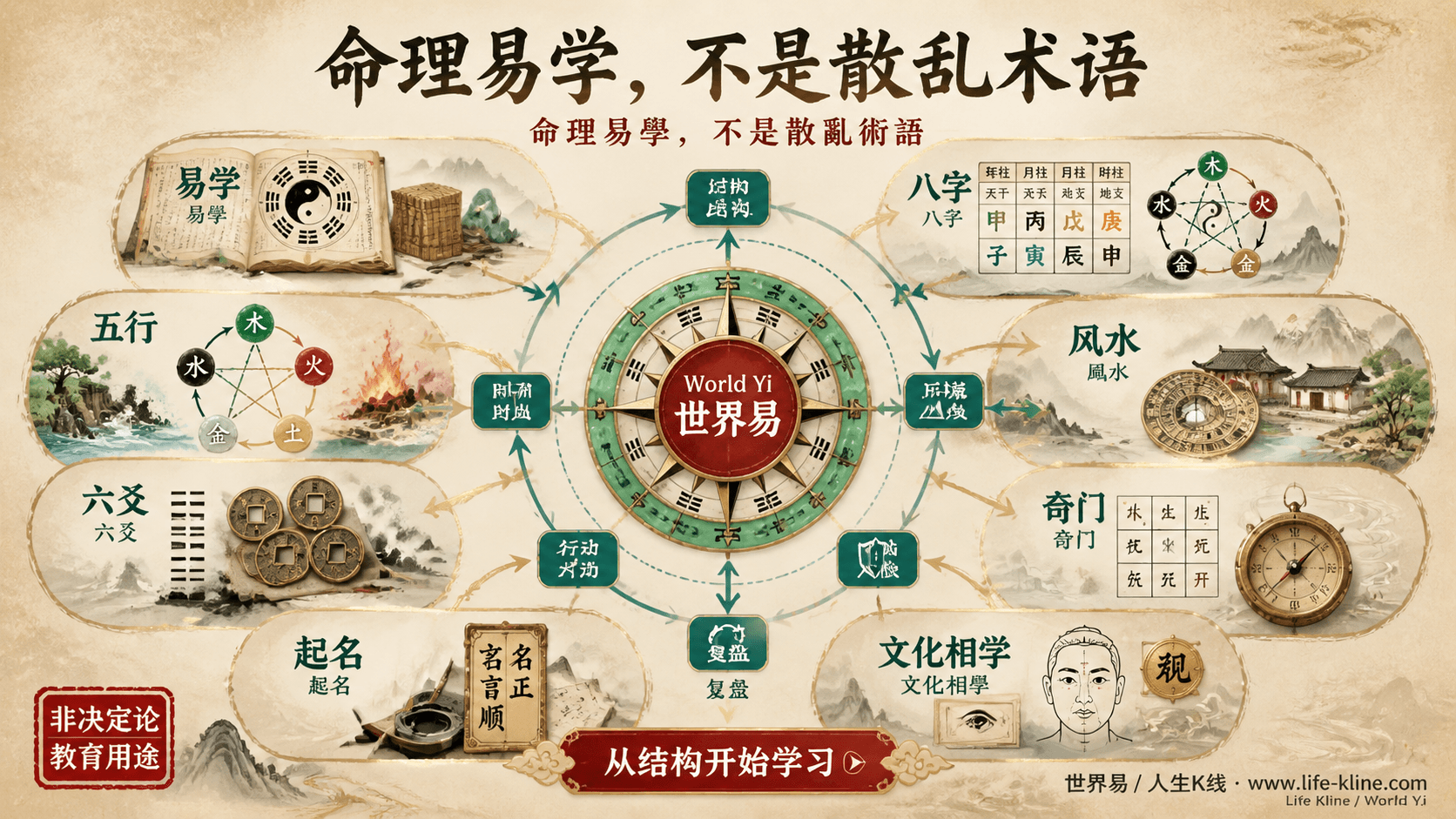
命理易学知识全景地图
这张图把《Detailed Analysis of Yintang Face Reading: Meaning, Observation, and Real BaZi Case Studies》里的命理概念转成关系、边界和应用场景,适合先看图建立结构,再回到知识文章正文理解细节。
用一张图说明易学、八字、风水、奇门、六爻、相学、起名与世界易的关系。
查看图片解读