Comprehensive Guide to Cheekbone Physiognomy and Its Metaphysical Connections
把这篇文章落到自己身上验证:先看结构,再进入个人分析,不做泛泛阅读。
What Are Cheekbones
Cheekbones are important facial bones located below the eyes and on the cheeks, determining the contour and three-dimensionality of the face. In traditional physiognomy, cheekbones not only reflect a person’s appearance but also symbolize demeanor and middle-age fortune.
According to ancient physiognomy theories, the height, width, and shape of the cheekbones directly affect one’s performance in career, wealth, and health. Full and moderately prominent cheekbones are generally considered to indicate a strong aura and robust social competitiveness.
The significance of cheekbones varies at different life stages. In youth, the focus is on the Tian Ting (Heavenly Court, forehead), while in middle age, cheekbones and nose are emphasized, reflecting middle-age fortune and physical condition. The cheekbone shape can mirror the Day Master’s strength and pattern changes in BaZi metaphysics.
From the origin of physiognomy, research on cheekbones integrates human anatomy and metaphysics, emphasizing the intrinsic connection between facial features and individual destiny. Thus, cheekbones have become one of the key indicators for evaluating a person’s overall fortune.
How to Observe Cheekbones: Core Elements
When observing cheekbones, the first focus is on their height and width. High and wide cheekbones typically represent strong momentum, stable and progressive middle-age fortune. Conversely, sunken or overly narrow cheekbones may indicate challenges in career or health.
Secondly, the firmness and roundness of the cheekbones are also crucial. Firm cheekbones symbolize stable support, resonating with the Yong Shen (favorable element) in metaphysics, showing that the individual can rely on their strengths to overcome difficulties and gain auspicious luck.
Combined with the Four Pillars (BaZi), the Day Master’s strength and pattern provide guidance on cheekbone appearance. A strong Day Master usually corresponds to more prominent cheekbones, reflecting aura and confidence. In charts with reasonable patterns and effective Yong Shen, cheekbone shape tends to be more harmonious, benefiting career and health.
Additionally, cheekbones interact closely with Da Yun (decade luck cycles) and Liu Nian (annual fortune). During auspicious Da Yun and Liu Nian, cheekbones often appear fuller and stronger, symbolizing rising fortune. Conversely, when Ji Shen (unfavorable elements) are in effect, cheekbones may become sunken or disharmonious, signaling caution.
Three Real BaZi Chart Cases
Case One is a female aged 30-35, with Four Pillars: Yi Hai year (乙亥), Gui Wei month (癸未), Gui Chou day (癸丑), Gui Chou hour (癸丑). The Day Master is Gui Water (癸水), balanced in strength, with a Bi Jian (比肩) pattern. Yong Shen is Metal, Ji Shen is Earth. Currently in Bing Xu Da Yun (丙戌, ages 26-35), a stable and consolidating luck cycle, with Liu Nian Bing Wu (丙午). This chart shows a balanced Day Master and effective Metal Yong Shen, so the cheekbones should be moderately full, symbolizing stable middle-age career and health, with a dignified but not ostentatious demeanor, suitable for maintaining achievements and accumulation.
Case Two is a male aged 50-55, with Four Pillars: Ren Zi year (壬子), Xin Hai month (辛亥), Yi Si day (乙巳), Ji Mao hour (己卯). The Day Master Yi Wood (乙木) is relatively strong, with a Qi Sha (七杀) pattern. Yong Shen are Metal and Earth, Ji Shen is Water. Currently in Bing Chen Da Yun (丙辰, ages 49-58), an auspicious luck cycle with career and wealth progress, and Liu Nian Bing Wu (丙午) supporting the trend. This chart’s relatively strong Day Master and effective Metal and Earth Yong Shen indicate cheekbones that are prominent and firm, reflecting a strong aura and career advancement in later middle age. The good cheekbone morphology reflects proactive spirit and favorable fortune.
Case Three is a male aged 25-30, with Four Pillars: Geng Chen year (庚辰), Ji Chou month (己丑), Ren Shen day (壬申), Bing Wu hour (丙午). The Day Master Ren Water (壬水) is balanced, with a Zheng Guan (正官) pattern. Yong Shen is Metal, Ji Shen is Earth. Currently in Xin Mao Da Yun (辛卯, ages 18-27), an auspicious cycle with career and wealth progress, and Liu Nian Bing Wu (丙午) supporting the trend. This chart’s balanced Day Master and effective Metal Yong Shen suggest cheekbones that are moderately full and firm, indicating good career and health in youth. The cheekbone shape reflects the stable fortune and positive social image brought by the Zheng Guan pattern.
Common Misconceptions
The height of cheekbones and strength of aura are not simply absolute. Overly high or protruding cheekbones do not necessarily signify good luck; they may bring a strong or even impulsive personality, affecting interpersonal relationships. Therefore, cheekbone judgment must be integrated with overall physiognomy and metaphysical patterns.
Many mistakenly believe cheekbone shape is fixed and ignore age-related changes. In fact, cheekbones change noticeably with age, especially after middle age, reflecting shifts in health and fortune, requiring dynamic observation.
Cheekbone quality alone cannot determine a person’s destiny; it must be combined with Day Master strength, patterns, and Yong Shen. Ignoring these factors and judging solely by cheekbones can lead to one-sided and misleading conclusions.
Some physiognomy enthusiasts confuse cheekbones with zygomatic bones (central cheeks). Cheekbones are located diagonally below the eyes, not at the center of the cheeks. Their metaphysical meanings differ and must be accurately distinguished.
Practical Suggestions
When observing cheekbones, it is recommended to combine personal Four Pillars (BaZi) analysis, especially focusing on the Day Master’s strength and Yong Shen status, to more accurately assess the fortune and personality traits reflected by the cheekbones.
Cheekbone shape changes should be viewed in conjunction with age stages. Changes during middle age especially reflect actual health and career conditions. Regularly monitoring facial features and adjusting lifestyle habits can help improve fortune.
In daily life, maintaining good routines and emotional management helps preserve healthy cheekbone shape. If noticeable abnormal changes occur, it is advisable to seek professional metaphysical guidance to properly adjust Yong Shen and mitigate Ji Shen influences.
FAQ
Question 1: Does physiognomy change with age? Answer: Yes, and changes are significant. Youth focuses on Tian Ting (forehead), middle age on cheekbones and nose, and old age on chin and nasolabial folds. Different age stages reflect differences in mindset, lifestyle, and health, so a person’s face at 30 and 50 can look very different.
Question 2: Which hand is more accurate for palm reading, left or right? Answer: Traditionally, “men’s left, women’s right” is said, but modern palmistry generally holds that the left hand represents innate potential (inborn talents), while the right hand reflects acquired conditions and trends. The greater the contrast between hands, the more changes the individual experiences in life. It is recommended to observe both hands comprehensively.
Question 3: What is the connection between cheekbones and metaphysics? Answer: Cheekbone shape reflects middle-age fortune and temperament, closely related to the Day Master’s strength, patterns, and Yong Shen in metaphysics. A strong Day Master with effective Yong Shen usually has full and firm cheekbones, symbolizing good aura and fortune; conversely, sunken or disharmonious cheekbones may indicate health or fortune issues needing attention.
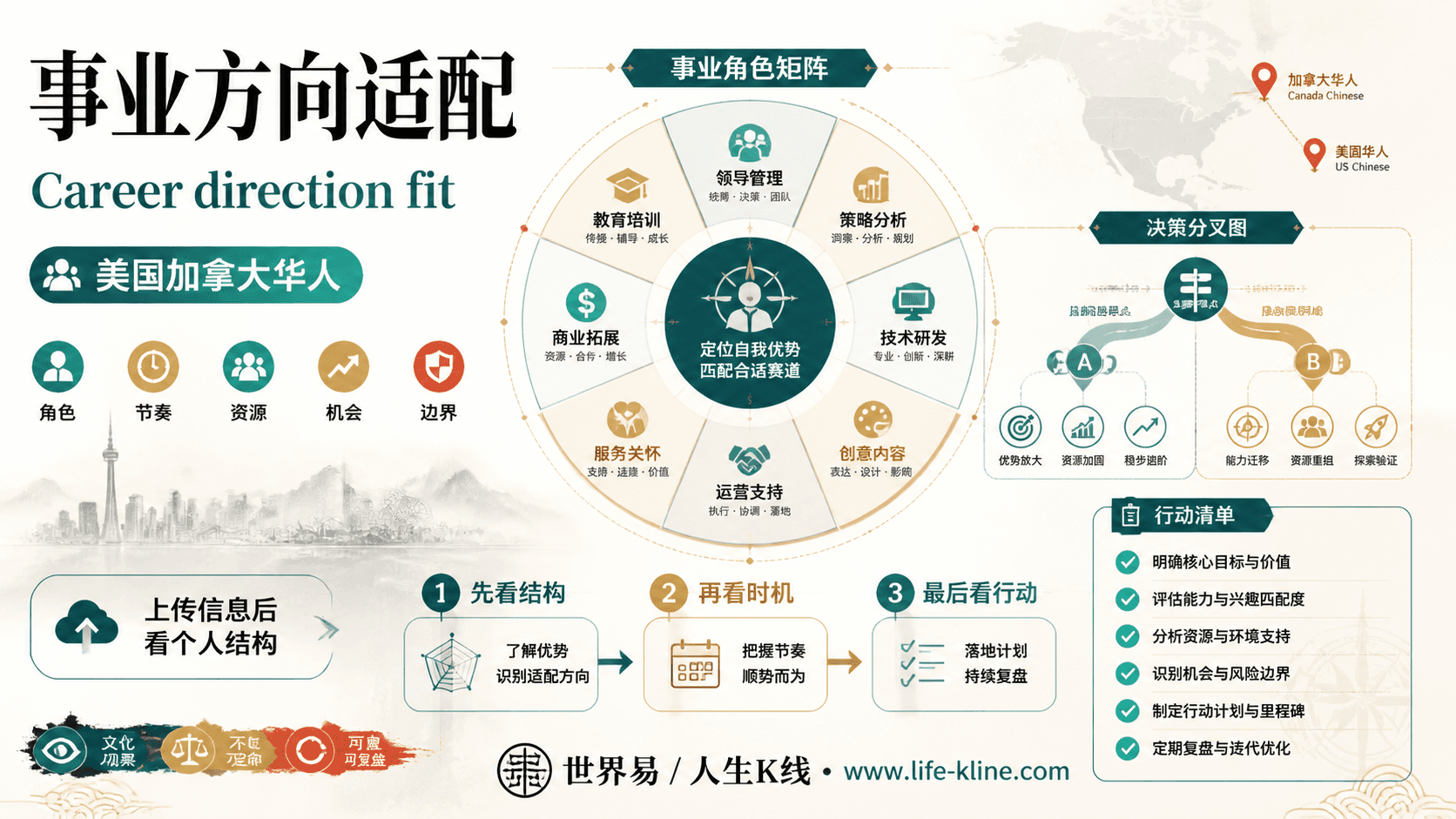
事业方向适配|美国加拿大华人
这张图把《Comprehensive Guide to Cheekbone Physiognomy and Its Metaphysical Connections》里的命理概念转成关系、边界和应用场景,适合先看图建立结构,再回到知识文章正文理解细节。
事业方向适配不应被写成固定结论。更适合美国加拿大华人的读法,是把传统术语翻译成结构、时机、环境、行动和复盘。
查看图片解读